
The Prophet Isaiah warned Judah during the reigns of several kings, delivering a strong message of judgment against the nation. In a few instances, Isaiah also warned—and even cursed—specific individuals. A potent example is recorded in Isaiah 22.
Thus saith the Lord, the God of hosts: Go, get thee unto this steward, Even unto Shebna, who is over the house: What hast thou here, and whom hast thou here, That thou hast hewed thee out here a sepulchre, Thou that hewest thee out a sepulchre on high, And gravest a habitation for thyself in the rock? Behold, the Lord will hurl thee up and down with a man’s throw; Yea, He will wind thee round and round; He will violently roll and toss thee like a ball into a large country; There shalt thou die, and there shall be the chariots of thy glory, Thou shame of the lord’s house. And I will thrust thee from thy post, And from thy station shalt thou be pulled down (verses 15-19)
Shebna was formerly the royal steward of King Hezekiah—the Hebrew title asher ‘al habayit, אשר על-הבית, literally “which is over the house”—a managerial position over the royal house and treasury. Because of Shebna’s pride, vanity and unfaithfulness, he was demoted and replaced by Eliakim, son of Hilkiah (verses 20-25).
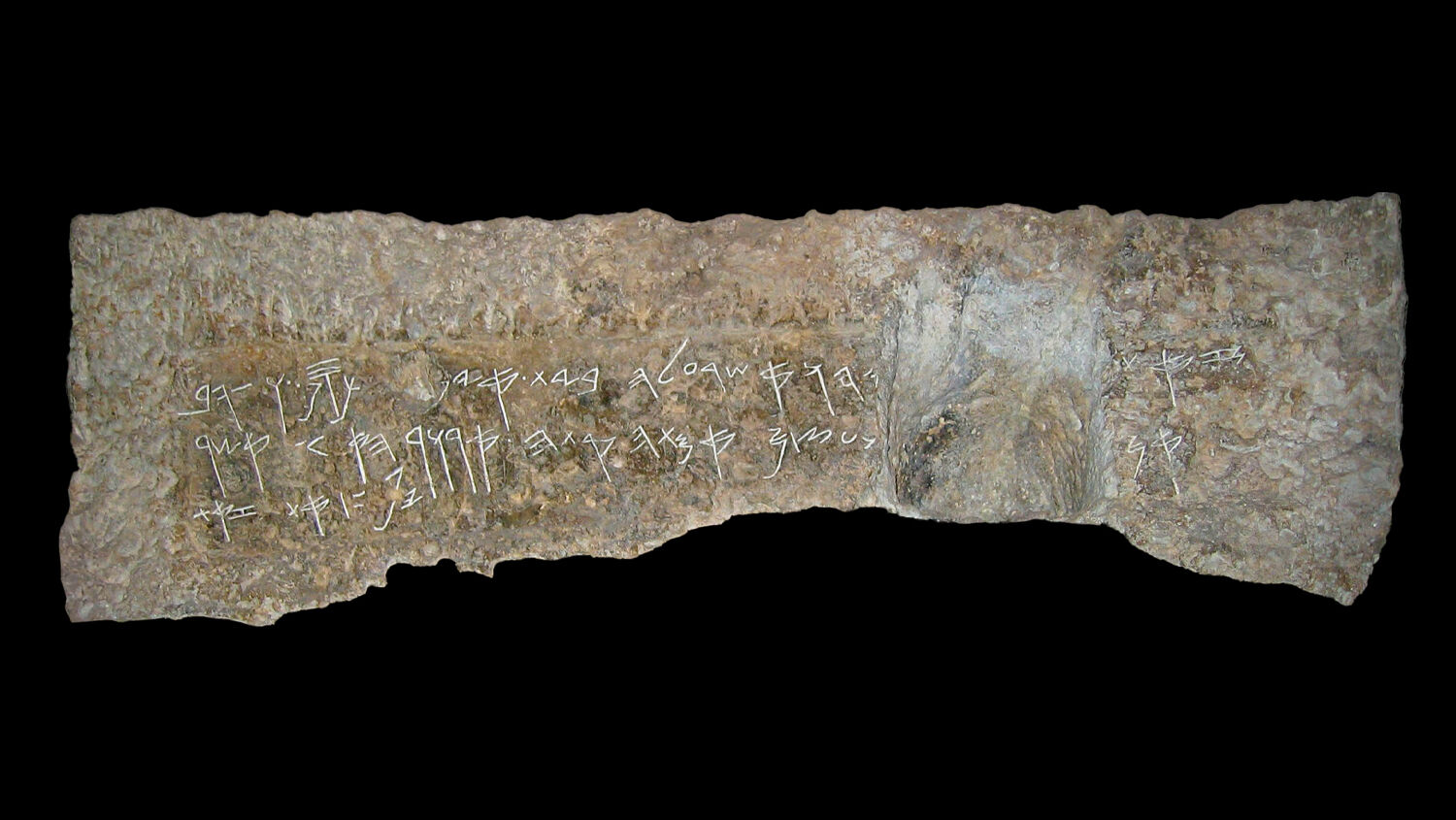
An ancient tomb text, known as the Royal Steward Inscription—sometimes referred to more directly as the Shebna Inscription—has an intriguing connection to this passage, in name, title, date and location—as well as in curse.
The Discovery
While leading explorations around Jerusalem in 1870, French archaeologist Charles Simon Clermont-Ganneau took note of one particular inscription above a tomb that sat on an especially high cliff on the edge of Silwan, overlooking the Kidron Valley. At the time, Clermont-Ganneau was unable to decipher its Hebrew inscription in full. He did postulate that part of the inscription contained the title “Royal Steward” and therefore put forward that it was the tomb of Shebna. Realizing the historical value of the inscription, he had it removed and sent to the British Museum, where it sat for more than 80 years before being translated.
In 1953, Israeli archaeologist Prof. Nahman Avigad finally translated the text. It reads: “This is [the tomb of] … iah [or yahu], which is over the house. There is no silver or gold here, only … [his bones] … and the bones of his maidservant with him. Cursed be the man who opens this.” He dated the Hebrew text on the inscription to the seventh century b.c.e. and “confirmed Clermont-Ganneau’s reading asher ‘al habayit, or ‘Royal Steward,’ and adopted his suggestion that the tomb belonged to Shebna,” wrote Hershel Shanks, former editor in chief of Biblical Archaeology Review, in “The Tombs of Silwan” (May-June 1994).
As such, this inscription became known as the “Royal Steward Inscription,” or “Shebna Inscription.” Although there is no visible mention of the name “Shebna,” researchers generally agree that the tomb belonged to this cursed steward of King Hezekiah. This is based on a few clues.
The Textual Evidence
The majority—and most important part—of the name is missing, but let’s consider what we can gather. The part of the name that remains on the inscription is the ending “yahu.” This is known as a theophoric ending. As Shanks wrote, this was a “common suffix in Judah that refers to yhwh, the personal name of the Israelite God,” adding that the Isaiah 22 Shebna’s “full name is, presumably, Shebnayahu.”
In The Village of Silwan: The Necropolis From the Period of the Judean Kingdom, Prof. David Ussishkin writes: “When the funerary inscription was deciphered, [Israeli archaeologist Yigael] Yadin and Avigad proposed completing the name as ‘[Sheban]yahu,’ of which Shebna is the abbreviated form, and this was accepted by many scholars.” In his 1953 Israel Exploration Journal article “The Epitaph of a Royal Steward,” Avigad explained: “It is a well-known fact that certain Hebrew names, ending in alef”—as Shebna does—are abbreviated “hypocoristica” of longer names ending in -iah or -yahu. He provides a number of examples, including עבדא/עבדיהו ,עורא/עזריהו ,אחא/ אחיהו. “A person could apparently be called both by his full name and by its abbreviation,” he wrote. While, as Avigad explained, this is a “conjectural suggestion,” it is the most likely conclusion considering all available evidence. Furthermore, two bullae (clay seal stamps) have been discovered bearing this longer name “Shebnayahu, Servant of the King”—one from Lachish and another from the antiquities market—which almost certainly belonged to one and the same biblical individual. (In the case of these bullae, the shorter three-letter Hebrew title “servant” makes logical sense for the tiny inscriptions, as compared to the nine-letter title for “royal steward.”)
More significant than the personal name is the exact parallel for the title used on this inscription. Notice Isaiah 22:15 again: “Thus saith the Lord, the God of hosts, Go, get thee unto this steward, Even unto Shebna, who is over the house.” Avigad continued: “This title, which may also be translated ‘Steward of the House’ or ‘Governor of the Palace,’ indicates that the deceased was an official of high rank, holding a position of great importance at the court of the king.” This title, or a form thereof, is found 14 times in the Bible—10 times in the exact form used both on this inscription and in relation to Shebna—and of these, 7 references are to the biblical Shebna/Eliakim episode. As such, there is a strong biblical connection to this name at this point in time—even without the personal name explicitly stated.
Another point is the dating: Paleographically, the inscription style is of the seventh century b.c.e. Chronologically, the biblical Shebna was on the scene at the end of the eighth and into the seventh centuries b.c.e., probably dying during the early to mid-seventh century b.c.e.
An additional note is the style of the engraving. In “Texts in the City: Monumental Inscriptions in Jerusalem’s Landscape,” Prof. Jeremy Smoak and Dr. Alice Mandell wrote, “Moreover, the engraved letters on this lintel are among the largest examples of writing in the corpus of inscriptions from the Iron Age southern Levant. Thus, the artistic design and scale of the letters compel audiences to wonder how much time and effort went into its production.” This rather flamboyant—might we say narcissistic?—textual style is emphasized in the spacing and size of the letters. Smoak and Mandell continue: “This arraignment produces an image that is dense with writing while the downwards vertical strokes of certain letter forms pull the eye down to the lower lines of text, thus creating an image of continuous script. The shape, spacing and slanting of the letters blurs the line between art and writing. … The prominent position of the inscription over the doorway combined with the width of the inscription conveyed messages about social hierarchies and boundaries.”
This tomb inscription wasn’t just words—it was a broadcast of pride, power and authority of the tomb’s owner. This is additionally attested in the tomb’s location.
Location, Location, Location
The Silwan necropolis contains around 60 tombs. These tombs are in rows that gradually increase in elevation on the cliff edge that runs above the Kidron Valley and across from the City of David.
In 1968, Professor Ussishkin, assisted by the late Prof. Gabriel Barkay, performed an in-depth survey of the necropolis and its tombs. “A careful study of the remains indicated the existence of a monumental necropolis,” he wrote in 1970, “where nobles and notables of the kingdom of Judah were undoubtedly interred.” The biblical text describes that the righteous kings of Judah were buried in the City of David. It would make sense, then, that Judah’s royal officials were buried in a different location but still nearby.
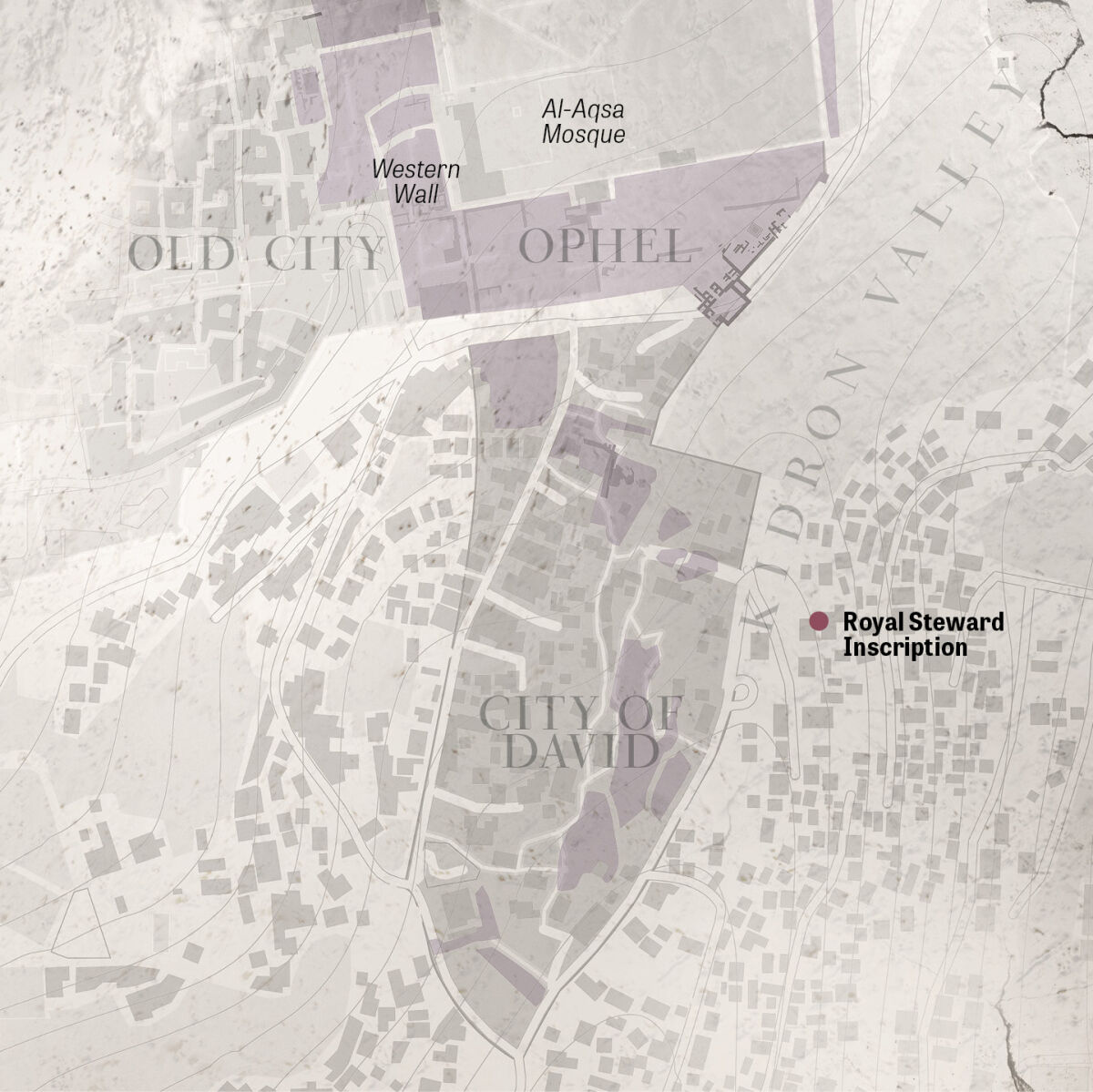
Of the tombs in the necropolis, the Tomb of the Royal Steward is one of the highest in elevation, standing out along the cliff edge with an unrivaled view of the temple, palace and City of David.
Taken together—the manner of the lintel inscription and the location of the tomb, besides the title, dating and partial name—we have a remarkable fit with the words of Isaiah: “What hast thou here, and whom hast thou here, That thou hast hewed thee out here a sepulchre, Thou that hewest thee out a sepulchre on high, And gravest a habitation for thyself in the rock?” (Isaiah 22:16). The rock-cut tomb in Silwan was indeed carved out on high—30 meters (100 feet) above the floor of the Kidron Valley. In The Necropolis From the Time of the Kingdom of Judah at Silwan, Jerusalem, Ussishkin describes its location as “distinguished.”
Isaiah’s Condemnation
Shebna was corrected by the Prophet Isaiah for his pride and arrogance, all tied directly to that tomb he was carving out for himself. As we’ve seen, this is aptly illustrated by the Tomb of the Steward in the Silwan necropolis.
But there is a final element to consider. The last part of the tomb inscription invokes a curse upon whomever would disturb the contents: “Cursed be the man who opens this.” This is especially interesting in Isaiah’s turning of a curse upon Shebna himself. Additionally, as seen in 2 Kings 18 and 19, Isaiah 22, 36 and 37, Shebna’s title was stripped from him and given to Eliakim, leaving Shebna with a grand tomb embossed with a title that he no longer carried.
What, then, became of the once Royal Steward Shebna? The Bible doesn’t say—short of Isaiah’s prophecy: “Behold, the Lord will hurl thee up and down with a man’s throw; Yea, He will wind thee round and round; He will violently roll and toss thee like a ball into a large country; There shalt thou die …” (Isaiah 22:17-18). Perhaps unsurprisingly, the Royal Steward tomb was found empty—as were other tombs along the Silwan necropolis. Curiously, also missing was this name of the tomb owner—and not only scratched out, as in the relatively common practice of damnatio memoriae, but remarkably deeply gouged out, creating a ball-shaped indent in the stone. “Isaiah prophesied that the biblical Shebna would be tossed ‘like a ball into a large country,’” wrote Let the Stones Speak contributing editor Christopher Eames. “Perhaps the name of this individual was quite literally carved out of the inscription into a ball shape, and tossed away” (“Inscriptions: The Biblical Figures That Nearly Were”). While we can’t know for sure, one thing is clear: The owner’s name that was attached to this cave was intentionally and deliberately removed, leaving behind only the divine name element at the end, -yahu.
The Royal Steward Inscription stands as one of the most important artifacts in biblical archaeology, offering a unique insight into the drama of Isaiah 22 and bringing biblical history vividly to life.
