
The late Dr. Eilat Mazar was one of Jerusalem’s most visionary archaeologists. This was evident nearly 30 years ago when she boldly proclaimed in the January-February 1997 Biblical Archaeology Review that she knew the location of King David’s palace—and believed she could prove it.
Part of what made her so successful was the fact that she used the Bible as her guide. In her 1997 article, she said she came to this conclusion through “careful examination of the biblical text” and the study of “modern archaeological excavations in Jerusalem.”
Eilat had her skeptics. But she was unfazed. “If some regard as too speculative the hypothesis I shall put forth in this article, my reply is simply this: Let us put it to the test in the way archaeologists always try to test their theories—by excavation,” she wrote. It took almost 10 years before Roger Hertog came along and gave Eilat the funds to test her hypothesis. When she finally did, she was proved right!
Before her death in 2021, Dr. Mazar made a bold prediction about another prominent Jerusalem site.
I would like to share with you what she said and announce some exciting news about our archaeological work in Jerusalem.

Looking Ahead
The 2018 Ophel season was the last opportunity we had to excavate with Dr. Mazar. That year, we sent students and volunteers to assist her in two areas of excavation: Area D, which we have continued to excavate for four more seasons, and Area M, the Ophel cave. At the end-of-season dinner in 2018, Dr. Mazar delivered a speech to the crew, thanking them for their work, reviewing what they had accomplished, and looking ahead to future excavations.
That excavation, as with every excavation since (2022, 2023, 2024 and 2025), dealt mostly with Byzantine and Second Temple Period remains. “[A]lthough we are thrilled about the Second Temple Period … and the Byzantine Period as well, we do want more of First Temple Period,” she said. “We want King David and King Solomon!” That is a statement we agree with 100 percent! She was eager to uncover more archaeology pointing to David and Solomon, the kings over Israel’s monumental united kingdom. And she knew just where to find it.
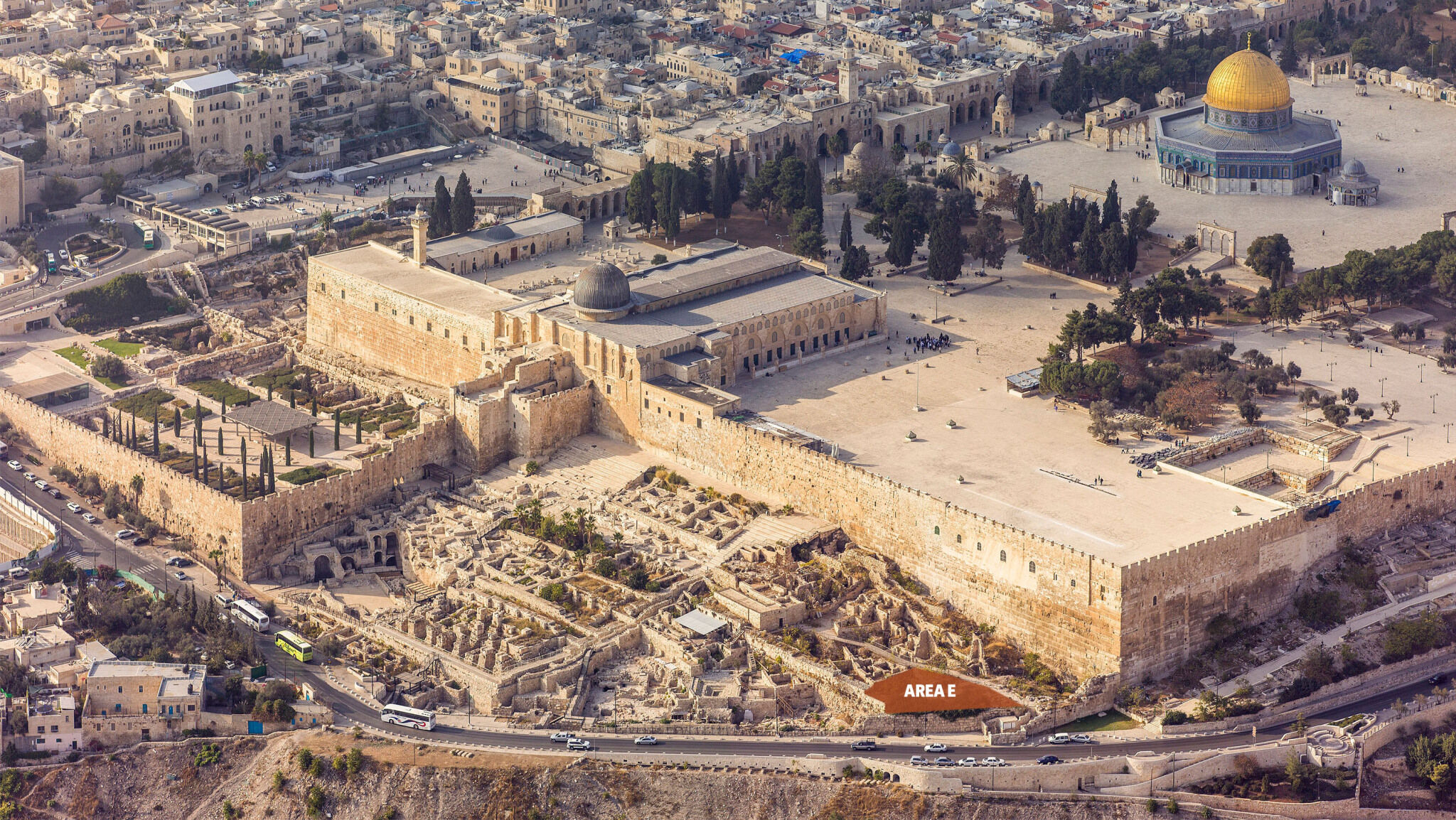
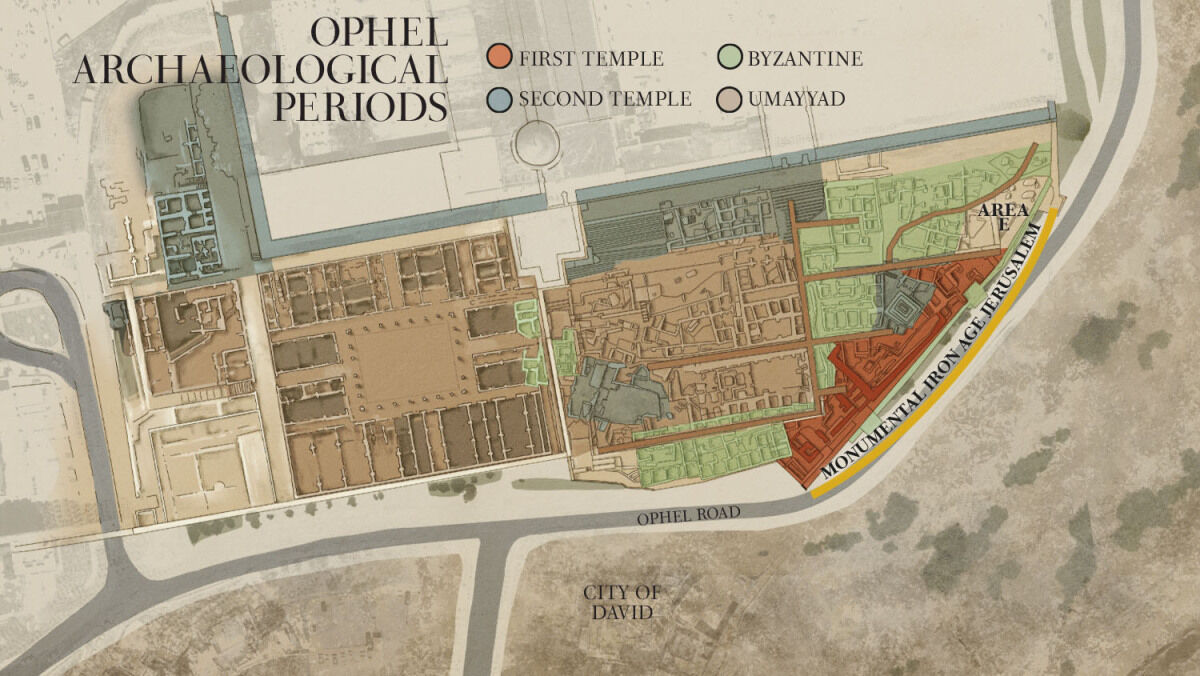
Eilat applied several times for a license to excavate what she named Area E. This was an area she told our crew she was “so anxious to excavate.” Area E is situated on the far northeastern side of the Ophel. It is large, deep and potentially rich with Iron Age (First Temple Period) material and architecture. We often refer to this period—from King Solomon in the mid-10th century through to Jerusalem’s destruction in 586 b.c.e.—as the period of royal biblical Jerusalem. This is when Judah’s kings, prophets and priests led Judah from the Ophel. For us, it’s the most exciting period of Jerusalem archaeology!
Dr. Mazar believed Area E was key to gaining a deeper, more detailed understanding of what she called the “royal Solomonic complex.”
“What would be inside the line of fortifications on the inner side that is from the time of King Solomon?” she asked. “The palace complex. This is the only place which they didn’t destroy because of garden works. I don’t think that even the Second Temple Period destroyed what was established there on the bedrock during the First Temple Period.”
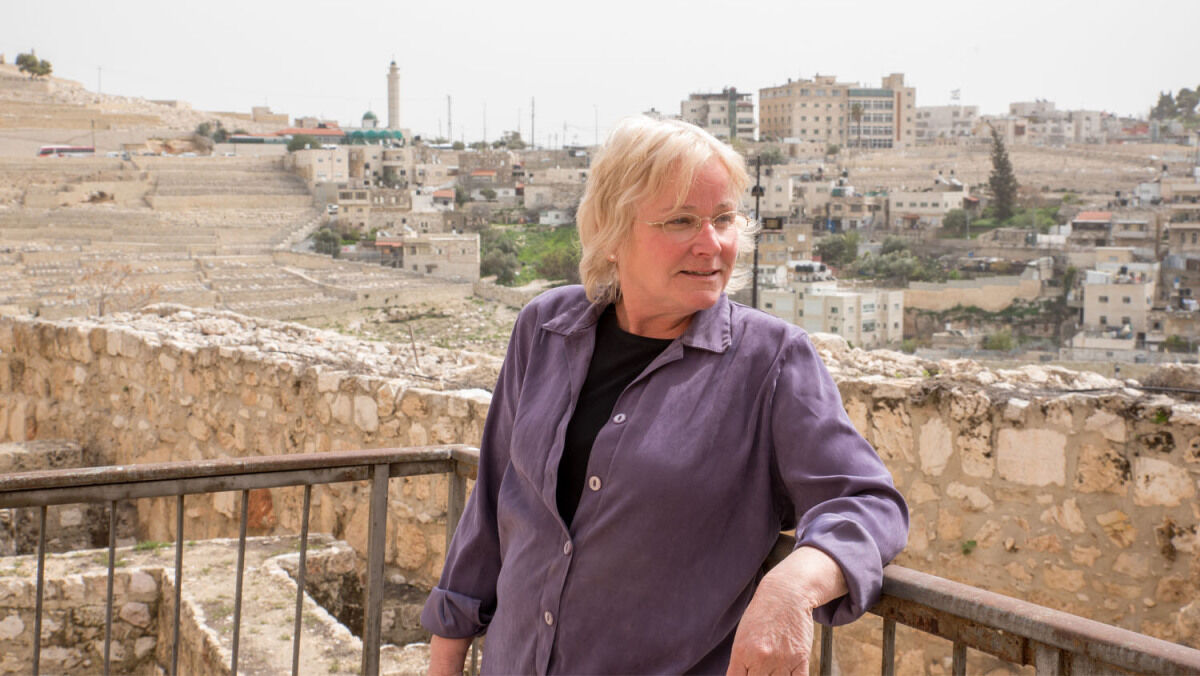
Eilat explained the enormous potential of Area E. “I do have high expectations—and usually I’m right. We are not promising anybody anything. But we know the area; we can sense the area. We know the bedrock falls there very rapidly, at least 10 meters. If it falls at minimum 10 meters, we have 5 meters preservation—at minimum. So, to have 5 meters preservation of Solomonic past—let’s find this. It’s there. It’s there. That is why I’m working hard and not giving up on that. We must go on. We must continue and excavate there—that’s it. That’s where we are going to continue—right?”
I am happy to announce, 12 years after Dr. Mazar first tried for a license, that we will be excavating Area E this summer!
The excavation will be led by Prof. Yosef Garfinkel from Hebrew University, sponsored by the Armstrong Institute of Biblical Archaeology and other generous donors, with the work carried out by students from Herbert W. Armstrong College.
There is a lot of material to remove, and most of it will be sifted, as it could be rich with finds. All totaled, we expect about 10 months of excavation, though we’ll do this in phases spread out over 12 to 18 months. As always, you will be able to follow the excavation of Area E at ArmstrongInstitute.org.
The opportunity to excavate this area arose suddenly and unexpectedly. Over just a few weeks in March, it virtually fell into our laps!
This reminds me of something Dr. Mazar once said: “There may be times where it will take 10 years for people to readjust to support or even accept the idea. But I’m not going to wait for them.” I like that. She was a lady in a hurry. She just kept moving ahead in spite of the critics, and there were plenty of those. Dr. Mazar had that spirit of David in many ways. And she was not waiting on anybody. She knew she had to move fast to get this work done. And she really helped to bring King David alive. If Dr. Mazar is right, then Area E will also highlight the monumental kingdom that began with King David’s reign.
The way this opportunity happened brings to mind Psalm 102:13-16: “Thou shalt arise, and have mercy upon Zion: for the time to favour her, yea, the set time, is come. For thy servants take pleasure in her stones, and favour the dust thereof. So the heathen shall fear the name of the Lord, and all the kings of the earth thy glory. When the Lord shall build up Zion, he shall appear in his glory” (King James Version). For nearly 60 years, we have taken pleasure in Jerusalem’s stones and favored its dust. (You can read more about the importance of this passage in Psalm 102 and the hope it contains here.)
Archaeology can inspire hope because of what it reveals about the Bible and how God worked with the nation of Israel. And so much of that history is displayed on the Ophel.
Why the Ophel?
The focus of Area E will be on uncovering the Iron Age architecture and material, which is so important to gaining an understanding of biblical Jerusalem.
The book of Kings records, “And Solomon became allied to Pharaoh king of Egypt by marriage, and took Pharaoh’s daughter, and brought her into the city of David, until he had made an end of building his own house, and the house of the Lord, and the wall of Jerusalem round about. … And this is the account of the levy which king Solomon raised; to build the house of the Lord, and his own house, and Millo, and the wall of Jerusalem …” (1 Kings 3:1; 9:15). After the construction of the first temple and Solomon’s royal complex, the Ophel became the seat of political and military power for the nation of Israel—and it continued that way for 400 years.
Area E will give us further insight into this period. Excavating Area E to reveal Iron Age infrastructure and materials would represent a significant expansion in the total area of First Temple Period archaeology featured on the Ophel. When it is finished, Iron Age Area E will connect via the “Solomonic wall” to the Iron Age gatehouse complex in the southern part of the Ophel. It will be a crescent of monumental, royal, First Temple Period architecture along the eastern border of the Ophel! (You can read more archaeological details of this location in Brent Nagtegaal’s article.)
The Ophel mound is rich with history! Think about what has already been discovered there from the First Temple Period: the bullae of King Hezekiah and the Prophet Isaiah; the Ophel Pithos Inscription, pointing to a relationship between Israel and the kingdom of Sheba; the golden earring pendant, pointing to a relationship between Israel and Phoenicia; and the monumental gatehouse from the time of Judah’s biblical kings. What a treasure trove. And we believe there is much more to be found!
Like Dr. Mazar, we are keen to begin excavating Area E. We don’t know what we will uncover. Perhaps it won’t be as interesting or remarkable as we think. Or maybe we will find something totally unexpected. All we know now is that both science and the biblical text suggest Area E will furnish a big piece of the puzzle that is the Iron Age Ophel.
The only way to know, as our good friend Eilat Mazar famously wrote, is to “put it to the test in the way archaeologists always try to test their theories—by excavation.”
