
The Ophel ridge is one of Israel’s most important plots of land. Visitors to the archaeological park can observe, and even touch, remains from history’s most important periods: Umayyad, Byzantine, Roman, Hellenistic, Persian and, most importantly, Iron Age/First Temple Period—the time of Israel’s and Judah’s biblical kings.
Looking at the site today, however, it’s hard to believe that until the late 1960s, the whole ridge remained almost entirely unexcavated. One of my favorite images from this pre-excavation period shows a verdant field continuing all the way up to the southern wall of the Temple Mount. In other photographs, local farmers can be seen traversing the area with livestock or working over the land with a plow, recalling the Prophet Micah’s words “Zion [will] be plowed as a field” (Micah 3:12).
It’s a very different picture today. The once barren field is now a vast labyrinth of archaeological remains: ancient walls, cisterns, pillars and ritual baths hewn into bedrock. Seven acres of ancient remains give witness to 3,000 years of almost continuous habitation.

And yet only about 5 percent of the total area features First Temple Period remains.
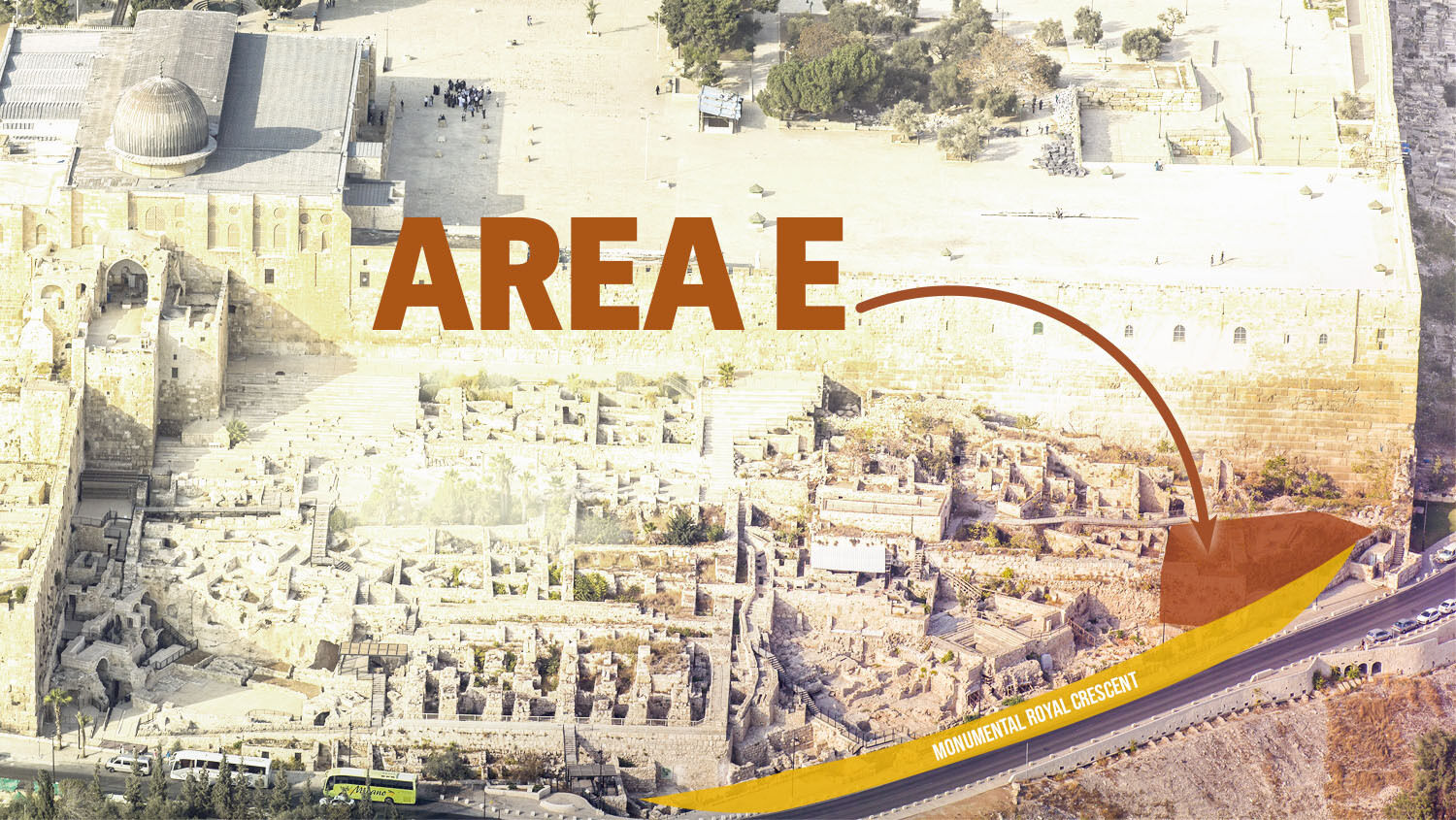
To find the architecture of the First Temple Period, a visitor has to travel to the far eastern side of the Ophel. There—as the bedrock of the long, skinny ridge of Jerusalem begins to fall away into the Kidron Valley—monumental remains from biblical times emerge.
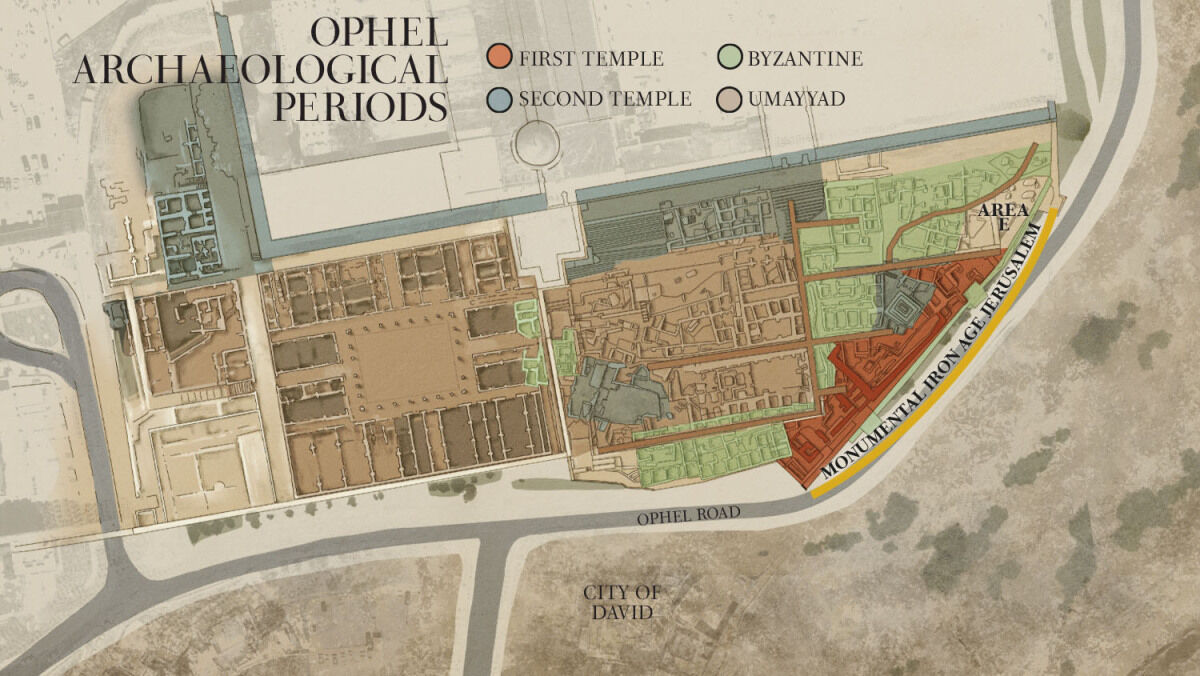
And it is here at the eastern Ophel, just 20 meters (66 feet) from the southeast corner of the Temple Mount, that an incredible opportunity for excavation has opened up—an opportunity that those of us at the Armstrong Institute of Biblical Archaeology are excited to take advantage of this summer under the direction of Hebrew University professor Yosef Garfinkel.
Why are we so excited for the opening of this new area, and what do we expect from the upcoming excavation?
Finding the First Temple Period
Following the 1967 Six-Day War, Israeli excavations, led by the late Prof. Benjamin Mazar of Hebrew University, began in haste. Over the next decade, the team excavated year-round, starting at the southwest corner of the Temple Mount and proceeding east along almost the entirety of the 279 meters (915 feet) of the southern wall.
Unfortunately for the team, only the final years of excavation produced Iron Age remains at the southeastern side of the allotted area. The fact that the earliest remains were found in this area is unsurprising for a site that underwent massive reconstructions through history. Often in archaeological digs, the most ancient remains are best preserved on the edges of the mound. Following the cycle of settlement, destruction and resettlement, the builders often have to clear away the debris and rubble from the top of the mound for their new city. This means pushing unwanted debris to the side of the hill, which then covers and preserves the more ancient remains.
This is certainly the case for Jerusalem’s eastern hill (the original ridgeline), where almost nothing is preserved from the First Temple Period on the crest of the ridge. On the easternmost slope, however, there is some absolutely massive architecture with impressive heights of preservation. This is logical considering the topography of the eastern hill.
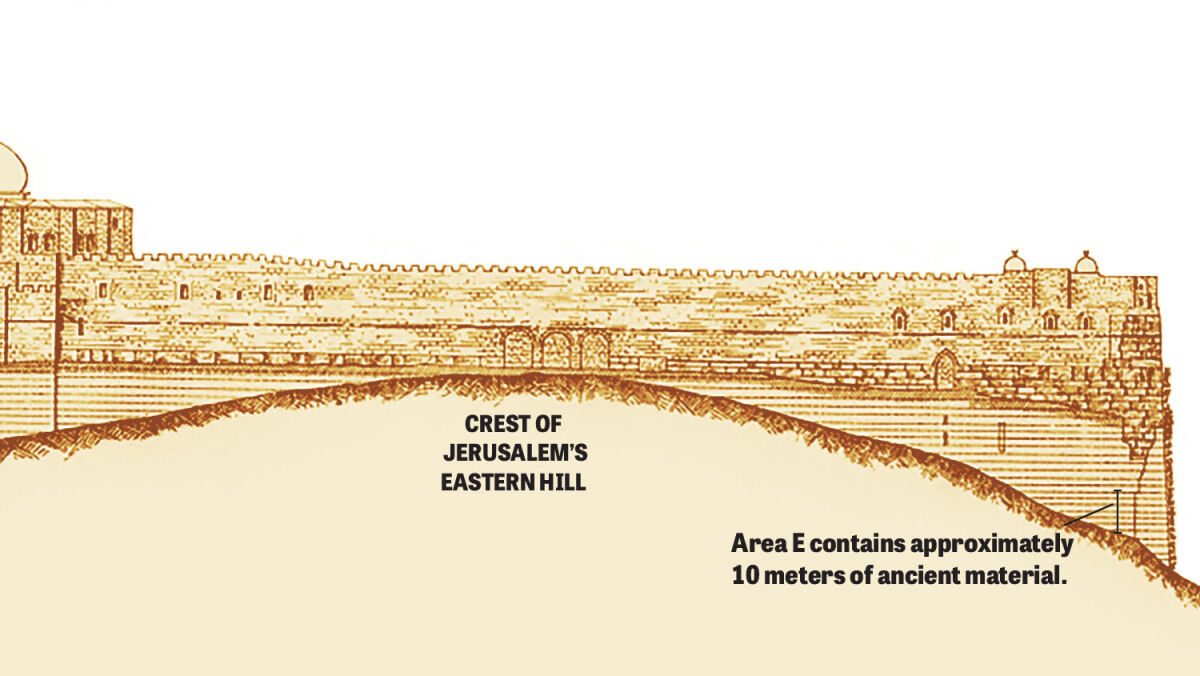
When considering which areas of the Ophel are the most likely to have First Temple Period remains, it’s important to understand where the crest of the ridge is. Based on a visual reconstruction, it would be assumed that the crest was somewhere around the center of the southern wall of the Temple Mount. That is not the case. Instead, the crest of the ridge is under the Triple Gate, two thirds of the way across the southern wall to the east and only 86 meters (282 feet) from the southeastern corner of the Temple Mount (see drawing from Charles Warren across the page). Thus, it makes sense that, prior to the construction of the southern wall, most of the earliest First Temple Period construction was likely concentrated on the eastern edge of the Ophel.
This was confirmed materially when explorer Charles Warren first documented the area in 1867 at the behest of the nascent Palestine Exploration Fund.
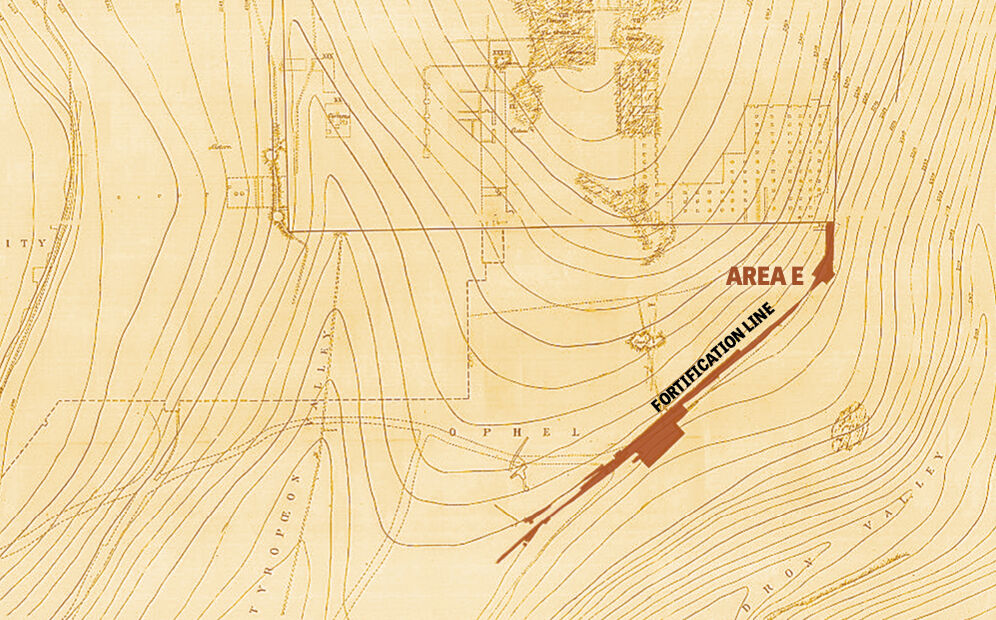
Starting at the southeastern corner of the Temple Mount, Warren dug shafts along the edge of the ridge, allowing him to patch together an eastern fortification line of the city, which was later dated to the Byzantine Period (mid-fifth century c.e.). Twenty-eight meters (92 feet) from the southern wall, he found a large rectangular tower incorporated into the city wall. The city wall then turned about 45 degrees to the west. About 95 meters from the first tower, Warren documented a second Byzantine tower, which was sitting on top of another earlier and more massive structure, itself built directly on top of bedrock. Archaeologist Kathleen Kenyon excavated this area and dated this monumental tower to the First Temple Period. To this day, it is partially visible from the Ophel Road, a busy thoroughfare that skirts the Ophel ridge.
In the final years of Benjamin Mazar’s excavation, the team excavated inside this fortification line and began to finally discover First Temple Period walls and floors. This area was subsequently excavated in 1986 by Dr. Eilat Mazar (Benjamin Mazar’s granddaughter), providing a clearer understanding of the layout of the rooms. Dr. Mazar’s excavations revealed smashed in situ vessels and charred remains on top of the limestone floor; these remains provided evidence of the 586 b.c.e. destruction of Jerusalem that closed the First Temple Period.
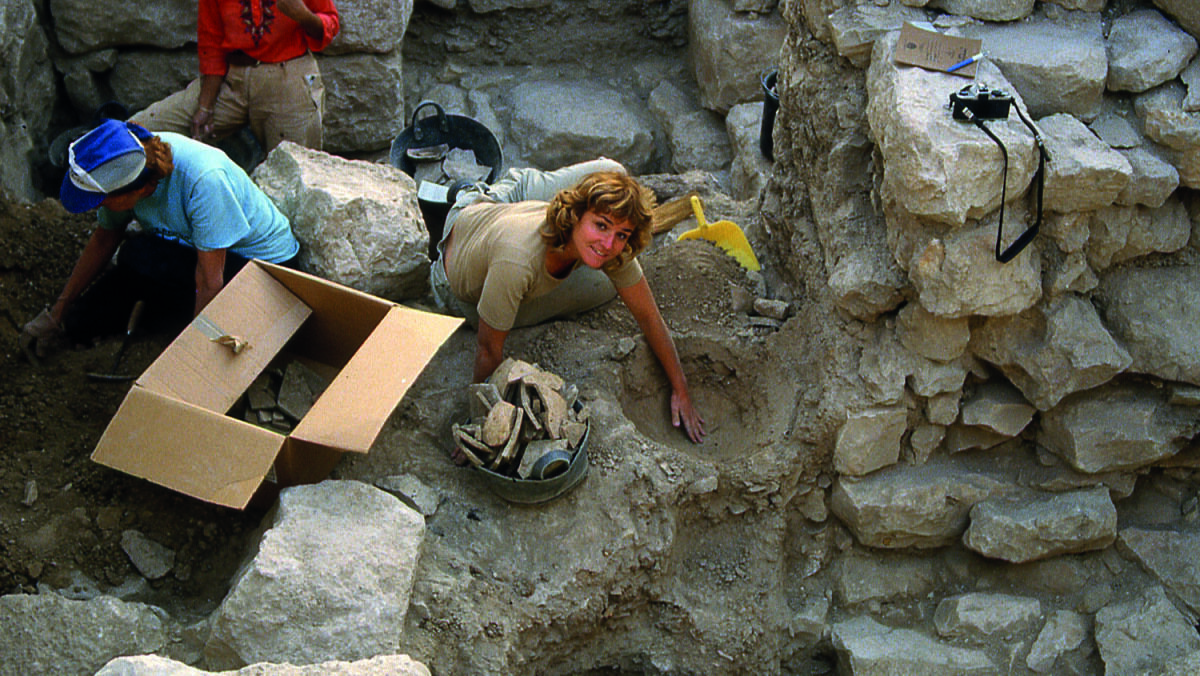
Following that excavation, Eilat put together numerous lines of evidence and determined the area to be a gatehouse complex from the Iron iia, most likely associated with the construction efforts of King Solomon. Archaeologists have since questioned the interpretation, but no one discounts that these are huge walls from the time of Judah’s biblical kings.
Thus, after two phases and years of excavation, it was possible to begin to discern the layout of the royal quarter of biblical Jerusalem—and it was found only in the eastern Ophel, deep down and adjacent to the Byzantine city wall.
Moving North
Between the end of Benjamin Mazar’s excavation in 1978 and Eilat’s excavation in 1986, most of the Ophel underwent massive reconstruction works in preparation for opening the area for tourists. These “gardening works,” as they have come to be known, succeeded in giving visitors to the Ophel a general picture of parts of the ancient site. However, in other instances, in particular the area between the gatehouse complex and the southeast corner of the Temple Mount, more than just reconstruction was completed. Further excavation was conducted down to bedrock, and yet absolutely no archaeological documentation was produced.
Eilat Mazar attempted to rectify this by reexamining the gatehouse area (2009) and opening up three areas to the north for further investigation (areas A, B and C in 2012–13).
In 2009, the excavations were extremely fruitful in solidifying the layout of the gatehouse and provided more datable material for a long straight section of a First Temple Period wall running parallel with the Byzantine city wall. Dr. Mazar dated the wall to King Solomon’s time (1 Kings 3:1).
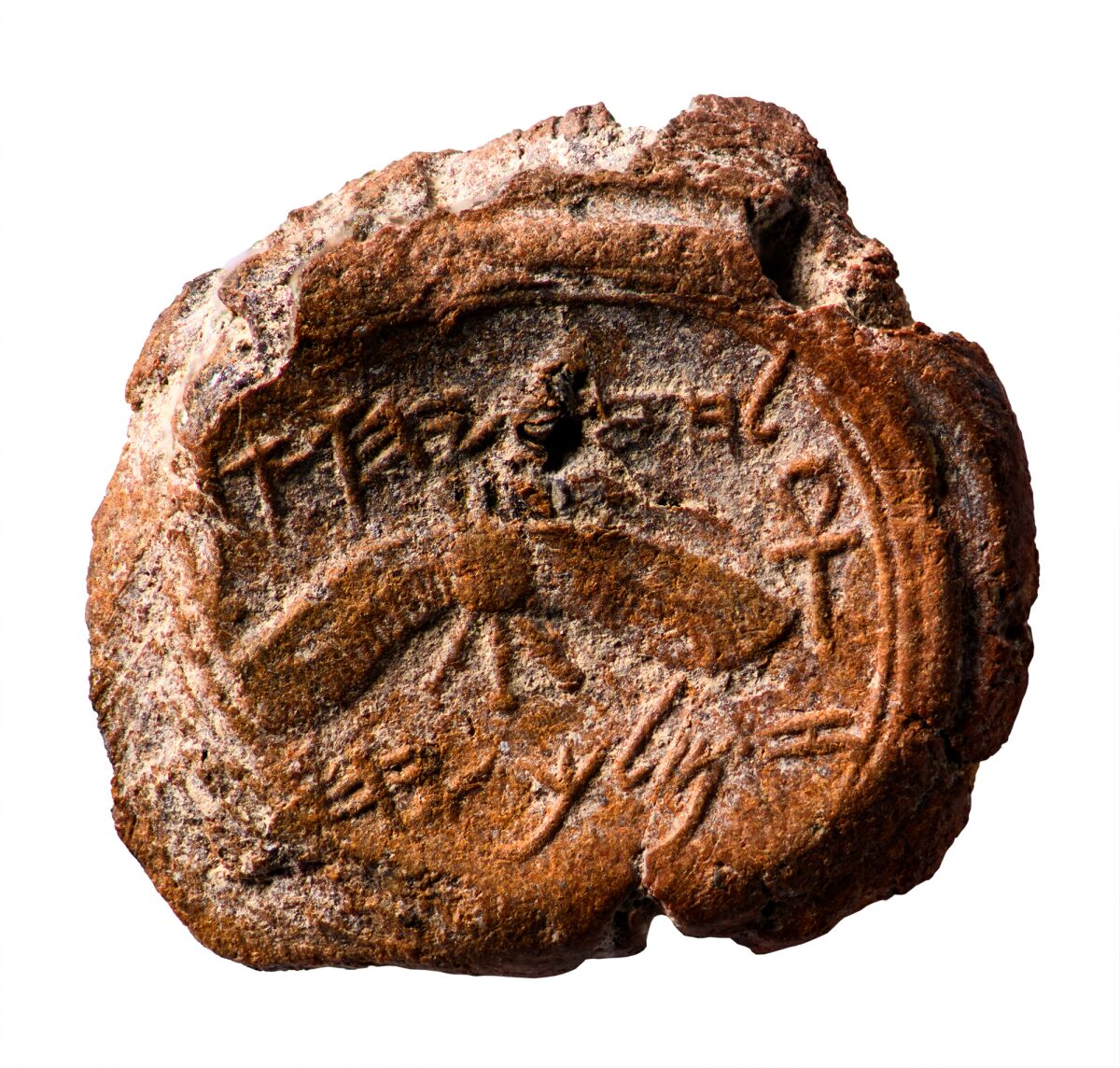
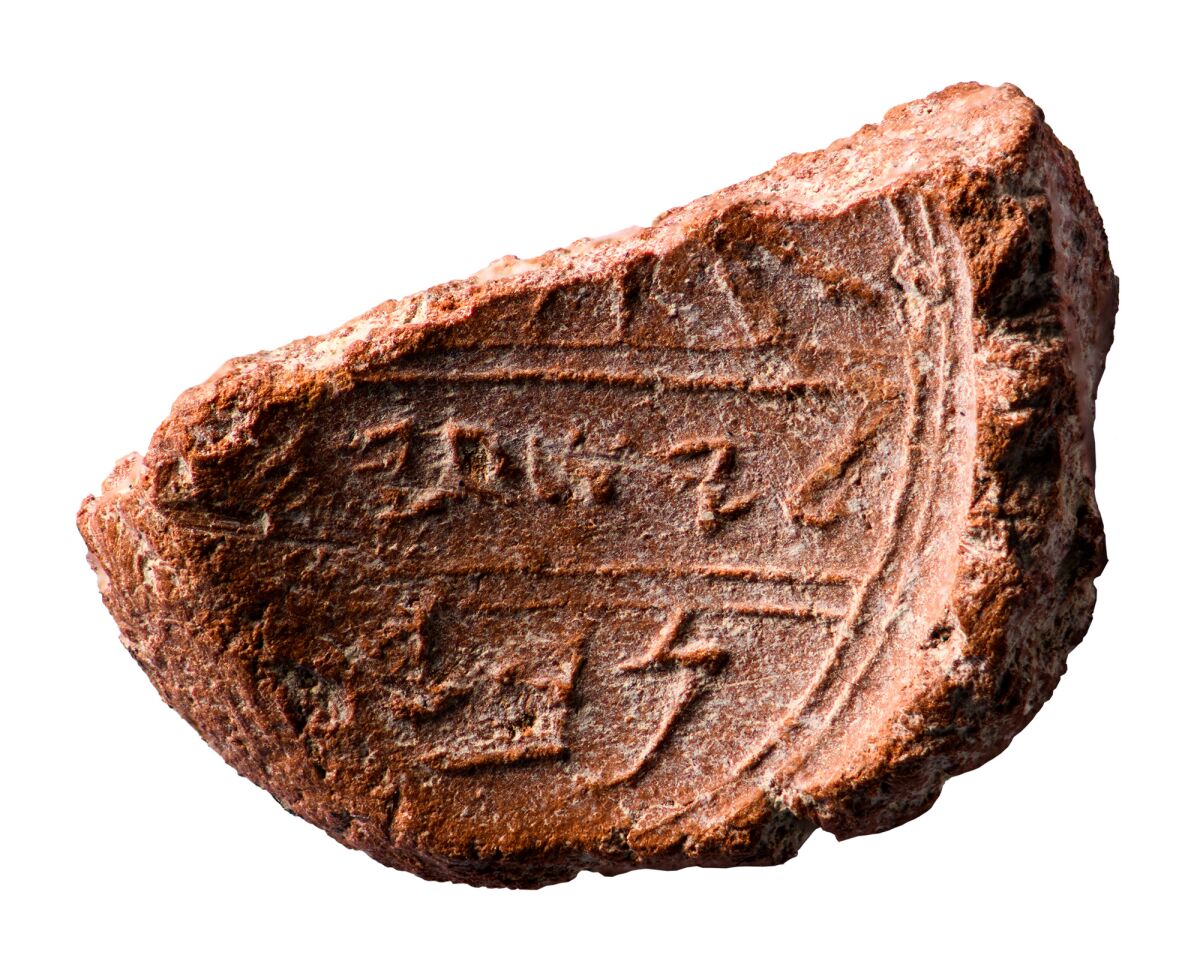
The excavation also produced a wealth of small finds of great importance, especially two seal impressions bearing the names of biblical figures. The first read, “Belonging to Hezekiah, [son of] Ahaz, King of Judah.” To this day, it is the only seal impression belonging to an Israelite or Judean king ever found in controlled scientific investigations.
A few meters away, the team discovered a second seal impression that reads in ancient Hebrew: “Yesha’yah[u] Nvy[?]” interpreted as “Isaiah the Prophet.” The discovery of both seal impressions next to each other is another indication of the prominence of the Ophel as the royal quarter of Jerusalem.
In 2012 and 2013, the team moved further northeast within the fortification line. I supervised work in Area B, directly adjacent to the 2009 excavation. Under Eilat’s guidance, we were able to peel back much of the 1980s restoration works and produce, for the first time, solid architectural plans and dating for the Byzantine and Roman periods. Preserved under some of these later remains were, just as at the gatehouse, more First Temple Period walls and floors.

All of the buckets of material from the First Temple Period remains were wet sifted, leading to the discovery of a wealth of small finds dating primarily to the 10th to ninth century b.c.e. (the time of Solomon and early Judean kings). Among the seals, seal impressions and the wealth of pottery in Area B, we also uncovered a beautiful gold earring piece, a type known as a basket pendant. Similar discoveries of this type of jewelry were found exclusively from Phoenician sites around the Mediterranean, leading previous scholars to identify it as a cultural marker of the Phoenicians. The Ophel Basket Pendant was dated by the archaeological context to the early Iron iia (10th century b.c.e.). As we have previously published, the presence of such an earring on the Ophel from this time speaks to a Phoenician presence in the construction phase of this area, which can be linked to the Phoenician King Hiram’s or Tyre’s assistance in the construction of the royal quarter during the time of Solomon (1 Kings 7:13-14; read “The Golden Earring Pendant of Jerusalem”).
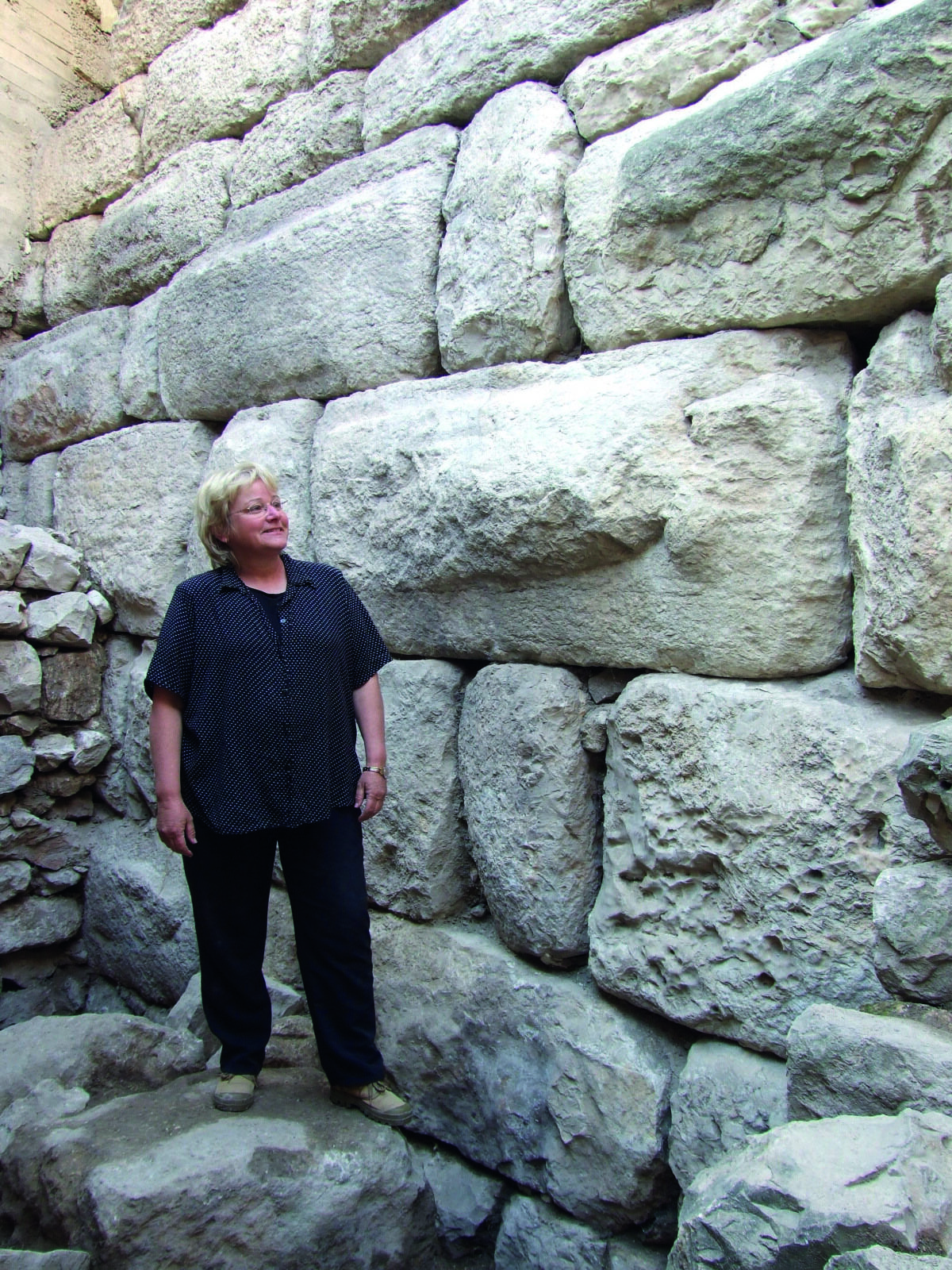
Moving from Area B further northeast, Eilat Mazar’s Area A yielded more First Temple Period wall and floors. This Area A structure apparently included another exceptionally large tower structure in the line of the First Temple Period fortification, albeit only partially revealed. Dr. Mazar concluded that this tower dated to at least the same period as the fortification wall running through Area B. Not much of this tower was able to be dated, as it is obscured by a later Byzantine Period tower. Dr. Mazar named it the “Great Projecting Tower” based on Nehemiah 3:27, which describes this as the next identifiable feature along the wall after the Water Gate, Projecting Tower and fortification wall of verses 25-26.
Inside this complex, the team discovered an inscription on the shoulder of a large, broken vessel known as a pithos. Dating to the 11th to 10th century b.c.e., it is the oldest alphabetic writing ever discovered in Jerusalem. For years, exactly what the inscription read—and even the exact language it was written in—remained elusive. However, a 2023 analysis, conducted by expert epigrapher Dr. Daniel Vainstub, brought together a remarkable convergence of biblical information.
According to Dr. Vainstub, the script isn’t ancient Hebrew or Canaanite but actually Sabean—otherwise known as Ancient South Arabian (asa). Furthermore, the inscription refers to a trade of incense known as ladanum (Cistus ladaniferus), known especially from the southern Arabian Peninsula. This discovery provides evidence of the extensive trade that occurred between King Solomon’s Jerusalem and the southern kingdom of Sheba.
The practice of archaeology, then, has proved that the areas along the fortification line of the Ophel produce some remarkable First Temple Period material.
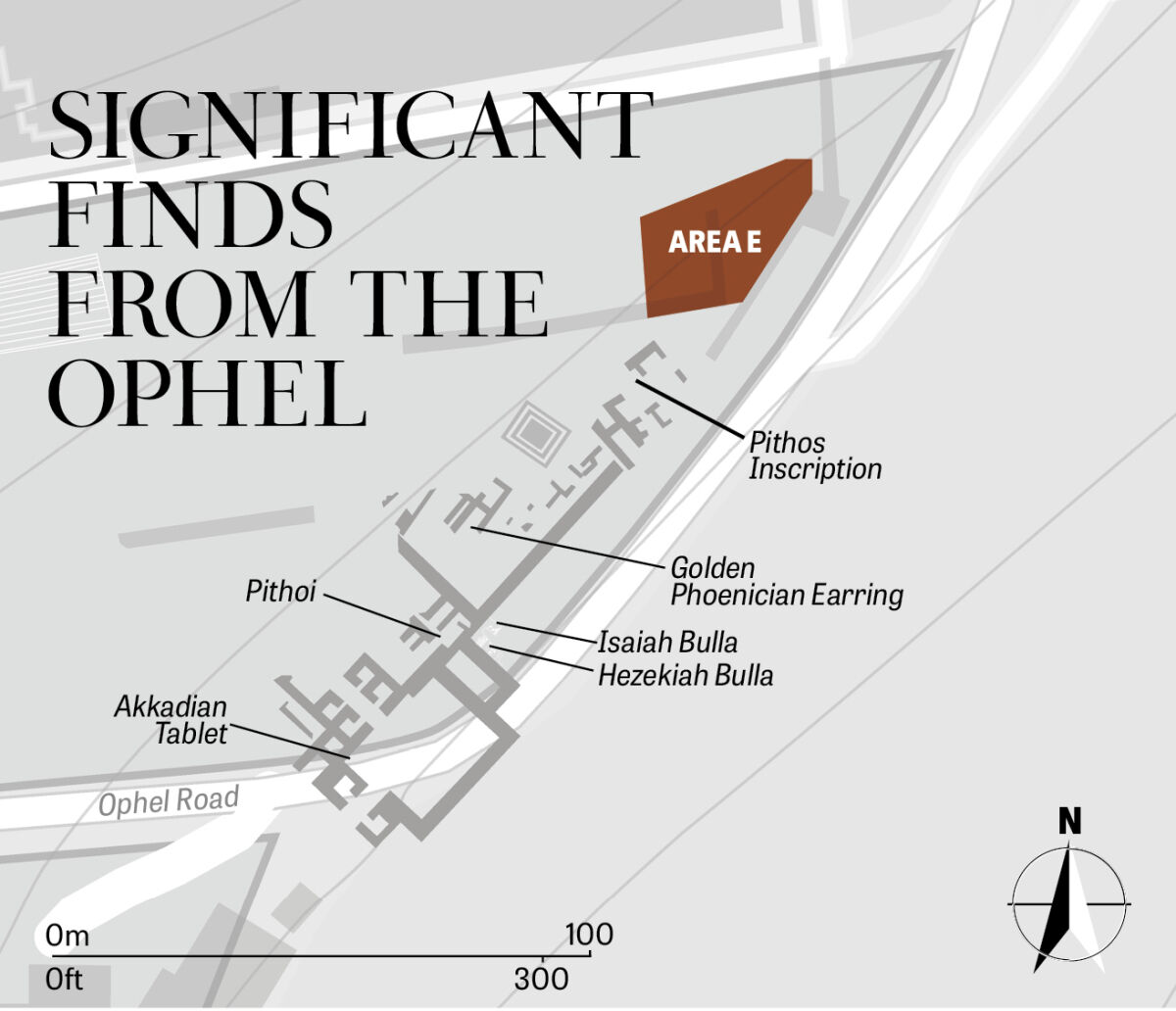
And Now, Area E
Beginning in 2014, Eilat Mazar desired to continue excavating along the fortification of ancient Jerusalem. She was given permission to excavate Area D, which is adjacent to areas A and B, but are further up toward the crest of the ridge. As expected, with the rising bedrock in those areas, while certain impressive Byzantine and Roman Period discoveries were found, almost no First Temple Period remains were discovered. Her real dream was to continue following the fortification line toward the Temple Mount, which she dubbed her future Area E.
Area E is in the same line and relative position on the eastern side of the ridge as the previously discovered First Temple Period architecture from 2009 onward. Even more important is the fact that very little “garden works” had been done in this area in the 1980s. The chances of finding undisturbed layers from royal Jerusalem, then, are extremely high.
Added to that, there was another enticing clue. One part of Area E had already been partially excavated decades earlier, but not all the way to bedrock. The excavation stopped at a certain depth to reveal the top of a wall that followed a completely different orientation from the later Byzantine Period structures above.
As we learned through the excavations in 2012 and 2013, the Byzantine Period architecture inside the fortification line follows the orientation of the southern wall of the Temple Mount. Excavating beneath, we discovered that all the buildings built before the 70 c.e. destruction of Jerusalem were oriented with the fortification line alongside the top of the Kidron Valley (45 degrees perpendicular to the southern wall). Thus in this probe of Area E, even though the top of a wall was only appearing, Dr. Mazar knew that it had to be from the Early Roman Period or earlier.
Further still, we could gather from the bedrock heights in Area A to the south of Area E that this wall was likely going to be preserved to a height of around 5 meters (16 feet). Such high preservation from the First or Second Temple Period, less than 30 meters (100 feet) from the southern wall of the Temple Mount, is astounding. That is what excited Dr. Mazar.
Another interesting detail is that the area between the Temple Mount wall and Area E was already partly excavated. Dr. Ronny Reich and Dr. Yuval Baruch excavated two areas adjacent to the Temple Mount in 1999–2000 on behalf of the Israel Antiquities Authority. Their team excavated to bedrock just north of Area E and found architecture matching the First Temple Period orientation, as well as scant remains of a floor from the late First Temple Period.
Thus, both sides of Area E have been excavated, and both sides have reached Iron Age material. In both areas, they reached down to a level of around 705 meters above sea level. But in Area E, the very top of the earliest remains stands at 711 meters above sea level. Then in 2023, a small test area was opened in Area E by Prof. Uzi Leibner and Dr. Orit Peleg-Barkat, which quickly exposed Hellenistic Period remains, and though this probe was not continued further, it had started to reveal some Iron Age material as well.
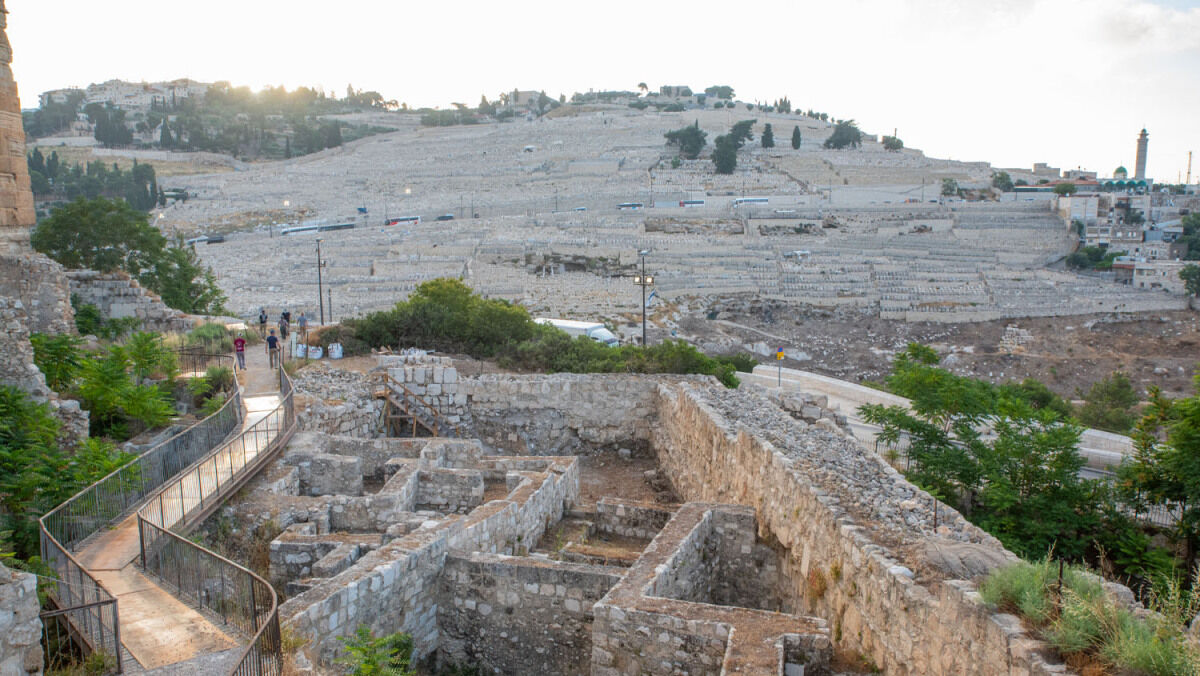
Putting all the facts together, the archaeological opportunity of Area E to yield findings from Jerusalem’s royal quarter of biblical lore is unmatched. Area E is a potential archaeological gold mine—a gem, largely untouched and undisturbed. Yet while the expectation is to find high preservation from the First Temple Period, there are always archaeological surprises along the way, and all periods will be treated with equal archaeological care.
The chance to excavate Area E is not an opportunity that comes along very often. This is a location just inside the fortification line of Jerusalem’s royal quarter, where kings of the Bible once roamed, along with priests and prophets. As we have learned over the past 60 years of on-and-off excavation, the Ophel, the First Temple Period remains further up the hill—near the crest—did not endure the throes of Jerusalem’s cycle of destruction and rebuilding. It is only here, in the very eastern Ophel, that the royal quarter from King Solomon and every king thereafter can be viewed. No wonder Eilat Mazar was excited to excavate there.
“I’m so anxious to excavate there,” she told our team in 2018. “In previous phases, we have found that we have a city gate, we have a line of fortifications, we have buildings that attach to the city gate, and continuation of a fortress that is part of these fortifications. But the fortifications are continuing encircling the Temple Mount compound, and this area is inside this line. What would be inside the line of fortifications on the inner side that is from the time of King Solomon? The palace complex. This is the only place which they didn’t destroy because of garden works. I don’t think that even the Second Temple Period destroyed what was established there on the bedrock during the First Temple Period. So I do have high expectations—and usually I’m right. We are not promising anybody anything. But we know the area; we can sense the area. We know the bedrock falls there very rapidly, at least 10 meters. If it falls at minimum 10 meters, we have 5 meters preservation—at minimum. So, to have 5 meters preservation of Solomonic past—let’s find this. It’s there. It’s there. That is why I’m working hard and not giving up on that. We must go on. We must continue and excavate there—that’s it. That’s where we are going to continue—right?”
Eilat Mazar couldn’t continue there, but we are just as eager and excited to work toward fulfilling her dream—revealing royal Jerusalem in Area E.
