

Earlier this month, the Egyptian Ministry of Tourism and Antiquities announced the discovery of an ancient Egyptian fortress at Tell el-Kharouba in the northern Sinai Peninsula, along an old military and trade route.
The complex covers an area of about 8,000 square meters (86,000 square feet). Archaeologists have excavated a 106-meter-long (350 foot) southern wall and a western wall with a zigzag shape, which most likely “helped reinforce the wall’s stability and reduce the impact of wind and sand erosion,” Hesham Hussein, undersecretary for Lower Egypt and Sinai Archaeology with the Egyptian Ministry of Tourism and Antiquities, told Live Science.
Eleven towers have been uncovered, with pottery found within their foundational deposits. According to the statement, several ovens were also found in the residential area, along with fossilized dough, revealing the living quarters of Egyptian soldiers. Another intriguing find was imported volcanic rock, potentially from Greece.
“Taking into account storerooms, courtyards and other facilities, we estimate that the garrison likely ranged between 400 and 700 soldiers, with a reasonable average of around 500 soldiers,” Hussein said.
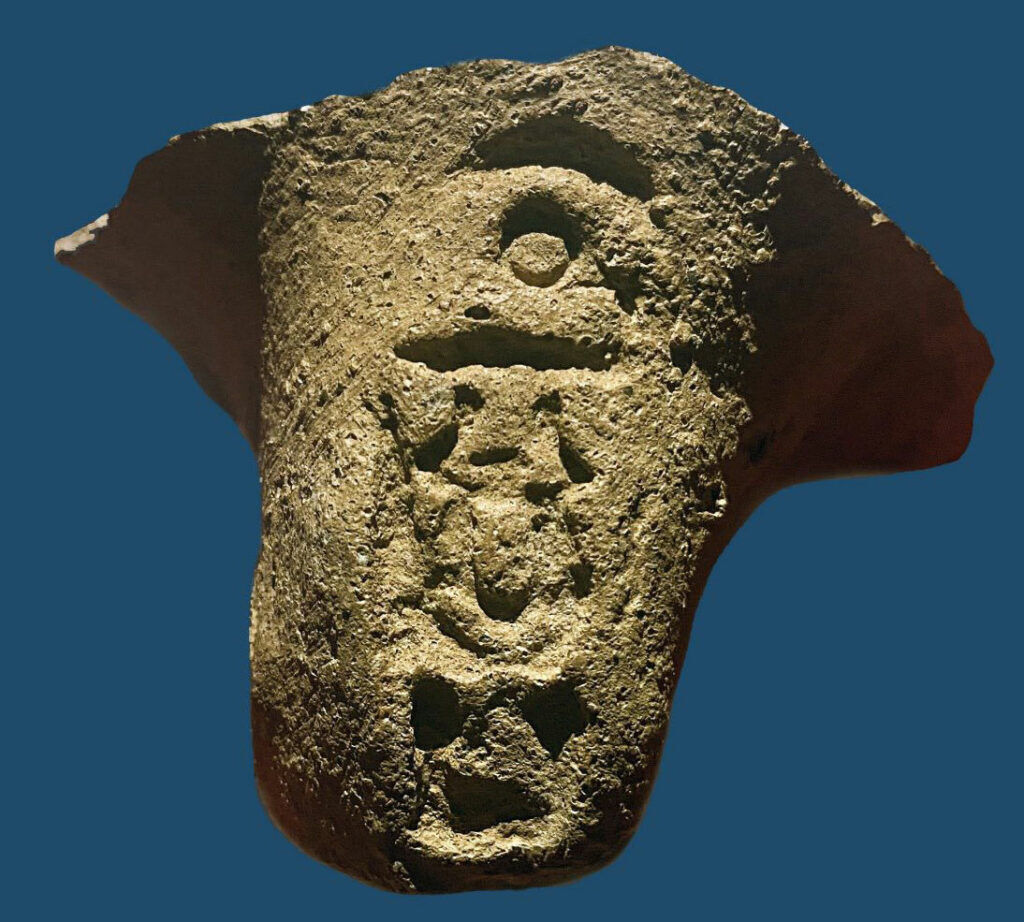
According to the excavators, the fortress belongs to the New Kingdom Period and was most likely built by Thutmose i—the third pharaoh of the 18th dynasty. One of the pottery handles found in the foundational layers from the fort’s construction was inscribed with his name. His reign is dated to the latter part of the 16th century b.c.e., several decades before the Exodus. Scholars often attribute Egypt’s expansion in Nubia toward Syria to Thutmose i. According to Nubian texts, the border of Tuthmose i’s kingdom extended to the Euphrates River in Syria.
One important part of this expansion was a trade and military road that stretched from Egypt to Syria, protecting and controlling the kingdom’s eastern flank. Anciently, this route was called wawt Hr, translated “the Ways of Horus;” it is also called the Horus Military Road.
It appears 11 such fortresses lined this coastal path along the Mediterranean; though this is the largest to be discovered so far. Other fortresses along this route that have been excavated include Tell el-Borg and Tell Habua i and ii. James Hoffmeier, of Trinity International University, who excavated Tell el-Borg told Live Science that this discovery supported the belief “that Thutmose i was the father of Egypt’s empire in Western Asia and that he likely was a key player in the beginning of this defense system [to] which succeeding kings added more forts.”
Egypt controlled this trade and military route for most of the New Kingdom Period, using it for its repeated military campaigns into Canaan and Syria, maintaining its influence there even after the Exodus.
Not only does the discovery of this fortress reveal more about the military expansion and defense of Egypt. More evidence of this military road highlights why God led the Israelites south through the Red Sea out of Egypt, instead of north and directly into the promised land.
“And it came to pass, when Pharaoh had let the people go, that God led them not by the way of the land of the Philistines, although that was near; for God said: ‘Lest peradventure the people repent when they see war, and they return to Egypt.’ But God led the people about, by the way of the wilderness by the Red Sea; and the children of Israel went up armed out of the land of Egypt” (Exodus 13:17).
In Egypt and the Old Testament, professor of Egyptology at the University of Liverpool Thomas Eric Peet wrote: “There can be no doubt that by ‘the way of the Philistines’ the writer meant the great military route which formed the highway, in ancient as in modern times, from Egypt to Syria ….”
Although “the children of Israel went up armed out of the land of Egypt,” God didn’t want to lead the Israelites through the militarily fortified “Ways of Horus” or “way of the Philistines” as they would have encountered much more resistance (verse 18).

In Reliability of the Old Testament, Kenneth Kitchen, renowned Egyptologist and Bible scholar, discussed the possible routes the Israelites could have taken out of Egypt. Based on the Bible, he excludes the northern route. He then references Seti i’s war scenes at the temple of Karnak, describing the pharaoh traveling up from Tjaru to Gaza, traversing several forts and settlements that parallel the “Ways of Horus.” Tjaru has been identified with the fortress discovered at Tell Habua.
The discovery of this new fortress appears to indicate that the military expansion of a pharaoh decades before the Exodus had an impact on the way the Israelites left Egypt. This fortress sheds light on the military and economic power of the Egyptian kingdom during the time of the Exodus.
Archaeologists hope to continue excavating this fortress to reveal its full extent.