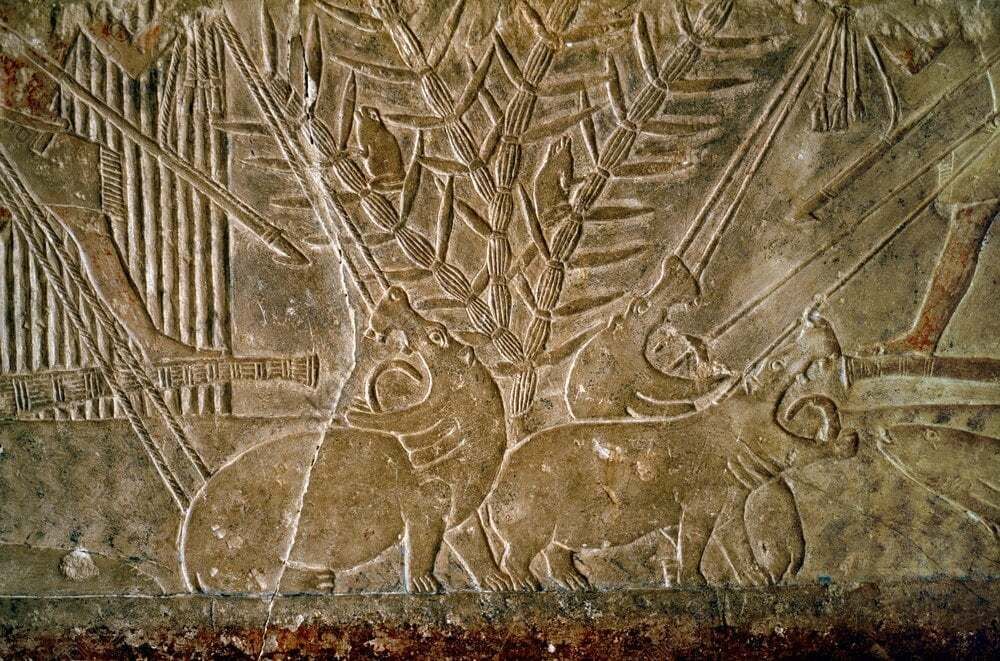
Hippopotamuses depicted in relief form in the tomb of Mereruka
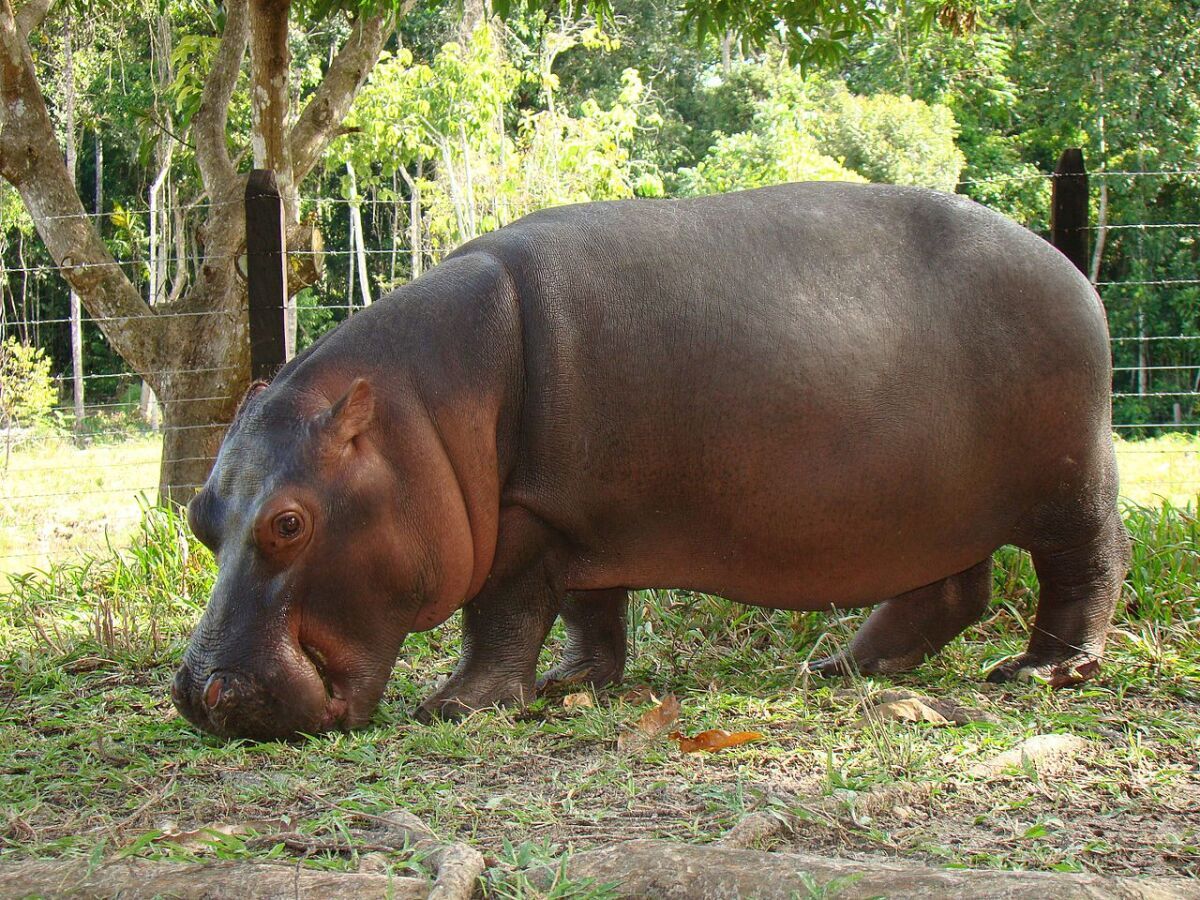
Colombia has a problem with hippopotamuses. Four of the non-native animals were brought into the country in the 1970s by the infamous drug lord Pablo Escobar. They eventually broke free of their less-than-sufficient enclosure in a private zoo at Escobar’s estate, roamed the countryside, and became a nuisance. The burgeoning population of these so-called “cocaine hippos”—now nearing 200—is beginning to get out of hand, posing a real danger to the Colombian ecosystem and people. Hippos are the deadliest large land mammal on the planet, killing roughly 500 people per year. Lions, by contrast, are responsible for 100 to 250 deaths per year.
But the story of problems with a private zoo of hippopotamuses is not just a modern one. Around 3,600 years ago, a similar hippopotamus zoo-related problem purportedly occurred—in ancient Egypt. This story may even have a connection to the Exodus account and an event that may have been the straw that broke the camel’s—or hippo’s—back in the relationship between the Egyptians and the Israelites.
In a recent article, we made the case for Kamose as the pharaoh who “knew not Joseph.” This was partly based on the identification of the Israelites with at least a core component of the Hyksos—a migratory dynasty from the land of Canaan, ruling in Egypt’s Delta—and Kamose’s words on the Carnarvon Tablet, stating that the Hyksos wielded too much power over Egypt. His speech is strikingly similar to the one delivered by the pharaoh in Exodus 1:9-10.
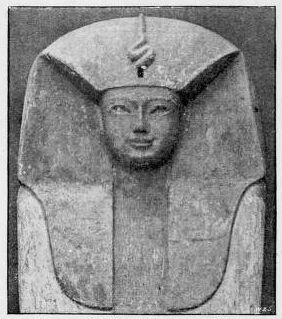
While it was Kamose who ultimately decided to rise up and overthrow the Hyksos (with their eventual “exodus” back into Canaan under a later monarch), it seems relations had soured already during the reign of Kamose’s father, Seqenenre Tao, over—of all things—hippopotamuses.
The ‘Quarrel of Apophis and Seqenenre’
Papyrus Sallier i is a New Kingdom Period document discovered at Thebes and acquired by the British Museum in 1839. Dating to the reign of Merneptah (late 13th century b.c.e.), it contains an account set centuries prior, toward the end of the Second Intermediate Period—specifically within the early-mid 16th century b.c.e., during the reign of the native Egyptian ruler Seqenenre Tao in the south (from Thebes) and the penultimate autonomous Hyksos ruler Apophis in the north (including the region of biblical Goshen, in which the capital, Avaris, was located).
Here are some pertinent excerpts from the somewhat fragmentary text of Papyrus Sallier i, sometimes referred to as the “Quarrel of Apophis and Seqenenre,” as published in Dr. James B. Pritchard’s Ancient Near Eastern Texts Relating to the Old Testament. (Note that this text contains numerous repetitions of the honorificlife, prosperity, health! following the names of the rulers—these have been removed for brevity.)
Now it so happened that the land of Egypt was in distress. … [A]s for King Seqnen-Re, he was Ruler of the Southern City. Distress was in the town of the Asiatics [Hyksos], for Prince Apophis was in Avaris [the Hyksos capital], and the entire land was subject to him with their dues, the north as well, with all the good produce of the Delta. …
Now then, as for [King] A[pophis], he wanted to [send] an irritating message (to) King Seqnen-Re, the Prince of the Southern City. … King Apophis sent to the Prince of the Southern City the message which his scribes and wise men had told him. … Then they said to the messenger of King Apophis: “Why were you sent to the Southern City? How did you come to (make) this trip?” Then the messenger said to him: “King Apophis sends to you as follows: ‘Have the hippopotamus pool which is in the orient of the city done [away] with! For they do not let sleep come to me by day or by night,’ and the noise is (in) the ears of his city.” Then the Prince of the Southern City was dumfounded for a long time, for it happened that he did not know how to return [answer] to the messenger of King Apophis.
Then the Prince of the Southern City said to him: “Well, your lord should hear something about [this pool which is in] the orient of the Southern City here.” Then [the messenger said: “The] matter about which he sent me [must be carried out]!” [Then the Prince of the Southern City had] the [messenger of King Apophis] taken care of, [with] good [things]: meat, cakes …. [Then the Prince of the Southern City said to him: “Tell] your [lord]: As for everything which you say to him, I will do it. Tell [him] so.” … [Then the messenger of King] Apophis started out to travel to the place where his lord was.
Then the Prince of the Southern City had his chief officials summoned, as well as every superior soldier that he had, and he repeated to them every message about which King Apophis had sent to him. Then they were one and all silent for a long time, (for) they did not know how to answer him, whether good or bad.
Then King Apophis sent to ….
Rather annoyingly, this is where the intriguing story breaks off, leaving imagination to fill in the missing details. At the heart of the story is a complaint from Apophis that Seqenenre Tao’s hippopotamus enclosure is too noisy. On the face of it, this would be understandable. The Smithsonian video below explains that their noise “can reach 115 decibels—the equivalent of a rock concert.”
Of course, even that is nowhere near loud enough to be heard all the way north, in Avaris—if we are to take at face-value this telling of the story, some 350 years on.
A Darker Turn
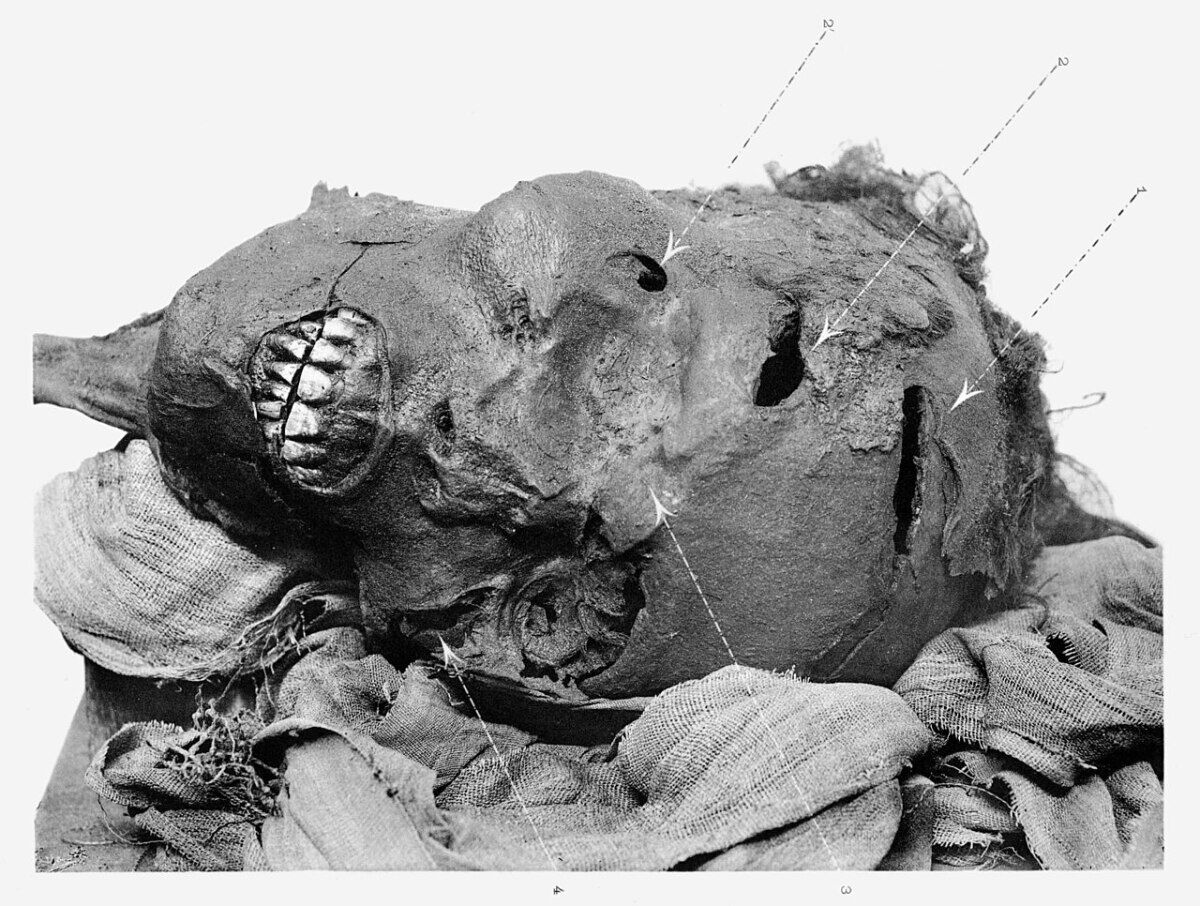
Dr. Peter Feinman summarized the story contained on the papyrus and varying interpretations thereof (including his own) in his article “The Quarrel Story: Egypt, the Hyksos and Canaan.” Was it historical? Allegorical? A blend of both from a later period? He noted a particular lynchpin moment in the debate over the text—the discovery of the mummy of Seqenenre Tao in 1881, the skull riddled with brutal puncture wounds. The discovery brought the story back into focus, prompting all sorts of dramatic reinterpretations. Feinman wrote:
The truncated story received an added aura of mystery when Seqenenre’s mummy was discovered in 1881 at Déir el-Bahrî. The unrolling of the mummy occurred on June 9, 1886. The stark reality of the physical body of the deceased pharaoh with its multiple holes and signs of head trauma immediately engendered an effort to reconcile the story with the skull. Gaston Maspero, who led this effort to uncover the mummy, thought Seqenenre had died in battle surrounded by Hyksos and that the Egyptians had recovered and hastily embalmed the partially decomposed body before bringing it to the family tomb in Thebes. He rejected the idea that the story was a historical document. Maspero saw it as a story that drew on historical figures as the basis for a fictional account.
Following a decades-later analysis of the body by G. Elliot Smith, however, an alternative option came to the fore: “It is clear that Saqnourî [Seqenenre] met his death in an attack by at least two and probably more persons armed with at least two (probably three or more) implements …. I think the balance of evidence is in favor of the view that he was attacked while lying down (possibly asleep) either on the ground or on a low bed …. [Possibly] he may have been felled by one blow … and then received the other four blows when lying prone upon the ground in an unconscious state” (The Royal Mummies). As such, Smith and other scholars have proposed that Seqenenre Tao may have been assassinated.
This may fit better with the complaints of his son and successor, Kamose, in expressing his grievances against the Hyksos (as on the Carnarvon Tablet). He never mentions the death of his father—surely no better excuse for all-out war, if his murder had been at the hands of the Hyksos. There are other interpretations besides.
Under what circumstances was Seqenenre Tao murdered? This remains as much of a mystery as the quarrel story.
Filling the Gaps
Feinman summarized the “standard Egyptian paradigm” applied to such Egyptian literary texts missing content—the overarching principle that the “pharaoh smites the enemy.” Thus, that Seqenenre Tao must have somehow risen up to avenge this insult in some way, shape or form—perhaps literarily or militarily. This, however, has its own difficulties—for example, in the less-than-impressive manner in which Seqenenre Tao is portrayed in the text (from an Egyptian perspective, and certainly as compared to Apophis). Also the fact that there was not much left of Seqenenre’s face to give an impression of victory. This has prompted other scholars to seek new meaning in the text—perhaps as not having resolution within the reign of Seqenenre Tao, but rather that of his sons, Kamose and Ahmose i; or perhaps it represents a later 13th-century b.c.e. political creation in which the authors used these earlier historical figures to narrate a political story for their own time. It bears remembering that this is a narrative told from the native Egyptian, rather than Hyksos, perspective.
The hippopotamus story has been commonly dismissed as later allegory, parable or some kind of diplomatic riddle/wisdom contest, or some kind of simple taunt on the part of Apophis. But given the missing gaps in both the story and the life (and death) of Seqenenre Tao, one can’t help but wonder if there could be more than a kernel of truth buried within this later account. Could some kind of hippopotamus-related “irritation” have been the final straw to an already-fomenting sense of discontent between the native Egyptians and the non-native Hyksos rulers?
In the end, we at least know the general outcome: The death of Seqenenre Tao under mysterious circumstances (either as a result of military action or an inside job); his son Kamose’s desire to unite the entirety of Egypt under his leadership (despite his counsellors intriguingly arguing for maintaining a favorable status quo with the Hyksos); and his brother Ahmose’s ultimate fulfillment of that dream, overthrowing the foreigners and initiating Egypt’s “golden age” of dominance and conquest—the New Kingdom Period, the setting best befitting the Israelite slavery and eventual Exodus.
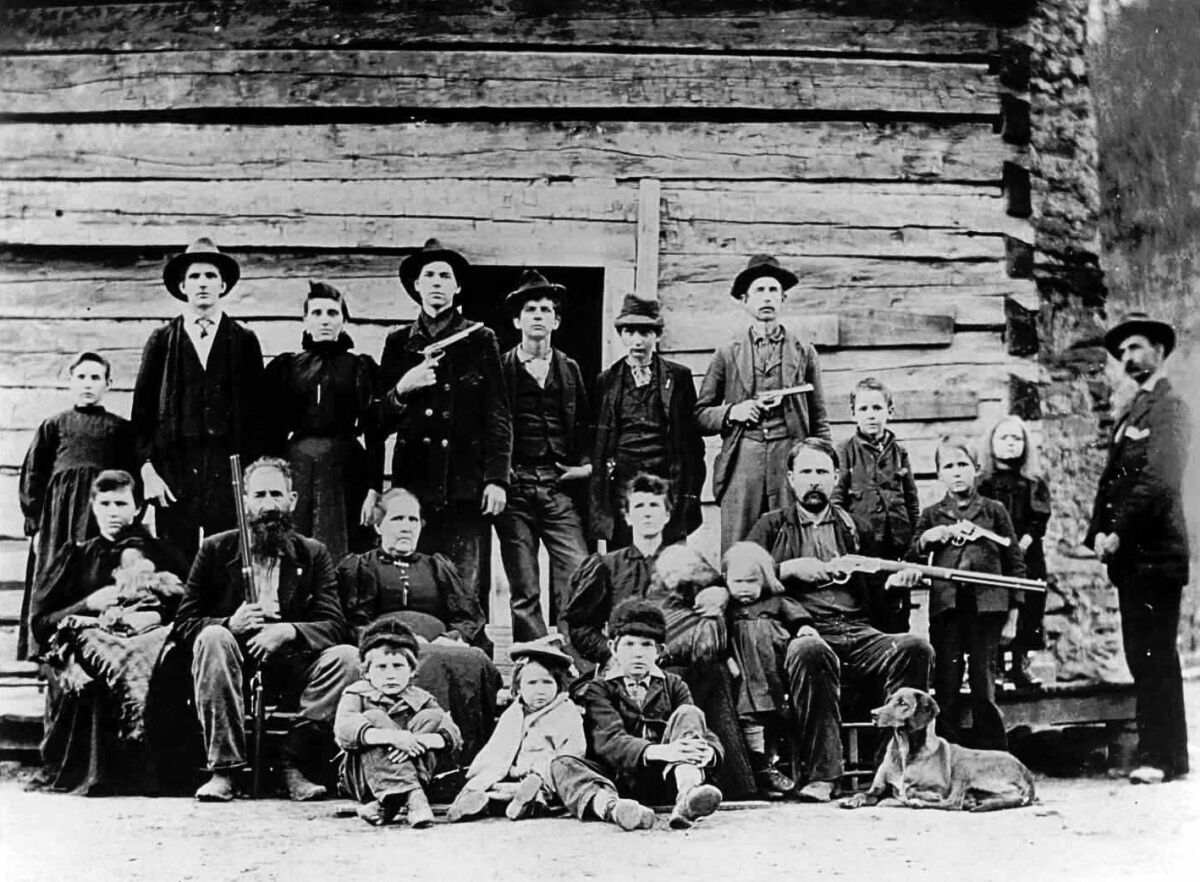
Sometimes, all it takes is an animal. The famous 19th-century Hatfield-McCoy Feud began with the disputed ownership of a hog. Well, not exactly—there’s more to it than that. But when tensions are already high, it doesn’t take much to light the match. And in the case of the Hatfields and McCoys, a snowballing of violence led to dozens killed and virtually all-out territorial war in a feud along the West Virginia-Kentucky border, lasting decades.
Is it too much to believe that a similar incident—involving nature’s biggest “hogs”—could have erupted into the most famous feud in history, between the Israelites and the Egyptians?