
Contrary to popular belief, there is an abundance of evidence for the historicity of Israel’s biblical united monarchy. This was a topic we explored in detail in the Exhibit Edition of Let the Stones Speak. Inscriptions, architecture, cities, garrisons, copper mines, evidence of trade—all of these demonstrate the historical reality of David and Solomon’s kingdom as described in the Bible.
As is the case with archaeology, new evidence is emerging all the time. That’s true of the material we published in our Exhibit Edition. Last year, Prof. Avraham Faust from Bar-Ilan University and Zev Farber from the Shalom Hartman Institute published a new book, The Bible’s First Kings: Uncovering the Story of Saul, David and Solomon. In Chapter 8, they discuss evidence of the kingdom of David and Solomon coming from an unexpected place—the Sharon Plain.
Let’s see how the settlement of the Sharon Plain is yet another piece of evidence for a strong united monarchy centered in Jerusalem.

The Sharon
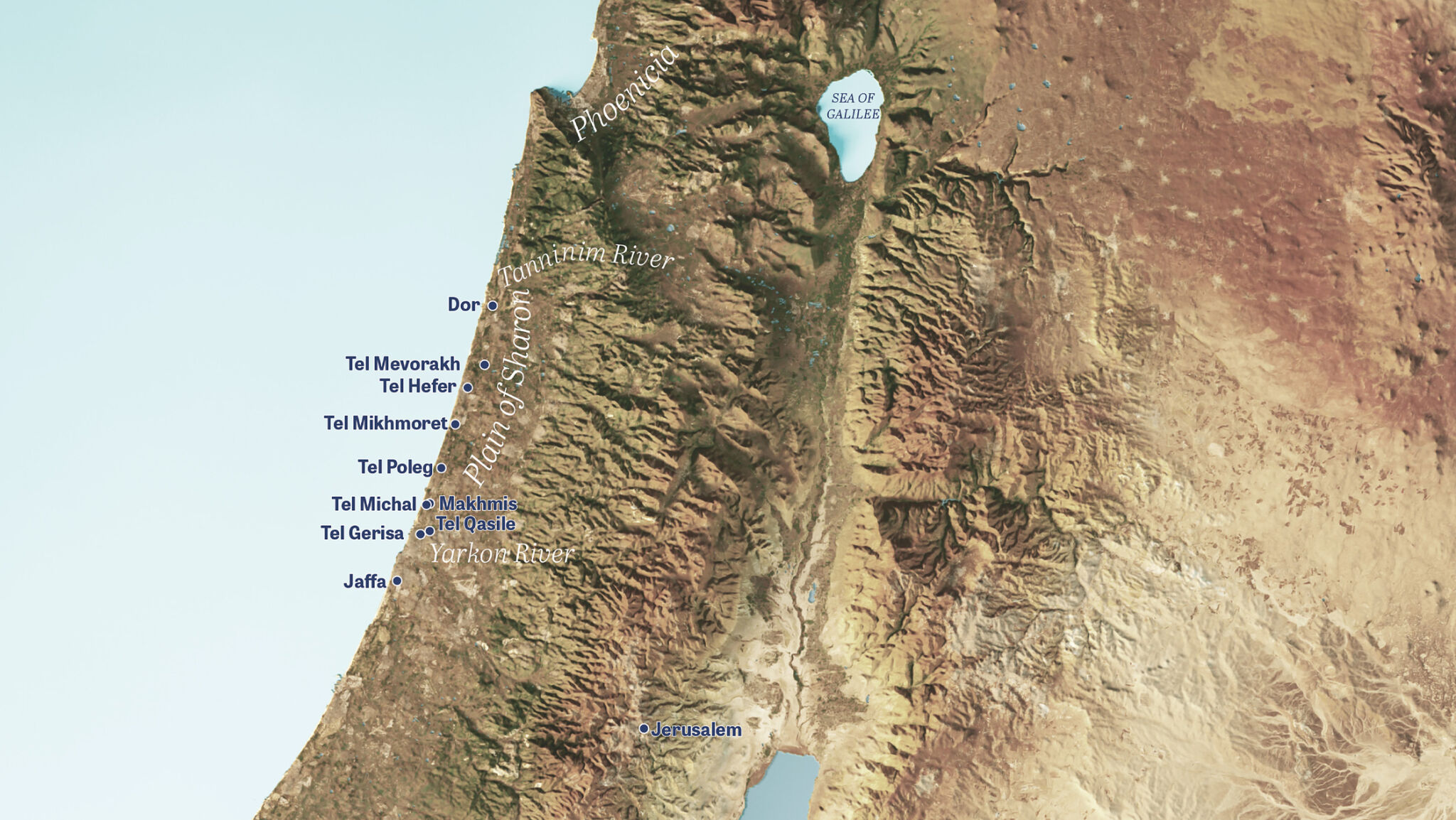
The Sharon is a fertile plain along the Mediterranean coast located between the Tanninim River in the north and the Yarkon River in the south. Today about a third of its agricultural land is used for citrus farming. This wasn’t always the case, however; for much of its history, the Sharon Plain was a swampland caused by drainage problems due to the kurkar (calcareous sandstone) ridges.
Regardless of its terrain, the Sharon had its fair share of settlements throughout the Bronze Age (3300–1200 b.c.e.). Joshua 12:18 reveals that the Israelites conquered the Sharon but left much of the local population to their own devices. Many of the sites remained Canaanite/Philistine throughout the Late Bronze Age and Iron Age i (1200–1000 b.c.e.).
During the Iron Age i, settlement around the Yarkon River began to increase while the rest of the plain experienced a gradual decline. After the Iron Age i, however, something changed.
“The 10th century (the beginning of the Iron Age ii), however, is outstanding,” wrote Faust in a 2007 Israel Exploration Journal article. “During this period there was a settlement peak in the Yarkon basin and the Sharon area, and the following sites were settled: Tel Qasile, Tel Gerisa, Tel Michal, Makhmis, Tel Aphid, Tel Hefer (with limited activity at best), Tel Mikhmoret, Tel Zeror, Tel Poleg and Tel Mevorakh” (“The Sharon and the Yarkon Basin in the 10th Century B.C.E.: Ecology, Settlement Patterns and Political Involvement”).
In their new book, Faust and Farber refer to the region as “an ecologically fringe swampland.” So why was there “a settlement peak” in the 10th century b.c.e.?
United Monarchy Takeover
One of the central sites Faust and Farber focus on is Tel Qasile.
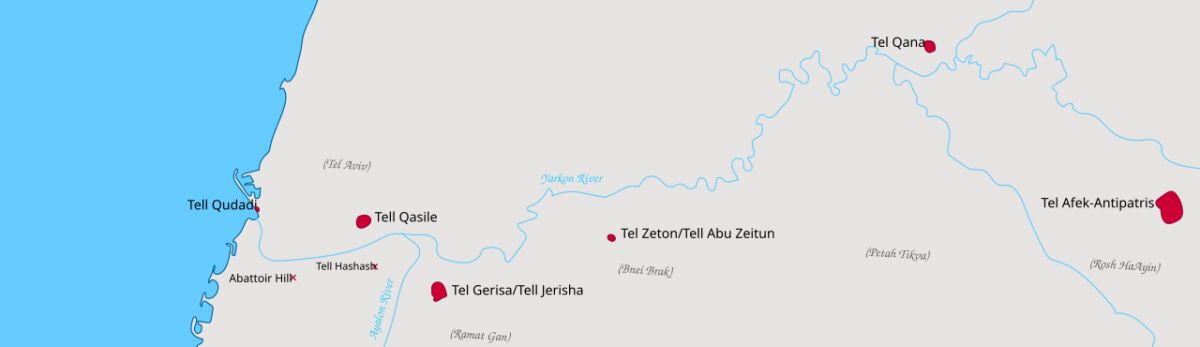
Tel Qasile is situated within the center of modern-day Tel Aviv. It lies close to the bank of the Yarkon River and is around 3 kilometers (1.9 miles) from the Mediterranean coast. It was first excavated by Prof. Benjamin Mazar in 1948—whose excavation of this site was the first license issued by the newly formed State of Israel. After his excavations concluded in 1950, archaeologist Jacob Kaplan continued to excavate between the 1950s and 1970s, followed by Amihai Mazar (nephew of Benjamin Mazar) in the 1970s and 1980s.
In addition to a residential area, archaeologists uncovered an extensive cultic center with a Philistine temple that was in continual use through three strata (Strata x-xii). The temple was expanded with each new stratum.
This changed, however, starting with the 10th century b.c.e., the period of the united monarchy. “Although the cultic compound, with its succession of temples, grew and developed in the course of Strata xii-x of the Iron Age i, after the massive destruction of Stratum x in the early 10th century b.c.e. the temples were not rebuilt,” Faust wrote (“The ‘United Monarchy’ on the Ground,” 2021). According to Faust, the Israelites were responsible for the destruction and transformation of Tel Qasile.
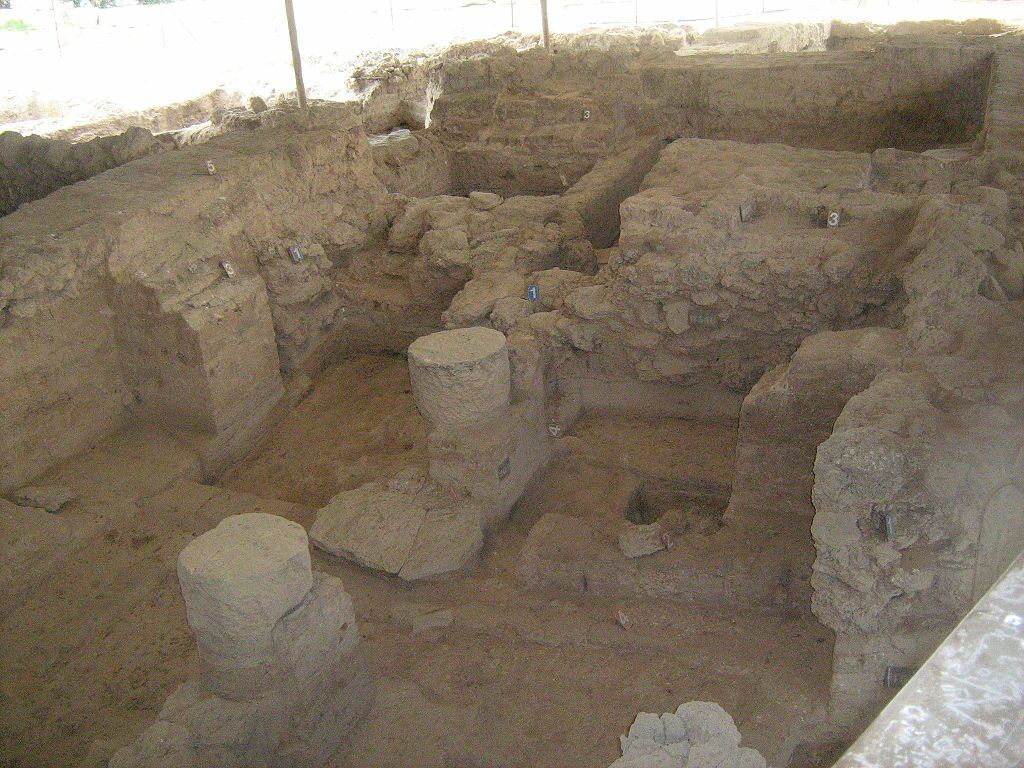
An absence of temples is a clear sign of Israelite society. In our Exhibit Edition, we wrote that these sites without temples, including Tel Qasile, “show that David’s territorial hold extended far beyond Jerusalem. He didn’t just rule over the southern highlands as a petty tribal chieftain; instead, his kingdom grew in size to engulf the Plain of Sharon and into the northern valleys, destroying foreign temples as he went” (read “Canaan’s Vanishing Temples” for more information).
Faust believed that the change in culture allows us to “see that the highland polity [united Israel, with its capital at Jerusalem] expanded into the Sharon and incorporated the region into its political and cultural sphere.”
Another clear sign of Israelite incursion into the area are the four-room houses present at Tel Mevorakh in the north of the Sharon. Archaeologists have identified these “longitudinal four-room houses” as a distinctly Israelite form of architecture. “These houses dominated the built landscape of Iron ii Israelite settlements, where almost all houses—rich and poor, large and small, urban and rural—were built in this manner,” Faust and Farber write. “At the same time, they were very rare outside Israelite settlements.” (For more on these four-room houses, read “Let the Homes Speak!”)
Geographically, it makes sense that David and Solomon crossed into the Yarkon basin. According to Faust and Farber, this region “would have been especially important when the political center that wished to benefit from the maritime trade was located in a limited area encompassing southern Samaria, northern Judah or the northernmost part of the Shephelah, somewhere between Ramallah, Bethlehem and Gezer.” As such, they conclude that the “only reasonable candidate is Jerusalem.”
Sharon in the Bible
The first biblical reference to this area at this time period is in 1 Chronicles 27:29, which speaks of one of David’s ministers named “Shirtai the Sharonite” who was “over the herds that fed in Sharon.” 1 Kings 4:10 says the region surrounding Tel Hefer (“land of Hepher”), which lies in the Sharon Plain, became a tributary of Solomon and delivered goods to the king for one month out of a year.
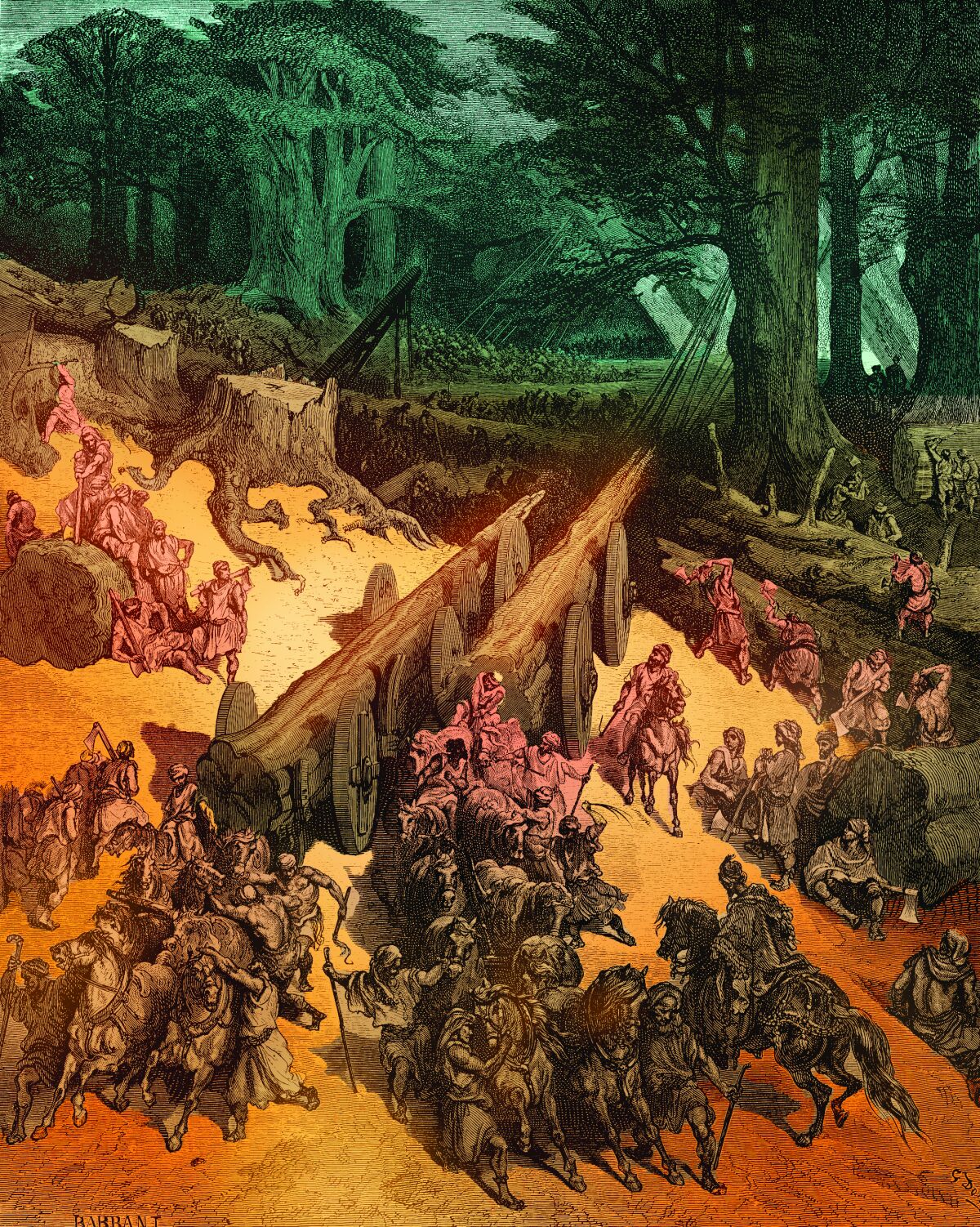
Slightly later in Solomon’s reign, the Bible reveals part of the reason there was an influx in activity in the area—especially around the Yarkon River. In 1 Kings 5, Solomon asked King Hiram of Tyre to provide him with cedar and cypress timbers for the construction of the first temple. “… I will do all thy desire concerning timber of cedar, and concerning timber of cypress,” Hiram said. “My servants shall bring them down from Lebanon unto the sea; and I will make them into rafts to go by sea unto the place that thou shalt appoint me, and will cause them to be broken up there, and thou shalt receive them …” (verses 22-23; verses 8-9 in other translations).
2 Chronicles 2:15 reveals that this appointed place was the port city of Jaffa, close to the mouth of the Yarkon River. Once the logs arrived in Jaffa, “the best route would be to bring the trees to the Yarkon, and from there by the river to Aphek, and only from there to carry them overland,” Faust explains.
Some of our readers live in or close to Tel Aviv and will be familiar with the Yarkon River. Three thousand years ago, that river may have been the very waterway Solomon used to move the timber from Phoenicia to Jerusalem for the construction of the temple.
Additionally, for Solomon’s “navy of Tarshish,” which operated in cooperation with the Phoenicians and whose voyages reached Spain and beyond (1 Kings 10:22), the Sharon Plain was the perfect outlet to the Mediterranean Sea.
Whole Sharon?
While the evidence shows increased prosperity in the whole Sharon, Faust and Farber admit that “most of the prosperity seems to have concentrated in a string of sites along the Yarkon basin, some of which might have been associated with Jaffa, located slightly to the south of the river, on the coast.”
Why, then, would the settlements in the rest of the Sharon flourish if the focus of the united monarchy was primarily on the Yarkon basin?
A lack of Canaanite temples and the prevalence of four-room houses testify of an Israelite takeover in the early 10th century b.c.e. Second, the Bible’s description of the construction of Solomon’s temple speaks of trade along the coast of the whole region. While the prosperity in the rest of the region doesn’t necessarily have to do with the movement of resources from Phoenicia to Jaffa, it does certainly fit with the expansion of a united Israel into that region and general trade along its coast.
“The main force pulling people to the region was most likely its ability to benefit from the maritime trade that passed along its coasts and channel some of it inland,” Faust and Farber write. “Maritime trade grew significantly with the advent of the Iron Age ii, and from this perspective, the Sharon settlement growth in the Iron iia should not come as a surprise.”
Movement to the Sharon Plain in general was a natural consequence of control and enlarged investment in the area by the highland polity. It demonstrates the consequences of a period of wealth and prosperity that fits with the united monarchy.
Short-Lived Glory
Just as the glory of the united monarchy was rather brief, so too was the interest and prosperity in the Sharon region. In his 2007 article, Faust said that the prosperity was “short-lived” and that “most of these sites—Tel Qasile, Tel Gerisa, Tel Michal, Makhmis, Tel Aphek, Tel Poleg and Tel Mevorakh—were abandoned by the end of the 10th century.” Only Tel Zeror (another site excavated by students of our namesake in the 1970s), Tel Hefer and Tel Mikhmoret continued to be used throughout the Iron Age iia-iib.
A decline and abandonment of most of these settlements in the Iron iib strata means they must have been destroyed or abandoned sometime during the Iron iia period. “Most excavators explicitly attributed the Iron iia settlements in the Sharon to the 10th century only,” write Faust and Farber. “In the ninth century [the second half of the Iron iia], the population plummeted from one of the highest it had ever been to almost entirely uninhabited.”
What was the reason for this abandonment? In the late 10th century b.c.e., after Solomon’s reign concluded, Pharaoh Shishak (Shoshenq i; see this article) invaded the Levant and destroyed many cities and villages, as listed on the Karnak Inscription (see 1 Kings 14:25-26). It is possible some of the cities and villages he destroyed included the sites in the Sharon Plain, although only the easternmost part of the Sharon is listed among the 43 cities on the damaged and incomplete inscription at Karnak.
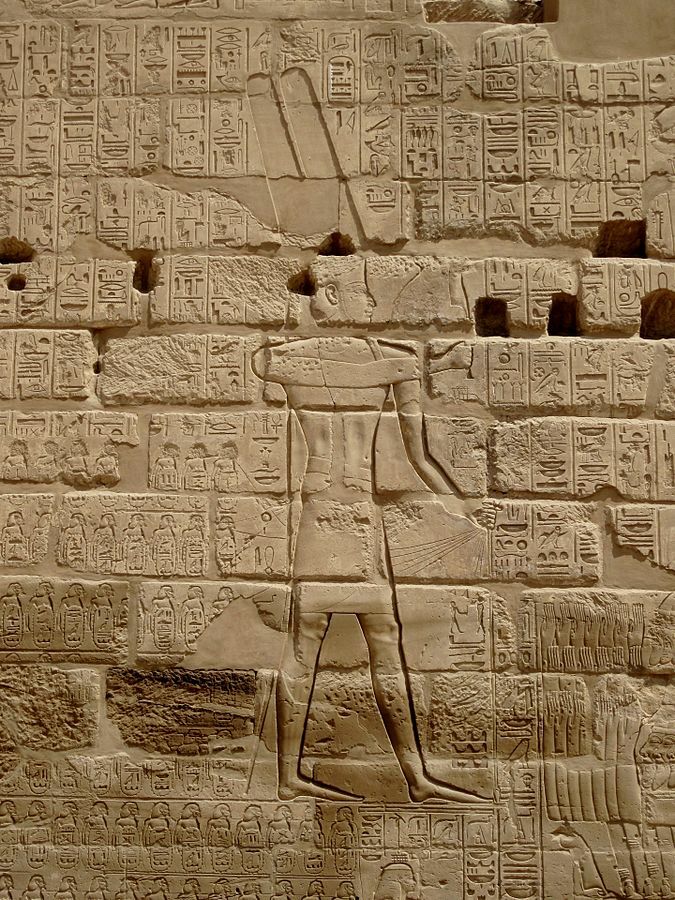
History shows that when the nation was unified and strong, the Sharon was a lucrative region, especially with Solomon’s construction of the temple requiring Phoenician goods be shipped by sea. After the nation divided, however, the inland polities lost interest in resettling and fortifying the swampy region.
“The entity that built the sites, namely the highland polity, no longer existed when Shishak visited the region and it could not therefore rebuild the sites, nor was there anyone who had an interest in sustaining the system as a whole,” write Faust and Farber.
After the nation split, maritime interest decreased and the Bible describes no successive kings that possessed a significant fleet of ships after Solomon (e.g. 1 Kings 9:27; 10:22)—besides Jehoshaphat’s and Ahaziah’s failed attempt at shipbuilding (1 Kings 22:48-49; 2 Chronicles 20:35-37). Thus, there was no incentive to reinvigorate the Sharon for the kingdom of Judah in the ninth century b.c.e.
For the northern kingdom, there was also no appeal in the region since the city of Dor, just north of the Sharon Plain, was the most convenient port access to the Mediterranean. Only for a united nation under a government headquartered in Jerusalem—as the united monarchy was—would investment in the Sharon region be expedient. Therefore, Faust and Farber explain, “only the highland polity of the 10th century could account for the region’s prosperity.”
Additionally, the Sharon is not mentioned in the Bible after the division of the nation until the time of the Prophet Isaiah in the eighth century b.c.e. (Isaiah 33:9; 35:2; 65:10). The insignificance the region was relegated to following David and Solomon is shown by both the lack of textual references in the Hebrew Bible and the archaeological record.
United Monarchy—Historical Reality
Excavations show that settlement only picked up again in the late Iron Age and hit a new high during the Persian period. Therefore, there was only a short window of time—the 10th century b.c.e.—when settlement in the Sharon peaked. As it happens, that time frame lines up with the history of David and Solomon’s great kingdom as described in the Bible. Coincidence? Judge for yourself.
As we combine the settlement history of the Sharon with the biblical narrative, the most logical explanation is the incorporation of the Sharon Plain into a strong united monarchy—a “highland polity” with its capital at Jerusalem. And when we read through those scriptures of the construction of the temple or Solomon’s navy of Tarshish, it brings to mind the words of Prof. Benjamin Mazar (emphasis added): “Pore over the Bible again and again, for it contains within it descriptions of genuine historical reality.”
