
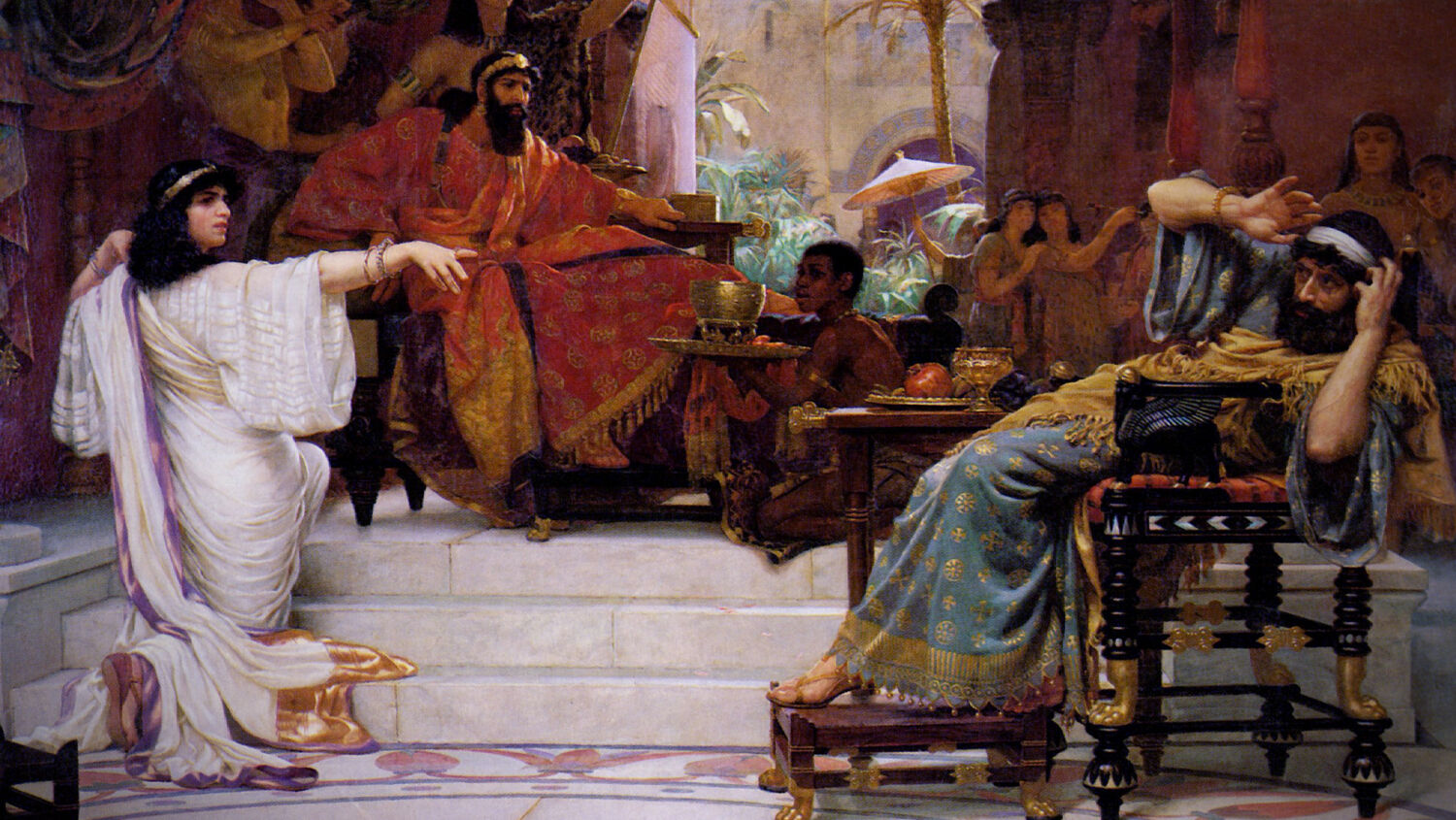
For all its unique qualities, the book of Esther provides a number of details that connect the reader to other passages in the Hebrew Bible. It points to the captivity of Jerusalem that occurred under the reign of Jeconiah at the start of the sixth century b.c.e. (Esther 2:6). It points the reader to the genealogy of Benjamin (verse 5), as well as a probable Amalekite line known as the Agagites (Esther 3:1) from where the story’s villain hails.
The book illuminates the tradition of fasting and the biblical practice of humbling oneself in sackcloth and ashes. And despite its complete omission of God’s name, it still has a thoroughly religious flavor; for example, it describes people of Persia becoming Jews, which, since biologically impossible, means a conversion in a religious sense: people adopting the practices of the Jewish religion.
There is another connection between Esther and a certain passage of Hebrew scripture—and this highlights the biblically significant number 40.
For the story’s Jewish component, the narrative introduces us first to Mordecai (Esther 2:5)—the only individual name in the Bible given the designation “the Jew.” (The Hebrew word for “Jew,” in all other places, describes a group of people or a singular, but unnamed, Jewish person.) His name was, at that point, a non-Jewish name, so his repeated designation as “Mordecai the Jew” is logical. It is important to the unfolding of events, not only that he is a Jew, but that he is known as a Jew.
We are introduced to him so we understand that “he brought up Hadassah, that is, Esther, his uncle’s daughter …” (Esther 2:7).
It’s All in the Name
There is no more perfect name than “Esther”—having a meaning in both the Persian language and Hebrew. In Persian, it meant “star,” and the Hebrew is a form of the word “hidden.” In Ezekiel 39:24, God says, “I hid My face from them.” The word “hid” is spelled the same way as Esther (אסתר).
It is critical to the story that Esther’s Jewish heritage remain hidden, but some also presume this is a nod to God Himself hiding in the details of the story—despite the fact He is not explicitly named.
The implication in Esther 2:7 is that she, though first named Hadassah, goes by Esther—a name given immediately without any explanation. No Gentile is mentioned as having given her this name. By contrast, in cases like Daniel and his three friends, “the chief of the officers gave” these Jewish boys non-Jewish names (Daniel 1:7). But the narrative persists in using Daniel’s Jewish name going forward. This happened to Joseph too, yet he is almost never referred to as “Zaphnathpaaneah.” The point is, we know how they were given those name changes and that it was done by a Gentile.
Here, we are introduced to “Hadassah” and then immediately told she’s “Esther.” The second name is given just before she enters the custody of the palace’s “keeper of the women” (Esther 2:8). But why give her original Jewish name at all? Mordecai is only known by his foreign name.
Something intriguing is hiding in the name Hadassah, which is used only once in the Bible. It is a variant of the word for “myrtle”—a tree (or perhaps larger shrub) that is unique to the Holy Land. We are to presume Esther’s parents named her after a tree that did not exist in Persia.
The word for “myrtle” (from which “Hadassah” is derived) is found in only a few places—usually in verses listing a variety of trees (either for tabernacle-making, as in Nehemiah, or in two prophecies Isaiah related to a prophesied paradise).
Where the “myrtle” features most prominently, however, is in a prophecy of Zechariah. “I saw in the night, and behold a man riding upon a red horse, and he stood among the myrtle-trees that were in the bottom; and behind him there were horses, red, sorrel, and white” (Zechariah 1:8).
Zechariah proceeds to quote the “angel that spoke with me,” whom he called “the man that stood among the myrtle-trees” (verses 9, 10). He again specifies that he was speaking with “the angel of the Lord that stood among the myrtle-trees” (verse 11).
The angel in the myrtle tree then recounts history related to Jerusalem lying waste for 70 years (verse 12). This messenger passes on a message from the Eternal, saying: “I am jealous for Jerusalem and for Zion with a great jealousy …. I return to Jerusalem with compassions …. [T]he Lord shall yet comfort Zion, and shall yet choose Jerusalem” (verses 14, 16-17).
The message this angel in the myrtle tree is passing to Zechariah revolves around the future of Jerusalem! This continues well into the next chapter. In fact, for all the visions of the first six chapters, it appears that Zechariah is talking to this angel, who is on a red horse among the myrtle trees.
Esther’s original Jewish name points us to these opening chapters of Zechariah, which contain great hope for Jerusalem and Judah. It creates a connection between this queen and this location. But there is an even more remarkable link.
Exactly 40 Years
Consider the timing of this vision: “Upon the four and twentieth day of the eleventh month, which is the month Shebat, in the second year of Darius …” (Zechariah 1:7). This would have been around February 519 b.c.e. Where does that place this vision in relation to the events in the book Esther?
As explained in our July-August 2024 issue, these events occurred during the reign of Xerxes the Great, whom is none other than the “Ahasuerus” of this biblical book. (The historicity of this is laid out in that issue.) Xerxes ruled from October 486 to August 465 b.c.e.
Esther 2:16 is clear on the exact timing when Esther enters the story and the exact month she entered the palace of King Xerxes: “the tenth month, which is the month Tebeth, in the seventh year of his reign.” The author is giving us events as related to the Jewish calendar.
There is a difference between the Persian and Jewish method of counting a monarch’s reign. Persians counted from spring to spring. So when Xerxes began reigning in October 486, that period to the spring of 485 was the “accession year,” and then spring 485 to spring 484 was year 1 of his reign.
Jews counted regnally from fall to fall. So the accession year was October 486 all the way to the fall of 485; the fall 485 to the fall of 484, then, was year 1. (This method of counting is clear in how the months and regnal years are described in Nehemiah 1-2.)
In short, year 7 of Xerxes’s reign, from a Jewish writer’s perspective, would be the fall of 479 to the fall of 478. The 10th month on the Jewish calendar would be around January 478.
But Esther 2:12 says Esther would have been in the custody of the royal court for around 12 months, meaning she entered the scene around January or February 479 b.c.e. This was exactly 40 years, perhaps to the very month, week or even day, since Zechariah’s epic vision of the angel in the myrtle tree.
Her original Jewish name, as well as this duration, makes a connection, tying her back to a series of prophecies that centered around Jerusalem itself.
Rebuilding Jerusalem
Esther most certainly would have had an impact on Xerxes’s successor, Artaxerxes. This was the king who allowed Nehemiah passage back to Jerusalem to rebuild its walls in 444 b.c.e. As explained in our July-August 2024 issue, Nehemiah 2:6 contains a likely reference to Esther as “the queen” sitting next to Artaxerxes (i.e. the queen mother; see “A Nehemiah-Esther Link” for more information). This is the same Artaxerxes who interacted with the scribe Ezra several years before Nehemiah.
Ezra 7 describes a decree Artaxerxes gave Ezra. This was in the first month of the seventh year of Artaxerxes’s reign (verses 7, 9—around the spring of 457 b.c.e.). The incredible decree, recorded in Aramaic in verses 12-26, mentions God 16 times. Four times it says He is the God of heaven. It mentions His laws five times and His house six times. Artaxerxes mentions Jerusalem six times and the altar once.
The silver and gold Ezra returned with was donated by the king and his seven counselors (verse 15). Ezra was to collect more from Babylon’s subjects, which was to be used primarily to buy animals for sacred offerings at the temple (verses 16-17).
“Whatsoever is commanded by the God of heaven [he does not say, by Ezra], let it be done exactly for the house of the God of heaven; for why should there be wrath against the realm of the king and his sons?” (verse 23). This question implies that Artaxerxes had a certain fear of what would happen to him and his dynasty if he doesn’t assist Ezra.
This king knew a great deal about the cultic operations of the Jewish religion—seeing them as requirements of a particular deity. He operated with a certain fear of not fulfilling those requirements himself.
Connections
Forty years after Zechariah’s vision, which contained hope for Jerusalem, a young Jewish girl entered a process that led to her becoming queen of the world-ruling empire of the time. After she passed from the role of queen consort to queen mother, her influence impacted the next king, who was instrumental in ensuring two of Jerusalem’s most prominent post-exilic leaders, Ezra and Nehemiah, could fulfill their God-ordained roles.
The name Hadassah, though only used once in the Bible, connects Esther to a hope-filled prophecy about Jerusalem. This reality reinforces the fact that this Jewish-born queen of Persia played a key role in the restoration of Jerusalem, including contributing to the beautifying of Jerusalem’s second temple and the wall that hedged the beloved city.
