
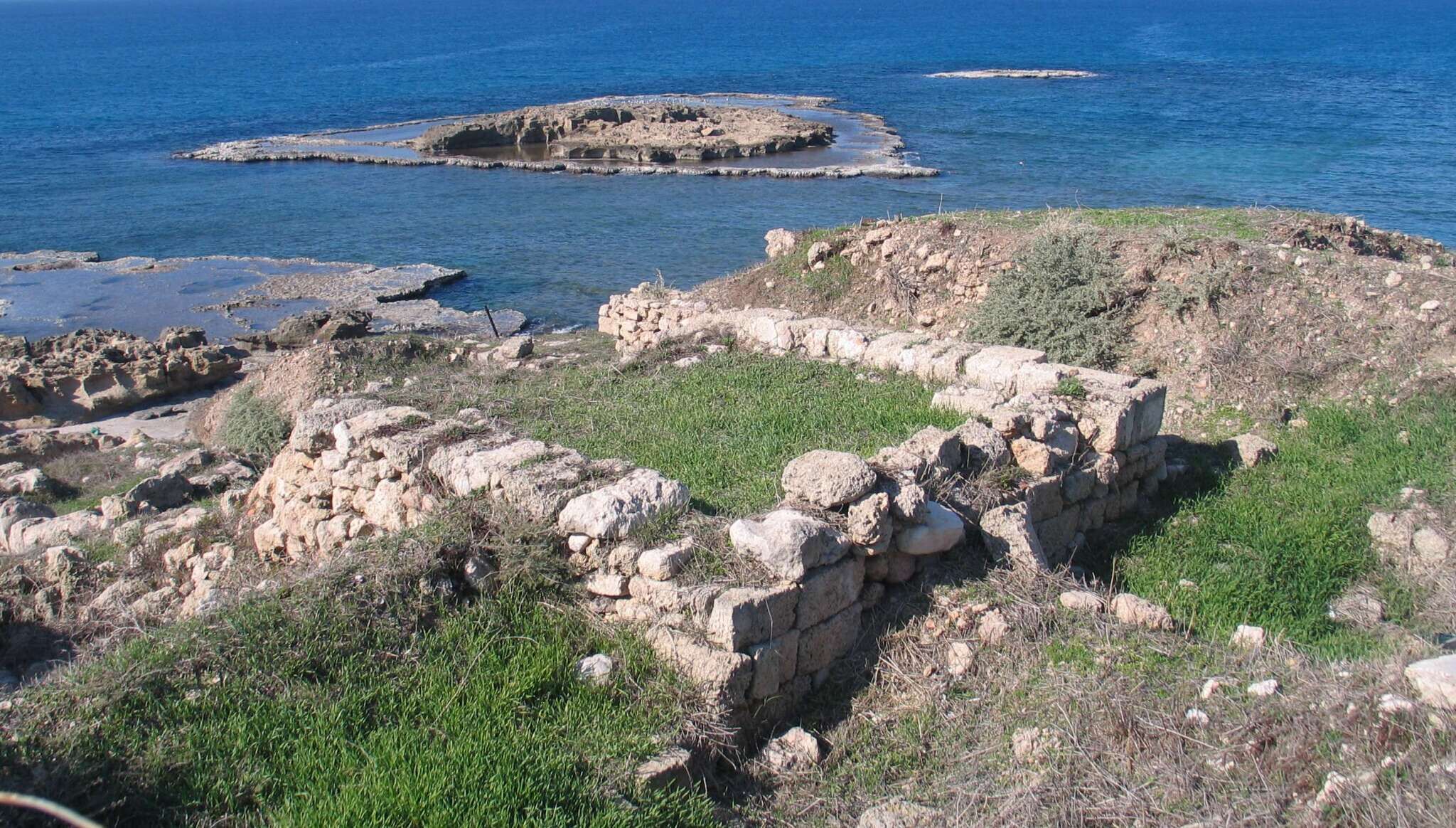
Last fall, we wrote about the discovery of three ancient shipwrecks off the coast of Tel Dor. The evidence uncovered within these wrecks have furnished us with new understanding of the metallurgical process in the Iron Age, as revealed in a recent study in npj Heritage Science.
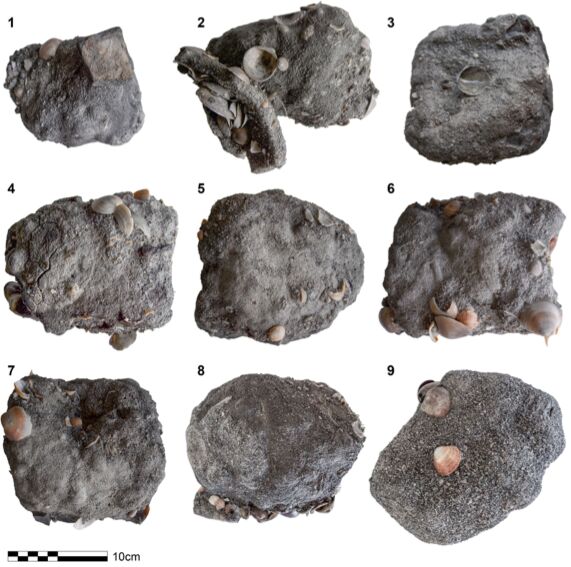
Nine iron blooms were found in Cargo L2 of the Dor shipwreck. By using an oak twig discovered in the slag of one of the blooms, researchers were able to securely carbon-date the cargo to the late seventh to early sixth century b.c.e.
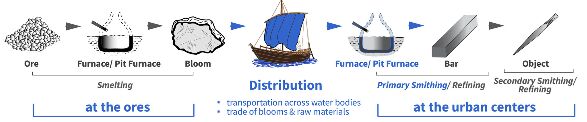
What exactly is an iron bloom and why is it important? To turn iron ore into a usable metal, it was first smelted in a furnace, which would remove some of the impurities and turn it into a bloom—a porous mass of iron. During the primary smithing process, the blooms were further refined and consolidated into a more workable and pure metal ingot or billet (semi-finished products). These ingots or billets were then forged into usable tools.
What the new research reveals is that the transportation of the iron occurred at a different stage in the process than initially thought.
In their report, “Earliest Iron Blooms Discovered Off the Carmel Coast Revise Mediterranean Trade in Raw Metal ca. 600 B.C.E.,” the researchers wrote:
It was long assumed that iron was not transported in the form of blooms, as the cooling of an unworked bloom was viewed as inefficient. Instead, it was suggested that primary smithing was typically performed by hammering the bloom while it was still hot, and that iron was usually transported and traded in the form of semi-finished or finished products, as billets.
However, the new evidence reveals the iron was turned into ingots or billets once it reached its destination.
Maintaining the slag likely played an important role in preserving the iron during transport, acting as an extra layer of protection against corrosion, which as especially important when transporting across the sea. For this reason, the iron blooms were preserved in an extraordinarily good condition for more than 2,500 years. “These findings demonstrate that shipping blooms in their as-smelted, slag-encased state was an effective and economical method of long-distance transport,” the authors wrote.
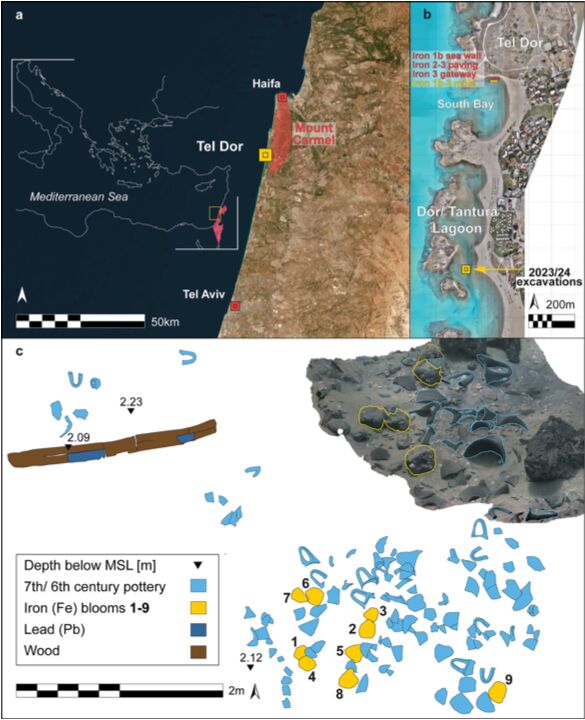
Based off the archaeology of Tel Dor, it’s obvious these iron blooms did not originate there but, rather, were being brought to Dor for the final smithing process. “Small-scale ironworking is attested at Dor in the seventh century b.c.e., evidenced by limited slag and hammer scale accumulations, precisely the waste expected from secondary smithing workshops,” the researchers wrote. “The fact that such large-scale smelting debris is absent at Dor strongly indicates that these workshops could not have produced the iron blooms.”
Ancient Dor, on the coast between Haifa and Tel Aviv, was the southernmost of the main cities inhabited by the Phoenicians in the Iron Age. Although it was the capital of one of Solomon’s districts during the 10th century b.c.e., archaeology has shown that the Phoenicians never left the city (1 Kings 4:11). Through the late Iron Age (seventh-sixth century b.c.e.), Dor came under the control of major empires—such as Assyria, Babylon and Egypt—yet was still fundamentally a Phoenician city.

The relationship of these empires with the Phoenicians stimulated an age of increased trade, urban development and population growth at Dor. At this time, the city “functioned under the authority of imperial client kings, while Phoenician actors were actively involved in its maritime commerce,” the researchers wrote. “Consequently, the iron trade represented by the Dor blooms likely occurred within Phoenician mercantile networks.” The Phoenicians had a well established maritime trade network and were well known anciently as skilled sea farers (to learn more, read “Uncovering the Bible’s Buried Civilizations: The Phoenicians”).
While Assyrian records indicate imperial control over the trade of iron in the eighth century, the researchers believe that the blooms may reveal “a parallel, possibly decentralized, system of long-distance trade operated beyond direct Neo-Assyrian control, which focused on semi-final products. … The availability of iron in the market meant that there was no significant restriction or state control on its procurement and on the production of iron objects.” This is a significantly different view from what was previously understood.
As for what this system of trade required, the researchers wrote: “This organization would have concentrated skilled labor, technical expertise, and fuel resources within specific production contexts, potentially supervised, managed, or controlled by elites or institutional authorities who regulated access to raw materials and redistribution.”
Although the finds mainly reveal part of the iron production process in the late Iron Age, the limited slag found at Dor and the state of the cargo blooms give researchers a reference point for finds at other urban centers throughout the Iron Age. “This finding resolves previous debates over the nature of ironworking debris found in Levantine cities, demonstrating that such remains may represent secondary smithing rather than primary smelting” (ibid).
As such, the new findings “provide the earliest direct archaeological evidence for sea-borne commerce in raw iron, transforming our understanding of Iron Age trade economies and metallurgical organization in the eastern Mediterranean.”
