
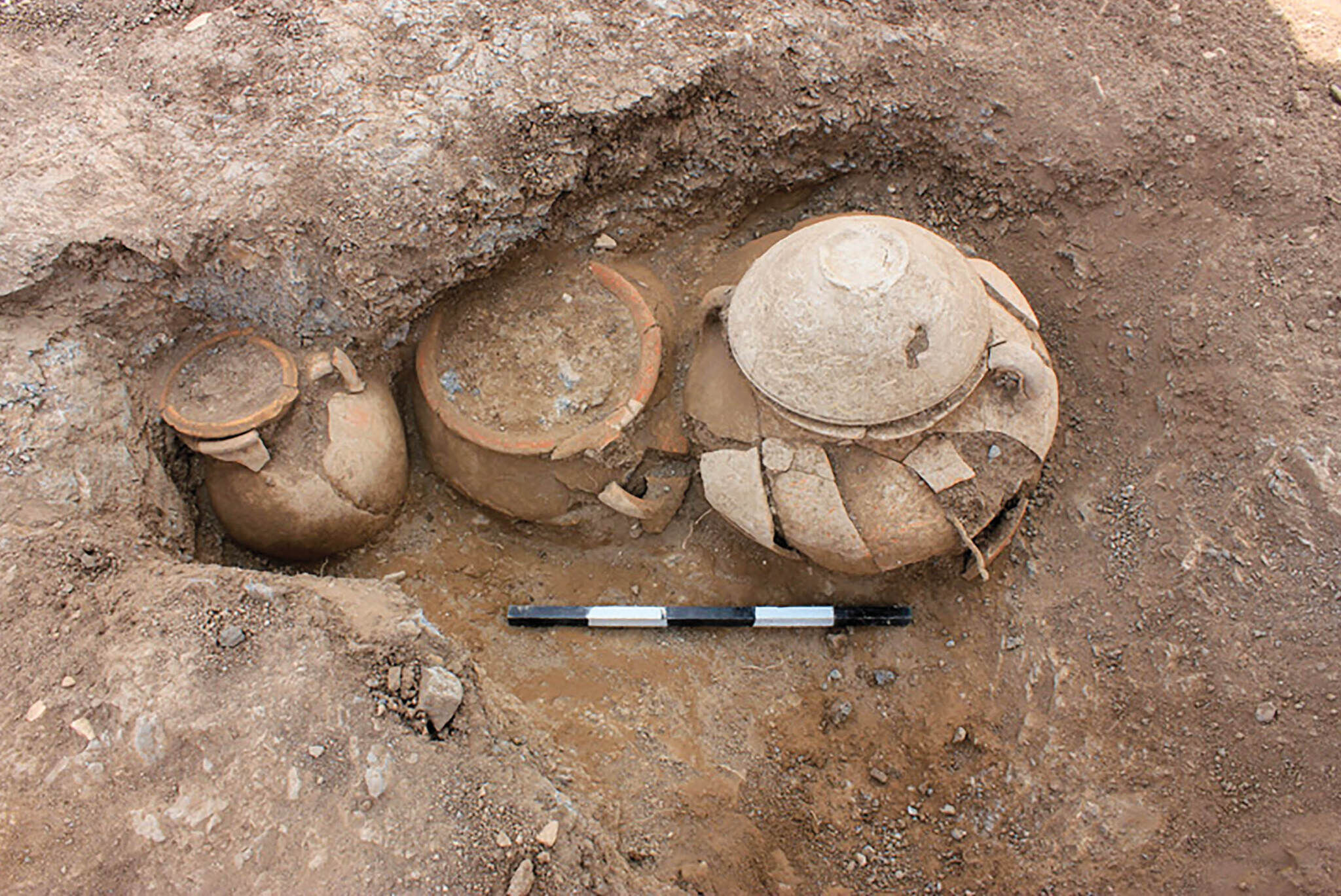
Brand new archaeological evidence has recently emerged that supports the biblical account of an Assyrian takeover of the northern territory of Israel in the late eighth century b.c.e. A recent excavation at Horvat Tevet, directed by Tel Aviv University’s Prof. Omer Sergi, uncovered an Assyrian cremation burial assemblage from the seventh century b.c.e.
Horvat Tevet is located in the Jezreel Valley—15 kilometers (9 miles) northeast of Tel Megiddo and 120 kilometers (75 miles) northeast of Jerusalem.
Horvat Tevet consists of nine occupation levels that have been systematically excavated. The top two levels are dated to the Islamic Period and the Roman-Byzantine Period. The next six levels are dated to the Iron Age, and the bottom level is dated to the Middle-Late Bronze Age.
In a recent article for Haaretz, archaeology correspondent Ariel David wrote, “[D]uring the Israelite monarchy, especially under the Omride dynasty, Tevet had been the hub of an important royal estate, which stored and distributed produce from the surrounding fields.” That all changed, however, between 721 and 718 b.c.e. when the northern kingdom was conquered by the Assyrian Empire (2 Kings 17).
“Tevet was no exception” to Assyria’s invasion, David wrote. “There are barely any signs of human habitation there during Assyrian times.” So why, then, is there an Assyrian burial at the site? “[S]omeone had deliberately brought these remains from somewhere else and staged this lavish burial” (ibid).
In the excavation report published in Journal of the Institute of Archaeology of Tel Aviv University, Omer Peleg et al. wrote: “The opulence of the burial contrasts sharply with meager findings in the site’s Iron iic occupational level” (“A Unique Assemblage of Cremation Burial From Horvat Tevet and Assyrian Imperial Rule in the Jezreel Valley”). During Assyrian occupation, Horvat Tevet was primarily an agricultural community. Due to its agricultural nature, Horvat Tevet and the surrounding area were sparsely populated.
The Assyrian cremation burial was found in occupation level three, which dates to the seventh century b.c.e. The burial “consisted of two adjacent burial pits, containing a cremation burial and an inhumation articulated burial,” or in other words, a skeleton with bones fully intact (ibid).
Within the burial, the archaeologists discovered three urns, which contained many small juglets and juglet sherds.
Four items in the assemblage are particularly important as they prove Assyrian occupation of Horvat Tevet during the seventh century b.c.e.
The first two are a glazed Assyrian bottle and an alabastrum. “The term ‘glazed Assyrian bottle’ has become commonly used for this type because of its widespread presence in Assyrian burial sites and centers of power. Parallels from the Assyrian heartland indicate that these bottles were often discovered within specific burial settings, alongside other valuable offerings vessels. … Notably, these glazed Assyrian bottles were found within both residential and public structures that correlate with Assyrian dominance over the region” (ibid).
The alabastrum, a vessel commonly used for perfumes or valuable oils, has many parallels throughout the Mediterranean coast—most of which date to the Iron iic. This is the first such example, however, to be discovered in the Levant.
The other two important items discovered are a stone weight and a Neo-Assyrian cylindrical seal. “The stone weight held particular importance, as precise weighing systems were essential for the organized flow of goods in such societies,” wrote Peleg et al. “The cylinder seal, on the other hand, was used to imprint markings on vessels, baskets, sacks and various records. … The presence of both the stone weight and the Neo-Assyrian cylinder seal … reflects, on the one hand, access to long-distance trade and, on the other hand, the Assyrian colonial network and sphere of influence.” These finds indicate that there was a strong central Assyrian government ruling over this territory.
The finds from Horvat Tevet indicate a large expanse of the Assyrian Empire. “During the Iron iic, Tel Megiddo iii served as a thriving administrative Assyrian city, which maintained strong economic ties with the eastern Mediterranean,” wrote Peleg et al. “The cremation burial at Horvat Tevet mirrors the level of complexity seen in urban centers like Tel Megiddo iii. … The high social status of the deceased points to the probable connection with the nearby Assyrian provincial center at Tel Megiddo.”
This site is located near many ancient trade outposts that were positioned to overlook the major trade routes out of Megiddo. Assyria’s expansive trade network is strong proof of their dominance in the area.
Based off the biblical text, Assyrian domination is exactly what we’d expect to find in this region. 2 Kings 17 states that, after defeating Israel, Sennacherib “brought men from Babylon, and from Cuthah, and from Avva, and from Hamath and Sepharvaim, and placed them in the cities of Samaria instead of the children of Israel; and they possessed Samaria, and dwelt in the cities thereof” (verse 24). This practice of taking conquered peoples and transplanting them into newly acquired territory has been called Assyria’s “deportation policy.” (Read “Assyrian Deportation Policy at Tel Hadid” for more information.) The archaeological evidence found at Horvat Tevet is further evidence of Assyria’s transplantation policy and dominance over these “cities of Samaria.”
