
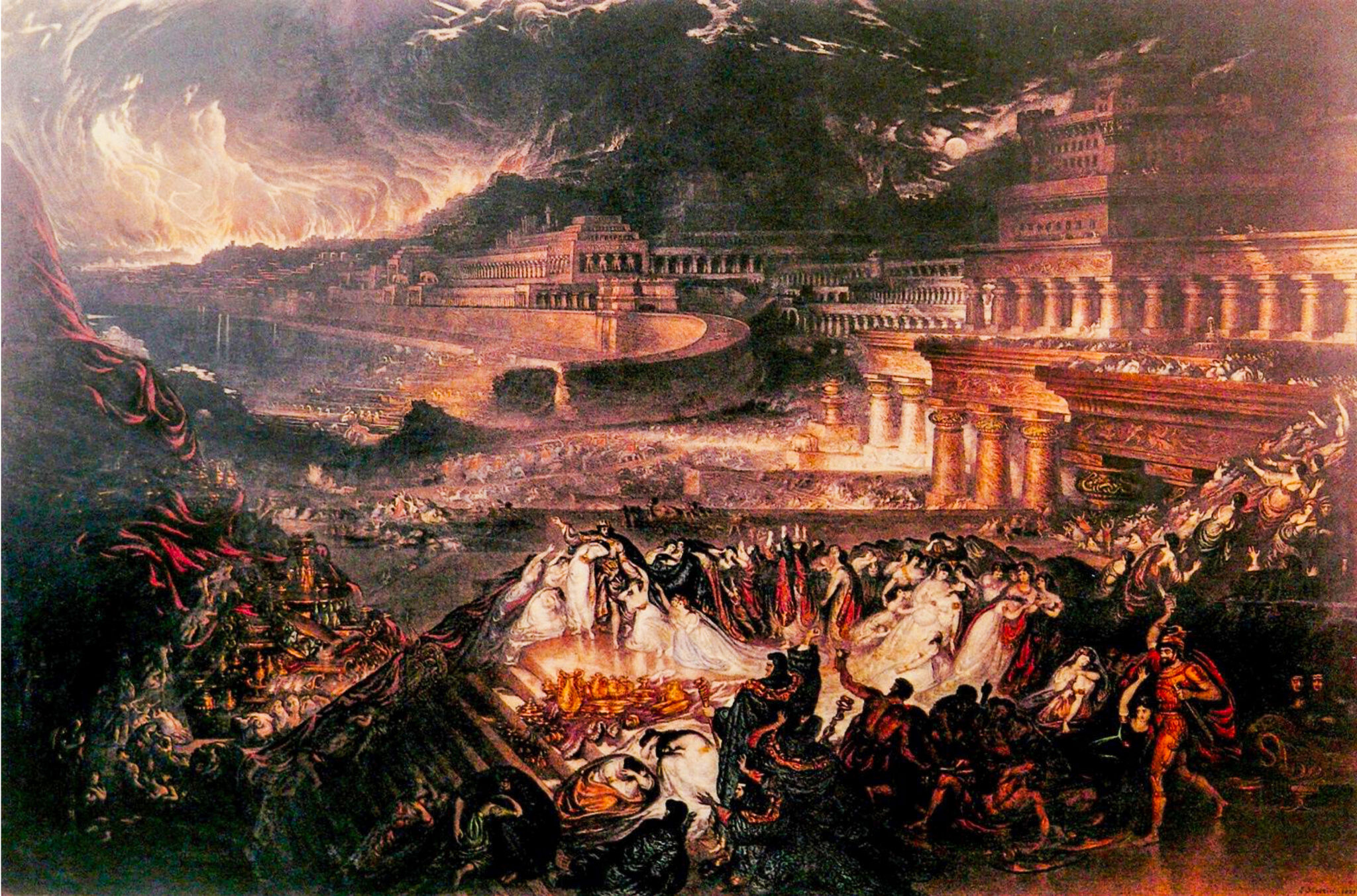
The story of Jonah is universal in Western culture and religion. Called by God to visit Nineveh and warn the city of its impending doom, Jonah attempted to flee to Spain, was swallowed by a massive fish, and after three days in its belly, was vomited onto a shore near Nineveh. Realizing that resistance was futile, Jonah delivered God’s message: “Yet forty days, and Nineveh shall be overthrown” (Jonah 3:4). Remarkably, and in one of the most unique turn of events in history, Assyria’s king and his subjects repented.
We explored the historical reality of Jonah in our article “Is the Book of Jonah ‘Entirely Ahistorical’?” from the January-February 2022 issue. In this article, we will examine the historical reality behind a lesser-known biblical book and prophet, but one connected to Nineveh.
Appearing on the scene about 100 years later, this Judean prophet was also commissioned to deliver an “oracle,” or warning, to the Assyrians, and specifically to the “mistress of sorceries”—Nineveh. Like his prophetic forebear, this man’s writings align remarkably well with extra-biblical records uncovered by archaeology.
Meet Nahum
While the book of Nahum is a literary marvel, the prophet himself is one of the most elusive in the Bible. The only biographical information we are expressly given is that he was an Elkoshite and that he wrote his short letter against the city of Nineveh (Nahum 1:1; see Sidebar 2, below).
Using historical references and context, we can know when the book was written. Nahum refers to Ashurbanipal’s sacking of Thebes (No-Amon) in Egypt (Nahum 3:8-10), which we know from other historical sources occurred around 663 b.c.e. Nahum refers to this event in the past tense, indicating his book was written sometime after. The book itself prophesies Nineveh’s destruction, which occurred in 612 b.c.e., giving a roughly 50-year window for its composition.
Nahum, therefore, was written during the reign of one of three Judean kings: Manasseh, Amon or Josiah. In Nahum 1:15, the prophet encourages Judah to “keep thy solemn feasts, perform thy vows,” a narrative that fits best with either Manasseh’s reforms after his repentance or Josiah’s reforms after his 12th year as king (e.g. 2 Chronicles 33:15-17; 34:3).
Since Nahum forecasts Judah’s deliverance from Assyrian oppression (Nahum 1:13), authorship during Manasseh’s reign (696–642 b.c.e.) seems most likely (e.g. 2 Chronicles 33:11). Assyrian power and influence had diminished substantially during the reign of King Josiah, making a reference to deliverance less pertinent (though it could still be possible). The second-century c.e. Jewish treatise Seder Olam Rabbah, or “Great Order of the World,” puts Nahum during Manasseh’s reign.
Assyria’s king at this time was Ashurbanipal (669–631 b.c.e.).
Nineveh Like Thebes
With the time frame established, let’s consider if descriptions from Nahum synchronize with ancient Assyrian records.
In Nahum 3:8-9, the prophet writes: “Art thou better than No-amon, That was situate among the rivers, That had the waters round about her; Whose rampart was the sea, and of the sea her wall? Ethiopia and Egypt were thy strength, and it was infinite; Put and Lubim were thy helpers.” The Assyrians conquered No-Amon, the ancient name for the Egyptian city of Thebes, in 663 b.c.e. during Ashurbanipal’s first campaign against Pharaoh Tanutamon.
On the Rassam Cylinder, Ashurbanipal recorded, “With the support of (the god) Aššur and the goddess Ištar, I conquered that city (Thebes) in its entirety.” The king also describes the great booty he carried back to Nineveh. Nahum’s writings show that the prophet was not only aware of Thebes’s destruction, he also knew some of the details concerning the conflict (see Sidebar 1, below).
According to Bible historian Edward D. Andrews, the account in Nahum 3:8-9 aligns with Assyrian records. The prophet’s description, he wrote, “reveals multiple layers of historical accuracy. It correctly describes Thebes’ geographical features (surrounded by water and fortified by the Nile), her foreign alliances (Cush—i.e. Nubia; Put—likely a Libyan tribe), and the subsequent devastation” (“The Capture and Exile of the Egyptian City of Thebes by the Assyrians”).
Biblical scholar Frederick Tatford wrote in his book Prophet of Assyria’s Fall: “Thebes was excellently situated; it was almost surrounded by the waters of the Nile and the river branched out into four channels at this point; an artificial lake (the ‘sea’ mentioned by Nahum), a mile long and 1,000 feet wide, with a large embankment, was a formidable barrier against any enemies.”
“The city was strongly fortified, and it was deemed impregnable,” Tatford continued. “Its strength was infinitely greater than that of Nineveh. Military alliances with the neighboring countries of Ethiopia and Libya ensured the safety of No-Amon. Yet as the Assyrians would be fully aware, the city had only comparatively recently been laid low.”
Most notably, Nahum’s description of the sacking of Thebes clearly shows his awareness of the geopolitical situation of the time, including Egypt’s alliances and the military achievements of the Assyrians. Had Nahum been composed much later, as some postulate, it’s unlikely the author would have been so apprised of regional politics.
Much like Thebes, Nineveh had an elaborate water system as part of its defenses. This included the juncture of the Tigris and Khosr rivers and a moat surrounding its walls. Nahum’s description that Nineveh was “like a pool of water” is accurate and reflects a familiarity with Nineveh (Nahum 2:9; verse 8 in other translations). Nahum implies that a failure of this defensive system is what would cause the breach of the city (verse 7; see verse 6 in other translations).
“The convergence between Assyrian inscriptions, biblical texts and archaeological findings in this case is especially notable,” wrote Andrews. “The sacking of Thebes was a major event in ancient history, and the fact that a minor Hebrew prophet could reference it accurately—both in timing and detail—speaks volumes about the credibility of the biblical record.”
This is only the beginning of the evidence attesting to Nahum’s credibility.
The Lion King
“Where is the den of the lions …?” the poetic prophet asks about Nineveh (Nahum 2:12; verse 11 in other translations). Lions were a major part of Assyrian culture, and history records the Assyrian kings were regarded as mighty lion hunters.
As it happens, Ashurbanipal was notoriously obsessed with lions. His annals record an “unprecedented number of lion hunts,” according to biblical Hebrew professor Gordon Johnston. He called Ashurbanipal “the most illustrious lion hunter in all Assyrian history and the last powerful Assyrian ‘lion’ king” (“Nahum’s Rhetorical Allusions to the Neo-Assyrian Lion Motif,” 2001).
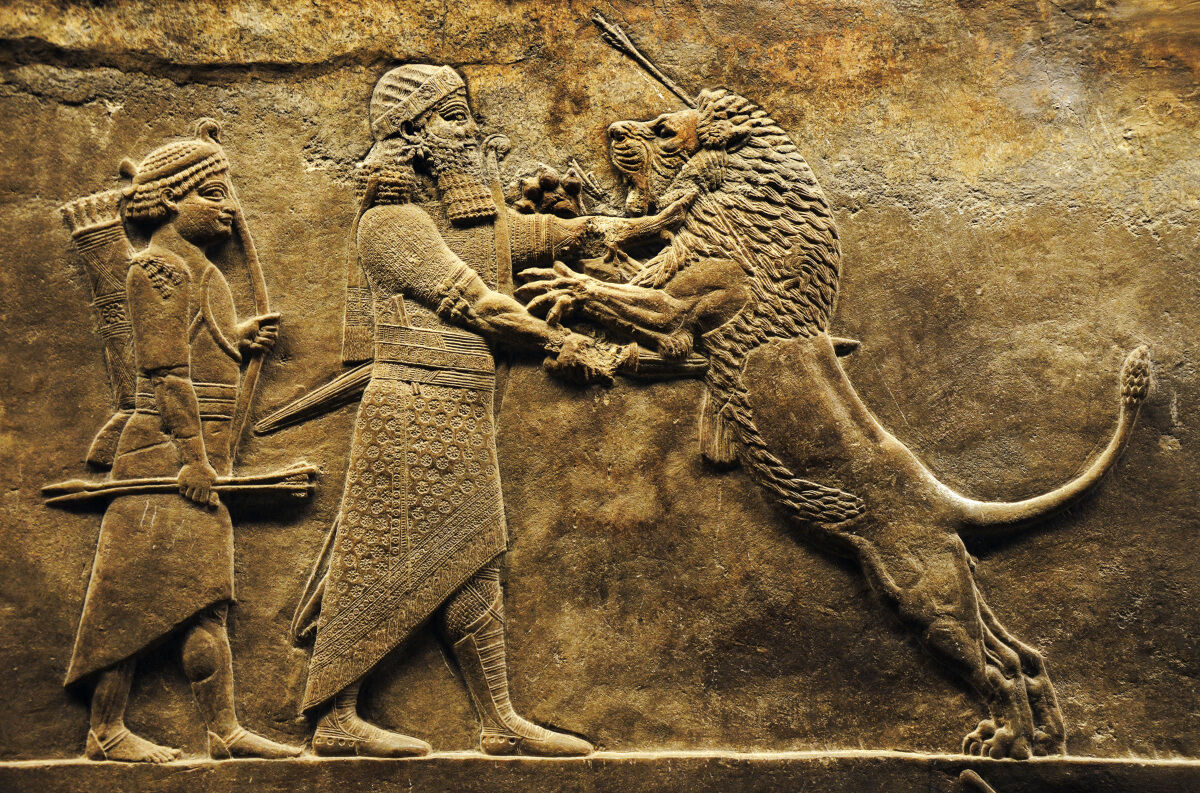
Lions were common predators in the wilderness areas around Nineveh. The king, as protector of his people, would go outside of the city to hunt them. Ashurbanipal didn’t just hunt lions outside the city, however. Wall reliefs at his northern palace show that he had lions captured and reared inside the city. He would stage lion hunts in a controlled environment, making Nineveh quite literally a “den of lions.” These staged hunts were sometimes conducted as religious rituals to receive blessings from the gods.
In one of the rooms of the northern palace, the king is illustrated in several wall scenes preparing for the hunt, shooting lions with arrows, piercing them with a spear, and stabbing them with a sword. These reliefs were intended to impress foreign emissaries and officials and fill them with respect and fear. They also functioned as propaganda for his own people, portraying the king as the divinely appointed protector of his subjects.
“Ashurbanipal was the Assyrian king who engaged in royal lion hunts more frequently than any other. He was the last known Assyrian king to sponsor a lion hunt, and he was the only Assyrian king other than Ashur-nasirpal ii (883–859 [b.c.e.]) to depict royal lion hunts in his palace wall reliefs. Therefore, it seems more than coincidental that Nahum would use lion motifs that parallel the unique proclivities of Ashurbanipal,” Johnston wrote (emphasis added throughout).
Ashurbanipal attributed his fearless ferocity and courage in battle and hunting lions to his gods, Ashur and Ishtar. In a May 2025 press release, archaeologists revealed a recently uncovered wall carving at his northern palace that shows the king standing between Ashur and Ishtar. This new discovery can be linked to the text on one of Ashurbanipal’s cylinders, where the king says: “Among men, kings, and among the beasts, lions were powerless before my bow. I know the art of waging battle and combat. … A valiant hero, beloved of Assur and Ishtar, of royal lineage, am I.”
Since the kings attributed their power to their gods—including in these lion hunts—the prophet’s language somewhat followed the principle in Exodus 12:12, but against all the gods of Assyria.
Assyrian records show soldiers of the empire being compared to lions. We also see this in the biblical text. The Prophet Isaiah witnessed the Assyrian conquest of the northern 10 tribes of Israel in the late eighth century b.c.e. and described Assyria’s military: “Their roaring shall be like a lion, They shall roar like young lions, yea, they shall roar, And lay hold of the prey, and carry it away safe, And there shall be none to deliver” (Isaiah 5:29). Nahum uses similar language, calling the Assyrian soldiers “young lions” (Nahum 2:12, 14).
“They would indeed be like lions,” Johnston writes, “not on the prowl but as prey in a lion hunt!” (op cit).
Nahum 2:12 concludes: “Where the lion and the lioness walked, and the lion’s whelp, And none made them afraid?” Such a scene is illustrated on a wall relief in the capital. The unusually peaceful relief shows a lion and lioness quietly resting in one of the beautiful gardens of Nineveh. Perhaps Nahum had exactly this scene in mind when he wrote these condemning words.
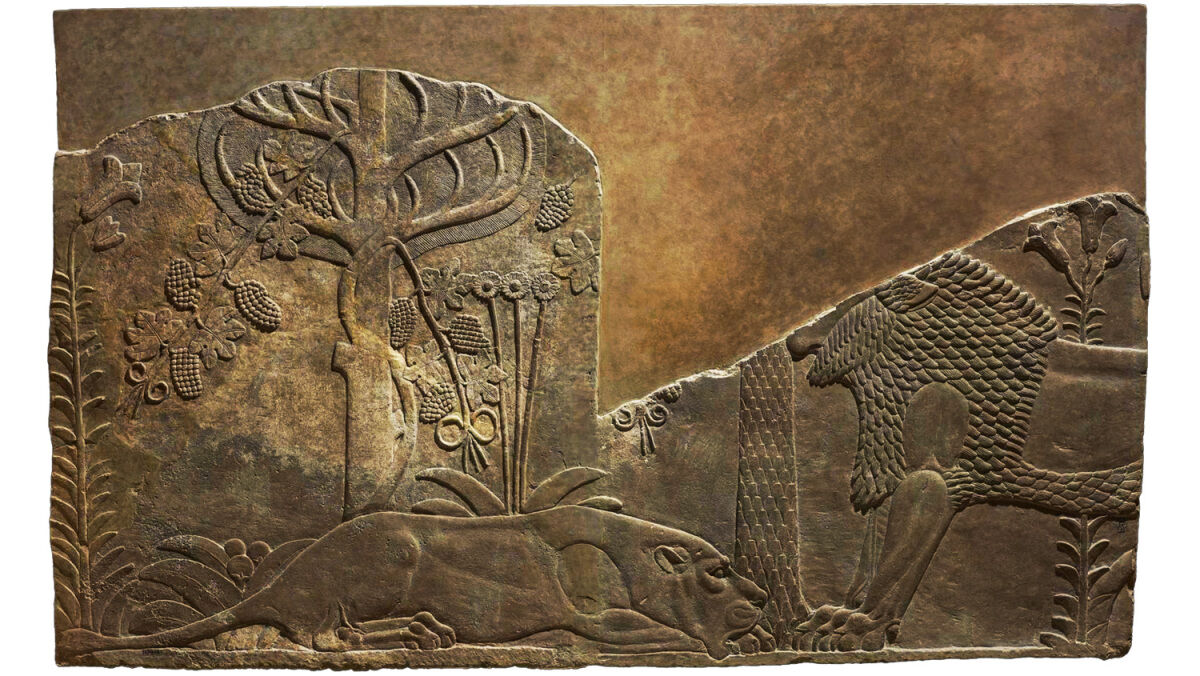
Although lion imagery was not uncommon in the general Near East, Johnston writes that “Nahum’s use of these lion motifs is probably not merely common stereotypical Semitic imagery but specific rhetorical allusions to the use of the lion motif in Neo-Assyrian literature and art, particularly its use by the last powerful Neo-Assyrian king, Ashurbanipal ….”
In his article “Nahum, Nineveh and Those Nasty Assyrians,” archaeologist and biblical scholar Gordon Franz wrote that these allusions show “Nahum was keenly aware of the culture that he was writing to and was able to effectively use it to convey a powerful message from the Lord” (Bible and Spade, Fall 2003).
Lions or Locusts?
Lions were not the only animals used by Nahum to describe the Assyrians. “Thy crowned are as the locusts, And thy marshals as the swarms of grasshoppers, Which camp in the walls in the cold day, But when the sun ariseth they flee away, And their place is not known where they are” (Nahum 3:17).
This scene, too, has a parallel on one of the reliefs from Ashurbanipal’s palace. After having put down the Elamite rebellion at the battle of Til Tuba and capturing their king (circa 653 b.c.e.), Ashurbanipal is depicted resting on a couch with his queen in his royal garden. On the left of the relief, the head of Elamite King Teumman is hanging on a tree—a gruesome reminder of Assyrian cruelty and powerful propaganda. Near the severed head is the depiction of a grasshopper about to be devoured by a bird. Inscriptions from Ashurbanipal speak of the rebellious Elamites as a “dense swarm of grasshoppers.” Ashurbanipal used the bird to symbolize the Assyrians. Yet in Nahum’s prophecy, the Assyrians are the locusts.
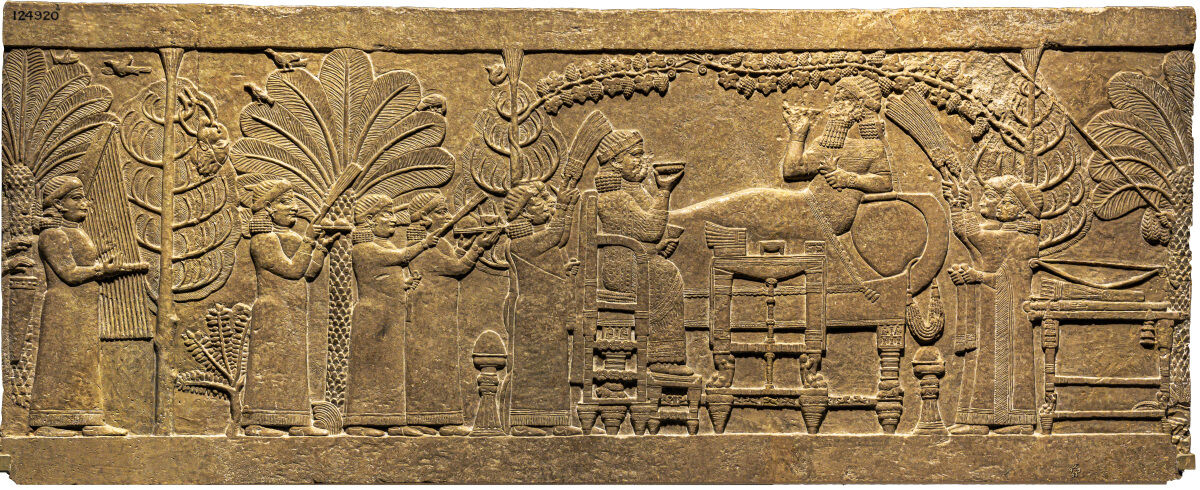
This language is also common in Assyrian conquest metaphors. “Just as Assyrian kings compared their massive armies to a swarm of locusts, Nahum depicted the numerous Assyrian troops and their allies to a swarm of locusts,” Johnston writes. “However, Nahum reversed the imagery in an ironic manner. First, the Assyrian troops would flee in battle just as a swarm of locusts takes to flight at the dawn. Second, Assyria’s numerous allies would turn on her in her moment of weakness, plundering the wealth of Assyria like a swarm of devouring locusts.”
Nahum utilized what Franz terms as a “reversal of fortune.” Instead of hunting the lions, the Ninevite soldiers are now the lions being hunted, and instead of their enemies being locusts, they are the locusts forced to flee.
Cruelty
The same scene highlights another facet of Nineveh’s society that Nahum targeted—its cruelty. “Woe to the bloody city!” he wrote (Nahum 3:1). Assyrian cruelty is well attested throughout the centuries, and Ashurbanipal was one of Assyria’s most violent kings.
According to Ariel Bagg of the University of Heidelberg, “brutality scenes” are depicted on 19 of the 54 Ashurbanipal scenes (“Where Is the Public? A New Look at the Brutality Scenes in Neo-Assyrian Royal Inscriptions and Art,” 2016). The reliefs show Assyrian soldiers throwing bodies into the river, taking inventory of casualties by counting severed heads, flaying skin, grinding bones, pulling tongues out and rape.
Nahum also records Assyria’s brutality. In one passage, the prophet reverses the Assyrian custom of raping their captive women. He writes, “Behold, I am against thee, saith the Lord of hosts, And I will uncover thy skirts upon thy face, And I will shew the nations thy nakedness, And the kingdoms thy shame” (verse 5). The Balawat Gates of King Shalmaneser iii (858–824 b.c.e.) bear several depictions of captive women with their skirts lifted and positioned next to naked Assyrian warriors in a scene we’d rather not have stuck in our minds.
Then, in verse 10, Nahum describes more of the cruelty done to the Thebans: “Yet was she carried away, She went into captivity; Her young children also were dashed in pieces At the head of all the streets … And all her great men were bound in chains.“ One of the wall reliefs, titled “An Egyptian Fortress” at the British Museum, possibly displays the Thebes’ capture. The relief shows Ethiopian captives being led away from the city with chains around their ankles; three children are depicted on the relief. Nahum describes the terrible fate that likely awaited these children.
“Were the Assyrians as brutal as they presented themselves in the written and iconographical sources?” Bagg asks. “The answer is no, they were more brutal, because we do not know all the details, and the reality must have surpassed by far the descriptions in words or the depictions.”
The evidence so far makes clear that Nahum’s familiarity with the Ninevite palace depictions and the Assyrians themselves informed his writings.
Corpses, Flooding, Figs and Much More
A lot of what we know about the fall of Nineveh comes from the Babylonian work the Fall of Nineveh Chronicle. According to C. J. Gadd, an early 20th-century British Museum Assyriologist, this document is “our earliest and best authority for the events” around the fall of Assyria’s capital.
Nineveh was a massive city at the time of its fall. Multiple chariots would have been able to ride beside one another on its 15-meter-thick (50 feet) walls, aligning with Nahum’s statement that “[t]he chariots rush madly in the streets, They jostle one against another in the broad places …” (Nahum 2:5; verse 4 in other translations).
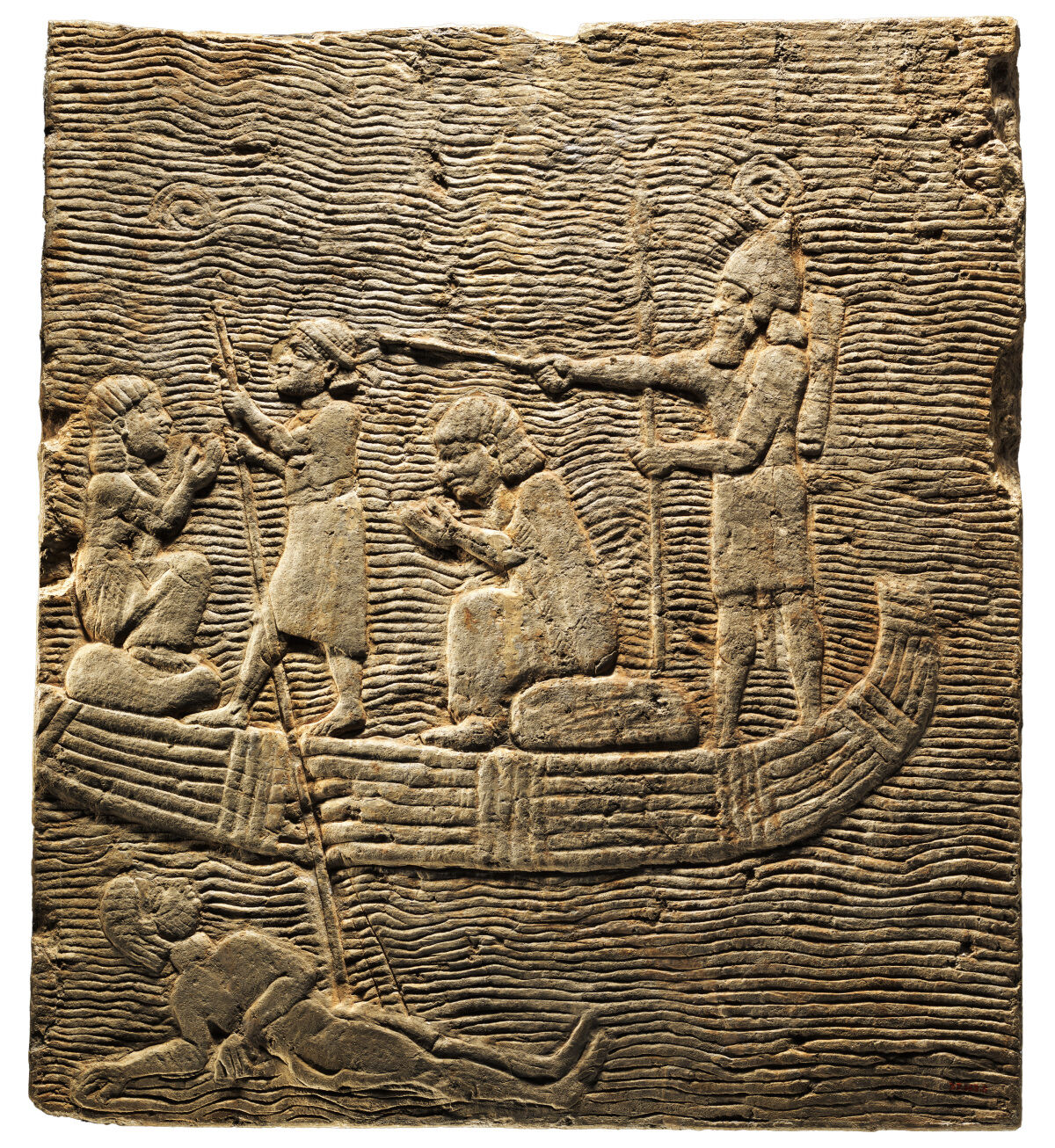
The prophet recorded that Nineveh’s fall was as bloody as its own conquests. Nahum 3:3 says there would be “a multitude of slain, and a heap of carcases; And there is no end of the corpses, and they stumble upon their corpses.” As a testament to Nineveh’s violent and murderous fall, over 16 skeletal remains, potentially the defenders of the city, were discovered under the Halzi Gate.
Returning to the comparison with Thebes and the city being a “pool of water,” it is debated whether the prophet’s reference to a flood (Nahum 1:8) should be taken literally or as a figure of speech. Various scholars have suggested that the writings of the Greek historian Diodorus Siculus (90–30 b.c.e.) contain historical references to the fall of Nineveh. He wrote that the swelling river “flooded part of the city, and cast down the wall to a length of 20 stades.”
There are some facts Diodorus gets wrong, however. He wrote that the siege lasted three years instead of three months, mistook the river Tigris for the Euphrates, and gave a different name (Sardanapalus) for the Assyrian king during the fall. These errors cast doubt on his accuracy as a historical source.
Regardless of whether the flood language was literal or figurative, the imagery still fits within the Assyrian context of the time. At the time, Ashurbanipal wrote that he “completely conquered that city [Thebes], and smashed it like a flood” (“Nahum’s Rhetorical Allusions to Neo-Assyrian Conquest Metaphors,” 2002.) Similar language was used by other Assyrian kings.
Alongside flooding, Nahum uses another simile to predict Nineveh’s fall, one that would also have made sense to Assyrians at the time: “All thy fortresses shall be like fig-trees with the first-ripe figs: If they be shaken, they fall into the mouth of the eater” (Nahum 3:12). Figs were prevalent in both Judah and Nineveh, as shown on the Lachish reliefs and the Assyrian Mashki Gate. As such, both Jews and Assyrians would have known that when a fig tree is shaken the ripe figs easily fall off, symbolizing the swift and almost effortless destruction of the mighty city. The Fall of Nineveh Chronicle says that the city fell after a brief but “heavy” three-month siege.
What about the riches of Nineveh? Bible students might recall that a century earlier, King Sennacherib had collected a large tribute from Judah’s King Hezekiah (2 Kings 18:14-16). Add that to the wealth brought in from the sacking of Thebes, and no doubt Nineveh was a trove of treasures for a conquering army. Nahum, aware of the riches of that city, wrote to the invaders, “Take ye the spoil of silver, take the spoil of gold; For there is no end of the store, Rich with all precious vessels” (Nahum 2:10; verse 9 in other translations).
According to the Fall of Nineveh Chronicle, that is exactly what happened. The Babylonian and Median armies “carried off the vast booty of the city and the temple and turned the city into a ruin heap.”
Several literary parallels can be made to the threatening imagery in the Assyrian vassal treaties and conquest annals of Esarhaddon (680–669 b.c.e.) and Ashurbanipal (669–631 b.c.e.). Esarhaddon, in particular, made treaties with King Manasseh containing similar language to Nahum, leading Johnston to believe that these were purposeful rhetorical allusions—not mere coincidence. They include breaking the yoke of vassalage (Nahum 1:13), darkness (verse 8), destruction of seed and name (verse 14), punishment of prostitutes (Nahum 3:5-7), calling enemy warriors women (verse 13), delivering an incurable wound (verse 19) and others. Those can be added to the aforementioned conquest metaphors, such as lions, locusts and floods.
While some of the imagery is also used in other Near Eastern writings, it was most prominent in the Assyrian records, particularly of Ashurbanipal and Esarhaddon. Scholar Bob Becking from the University of Utrecht also points to several Assyrian loanwords that Nahum substituted for Hebrew, placing the prophet in an Assyrian context.
The Only Logical Conclusion
Some scholars claim that Nahum was written long after Nineveh’s fall, perhaps in the Herodian Period (first century b.c.e.)—the period the earliest Dead Sea Scroll segments of the book were dated to. There is one big problem with this claim.
Unger’s Bible Dictionary says: “In 612 b.c. the ancient capital of the Assyrian Empire was so completely obliterated that it became like a myth until its discovery by Sir Austen Layard and others in the 19th century.” Very little was known about Nineveh and Assyrian society. Had Nahum not been present in the seventh century b.c.e., the prophet would never have been able to write such a fantastic literary marvel filled with loanwords, metaphorical allusions and historical events.
And so the weight of evidence piles up in favor of the Bible’s historical credibility. Knowledge of historical geopolitical events, Assyrian royal culture and even language mirroring Assyrian documents put Nahum’s composition in the last decades of Assyria’s domination.
Skeptics would like to believe that the Bible was composed much later than the events it describes. However, it’s undeniable that the archaeological record clearly shows that the prophet’s writings are historically accurate and reveal an awareness of the society he was writing to.
Was Nahum written in the Assyrian period? The weight of evidence answers, somewhat emphatically, yes!
Sidebar 1: Manasseh at Thebes
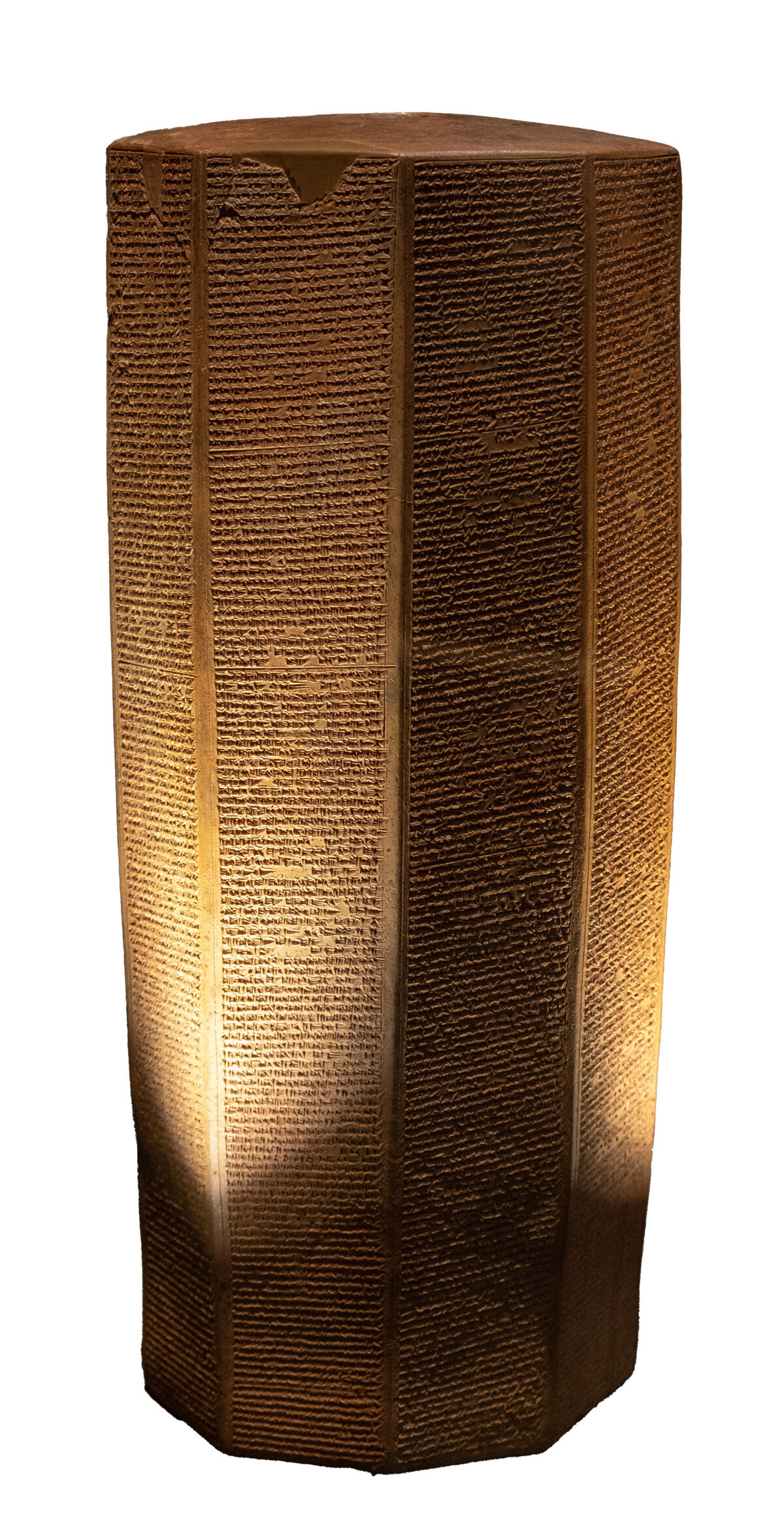
Archaeological evidence reveals that one of the kings who joined Ashurbanipal on his campaign against the Egyptians in 663 b.c.e. was none other than King Manasseh of Judah.
The Rassam Cylinder, found at the northern palace at Nineveh, lists Manasseh as one of the 22 kings who sent troops to support Ashurbanipal’s campaign against Pharaoh Tanutamon. “During my march (to Egypt) 22 kings from the seashore, the islands and the mainland, Ba’al, king of Tyre, Manasseh (Mi-in-si-e), king of Judah (Ia-ti-di) … servants who belong to me, brought heavy gifts (tdmartu) to me and kissed my feet. I made these kings accompany my army over the land—as well as (over) the sea-route with their armed forces and their ships,” the cylinder records. Manasseh, therefore, helped the Assyrians conquer Thebes, the city of the god Amon. Interestingly, Manasseh’s son, Amon, was 22 when he began to reign (circa 640 b.c.e.; 2 Kings 21:19). This means he was conceived or born around the time his father supported Ashurbanipal against No-Amon, or Thebes. Biblical scholar Gordon Franz believes the idolatrous Manasseh named his son after this city and its god (“Nahum, Nineveh and Those Nasty Assyrians,” Bible and Spade, Fall 2003).
A more interesting question is: If Manasseh went to Thebes, could Nahum himself have been among the Jewish men who accompanied him? Nahum’s writings do read like an eyewitness account. He certainly could have based his writing on accounts from other records or witnesses. And what’s more powerful than describing events your audience would be familiar with and that you witnessed yourself?
Is it far-fetched to think Nahum was among the Jews Manasseh took with him on his campaign with Ashurbanipal against Egypt? Perhaps Nahum was being trained at the Assyrian royal court (see Sidebar 2, below).
Sidebar 2: Nahum’s Nativity
Biblical scholars marvel at how familiar the Prophet Nahum was with the customs, art and even the literature of the Assyrian Empire. He understood Assyria so well he incorporated Assyrian lingo and culture into his prophecy against it. This observation has raised the question of Nahum’s origins. Several suggestions have been furnished.
Nahum 1:1 says the prophet came from Elkosh. The exact location of this city is debated. The most common suggestions are either in Al-Qush, north of Nineveh, where the so-called Tomb of Nahum is located, or someplace in the southern kingdom of Judah. A few have also proposed Capernaum at the Sea of Galilee due to its name meaning “Village of Nahum.”
Researcher Bob Becking from the University of Utrecht believes, based on historical examples, that Nahum might have been raised as a young, elite Jewish hostage at the Assyrian court in Nineveh who was sent back to Judah to serve the empire’s interests (“Who Was Nahum? A Wild but Informed Guess,” 2025).
Could it be that Nahum, as a young Jewish servant trained in Assyria, walked through the halls of Ashurbanipal’s palace and throughout Nineveh and later based his writings on what he saw? Wall reliefs were one of the main means of Assyrian propaganda against foreign emissaries and officials who entered the royal court. Perhaps these foreigners included Nahum, who powerfully and fearlessly reversed this propaganda on the Assyrians’ heads, utilizing facets of their own language and culture. While we can only speculate, it is an intriguing possibility.
