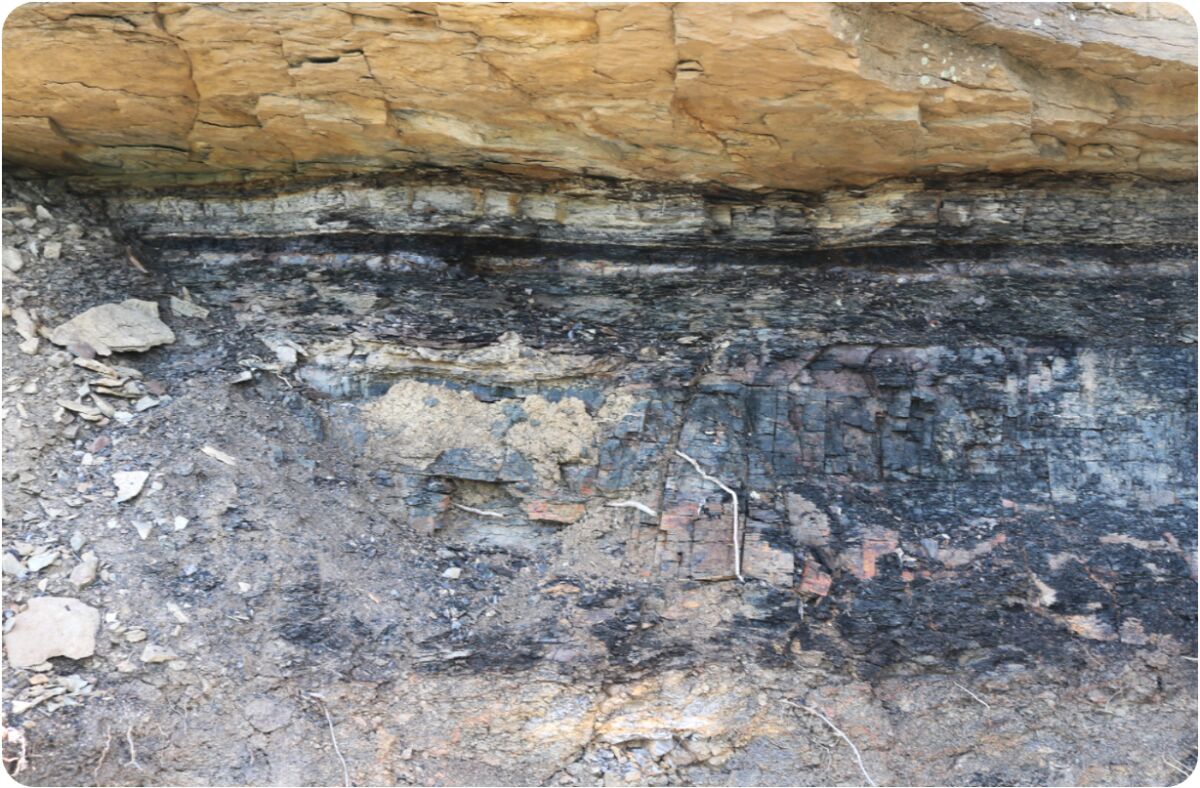
Of all the remarkable discoveries in the world of biblical archaeology—the Tel Dan Stele, King Hezekiah’s seal impression, the Siloam Tunnel and Lachish Reliefs—the below picture represents one of my favorites. Most people probably wouldn’t consider it relevant to “biblical archaeology.” It seems more relevant to the fields of paleontology or geology. But I believe it has a direct connection to the biblical account—although just how is a matter of significant controversy.
On the face of it, this band of material sandwiched between layers of rock doesn’t seem that impressive. What is it exactly? Scientifically, this is known as the Cretaceous-Paleogene (K-Pg) Boundary. It is prominently exposed and visible at various sites around the planet. This layer contains high quantities of iridium (77Ir)—one of the rarest elements in Earth’s crust, but abundant in meteorites, and found in high percentages around impact craters.
In simple terms, the K-Pg Boundary is the visual dividing line between man and the dinosaurs. It is the destruction layer separating the Age of Reptiles from the Age of Mammals—the Mesozoic Era from the era in which we find ourselves today, the Cenozoic (“New Life”).
I am what you might refer to as an “old-Earth creationist.” For many believers, that term comes with some baggage—conjuring up varying ideas of evolution; manipulation of internal biblical data to fit external, nonbiblical data; or passing off the early passages of Genesis as merely symbolic. Certainly, there are old-Earth creationists who do hold to theistic evolutionary models. I am not one. Nor am I a proponent of the “day-age” theory, that reinterprets the “days of creation” as each representing nondescript, immense lengths of time; nor do I consider the early passages of Genesis to represent mere symbolism.
Instead, I am a proponent of “gap creation,” also referred to as the “gap theory,” “ruin-restoration theory” or “gap creationism.”
What is gap creation exactly? Put simply, this considers “creation week” recorded in Genesis 1 as a re-creation. Gap creation refers to the re-creation of a world already brought to existence at some nondescript time in deep antiquity (per Genesis 1:1); one that sometime later fell to ruin (per Genesis 1:2) and was eventually restored (per Genesis 1:3 onward).
Many readers will likely be somewhat familiar with gap creation, due to the significant growth in popularity it enjoyed throughout the 19th and early 20th centuries. It was popularized by the Scofield Reference Bible and promulgated by many high-profile theologians and educators (among them our own namesake, Herbert W. Armstrong).
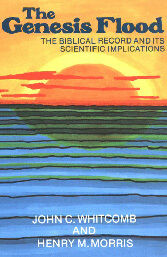
Yet starting in the second half of the 20th century, there has been a growing pushback against gap creation. One of the catalysts for this was the 1961 publication of The Genesis Flood, by young-Earth creationists John Whitcomb and Henry Morris. This work is considered to be “largely responsible for the revival of Flood geology and young-Earth creationism” (Tom McIver, “Formless and Void: Gap Theory Creationism”). Still, it is a work whose main arguments have been significantly revised or abandoned by many young-Earth proponents in the decades since publication (as outlined, for example, in former proponent Prof. Kenneth Keathley’s 2013 article “The Confessions of a Disappointed Young-Earther”).
Criticism towards gap creation even comes from other old-Earth creationists, including one of the most prominent modern Christian philosophers, Dr. William Lane Craig—an old-Earth theistic evolutionist who caricatures “the classic gap theory” as portraying “a kind of botched creation between Genesis 1:1 and Genesis 1:2 …. This is a desperate attempt to explain away the fossil evidence for the antiquity of the world” (“Is Genesis Gap Theory Correct?”). Critiques of gap creation commonly allege that the view is held only because of external, modern science-driven conclusions, in spite of an otherwise-clear reading of the biblical text.
This is decidedly not the case. As we shall see, the biblical text alone leads one to conclude an old Earth, gap creation. While proponents naturally point to scientific discoveries in substantiation (who wouldn’t consider external evidence that supports the biblical text?), the fact of the matter is that the “gap theory” emerged long before the more modern scientific conclusions about Earth’s prehistory.
This article presents an overview of gap creation and addresses some of the more common objections.
“In the beginning God created the heaven and the earth.” So begins the first verse—and surely one of the most beautifully simple—of the Bible. Creation is recorded here without any timestamp or qualification as occurring at some time in deep antiquity and obviously prior to the proceeding creation week verses that follow.
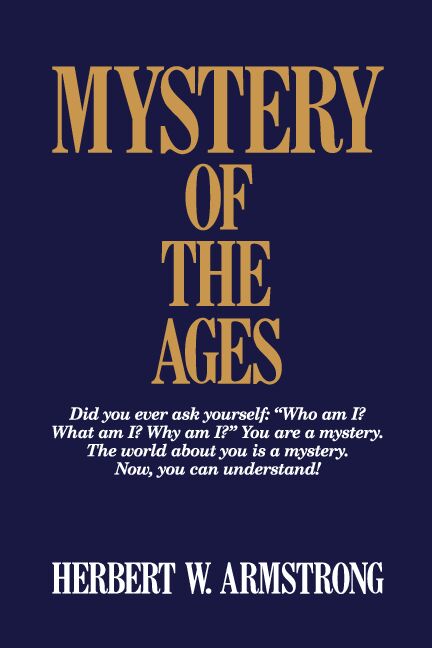
Actually, the very first word—בראשית (typically translated as “in the beginning”)—contains something very interesting: There is no definite article, “the.” It reads, “In a beginning”—further implying a disconnected, indefinite point in time, deep within the past. “It might have been millions—or even billions—of years [ago],” wrote Herbert Armstrong (Mystery of the Ages, 1985)—we are simply not told, nor is it important for us to know at this juncture.
Genesis 1:2a: ‘Tohu and Bohu’
“And the earth was without form, and void; and darkness was upon the face of the deep.” This verse is the key passage for gap creationists. The words “without form and void” are tohu and bohu in Hebrew (תהו ובהו)—a phrase translated variously as “waste and empty” (American Standard Version), “desolation and emptiness” (Smith’s Literal Translation), “chaos and empty” (Peshitta).
The joint use of these terms is found in two other places. One is Isaiah 34:11, in a passage describing God’s vengeance against the nations: “… For God will measure that land carefully; he will measure it for chaos [tohu] and destruction [bohu]” (New Living Translation). The other passage is found in Jeremiah 4, comparing Jerusalem’s prophesied destruction to Genesis 1:2: “… Behold—publish concerning Jerusalem … I beheld the earth, And, lo, it was waste [tohu] and void [bohu] …” (verses 16, 23). These wartime passages reflect a picture of destruction and ruin coming upon a former state of peace and population. If we infer the same for Genesis 1:2, then tohu and bohu are inflicted upon the initial state of creation described in Genesis 1:1.
By contrast, the standard young-Earth explanation of Genesis 1:2 is that it represents the as-yet unformed state of earth, as created by God. This view implies God created Earth in a state of tohu. Yet this belief clearly contradicts Isaiah 45:18, which says, “For thus saith the Lord that created the heavens, He is God; That formed the earth and made it, He established it, He created itnota waste [tohu, other translations, “in vain”] …” (Isaiah 45:18). Here we have the explicit statement that God created the Earth “nottohu.”
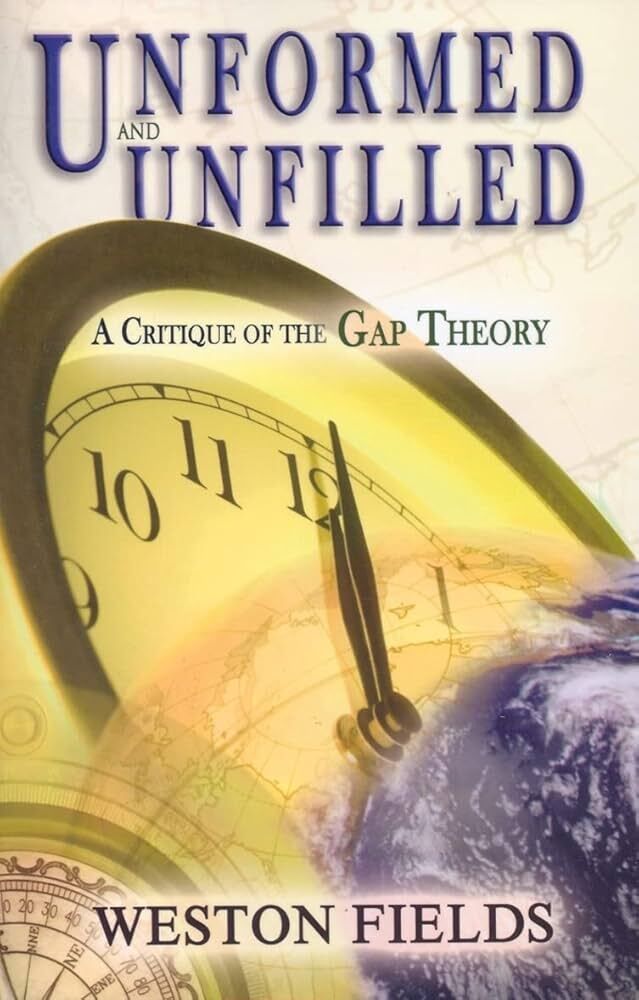
Some young-Earth proponents argue that Isaiah 45:18 should be translated “not to betohu,” in order to reconcile the passage with Genesis 1:2. Yet there is no “to be” in the Hebrew of Isaiah 45:18. Simply, לא תהו בראה (using the same verb for “create” found in Genesis 1:1)—He created it not tohu. Young-Earth proponent Weston Fields wrestled with this question in his book Unformed and Unfulfilled: A Critique of the Gap Theory (1976), submitting instead that it “cannot be assumed a priori that tohu as used in Genesis 1:2 has the same meaning when used in Isaiah 45:18.”
The young-Earth view holds God to have created the tohu of Genesis 1:2. Yet Isaiah 45:18 says plainly that God “created not tohu.” And passages like Isaiah 34:11 and Jeremiah 4:23 describe such a state in the context of war.
“The original Hebrew words which Moses wrote, translated ‘waste and empty,’ are ‘tohu’ and ‘bohu,’ otherwise translated ‘chaotic and in confusion,’” wrote Herbert Armstrong in a March 1968 Plain Truth personal. “In the beginning God created the heaven and the Earth. It was perfect. The angels shouted for joy (Job 38:1-7). God is not the author of confusion ….” Yet in Genesis 1:2, we have a confused and chaotic, tohu Earth.
What happened?
‘Fallen From Heaven’
The explanation for this is theological. What is described in Genesis 1:2 is recognized by gap creationists as representative of a “fall,” not of man, but of angels, in an event sometimes called the “angelic rebellion.” This rebellion, which caused Earth to fall into a state of tohu and bohu, is recorded in both the Hebrew Bible and New Testament.
Isaiah 14:12-15 say, “How art thou fallen from heaven, O Lucifer, son of the morning! … [T]hou hast said in thine heart, I will ascend into heaven, I will exalt my throne above the stars of God: I will sit also upon the mount of the congregation, in the sides of the north: I will ascend above the heights of the clouds; I will be like the most High. Yet thou shalt be brought down to hell …” (King James Version).
Ezekiel 28:14-16 say, “Thou art the anointed cherub that covereth; and I have set thee so: thou wast upon the holy mountain of God; thou hast walked up and down in the midst of the stones of fire. Thou wast perfect in thy ways from the day that thou wast created, till iniquity was found in thee. … [T]hou hast sinned: therefore I will cast thee as profane out of the mountain of God: and I will destroy thee, O covering cherub …” (kjv).
Luke 10:18 says, “… I beheld Satan as lightning fall from heaven.” The Apostle Peter wrote, “… God spared not the angels that sinned, but cast them down to hell, and delivered them into chains of darkness, to be reserved unto judgment …” (2 Peter 2:4). Jude 6 says, “And the angels which kept not their first estate, but left their own habitation, he hath reserved in everlasting chains under darkness unto the judgment.” The book of Revelation also describes an angelic rebellion against God: “[T]here appeared another wonder in heaven; and behold a great red dragon …. And his tail drew the third part of the stars of heaven, and did cast them to the earth …” (Revelation 12:3-4).
Among many young-Earth proponents, there is significant disagreement as to where exactly to put the angelic fall—such as at some arbitrary point within the six days of creation or shortly thereafter, prior to the Genesis 3 incident. For gap creationists, Genesis 1:2 provides the resounding answer: The angelic rebellion was the cause of the wartime state of tohu and bohu inflicted upon prehistoric Earth. Fascinating early texts articulating this event in detail include the seventh-century c.e. Hymn of Cædmon (see Sidebars 1 and 3, below).
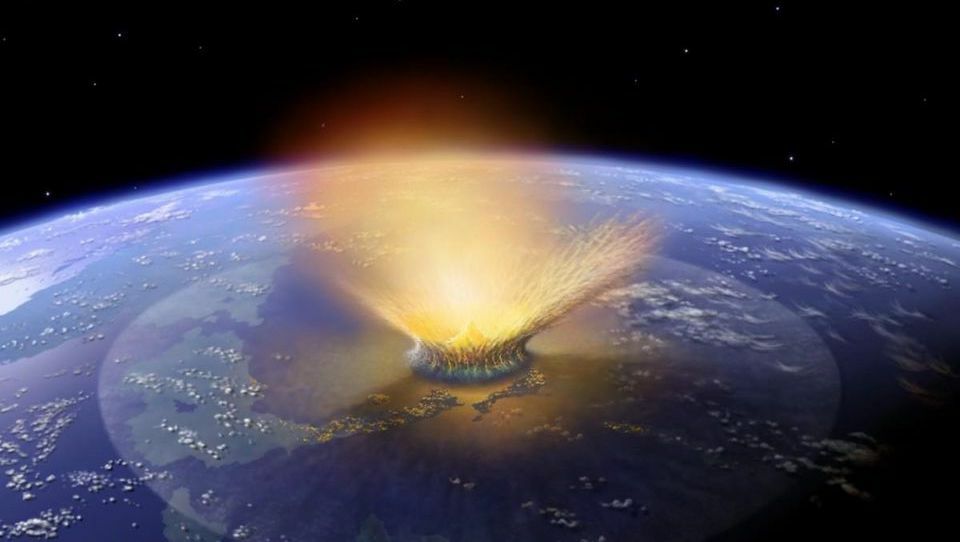
Remember the K-Pg Boundary? This represents the most conspicuous visual evidence of a great Earth-wide extinction event that destroyed most life forms (animals and plants). It is visual evidence of a catastrophic episode that can incontrovertibly be described as “tohu and bohu” (see Sidebar 2, “Chicxulub,” below).
Then follow the six days of creation, or in gap creation parlance, re-creation.
Genesis 1:2b: ‘Renewal’
“And the spirit of God moved upon the face of the waters.” From here—the latter part of verse 2 onward—we move into the ensuing six-day creation account. And notice what we already have from verses 1-2. We already have “heavens”—a plural Hebrew word referring not only to outer space but also Earth’s atmosphere. We already have “earth,” land. We already have “waters.” And note that all of this is before the “first day”—all before the “spirit of God moved” to initiate work.
There is a fascinating parallel passage to Genesis 1:2b. Psalm 104 extrapolates on this creation account, yet contains peculiar details that have led some young-Earth creationists to dismiss it as solely poetical. But there is reason to its rhyme. Note in particular verses 29-30: “Thou hidest Thy face, they [the creatures of the Earth] vanish; Thou withdrawest their breath, they perish, And return to their dust. Thou sendest forth Thy spirit, they are created; And Thou renewest the face of the earth.”
This inspired psalm clearly speaks of sending forth of spirit and a renewal. Of what? Of the face, or surface, of the Earth. This word for “renewal” is rare, found in only nine other verses—all of which describe the “repairing” or “renewing” of preexisting things (e.g. the altar, temple, etc).
“From verse 2 of Genesis 1 on, the remainder of this first chapter of the Bible is not describing the original creation of the Earth,” Mystery of the Ages continues. “But it is describing a renewing of the face of the Earth, after it had become waste and empty …. The verses that follow in this first chapter of the Bible describe the renewing of the face of the Earth, yielding beautiful lawns, trees, shrubs, flowers, vegetation—then the creation of fish and fowl, animal life, and finally man” (emphasis added throughout).
This renewal process, then, brings us to our “first day.”
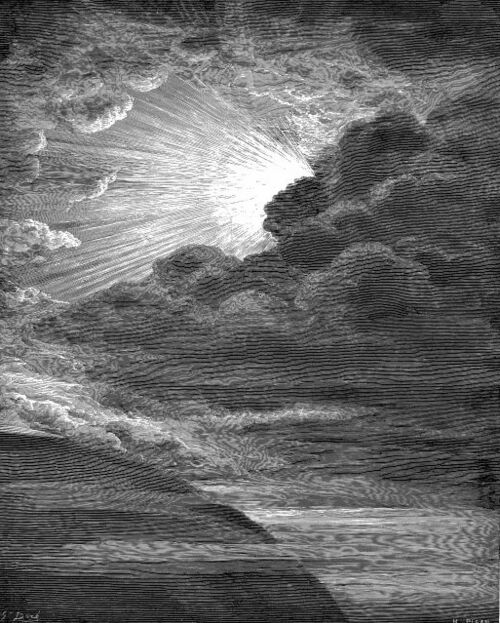
“And God said, Let there be light: and there was light. And God saw the light, that it was good: and God divided the light from the darkness. And God called the light Day, and the darkness he called Night. And the evening and the morning were the first day.”
Actually, “first day” is not the Hebrew term used here (though this is a common translation). The Hebrew term for “first day” does exist and is used ubiquitously in the Bible. But we have here something different—simply, “one day”—thus “evening and morning one day” (Douay-Rheims). Other passages demonstrating this notably more generic Hebrew terminology include Genesis 33:13 (“one day, all the flocks will die”); 1 Samuel 27:1 (“I shall perish one day”); Zechariah 14:7 (“there shall be one day”).
The first-century c.e. Jewish philosopher Philo noted, “He called it not ‘the first day,’ but ‘one day,’” presenting his own philosophical reasons as to why (On the Creation, 9). Later that century, Jewish historian Josephus argued that this was the first day, but deferred his explanation about the reason for the odd language: “[T]his was indeed the first day. But Moses said it was one day; the cause of which I am able to give even now; but … I shall put off its exposition” (Antiquities of the Jews, 1.1.1).
Yet on the basis of gap creation, this use of “one day” in verse 5 only makes perfect sense if there had been others before it. The use of “one day” in time then becomes the referent for the days of re-creation to follow (thus “second” day from the initial one, “third,” and so on).
As far as gap creation goes, this is by no means the extent of the evidence. It should also be mentioned that variations also exist, such as the “soft gap theory” and “pre-creation chaos gap theory” (neither of which I find compelling). What I have described here is generally labeled as more of a “classic gap theory.” Author James Rochford, in comparing different views of creation, summarizes: “[I]f the Gap Theory is true, it would resolve some of the most controversial subjects between creation and modern science …. [I]t should be noted that a theory with the most explanatory power and explanatory scope is usually the theory that is correct, and Gap Theory offers a possible model that has both” (Evidence Unseen, “Gap Theory Interpretation”).
We now turn to address some of the common objections to gap creation.
Objection No. 1: Grammar
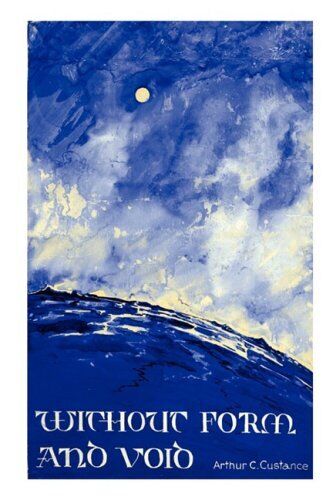
Genesis 1:2 is often translated in gap creation circles as, “And the earth became [rather than was] without form and void ….” Gap creationist and ancient languages expert Arthur Custance renders the verse: “But the earth had become a desolation ….” His 1970 book Without Form and Void centers primarily around the grammatical argument.
The grammar of Genesis 1:2—especially the nature of the word היתה as “was” or “became” (as well as the nature of the leading prefix ו as “and” or “but”)—has been a subject of fierce debate. Weston’s aforementioned 1976 book was penned in direct response to Custance’s arguments. Young-Earth creationist Dr. William Barrick views this grammatical argument as the chief reason for the gradual abandonment of gap creation over the past half-century: “The arguments against it [gap creation] have been so strong … one of the biggest reasons is Hebrew grammar. This is where Hebrew grammar really does form the argument—not vocabulary, but grammar” (interview, Biblical Studies and Reviews, Oct. 27, 2025).
These grammatical arguments get very technical, and in my opinion, go far beyond the evidence at hand. Despite claims to the contrary, there do still exist manifold differing interpretations of the language of Genesis 1:1-2. Custance rightly points out that those scholars arguing against any sense of the word became inevitably end up “contradict[ing] themselves in certain critical ways. [Commentator Carl Friedrich] Keil refuses to recognize the possibility of ‘became’ for ‘was’ in Genesis 1:2 but suggests it for ‘was’ in Genesis 3:20 where the same word occurs in precisely the same form.” (Genesis 3:22 is another case in point—using the masculine form of the word, היה, translated as “is become.”)
Personally, I do not find this argument over grammar compelling. Even if the word “was” was the best rendering in verse 2, this in no way argues against a change or gap between verses 1 and 2. It would simply mean in verse 1 the Earth was one way, and then in verse 2, it was another.
Objection No. 2: Death Before Adam?
An objection that commonly surfaces within Christian circles is the notion of animal death before Adam. Two New Testament passages are typically appealed to. The first is Romans 5:12, which says, “[B]y one man sin entered into the world, and death by sin ….” The other is 1 Corinthians 15:21, which says, “For since by man came death ….”
Thus, it is inferred that animal death only began with Adam and Eve (starting in Genesis 3). There is a problem with this argument, however—a reason why these New Testament passages are only ever partially quoted in this debate. Both passages are clearly referring to human death—and more than that, spiritual (eternal) death. The last half of Romans 5:12 specifies this “death passing upon allmen” (e.g. verse 14). 1 Corinthians 15:23 also specifies “every man” as part of this described cycle of death followed by resurrection.
The passages do not suggest animal death only began in Genesis 3.
Objection No. 3: What About the Fourth Day?
Another objection is that Genesis 1:14-19—the fourth day of re-creation—seem to imply the creation of the sun, moon and stars. How does this fit into the gap creation model, which puts the creation of these entities much earlier?
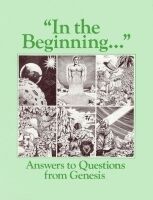
“And God said, ‘Let there be lights in the firmament of the heaven to divide the day from the night; and let them be for signs, and for seasons, and for days and years; and let them be for lights in the firmament of the heaven to give light upon the earth’ …” (verses 14-15). The Ambassador College publication ‘In the Beginning …’ Answers to Questions From Genesis explained this passage as follows:
[G]reat destruction had occurred to the Earth as pictured in Genesis 1:2. [The] atmosphere [was] filled with thick clouds. If there had been a human being on the Earth’s surface, he would have seen nothing—because no light penetrated the saturated atmosphere. [O]n the fourth day of creation, God cleared the clouds away so that the sun, moon and stars could be clearly viewed. Verse 16 tells us that God ‘made’ the sun and moon. … It could be translated as “made,” “had made” ….
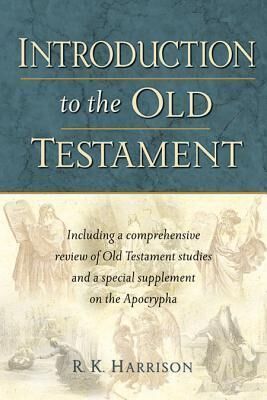
Note what one well-known Old Testament introduction says on the subject: “In explaining this phenomenon, it must first be noted that the standpoint of the first chapter of Genesis is an ideal geocentric one, as though the writer were actually upon the Earth at that time and in a position to record the developing phases of created life …. From such a standpoint the heavenly bodies would only become visible when the dense cloud-covering of the Earth had dispersed to a large extent” (R. K. Harrison, Introduction to the Old Testament, page 554).
Actually, questions surrounding the fourth day of creation are not so common in relation to gap creation. Instead, they represent far greater difficulty for the young-Earth position, in something known as the “light before luminaries” problem. Verses 3-13 already describe the presence of light, the passing of evening and morning,day and night—all of which we know to be the product of the sun and of Earth’s rotation around it.
This problem was one of the biggest reasons for early theologians to posit entirely different theories of creation—not pressure from “modern science” or the “geologic column.” The third-century c.e. Origen recorded the following mockery from the second-century c.e. Greek philosopher Celsus: “By far the most silly thing is the distribution of the creation of the world over certain days, before days existed: for, as the heaven was not yet created, nor the foundation of the Earth yet laid, nor the sun yet revolving [prior to the discovery of heliocentrism], how could there be days?” (Contra Celsum, 6.60).
Far from the account of the fourth day representing a problem passage for gap creation, I would submit that only this explanation sufficiently answers the “light before luminaries” conundrum—with the preexistence of the heavens and Earth, including prior “days” (once again, something already implied in the language of Genesis 1:5, “one day”).
Objection No. 4: Exodus 20:11
Another objection is an appeal to Exodus 20:11—a description of creation contained within the Sabbath commandment. “[F]or in six days the Lord made heaven and earth, the sea, and all that in them is, and rested on the seventh day ….” Doesn’t this imply all were created within the single six-day period?
There is something curious about this verse. It does, of course, connect to the Genesis 1 account. It includes the description of both Earth- and heaven-associated activity—the latter of which is clearly associated with days one and four, and for that matter can refer exclusively to Earth’s atmosphere (e.g. Genesis 27:28). Yet more interestingly, the verb used in Exodus 20:11 is not the same as in Genesis 1:1—bara, ברא—meaning to “create.” A different verb is used—asah, עשה. While it can be used in the sense of creating, this is not necessarily the case—it is a more generic word implying doing,working, completing. If Exodus 20:11 was keying into Genesis 1:1, then its omission of the very verb used in this passage to specify creation would be odd indeed.
Custance addresses this objection in detail in Appendix xx of Without Form and Void, concluding: “Exodus 20:11 surely refers to the work of these six days not as a time of creation ex nihilo but as a time in which a ruined cosmos was re-ordered as a fit habitation for man.”
Prof. Haim Shore of Israel’s Ben-Gurion University of the Negev also draws attention to the fundamental semantic differences between the Hebrew words bara and asah used in the biblical creation account—the “strong distinction between creating and doing”—in his book Coincidences in the Bible and in Biblical Hebrew (2013). Citing Exodus 20:11, he writes:
No “creating” is alluded to, only “doing.” … The distinction between the worlds of creating, forming, and doing is central to Jewish philosophy and theology. According to the Malbim (1809–79), one of the greatest biblical commentators, “creating” refers to bringing forth into existence out of nonexistence, “forming” refers to bringing forth that which is potentially in the created, still hidden … and “doing” is the completion of the forming and the removing of that which is not inherently in the nature of the created (the act of tikun, or repair).
“The distinction between creating, forming, and doing permeates the Bible,” he concludes (1.3.2).
Objection No. 5: Bending Scripture to Science?
This final, most oft-repeated objection goes something like this: The gap theory was only invented in modern times as a way to bend Scripture to science, to fit with emerging theories about the antiquity of Earth.
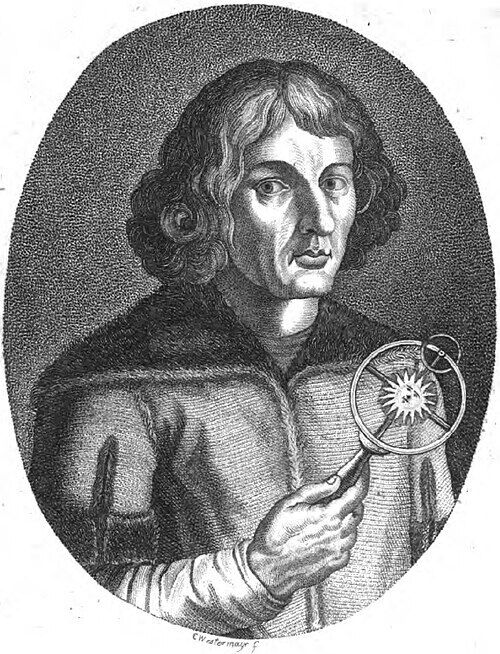
Old-Earth creationist Dr. Gavin Ortlund aptly summarized the flaws inherent in this objection, noting that “it’s kind of lazy to just dismiss all science. Nobody can really do that … there are times when science does correct an interpretation of Scripture.” He highlighted Nicolaus Copernicus’s discovery of heliocentrism (the rotation of the Earth and other planets around a central, stationary sun), which received scathing condemnation from 16th-century religious authorities. “They had the exact same appeal—don’t take man’s science over God’s Word” (“Response to Ken Ham: Animal Death, Historicity and Science”).
Custance, for his part, carefully couches the issue: “[T]he question of whether Genesis 1 can be squared with modern geological theory is of secondary importance. I do not for one moment say it is quite unimportant. It is important. But the more important thing is, undoubtedly, to determine what Genesis says.”
But what about it? Is gap creation really such a modern idea?
Truth is, this view existed long before modern discoveries of Earth’s antiquity. As David F. Payne wrote, “The ‘gap’ theory itself, as a matter of exegesis, antedated the scientific challenge, but the latter gave it a new impetus” (“Genesis One Reconsidered”).
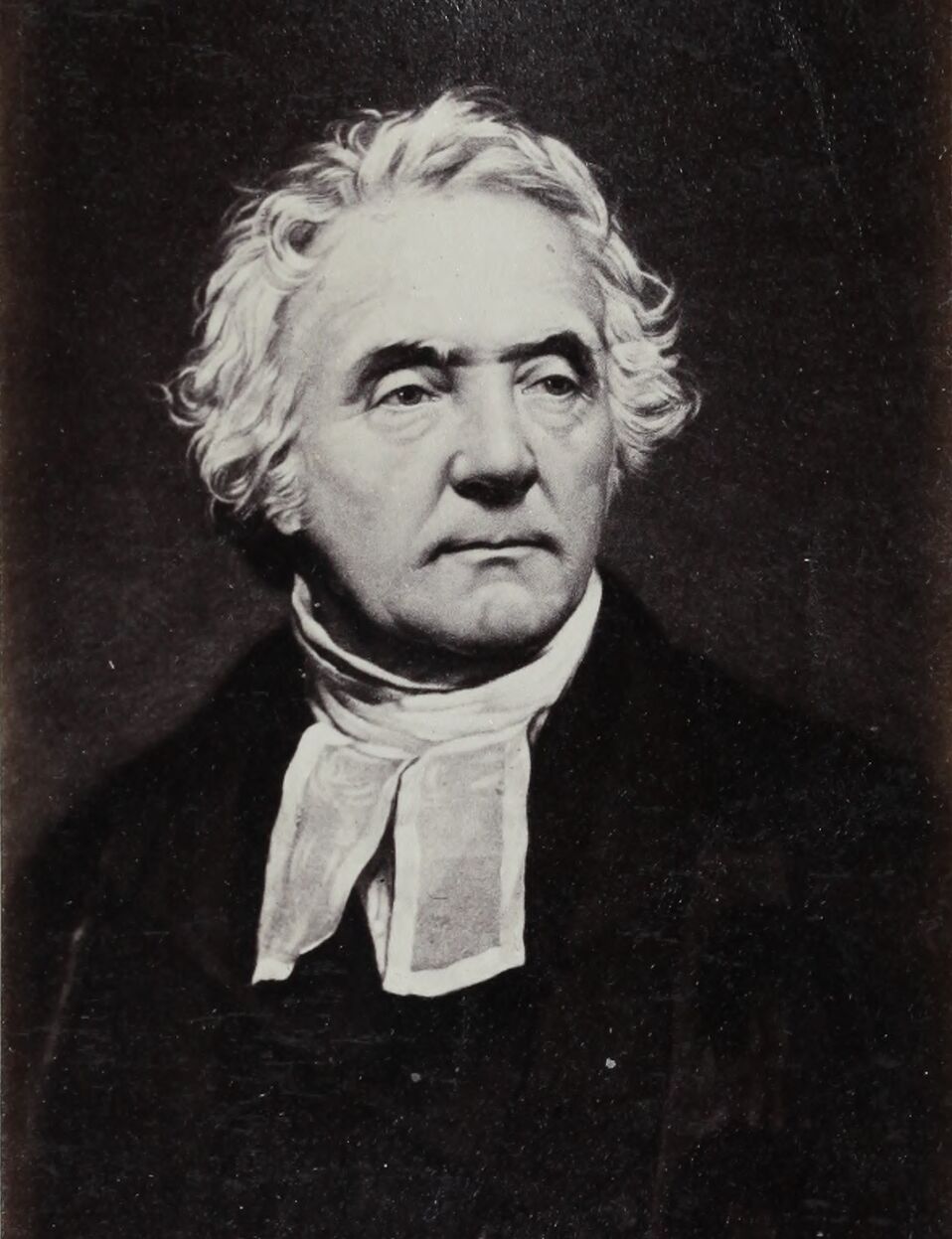
Modern scientific views on geology and the deep antiquity of the Earth began to be formulated at the very end of the 18th century, beginning especially with the 1788 publication of James Hutton’s Theory of the Earth. Even still, it was not until the early 19th century that Hutton’s work began to be taken seriously, causing alarm within some religious circles. To this, the Scottish theologian Thomas Chalmers responded in 1804: “It has been alleged that geology, by referring the origin of the globe to a higher antiquity than is assigned to it by the writings of Moses, undermines our faith …. This is a false alarm. The writings of Moses do not fix the antiquity of the globe” (Memoirs of the Life and Writings of Thomas Chalmers). In 1814, Chalmers published “Remarks on Cuvier’s Theory of the Earth,” addressing the matter in further detail—a publication often cited by critics as the genesis of the gap theory.
Custance, alongside Payne, begs to differ, arguing in Chapter 1 of his book that gap creation was a view held long prior. Case in point, the Book of Jasher, printed in 1751—decades before the works of Hutton and Chalmers—commented on Genesis 1:2, stating “the face of nature was formed a second time.”
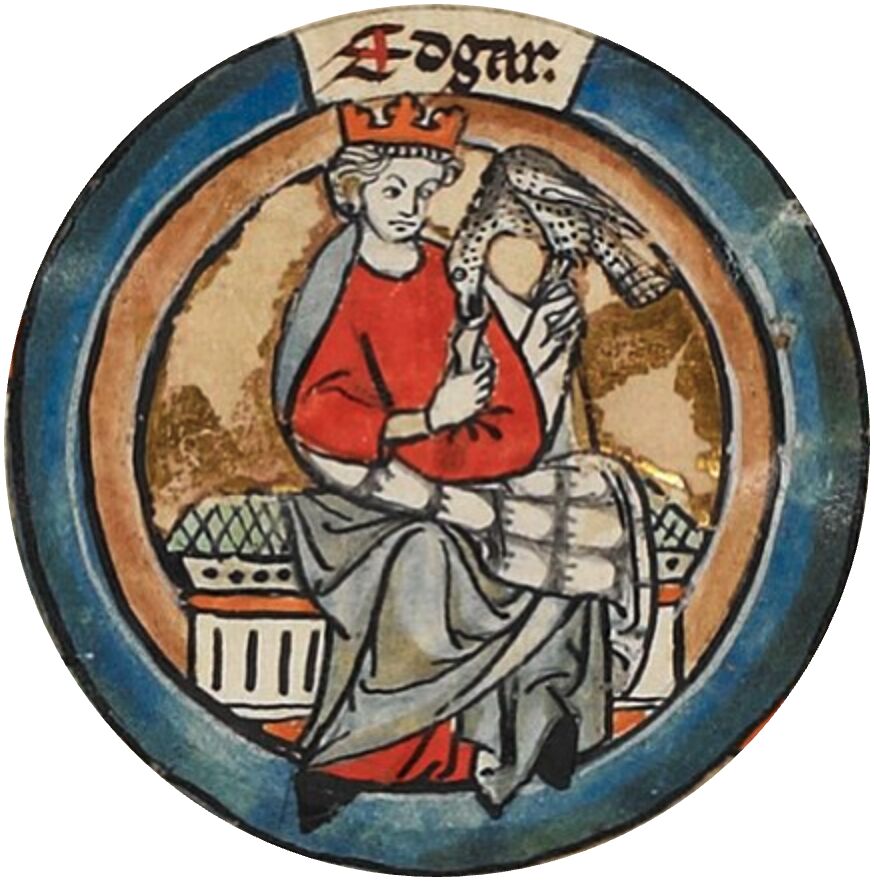
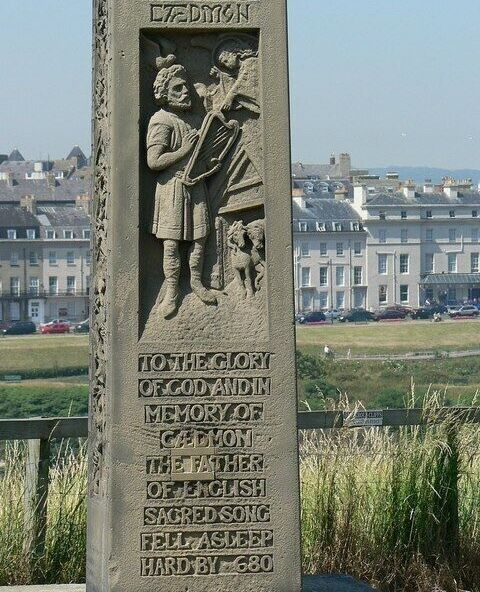
Custance wound the clock back much further, arguing that gap creation views were held by the likes of King Edgar of England (943–975 c.e.) and Cædmon (circa 600–684 c.e.; see Sidebar 1, “Cædmon’s Hymn”). Among early Jewish thought, Custance highlights midrashim, collected into Louis Ginsberg’s The Legends of the Jews, commenting on Genesis 1: “Nor is this world inhabited by man the first of things earthly created by God …. [W]orlds before ours” had been “destroyed” (1.1.4). From the 13th-century Zohar, in elaborating on Genesis 2:4: “[T]hese are the generations of the destruction which is signified in verse 2 of chapter 1. The earth was tohu and bohu. These indeed are the worlds of which it is said that the blessed God created and destroyed” (as quoted in Without Form and Void).
Theological differences of various proponents aside—from Judaism to Christianity to Islam—the idea of “an early pre-Adamic catastrophe affecting the whole Earth” was “apparently quite widespread …. It certainly antedates modern geology,” wrote Custance.
[O]ne thing stands out clearly. The [early] writers would not have agreed with [17th-century chronologist James] Ussher, that creation occurred 4000 b.c. They might very probably have assented to his chronology as applied to the creation of Adam, but they would have set the creation of the universe (the heavens and the Earth) further back in time by some unstated amount.
Far from certain later scientific discoveries being the impetus for the notion of gap creation, then, they are quite justifiably seen as substantiating it.
‘Planting the Heavens’
Thus far ends our summary of gap creation, looking back on the world that was. Yet we shall not conclude by looking backward. For what is most inspiring about the so-called gap theory—yet what unfortunately gets overlooked almost entirely —is not looking back in time, at the “gap” pertaining to the Earth.
It is the “gap” pertaining to the heavens—looking forward in time, to the promise of restoration of the wider universe. “And I have put My words in thy mouth, And have covered thee in the shadow of My hand, That I may plant the heavens,” the Prophet Isaiah quotes God as saying (Isaiah 51:16)—Isaiah looking forward in time to a cosmic renewal!
This is another passage commentaries struggle with. “‘That I may plant’: This is no doubt the right translation,” states the Cambridge Bible Commentary. Yet “[t]he metaphor of ‘planting’ the heavens is strange.” The commentary notes the attempts of “some critics … changing a letter” to force a different reading. But this peculiar passage is yet another one aptly explained by the gap creation model.
“Apparently all such planets in the entire universe now are waste and empty—decayed (tohu and bohu)—like the Earth was, as described in Genesis 1:2,” wrote Herbert Armstrong in Mystery of the Ages. “But God did not create them in such conditions of decay—like our moon. Decay is not an original created condition—it is a condition resulting from a process of deterioration.”
Other biblical passages expound on this subject of universe restoration as part of man’s ultimate purpose and potential. “[Other] verses portray a universe filled with planets in decay and futility—yet as if subjected now to this dead state in hope! … Could the whole universe with its myriad of other planets have been created for the eventual purpose of sustaining life?” (ibid). The Cambridge Bible Commentary, citing Isaiah 51:16, calls this the “ultimate goal of God’s dealings with Israel.” This innate yearning to bring life to dead planets is for now only an expensive dream for individuals such as Elon Musk (whose stated goal is to “make life multiplanetary”).
“The creation is pictured as ‘groaning in travail in hope,’” continues Mystery of the Ages. “[T]he planets, except for this Earth, are in a state of death, decay and futility—but not forever—waiting ….”
Following are excerpts of the Hymn of Cædmon in a section known as “Genesis A.” Though attributed to the seventh-century Cædmon (per the Venerable Bede), the earliest manuscript evidence dates to the 10th century. Debate of origin aside, it still constitutes the earliest datable example of Old English verse (challenging the famous Beowulf, whose composition date is more speculative). The following is a translation of the text transmitted in Codex Junius 11, Liber 1:
The angel legions knew the blessedness of God, celestial joy and bliss. Great was their glory! … They knew no sin nor any evil; but dwelt in peace for ever with their Lord. They wrought no deed in heaven save right and truth, until the angel prince in pride walked in the ways of error. Then no longer would they work their own advantage, but turned away from the love of God. They boasted greatly, in their banded strength, that they could share with God His glorious dwelling, spacious and heavenly bright.
Then sorrow came upon them, envy and insolence and pride of the angel who first began that deed of folly, to plot and hatch it forth, and, thirsting for battle, boasted that in the northern borders of heaven he would establish a throne and a kingdom. Then was God angered and wrathful against that host which He had crowned before with radiance and glory. …
Fierce of heart, they boasted they would take the kingdom, and easily. But their hope failed them when the Lord, High King of heaven, lifted His hand against their host. … He crushed His foes, subdued them to His will, and, in His wrath, drove out the rebels from their ancient home and seats of glory. …
Then our Lord took counsel in the thoughts of His heart how He might people, with a better host, the great creation ….
As yet was nought save shadows of darkness; the spacious earth lay hidden, deep and dim, alien to God, unpeopled and unused. Thereon the Steadfast King looked down and beheld it, a place empty of joy. He saw dim chaos hanging in eternal night, obscure beneath the heavens, desolate and dark, until this world was fashioned by the word of the King of glory. Here first with mighty power the Everlasting Lord, the Helm of all created things, Almighty King, made earth and heaven, raised up the sky and founded the spacious land.
(Update: Just three months after the publication of this article, the exciting discovery of another early manuscript of Cædmon’s Hymn was announced—see here for more detail.)
Sidebar 2: Chicxulub
Ground zero for discussions about the K-Pg extinction event is the Chicxulub crater, located just off the shore of Mexico’s Yucatán Peninsula. First discovered in the 1970s, the crater was named after the nearby coastal town of Chicxulub (Pueblo)—a rather appropriate ancient Mayan name variously translated as “devil’s flea,” “devil’s tail” or even “place where the devil fell.”
The original impact crater is estimated to have been circa 100 kilometers (60 miles) wide and 30 kilometers (19 miles) deep, before collapsing in on itself—creating a depression 200 kilometers (120 miles) wide and several kilometers deep.
Modeling of the impact estimates it to have been the product of an asteroid approximately 10-15 kilometers in diameter (6-9 miles—from sea level, taller than Mount Everest), approaching at a speed of Mach 58 (20 kilometers/12 miles per second), and delivering an impact estimated at over 900 billion times that of the atomic bomb dropped on Hiroshima.
The results would have been unimaginable—causing mega-tsunamis, mega-earthquakes, firestorms and a “nuclear winter” around the globe, consisting of a thick “soot cloud” entirely blocking sunlight, with debris even escaping Earth’s orbit—ending the majority of all life forms on the planet.
Sidebar 3: ‘Chaos’ in Other Ancient Creation Accounts
A growing number of ancient creation accounts have been discovered, dating back thousands of years—including texts from the ancient Assyrians, Babylonians and Sumerians. These accounts, while containing varying conflicting and fantastical details, are remarkably united in their emphasis on an episode of chaos in primordial history—paralleling the biblical tohu and bohu—each elaborating on this as a period of warring divinities, darkness, monsters and many waters. In the words of Dr. Joseph Lam, in a recent Bible and Archaeology interview “Why Creation Stories All Look the Same”: “This was a ‘thing’—this was stuff that other ancient peoples around Israel knew about. … When we look across many of these ancient Near Eastern accounts, chaos, water … this is a recurring image, not limited to Mesopotamia or Egypt. It shows up everywhere, in a lot of different stories.”
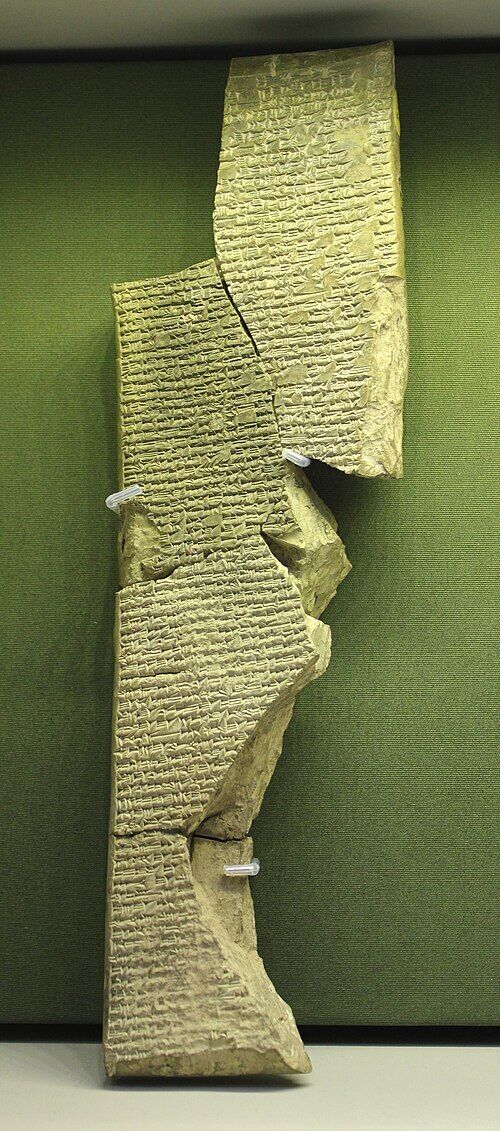
The Enuma Elish—the ancient Babylonian creation epic whose tablets date back to at least the second millennium b.c.e. but whose story is believed to predate even this—is a classic case in point. It speaks of a great spiritual war between rival divine beings with deities “grieved over the plotted evil” that would “destroy what we have given birth to.” The following exemplary excerpts are taken from Prof. Wilfred George Lambert’s Mesopotamian Creation Stories:
The gods took no rest … they plotted evil …. Make battle, avenge … reduce to nothingness! Tiamat heard, the speech pleased her. She said, ‘Let us make demons, as you have advised.’ The gods assembled …. They conceived evil against the gods their begetters. They … took the side of Tiamat, fiercely plotting, unresting by night and day. Lusting for battle, raging, storming, they set up a host to bring about conflict. Mother Hubur, who forms everything, supplied irresistible weapons, and gave birth to giant serpents. They had sharp teeth, they were merciless …. She clothed the fearful monsters with dread, she loaded them with an aura and made them godlike. … Bel lifted up the Storm-flood, his great weapon …. He let loose the Evil Wind, the rear guard …. He let fly an arrow and pierced [Tiamat].
In the aftermath of this conflict, an ordering of the heavens and Earth is described as taking place, and man is created.
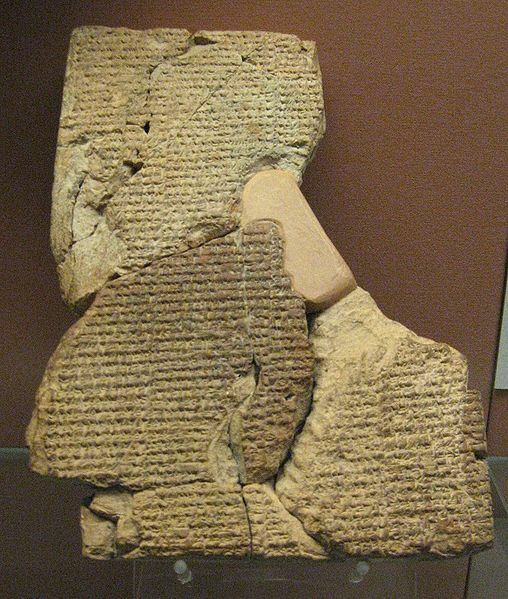
Similarly, the 18th century b.c.e. Akkadian Atra-Hasis epic describes the initial heavens and earth before man as a habitation of “gods instead of man”—deities who became discontented. From Assyriologist Dr. Stephanie Dalley’s translation of the somewhat fragmentary text in Myths From Mesopotamia: Creation, the Flood, Gilgamesh and Others:
They groaned and blamed each other … ‘Let us confront our […] the chamberlain’ …. Then Alla made his voice heard, and spoke to the gods … ‘Now, cry battle! Let us mix fight with battle!’ The gods listened to his speech …. Enlil made his voice heard and spoke to the great gods, ‘Is it against me that they have risen? Shall I do battle? What did I see with my own eyes?’ … [Anu said] ‘Who is in charge of the rabble? Who will be in charge of battle? Which god started the war?’
In the aftermath of this episode, mankind is brought into being from clay.
Custance writes on this subject and the strikingly similar motifs (op cit):
The Egyptians believed that the earth had suffered more than one destruction and renewal, and certainly the Babylonian traditions held strongly to at least one serious destruction and reconstitution quite apart from their recollections of the great Flood of Noah’s time. … The great catastrophe of Genesis 1:2 in time became one of the most popular themes of cuneiform literature. … There is, therefore, from the very earliest times, a continuity of tradition that at some remote time in the past, great spiritual powers came under the judgment of God and brought about a disruption of the Cosmos, the record of which is surely reflected in Genesis 1:1 and 1:2.
So similar are the themes in the likes of the early Enuma Elish that many modern scholars assume such to have been “the inspiration for the Hebrew scribes who created the text now known as the biblical book of Genesis”—scribes who “tightened the narrative and the focus but retained the concept of the all-powerful deity who brings order from chaos” (Joshua Mark, “Enuma Elish: The Babylonian Epic of Creation”). I do not subscribe to this view, instead following that of scholar Percy Wiseman, who turns this concept on its head, arguing the Genesis content as promulgating the original storyline, and other such copies bearing the marks of derivation. This is articulated in his book New Discoveries in Babylonia About Genesis (including a fascinating biblical explanation for just how, and even by what title, such stories may have entered circulation in the ancient world—see here for more detail).
Nevertheless, the connections that do exist between these accounts—especially concerning chaos and spiritual warfare—are obvious and cannot easily be explained away. They are, however, aptly accounted for by one particular model of biblical creation, which emphasizes such a primordial state of chaos and spiritual warfare, preceding a reordering of creation: the gap creation model.