Wise King Solomon once wrote, “Where there is no vision, the people perish: but he that keepeth the law, happy is he” (Proverbs 29:18; King James Version). Vision is a mental image of what the future will be or could be. We all need vision—and hope and inspiration—or we perish!
Our namesake, Herbert W. Armstrong, a man who died 40 years ago this year, was a man of vision. He wrote in his autobiography, “To climb the ladder of ultimate success in accomplishment, one must exercise vision ….” Yet this quality, he said, was “rare among people.” Vision defined his more than 50 years as a philanthropist, humanitarian, educator, minister and unofficial ambassador for world peace.
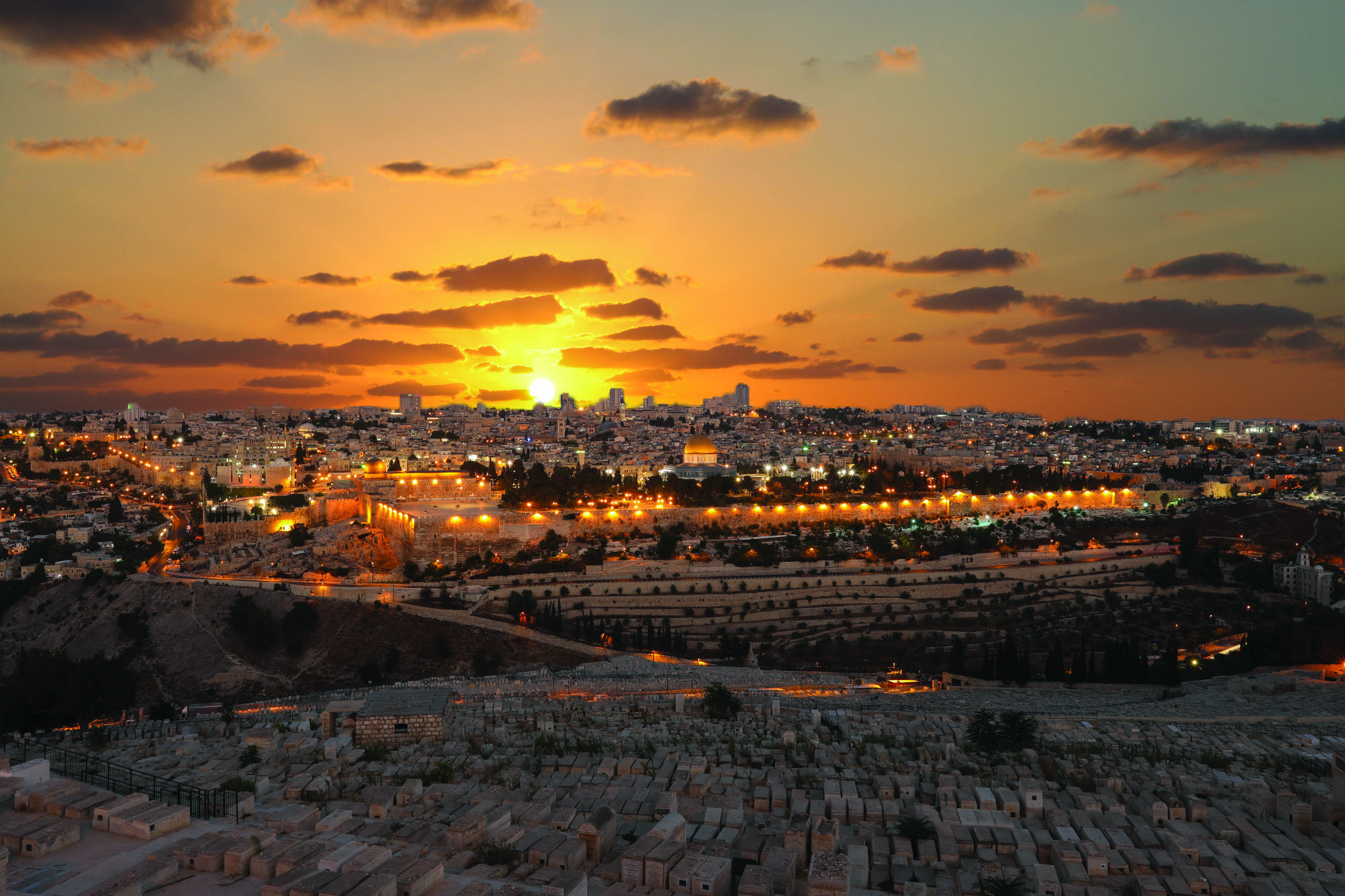
Mr. Armstrong knew that of all places on Earth, there was great vision in Jerusalem. No other city has a past, present or future filled with such meaning and hope. There is vision in the Old City, in the City of David and on the Temple Mount. There is vision in the hills of Judea and on the coastal plains. There is vision in the ancient ruins that testify of this land’s incomparable history and in the many sensational artifacts that have been uncovered in archaeological excavation, illuminating Israel’s ancient past.
Israel today is also the epicenter of major issues and trends, both regionally and globally. Though the news media do not convey it, there is enormous vision in this daily news. Israel’s domestic politics, the terrorist threat, the ongoing conflict with Iran and its proxies in Lebanon and Gaza, and many other events become staggeringly meaningful when viewed in light of Israel’s past and the writings of its prophets. These sacred writings foretell a magnificent future for this incomparable city. That future, soon to be realized, should set our hearts aflame!
Behold Your God!
King Solomon wasn’t the only one to discuss vision and its importance to individual and national health. Many biblical priests, prophets and leaders talk about vision, especially the importance of the Jerusalem vision.
In Psalm 137:5-6, the psalmist wrote: “If I forget thee, O Jerusalem, Let my right hand forget her cunning. Let my tongue cleave to the roof of my mouth, If I remember thee not; If I set not Jerusalem above my chiefest joy.” Written in Babylonian captivity, this beautiful song expresses deep yearning for this city of God. It is a perpetual reminder to hold fast the vision of Jerusalem.
The Bible is filled with passages that describe how important it is to cherish the Jerusalem vision.
The Prophet Isaiah wrote extensively about Jerusalem. Consider Isaiah 40, which is about both the past and the future, and illuminates the Jerusalem vision. Verse 9 says, “O thou that tellest good tidings to Zion, Get thee up into the high mountain; O thou that tellest good tidings to Jerusalem, Lift up thy voice with strength; Lift it up, be not afraid; Say unto the cities of Judah: ‘Behold your God!’”
Jerusalem and the State of Israel are filled with history and events that declare, “Behold your God!” Traveling that land is like walking through the Bible. There are biblically significant archaeological excavations, artifacts and ruins all over the country. In its own way, each of these declares, “Behold your God!”
This message, though, must also be specifically declared and made plain, or people will not recognize it. During the last half of the 20th century, this vision was trumpeted by a specific individual—a man who has been called a modern-day “prophet” for Jerusalem.
“His deep devotion to the ideals of peace and justice in the spirit of the biblical prophets was appreciated by his friends in Israel. His feeling for Israel and Jerusalem was manifested in his true interest in the archaeological excavations near the Temple Mount and in the City of David. His name will always be attached to this most important undertaking carried out in Jerusalem.”—Professors Benjamin Mazar and Joseph Aviram, January 1986 Joint Statement
Jerusalem’s ‘Prophet’
From 1965 to 1993, the mayor of Jerusalem was Teddy Kollek. He had a vision for the city and was able to turn much of that vision into reality.
After his fourth reelection as mayor in 1983, Kollek hosted a luncheon for a friend of his, with whom he could share, develop and expand his vision of his beloved city: Herbert W. Armstrong. Mayor Kollek deeply respected Mr. Armstrong’s understanding of the Bible and of Jerusalem’s central place in its history and prophecy. After Mr. Armstrong toasted the mayor’s electoral success, Mayor Kollek smiled and responded from his chair, “Jerusalem at this time does not have a prophet. You will have to be our prophet.”
That statement, while offered in a lighthearted moment, showed insight. Mayor Kollek elsewhere told Mr. Armstrong, “The stories of the Bible are better known to you than to anyone around this table.”
Mr. Armstrong was chancellor of Ambassador College, headquartered in Pasadena, California. A prolific author, educator, philanthropist and theologian, Mr. Armstrong traveled the world teaching the true causes of the problems facing humanity and their ultimate solutions. He directed many important projects, but his greatest passion, especially in the final decades of his long life, was for the Jewish state and for Jerusalem.
He personally befriended all of Israel’s prime ministers and presidents during this time. Like the biblical prophets and the great Jewish figures of antiquity, Mr. Armstrong had an extraordinary vision of Jerusalem and the Jewish state. He understood that there is tremendous hope and inspiration bound up in the past, present and future of this city and nation. And he devoted a lot of energy to sharing this hope.
In 1968, Mr. Armstrong and Ambassador College formed what Israel’s tourism minister at the time called “an iron bridge that can never be broken” with Hebrew University and the State of Israel. Mr. Armstrong and Ambassador College supported several archaeological digs in the Old City, including the massive Temple Mount excavations led by Prof. Benjamin Mazar and Hebrew University.
Mr. Armstrong’s involvement in Israel’s archaeology wasn’t without its challenges and difficulties. Mr. Armstrong and Ambassador College were in a unique position as the first American-Christian organization to support biblical archaeology in Jerusalem after the 1967 reunification of Jerusalem. There were bound to be hurdles. But because of his love for Jerusalem, Mr. Armstrong was determined to surmount those obstacles! His knowledge of the Bible’s prophecies kept him focused on that city. He saw its importance because he had vision!
On April 15, 1967, just as Mr. Armstrong was working to become more involved in Jerusalem, his wife of 49 years died. In the same letter to his followers announcing the death of his wife, Mr. Armstrong explained the tremendous hope there is in Jerusalem, highlighting that “Jerusalem is to be the capital of the Earth!”
The day after sending that letter, Mr. Armstrong boarded a plane to Jerusalem.
There is a great lesson in this: When you have the Jerusalem vision, even heavy trials will not stop you.
Mr. Armstrong’s legacy shows that something special was happening in his life and in the work he led. Some of the most outstanding universities in America were trying to be a part of those excavations—the most important dig on Earth. Yet a small college in Pasadena, California, was the one that received that honor!
In 1986, Ambassador College students appeared on the cover of Biblical Archaeology Review—impressive prestige and publicity for any college.
The Enduring Vision
Inspired by the same vision Mr. Armstrong had, we have continued his legacy and humanitarian work in Jerusalem with the Armstrong Institute of Biblical Archaeology. We worked to restore Liberty Bell Park. Shortly after Dr. Eilat Mazar discovered King David’s palace in the City of David, we started an archaeological partnership with her. We sent our first students to assist in her excavations in 2006.
That same year, we met Jerusalem Mayor Uri Lupolianski and reconvened with longtime friends of Mr. Armstrong’s, such as Prof. Joseph Aviram. We’ve also built relationships with other Israeli officials and ambassadors.
Since 2006, our students have been heavily involved in several digs that have unearthed marvelous, biblically significant artifacts, including Nehemiah’s Wall; the bullae of Jehucal, Gedaliah, King Hezekiah and Isaiah; and Solomon’s Wall.
On March 30, the New York Times published an article titled “Can an Archaeological Dig Change the Future of Jerusalem?” It quoted former U.S. Ambassador to Israel Dan Shapiro as saying, “It’s hard to overstate how moving it is for Jews to connect to David’s Jerusalem.” Just as Mr. Armstrong did, we aim to connect the people of Israel to David’s Jerusalem.
The Jewish people have amazing history and heritage that is being unearthed from the soil under their feet—artifacts that connect to prophecies in their Bibles!
There is wonderful vision wrapped up in Isaiah 40. Watch Jerusalem. You need the vision of what is about to happen in that city! In a short while, Jerusalem is going to be the capital of the world. It will be called a city of truth. Peace, joy and happiness will be abundant (Zechariah 8:3-6). People from around the world will flow to Jerusalem to be taught God’s law and to learn the way of peace (Isaiah 2:1-5). God’s education and truth will fill the Earth! (Habakkuk 2:14).
This was the vision that fueled Mr. Armstrong’s love for Jerusalem—and this vision motivates our work today.
