
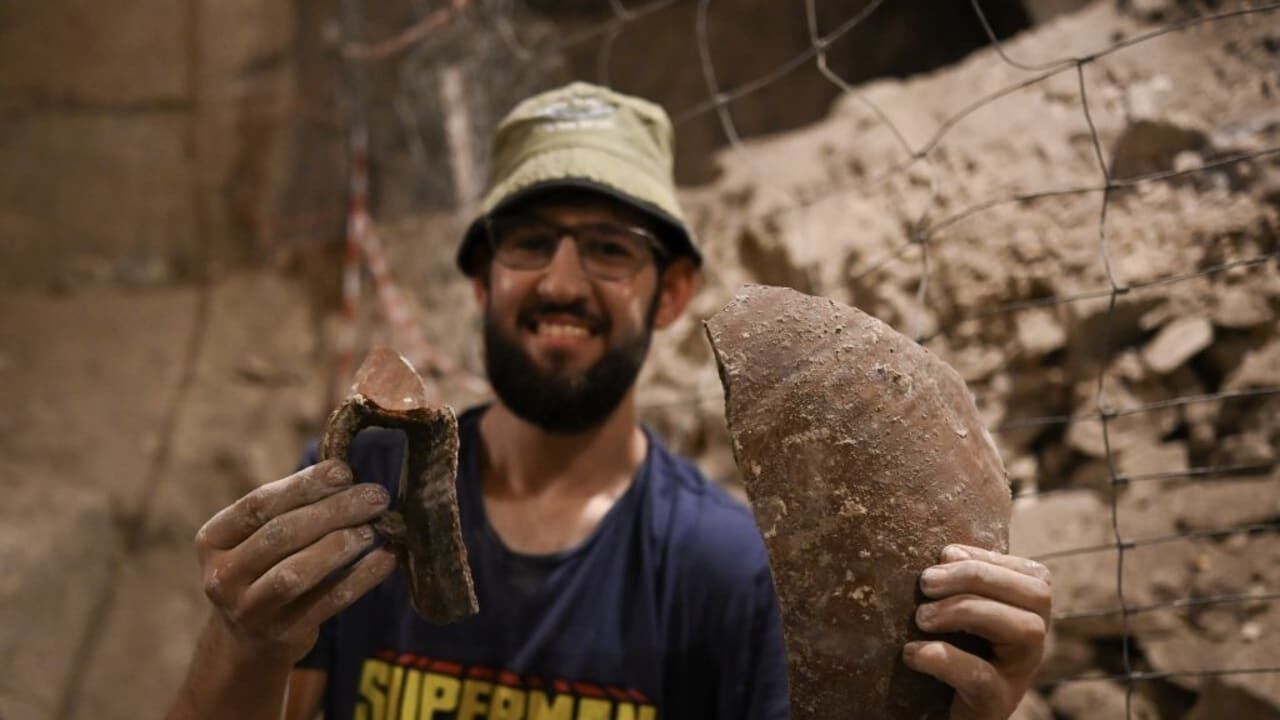
One of the most common finds on an excavation site are pottery sherds. What you don’t often find are the kilns where these vessels were made. The Israel Antiquities Authority (iaa) announced a new Israeli research initiative that will use scientific methods to determine where discovered vessels were made.
The joint project will be headed by Dr. Anat Cohen-Weinberger of the iaa and Prof. Alexander Fantalkin of Tel Aviv University. Their analysis will help bridge the gap between where pottery was discovered and where it was fired in a kiln.
There are two methods used in the analysis. The first method is petrography. This is when an extremely thin slice of the vessel is examined under a polarizing microscope to identify its minerals and rock fragments.
The second is a chemical analysis using neutron activation analysis. This is done by taking a small sample and testing it in a nuclear reactor to find its elemental composition. It can also show rare trace elements.
By examining the mineral and chemical composition of pottery from a known area, the project will be able to give ancient production kilns a “fingerprint.” According to the iaa, combining both analyses will provide a unique profile for each kiln that will be added to a database that can be used as a reference point for pottery discovered without a kiln. In the cases of no kiln, researchers will be able to compare the pottery to those in the database. If there is a match, a stronger proposal can be made as to where the pottery is from.
The ultimate goal is for a digital “kiln atlas” to be created. This atlas will have all of the consolidated knowledge from the analyses and make the knowledge available to researchers through a platform being developed by the iaa’s digital technologies division. The purpose of the atlas is to serve as an infrastructure for studying production, trade and regional connections.
University of Haifa’s head of Petrography Laboratory at the Zinman Institute, Dr. Mechael Osband (not associated with the iaa’s initiative) said the project will “make a significant contribution to understanding economic and social connection in antiquity.”
Combining the scientific methods will help archeologists put the pieces together from the past, bringing Israel’s ancient civilizations to life.