
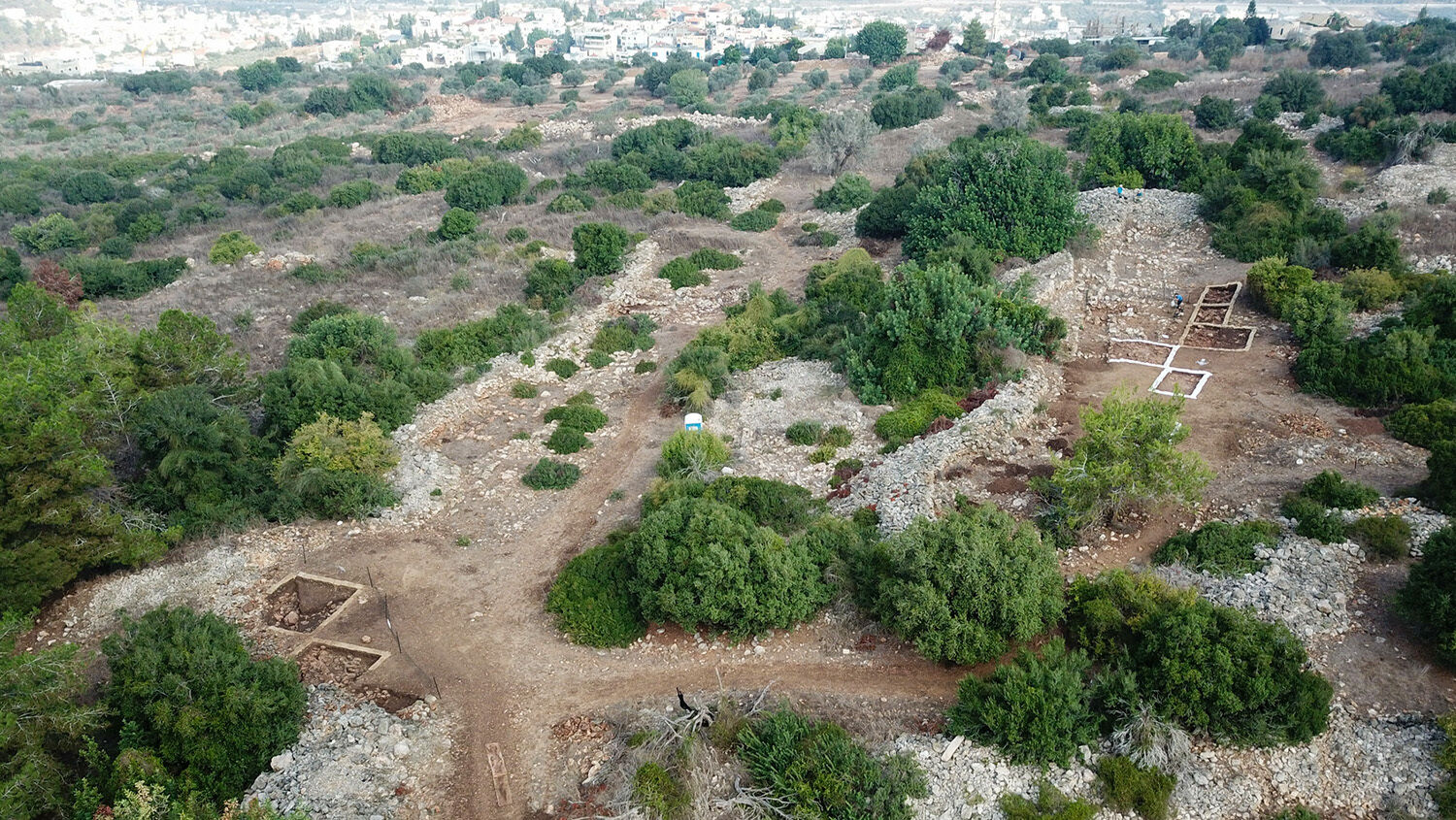
A team of researchers from the University of Haifa has published evidence of bronze production at the northern edge of the Central Hill Country in Israel, at el-Ahwat, in a new study published in plos One. The scholars suggest that this site links to a complex network of Iron Age copper and bronze production sites throughout the Levant, specifically linked to the large mines at Timna and Faynan in the Arabah Valley.
It is important to first define the two metallurgical processes often discussed in relation to bronze production. “Bronzeworking” or “recycling” is simply melting preexisting bronze, whereas “bronzemaking” is alloying copper with tin, either in metallic or oxide form, on site.
At el-Ahwat, 12 kilometers (7.5 miles) southwest of Megiddo, researchers found the earliest example of bronzemaking in the land of Israel—dating to around 1000 b.c.e., the time of the biblical King David.

In previous excavations at el-Ahwat, Prof. Adam Zertal’s team discovered numerous metal fragments and artifacts, but they were kept in his office for a long time without any outside knowledge of them. After his death in 2015, a box with 175 of these artifacts was found in his office by one of the authors.
The study examined seven copper and bronze spills as well as a slag fragment. “The analysis of the copper and bronze spills, along with the slag samples, indicates that bronze was produced at el-Ahwat during Iron Age i,” the authors wrote. Thus, this is “the first site in the region to yield unequivocal evidence for the primary production of bronze through alloying copper with tin.”
According to the report, “Lead isotope analysis, chemical composition and microstructure link some of the metal specifically to the Faynan ores, and other finds to the Timna ores, suggesting that both ores, possibly controlled by a joint polity, supplied copper to el-Ahwat.
“These findings challenge long-standing assumptions about the localization of bronzeworking in urban lowland centers, and open new perspectives on the inland trade routes and social organization of the early Iron Age southern Levant.”
Bronzeworking in Iron Age i is often characterized as being decentralized and localized, consisting of households remelting scraps. El-Ahwat challenges this notion. It shows that bronze was produced from raw materials of copper and tin on location.
El-Ahwat now joins and contributes to a broader landscape of metallurgical activity. The fact that this site didn’t just recycle bronze but alloyed copper with tin to produce bronze reveals a high level of expertise and a centralized system capable of securing and providing the raw materials needed for production.
“While el-Ahwat provides the only direct evidence of local bronze production to date, it was likely not unique. Other sites from the same period, such as Tel Rehov and Tel Masos, have yielded bronzeworking remains with high tin concentrations, though these materials have yet to be studied systematically,” stated the report.
In other words, it’s quite likely that there are other sites in the area where bronzemaking was taking place. The question then becomes: Who was the organizing entity that was able to bring the copper from the Arabah and the south, and tin from afar (perhaps even as far as the British Isles)? Dr. Tzilla Eshel, one of the paper’s authors, is asking these same questions. She told the Times of Israel, “Was there a polity organizing the network? And if so, who was the polity? One possibility is that it was the early Israelites” (August 26).
The Bible clearly describes a united, centralized monarchy in the region of ancient Israel producing and utilizing an enormous amount of bronze—so much so, that it was innumerable: “And Solomon did not weigh all the articles, because there were so many; the weight of the bronze was not determined” (1 Kings 7:47; New King James Version).
The research paper acknowledged the conflicting scholarly views on this topic. “A key debate concerns the control of copper production in the Arabah during Iron Age i (circa 1150–950 b.c.e.) after the end of Egyptian hegemony in the region. Central questions remain unresolved, namely who initiated and organized this large-scale enterprise, and where were its products headed?
“Bronzeworking has customarily been viewed as a lowland activity. As a result, the ongoing debate regarding the origin of the groups that eventually established the northern kingdom of Israel and the southern kingdom of Judah during the 10th or ninth century b.c.e. has been isolated from the political and economic context of copper production in the Arabah in the preceding centuries.”
This is what makes el-Ahwat fascinating. Geographically, it directly connects the massive Arabah Valley mining operations with northern Israel.
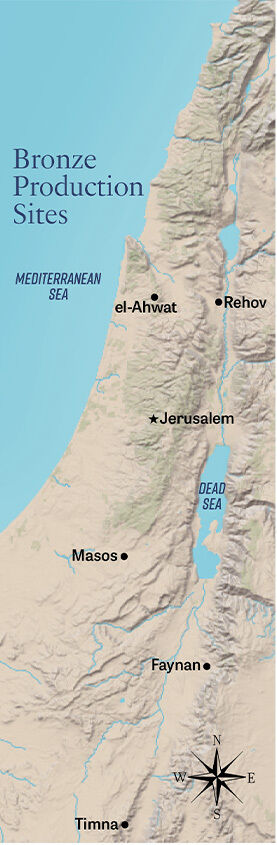
Linking the copper found at el-Ahwat with the mines at Faynan and Timna is especially intriguing. Comparative studies between the mines have shown that around 1000 b.c.e. both locations experienced identical changes in copper production.
The Bible describes this as the time the united Israelite monarchy came to power and exerted control over Edom (2 Samuel 8:14).
According to Prof. Erez Ben-Yosef, director of the Central Timna Valley Project, a profound shift was evidenced in the fact that both copper mining/smelting sites, which are separated by over 100 kilometers, began to produce the exact same quality copper around this same time. “Data suggest that significant technological changes were associated with the reorganization of the instruction around the turn of the first millennium b.c.e. … Prior to these changes, the standardization of the production across the Wadi Araba was rather poor, reflecting a different practice for each smelting site” (“Ancient Technology and Punctuated Change: Detecting the Emergence of the Edomite Kingdom in the Southern Levant,” plos One).
Thus, around 1000 b.c.e. both mines were operating on the same shared knowhow, indicating a single polity was controlling both. This material change runs concurrently with the relatively short window that bronze from Faynan and Timna appeared in el-Ahwat, toward Israel’s north, for bronze production.
Additional excavations will hopefully shed more light on the scope and production area within the site and its broader connections. “There is a general problem of dating early Iron Age sites in the Central Hill Country,” Dr. Eshel told the Times of Israel. “Many sites were excavated a long time ago, when carbon-14 dating did not exist or was much less common.”
She noted that at el-Ahwat, “some olive pits were radiocarbon-dated to the late 11th/early 10th centuries b.c.e., but they were all found in the same pit, so they are not conclusive as one individual location is not enough to date the whole site. We hope to find more samples suitable for radiocarbon dating across el-Ahwat.”
Regardless, the bronzemaking at el-Ahwat shows a unity in production and advanced metalworking knowledge, as well as a synchronized trade network of copper and tin—all evidence of a central administration, or put another way, a kingdom!
As Ben-Yosef summarized to the Times of Israel, “The study proves that copper and tin were alloyed to produce bronze locally in ancient Israel at this early date.” He added that, in his view, “a well-established Israelite kingdom did exist in the 10th century, and in light of its geographical location, el-Ahwat belonged to it.”
