
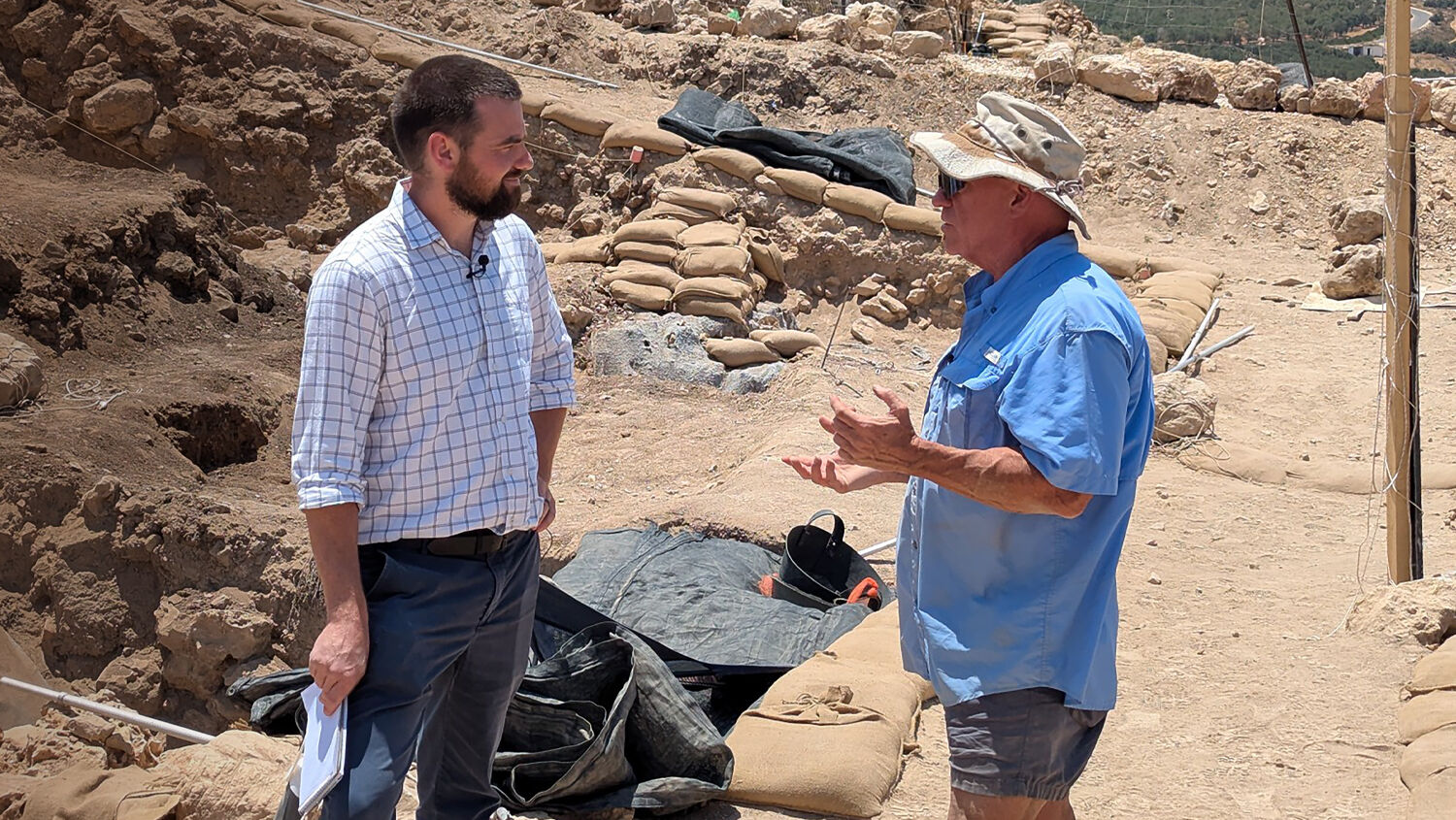
The tabernacle at Shiloh was the central focus of Israelite society during the period of the judges. In June, Let the Stones Speak podcast co-host Christopher Eames visited the site on the final day of excavation and received a tour from excavation director Dr. Scott Stripling. This is an edited transcript of their conversation.
Christopher Eames (CE): Dr. Stripling, here we are again. We like to come out every year to interview you and see how it is going at the end of the season. This is year four or five for us doing this. How many seasons has it now been for you?
Dr. Scott Stripling (SS): This is season seven. We started in 2017 and missed two years digging with the pandemic. So, it has been nine years since we started, but seven seasons of excavation.
CE: How has it been going this season? We are still in the middle of the war at the moment [referring to Israel’s ongoing war, not the 12-Day War with Iran that began two days after this interview was conducted].
SS: Well, we were aware of that, but we came anyway. One hundred thirty-five great people came with me. Last year we had 75, when the war was still sort of new. The year before that, 225. But we have had a great season, great finds. Everybody is healthy and enthusiastic. We have had the best weather we have ever had for a dig.
CE: Even still, I think your dig must be one of the biggest in terms of numbers.
SS: I have no doubt that it is definitely the biggest dig in Israel this summer. They say, “You people are crazy.”
CE: Well, I think it is great what you are doing here. And for this episode, we are going to do it a little different. Usually we sit down and do an interview. But you are kind enough to take us around the spots that you have been excavating. And where we are now is one of the key spots at the tabernacle site of Tel Shiloh. If you could tell us about where we are standing and why it is significant.
Location 1: The Gate
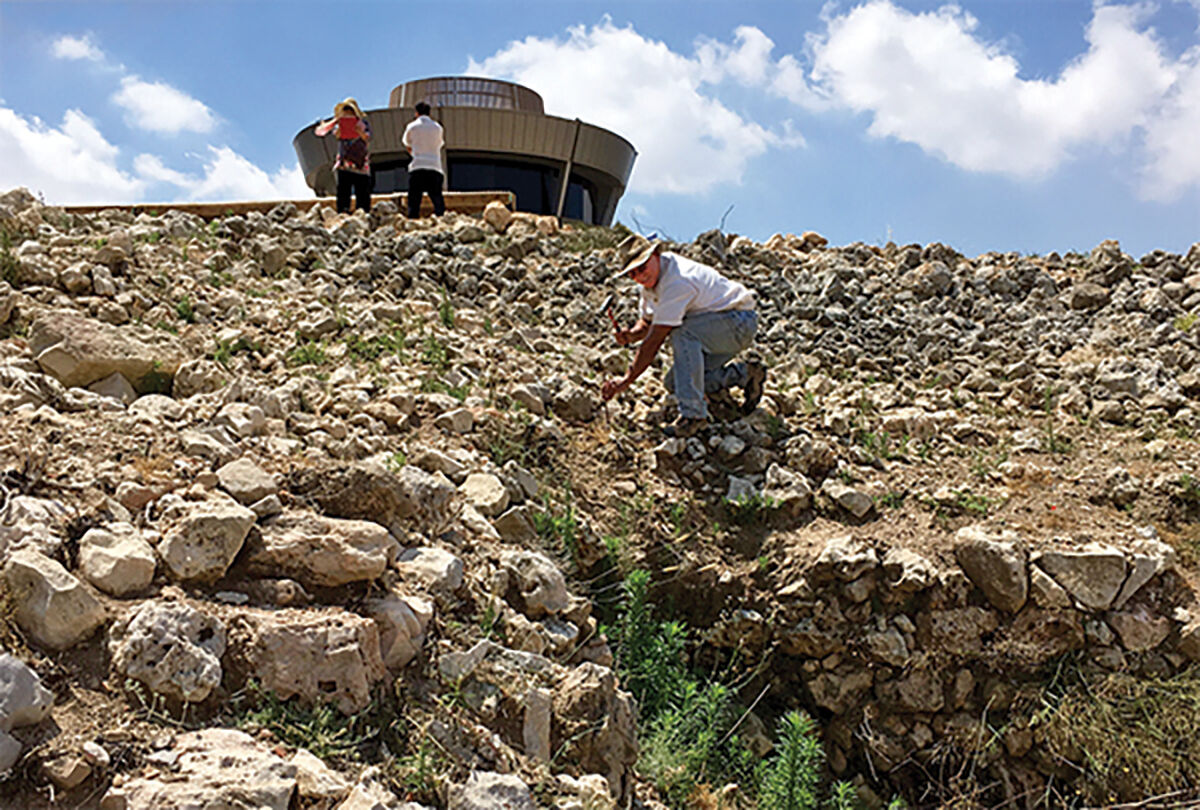
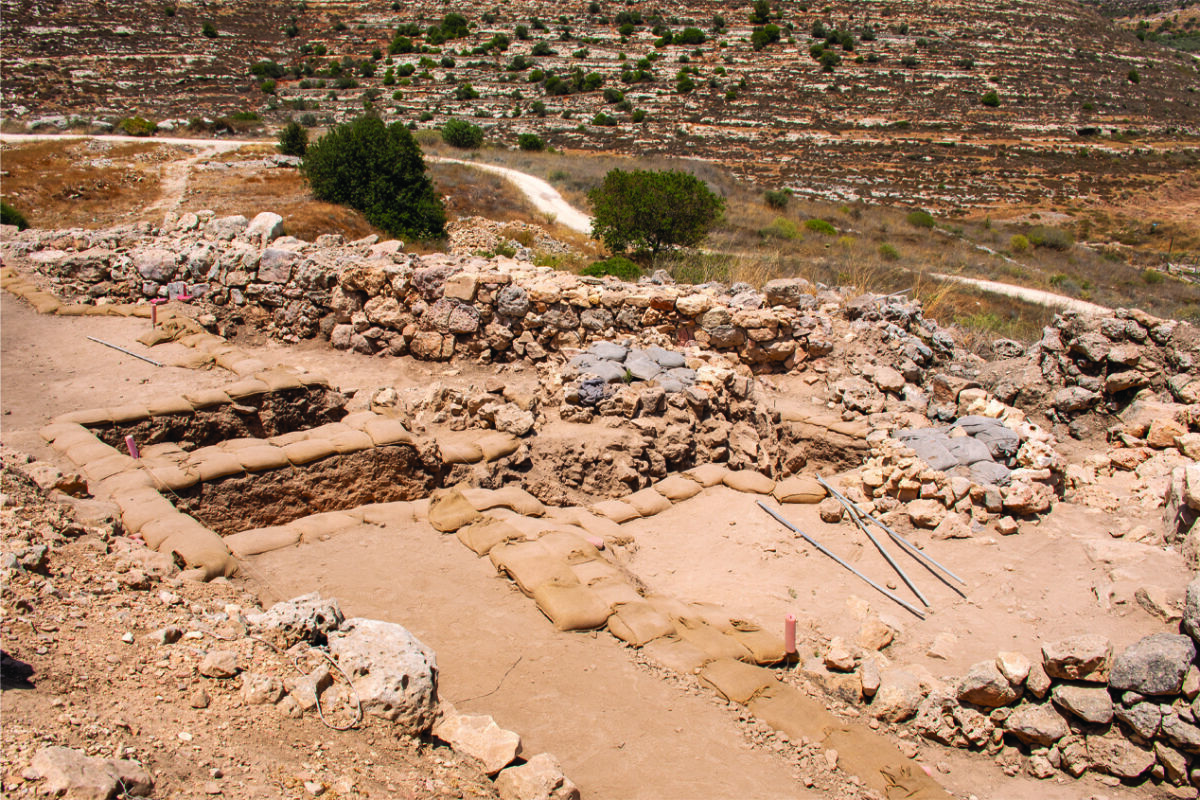
SS: If you had asked me back in 2016, “Scott, in your dream world, what would you like to find at Shiloh?” I would have said, “Well, evidence of the tabernacle of course, the gate of Shiloh that is mentioned in the Bible, and thirdly, evidence of the sacrificial system.” There is a picture of me in 2016 on this path when all this was underground. There was a huge terrace. I walked up and across that terrace, and drove the first stake for the excavation in June 2016—not realizing that where I drove the stake was the monumental building, where we now believe is most likely the location of the tabernacle. And to the north of it was the gate complex. I was very fortunate that at the area we began to excavate were the three things that were most interesting to me.
CE: As far as gates go, this is the money area for an archaeologist—finding a city gate—especially at Tel Shiloh because of its connection with some of the biblical account of what happened. Perhaps you could give us a summary of that account.
SS: First, let me give a shout out to the Armstrong Institute and Hebrew University for their work in the gate area in Jerusalem. I was just there a few days ago, and I’m convinced that you have a six-chambered gate there; so, congratulations. You’re right, this is the money spot because of what you find in gate complexes. You can find evidence of judicial activity, archival material, economic activity, even cultic activity within the gate, and the security function. Our gate is a Late Bronze Age complex; it was used into the Iron Age i, but it is different from the one you are working on in Jerusalem. We don’t have chambered gates. We have an outer arm that leads into an inner gate—so an outer gate and an inner gate.
CE: So that Late Bronze-Iron i period is late second millennium b.c.e. judges period for those linking it to the biblical account?
SS: Conquest-judges period if you’re trying to connect to the biblical account: 14th through 12th centuries.
CE: There is a link to the priest Eli, correct—as far as the account of what happens at Shiloh and in the gate?
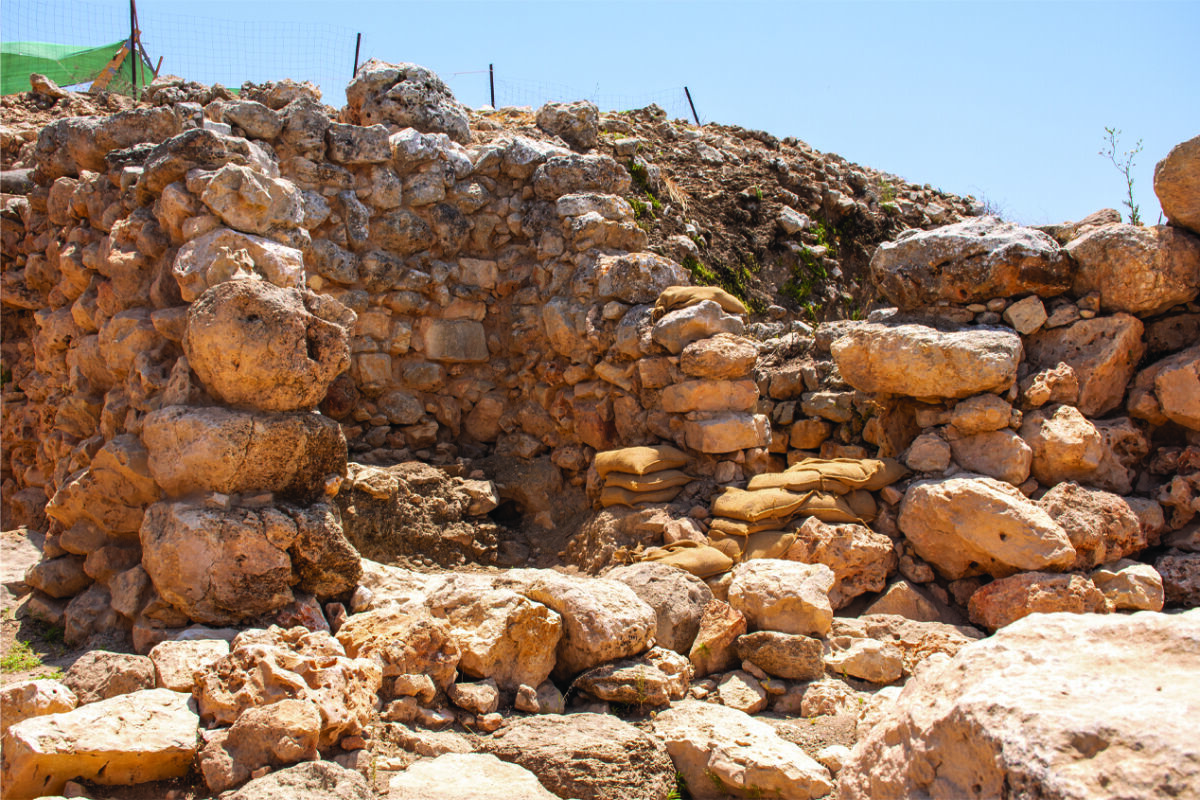
SS: Yes, it’s a tragic story. The Bible says in 1 Samuel 3 and 4 that Eli is in the gate of Shiloh, and he is watching the highway—what we assume to be the Patriarch’s Highway. The ark has been sent to Ebenezer. He sees this runner coming with tragic news that the ark has been captured. Eli hears it and falls over backward in the gate and dies. Now, until last year we never found any human bones here at Shiloh. You don’t find human bone inside a city because they bury outside the city. If you find bones in the city that means trauma, a murder, something tragic has happened. Just behind us here, we are finding pieces of just one human being in the gates. It’s interesting because we have this story and El Amarna letter 288 refers to Silu, which probably refers to Shiloh. It names two people who were murdered in the gate of Silu: Turbazu and Yaptih-Hadda. So we have three accounts of death in the gates of Shiloh, and now that’s what we are excavating.
CE: To quickly explain what this is behind us, what are we looking at here?
SS: The first clue I had was this big wall, that is Middle Bronze Age; let’s say MB3. We were way above that; so as we began to excavate it, we began to see there was no glacis or rampart here. On the other side of that wall is a rampart, and the rampart goes around the entire side. I asked myself, “Why is there no rampart here?” I thought there might be a gate or something like that. We continued to excavate and found an opening in the wall, a symmetrical opening that had a patch over it. When we removed the Byzantine patch, there was a symmetrical opening. There is only one reason you would have an opening in the wall. I thought it was at least a postern gate. As we began to come down, these pillars began to emerge. And Chris, they are preserved to their original height. You can see the niche: We put a beam in there last year to go across the top; just incredible that they are preserved to their original height. You can picture the activity going on here. On the other side of the middle pillar is in-situ pavement from the Bronze Age that is geometric in shape: diamonds, hexagons, triangles and so forth. We know that from the Second Temple Period, but it is unheard of in the Late Bronze Age. This is what’s so fun about archaeology; we think we know everything in archaeology, and all of a sudden, our paradigm gets turned upside down.
CE: You have Frankie Snyder on your team. She was the famous one who re-created this tiling for the Temple Mount compound with all of the shapes. And so, that’s what you have here essentially in the Bronze Age.
SS: It couldn’t have been any better. Yes, she used simple math to help us know what the flooring in the Second Temple looked like because she was able to crack the geometric code. Now we have geometric pavers from the Late Bronze Age. She’s excited, and I’m excited.
CE: Alright, let’s move onto the next one.
Location 2: The Favissa
CE: Dr. Stripling, where are we standing and what is it?
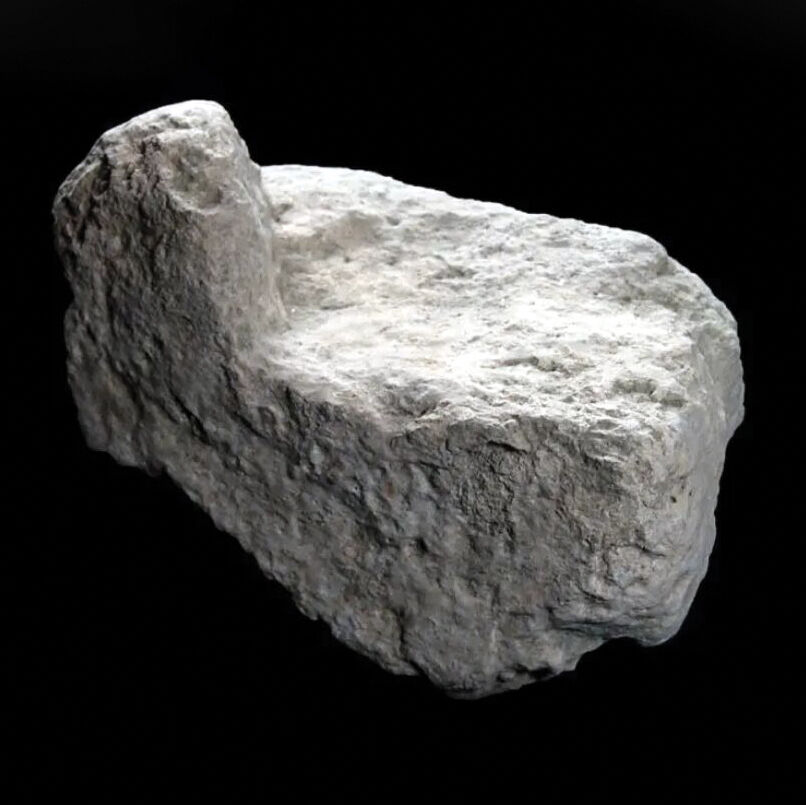
SS: You are standing right in the midst of the ancient favissa of Shiloh that dates to the biblical times. About right here, Chris, from your shoulders to your feet, this was solid bone—bone on top of bone mixed in with Late Bronze Age pottery—beautiful painted pottery, chalices, goblets, bowls—that you would associate with the sacrificial system. The building that we believe was the building of the tabernacle is due west of here. So you leave the tabernacle building and walk about 30 seconds to the edge of the site. And then they had dug a pit here where they would deposit the bones of the animal that had been sacrificed, along with the drink offering vessels. So the pottery are goblets, chalices, bowls and things that are cultic in nature, maybe a libation has been poured out. And then the vessel itself has value; it’s given over, not to be reused again. So far, we have found eight gold and silver objects in this immediate area.
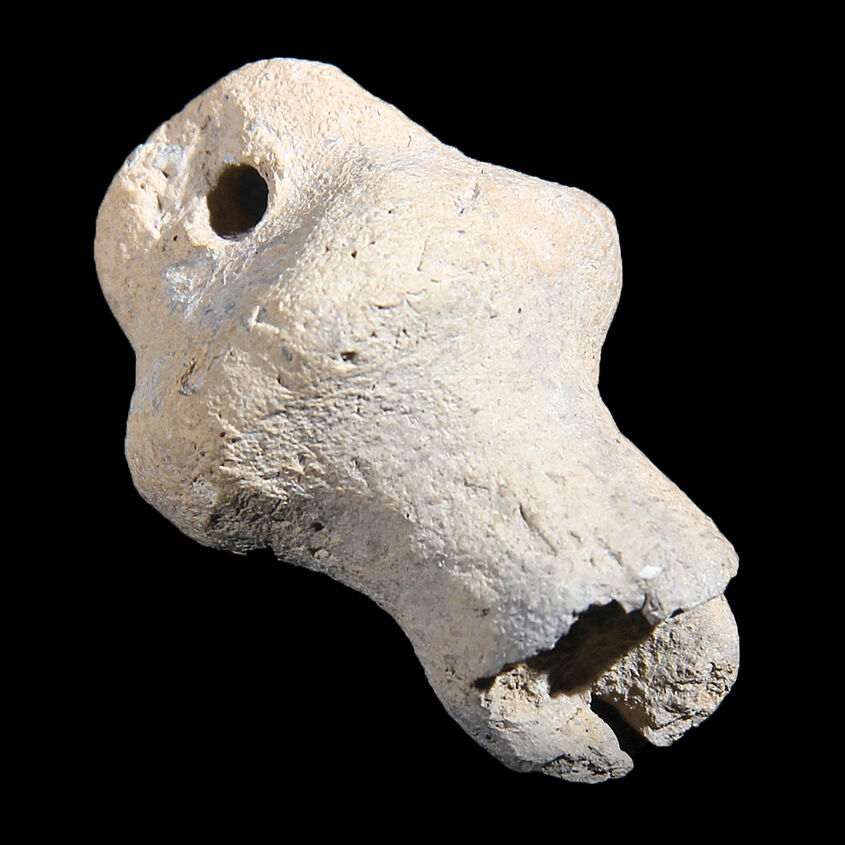
CE: You were telling us last year you found some gold stars that had been found, including a very interesting one with a face on it?
SS: That’s right; it’s very exciting. We have an article that will be coming out about those findings. In the 1980s, Bar Ilan University excavated this area for four seasons. They left the balks behind. Eighty percent of the material is in the squares; only 20 percent is in the balk. In the squares, they found one gold piece. In the balks, we found seven gold and silver pieces, and it just has to do with new technology, different and better technology. So you can extrapolate out and say, “Wow, in the dump pile, there must be 20 or 30 gold and silver objects as well.” Gold was so valuable in the ancient world; people didn’t lose it. This is something of great value. They come to Shiloh, not only with this animal and drink offerings, but they’re also depositing something that means a lot, that costs them something.
CE: What we are talking about here is sacrificial remains and remains of offerings in relation to the use of the tabernacle. And, it’s interesting that you have this burial here. Is it similar to Judaism and this concept of the genizah reburial of perhaps damaged biblical texts? You don’t want to throw them away but carefully rebury them and preserve something that is seen as sacred.
SS: That’s a very good analogy; it’s very similar to a genizah.
CE: When it comes to this area, you guys at [Associates for Biblical Research] had done a great video a few months ago clarifying some things about how this favissa or ritual burial ground operated. You mention Israel Finkelstein, who was one of the lead archaeologists back in the 1980s. He had his own ideas about when this favissa was operational, which affects when the tabernacle was potentially operational. You’ve been able to clarify some of the dates about when we start having these remains laid down. What can you tell us about the dating for the use of this favissa?
SS: Professor Finkelstein’s view was that the tabernacle had been on the summit of the tel. He believed the Israelites arrived around 1200 b.c.e. There was all this material from Canaanite sacrifices that had been piled up for hundreds of years. I suppose he envisioned that in Canaanite temples they just had big mounds of bones. He thought they removed them from the summit and dumped them all here on the edge of the tel all at one time, and so the favissa was created in 1200, the very end of the Late Bronze Age. What we have found is different from that. We have seen microstratigraphy; you can see it in the balk. There are bones sticking out of the balk, and there are layers and so forth within that. The pottery is Late Bronze Age ii, not Late Bronze Age i. He thought it was a Canaanite sacrificial system. Our view is that it synchronizes perfectly with the biblical sacrificial system. The bones coming out of this core favissa are 99.9 percent kosher as per our zooarchaeologist Prof. Haskel Greenfield. The pottery is all Late Bronze Age ii pottery. The stratification, the dating of the pottery, the radiocarbon dating, which they did not do in the 1980s and which we are now doing, all point to deposition over time. In my view, the Israelites arrive here at the beginning of the 14th century, and it matches very well with that.
CE: That’s something I would agree with about that early Exodus and early conquest model. I think it fits perfectly to what you have here, because if you take the comparatively popular late view, you have to conclude that these are Canaanite remains from these earlier periods.
SS: That’s right, because you’re talking 150 to 200 years difference, and so you would have to conclude that. Now, challenges are: Why are the bones all kosher? Why are they disproportionately from the right side of the animal? On the rest of the site, the bones are equal distribution 50/50. Here, about 55 percent derive from the animals’ right side. So it’s not one thing, but it’s sort of inductively that we draw conclusions. It’s a lot of things that build up to give us a high degree of confidence that this is an Israelite favissa.
CE: The biblical account speaks to the use of the right side of the animal.
SS: Yes, Leviticus 7. The right side of the animal is the priestly portion. Who lives at Shiloh? The priests.
CE: It all makes sense. This is amazing. On to the next one.
SS: Alright, here we go.
Location 3: The Tabernacle Site
CE: Alright, Dr. Stripling, you brought us here to the more central, northern part of the tel. Where are we standing now?
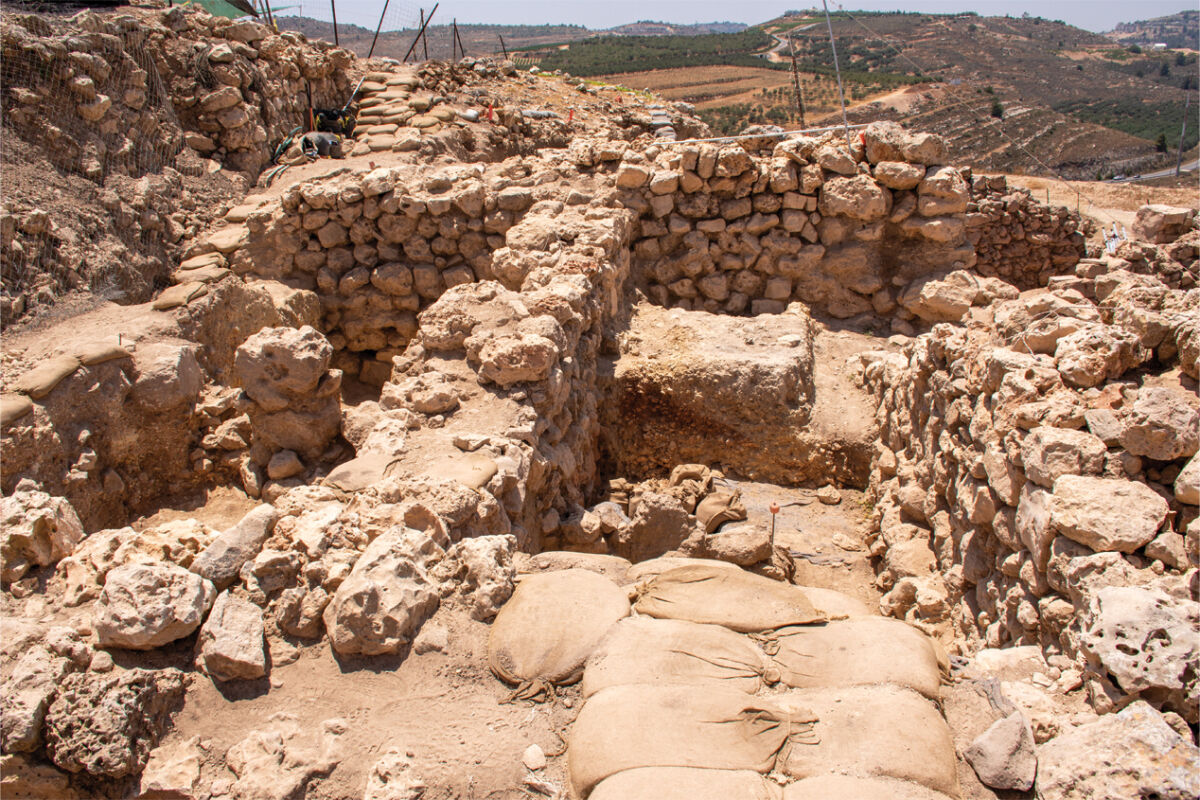
SS: We are inside a monumental building that dates from the Late Bronze Age iib to the Iron Age ib—in other words, about 1250 b.c.e. to about 1175 b.c.e. A permanent structure has been built at Shiloh according to 1 Samuel 3 and according to two places in the Mishnah. So, we find a building that is east-west oriented, matches the biblical dimensions, and it is divided on 2:1 ratios. Within this building we are finding miniature pomegranates with loops for attachment (four so far), which is a motif of the tabernacle, a demolished altar, horns as well. And as we are bringing all this area down in what we might call the holy place, then we moved into the most holy place and that is where the ark of the covenant would have been for over 300 years.
CE: Alright, Dr. Stripling, you have brought me a little further west; I feel like I should have ritually purified myself.
SS: So do I.
CE: Where are we right here?
SS: If our theory is correct, Chris, we’re in the holy of holies and literally where the ark of the covenant would have been. This is all one open area. The ark would have been about where we are standing.
CE: And do you have a parallel with the measurements for what we know of the tabernacle at that time?
SS: Right. Of course, none of us are exactly certain what the cubit was, but what’s most important is that it’s a 2:1 ratio. And so it does closely match the biblical account if we’re accurately understanding what a cubit is. But most importantly to me is it is perfectly east-west and it’s divided on a 2:1 ratio. Right here in this area is where the pomegranates are coming from. Now why is it that nowhere else on site are we finding pomegranates? Why do we only find them here?
CE: Because this must have been the place the priests were wearing them.
SS: The Bible says that the high priests, at least, were wearing bells and pomegranates on the hems of their garments.
CE: Yes, that makes a lot of sense. As far as the structure itself here, I think a lot of people will be wondering: Wasn’t the tabernacle a simple tent structure?
SS: Let me give you a short response to that. Yes, it was a tent when it was brought here. I don’t know where it would have been at that period—perhaps on the northern platform. A lot of people like that idea. But 1 Samuel 3 talks about the temple of the Lord at Shiloh. In Hebrew, the wording is very clear. Commentaries have long noted that it seems like a permanent building had been built there. Then the Mishnah says in the Zebahim 14.6 and Seder Olam 8 that a permanent building was built there at Shiloh with a tent over the top as a roof. So, it’s a quasi-tabernacle tent structure at Shiloh. Then we come along as archaeologists and what do we find? Something that matches that very description.
CE: That makes a lot of sense. The tent structure for the sojourn going place to place, but once you’re here and set up to have that permanent structure and the tent over the top.
Now, back to Israel Finkelstein. He said his theory was that it had probably been located on the top of the tel. For people thinking about where a tabernacle would be located, that would be a typical assumption: right on the very top. Is there any reason to believe it wouldn’t be on the top? Any biblical hints as to being on the north?
SS: No, in fact, I agreed with Professor Finkelstein about that. I wrote an article in 2016 stating that I thought the most logical place would have been on the summit of the tel. I never liked the idea of it being on the northern platform and being unprotected. I thought this made a lot more sense, so I was more surprised than anyone. This was the first wall: Wall 10. When that began to emerge and that was east-west, I was very interested. The next year, the perpendicular walls began to appear, then I was even more interested. And then the next perpendicular wall, and it started unfolding each year.
CE: Amazing. For me, it at least brings to mind that passage in Isaiah 14 where it talks about the throne of God in the sides of the north. And here we are on the north side.
SS: We are uncertain why Joshua chose Shiloh for the mishkan [tabernacle]. When we arrived the last two mornings, and it is almost every morning like this, there are no clouds, no fog, until you get to Shiloh. So, you’re going through Judah, through Benjamin, and when you begin to approach Shiloh (Ephraim territory), there is a big cloud hanging over it. And of course, in their mind, God dwells in the clouds. And so as we pulled in this morning, here was this cloud hanging over Shiloh. We drove up to the very top with our bus and then we were above the cloud, and we were able to look down at the cloud hovering over the proposed tabernacle area. In their minds among other reasons, that must have been an awesome thing: God descends in the cloud.
CE: There’s some amazing phenomena at the site. Some of our listeners might not be aware of the acoustic studies that have been done in this area as well. It would have been a perfect place for addressing large crowds as Joshua did, and to your point about the clouds: Amazing pictures of this site, especially in electrical storms, you see some lightning coming down right on top of the tel.
SS: Yes, of course, they interpreted that as God speaking when they saw that through the natural phenomenon, clouds and lightnings
CE: To wrap things up, what are the future plans for you guys here as the site? You’re wrapping up another season. Many more seasons planned in the same areas?
SS: Probably three more years, I think, to finish these three critical areas: the favissa, the monumental building and the gate complex. I’m going to focus all our labor, all of our attention, on those three areas. And that’s just a brilliant stopping point as far as I’m concerned. That will be 10 seasons of excavation. Although we are publishing stuff right now, we’ll put our efforts into final publications and try to get it out as quickly as possible.
CE: We appreciate that you’ve got some of the leaders in these areas who are doing Ph.D.s on this.
SS: Yeah, each one of our areas has one of my students doing Ph.D.s. Others, like Abigail, sort of sitewide; her expertise is the transition between LB ii and Iron i. So, to me that means a lot. I think we’ll have seven Ph.D.s that will come out of the dig. So not only are we understanding and clarifying the ancient record, but we’re also training the next generation of leaders.
CE: Amazing; we really appreciate the interview. What you guys are doing here is just amazing. And coming in these times as well, it’s not easy. So really appreciate it. Thanks very much for this.
SS: Thank you, Chris. We’re grateful.
