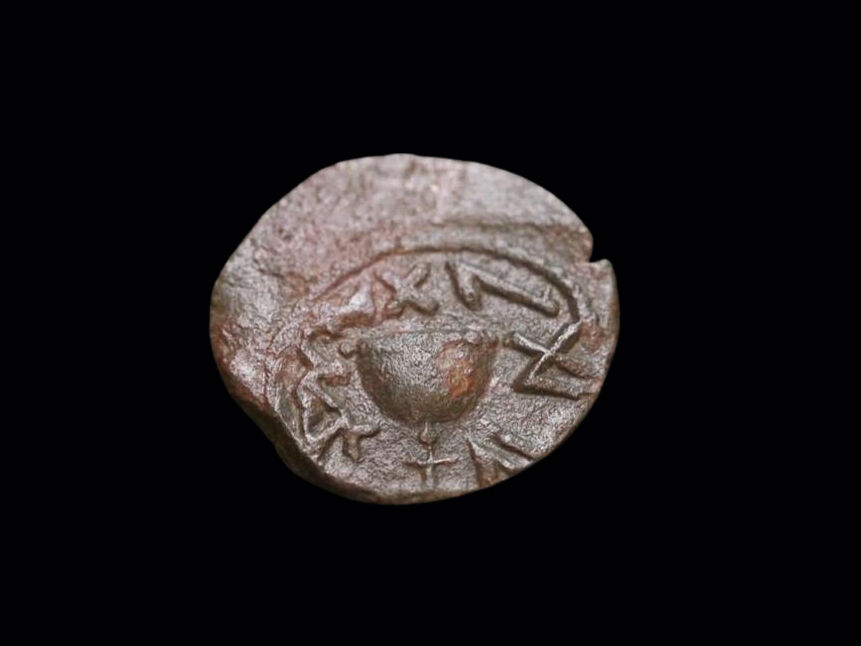
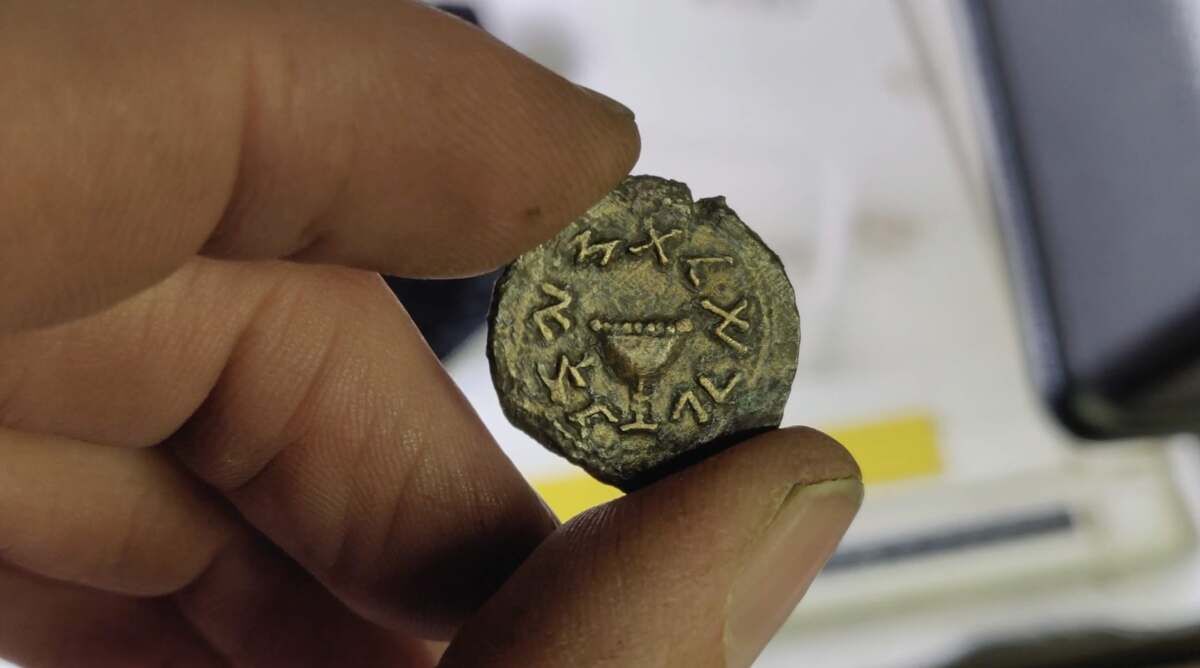
A rare bronze coin minted in the fourth year of the Great Revolt, 69–70 c.e., was discovered at the foot of the southwest corner of the Temple Mount in Jerusalem, the Israel Antiquities Authority (iaa) announced on Thursday.
This rare coin bears the inscription “For the Redemption of Zion” and was minted in the final year before the destruction of the temple.
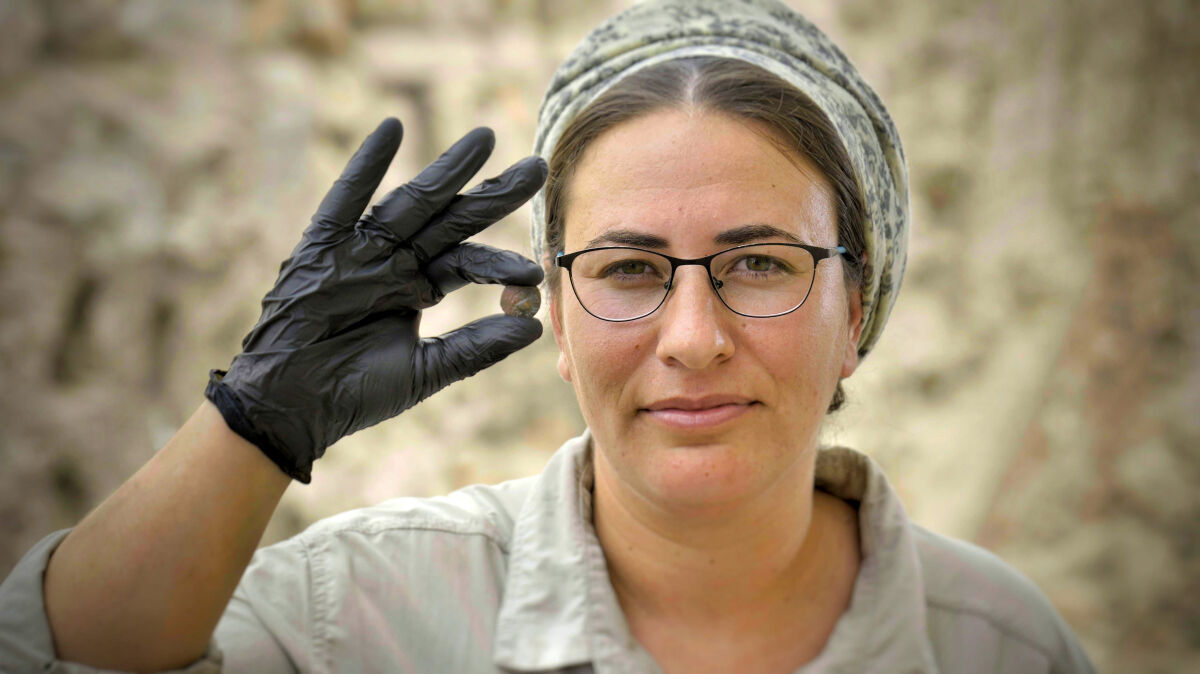
According to Yaniv David Levy, a researcher and curator in the coin department of the iaa:
The coin is made of bronze, and its state of preservation is quite good. On its obverse side you can see a model of a goblet, and around it is an inscription in ancient Hebrew script: “LeGe’ulat Zion,” “For the Redemption of Zion.” On its reverse is a lulav, a palm frond used in the Sukkot festival ritual. Next to it are two etrogs, the citron used in that same ritual. The reverse bears the inscription: “Year Four.”
The Great Revolt began in 66 c.e. as the relationship between Judea and Rome deteriorated. The Roman Empire had already granted limited permission for other local rulers to mint bronze coins, but one way for Judea to assert its dominance and independence was to mint its own currency. The Romans had previously minted coins in Jerusalem, but at the time of the revolt, that ceased and the Jews started minting their own coinage, featuring paleo-Hebrew script.
According to Levy, “The ‘Year Four’ bronze coins differ from their predecessors. Their size and weight increased significantly. The earlier revolt coin inscription, ‘For the Freedom (Herut) of Zion,’ is replaced by a new inscription—‘For the Redemption of Zion.’”
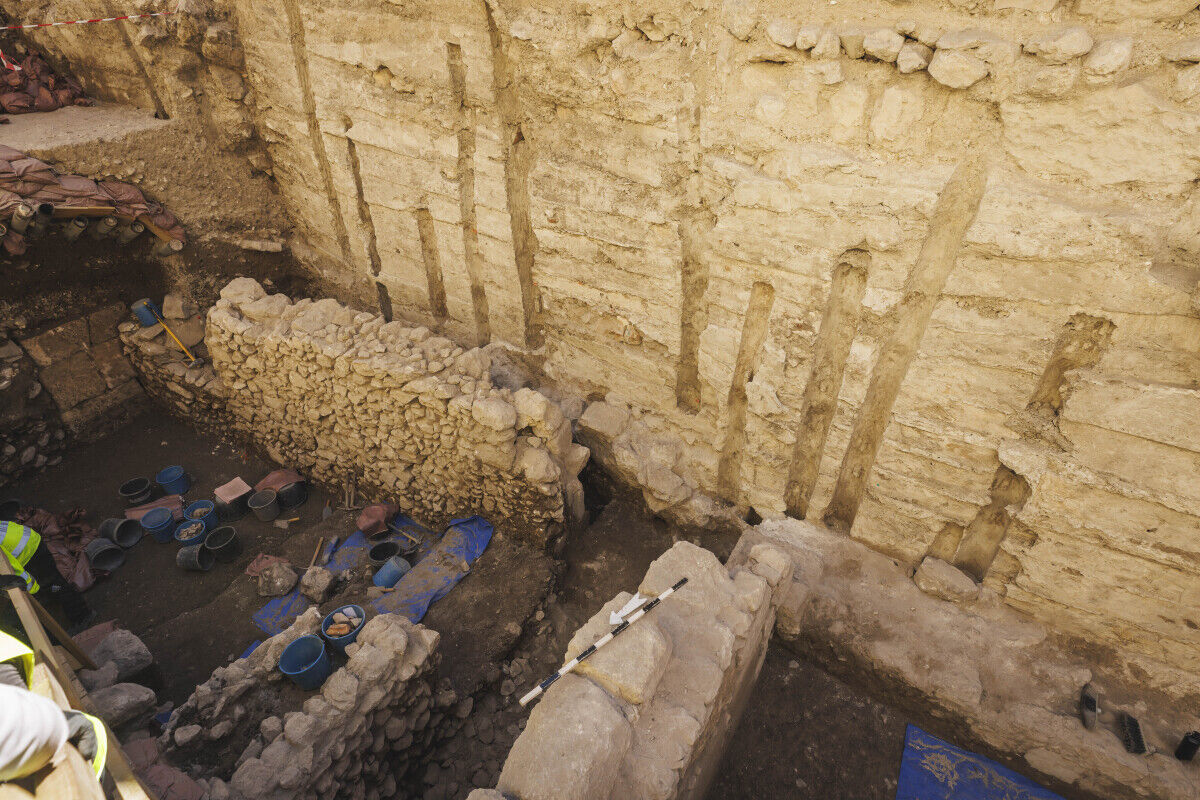
According to Dr. Yuval Baruch, excavation director on behalf of the iaa, who has researched this site for over 25 years,
The inscription on the coin—“For the Redemption of Zion,” replacing the earlier “For the Liberation of Zion”—indicates a profound change of identity and mindset, and perhaps also reflects the desperate situation of the rebel forces about six months before the fall of Jerusalem on Tisha B’Av, the 9th of the Hebrew month of Av; in August of the year 70 c.e. It would seem that in the rebellion’s fourth year, the mood of the rebels now besieged in Jerusalem changed from euphoria and anticipation of freedom at hand to a dispirited mood and a yearning for redemption.
Revolt coins are typically made of either silver or bronze. They are labeled with the year of the revolt in which they were minted. Year One corresponds to 66 c.e., while Year Four and Five coins correspond with 70 c.e., the year Jerusalem was finally destroyed. Although the revolt continued until the famous Masada fortress was captured in 73 c.e., no six- or seven-year coins have ever been discovered. This is why scholars believe revolt coins were minted in Jerusalem. When Jewish rule over Jerusalem ended in 70 c.e., so did the minting of new coins.
While revolt coins (especially Year Two coins) have been found in excavations across Israel, most have been found in Jerusalem. And in Jerusalem, the richest deposit of revolt coins has been the Ophel, the area immediately south of the southern wall of the Temple Mount, close to where this latest Year Four coin was discovered by the Israel Antiquities Authority.
During the 2018 season of the Ophel excavations led by the late Dr. Eilat Mazar of Hebrew University, Armstrong Institute staff excavated a large cave-turned-cistern that was used as a hideout by Jews during the revolt. Inside this cave, we discovered a wealth of evidence of the very last moments of the Jewish revolt—including 24 Year Four coins, which remains the largest collection of such revolt coins ever discovered in one context.
Given the time frame, it’s understandable that many Year Four coins were discovered in the rebel hideout from immediately before Jerusalem fell. Interestingly, the coins were not found all together, as one might expect. Rather, the Year Four coins (along with several Year Two and Three coins) were found littered throughout the 7-by-14-meter cave. They were found in strata correlating to the last year of the Roman revolt. And they were found alongside broken pottery vessels, including jars and cooking pots. The cave had not been disturbed since the Second Temple period, providing a “time capsule” of Jewish life during the revolt.
Since the discovery of the coin horde in the Ophel cave in 2018, more Year Four coins have been discovered almost yearly inside the archaeological park just south of the southern wall of the Temple Mount, including this latest example by the iaa.
Dr. Baruch said, “Two thousand years after the minting of this coin, we come along a few days before Tisha B’Av and find such a moving testimony to that great destruction, and I think there is nothing more symbolic.”
This unique ancient coin is being presented to the public for the first time during the family tours being held all summer at the Jay and Jeanie Schottenstein National Campus for the Archaeology of Israel in Jerusalem. The excavations were conducted by the Israel Antiquities Authority, in collaboration with the City of David and the Jewish Quarter Reconstruction and Development Company.
