
The Ipuwer Papyrus: Eyewitness Account of the Exodus Plagues?
The Nile turned to blood. Pestilence. Blighted livestock. Destroyed crops. Darkness. Frustrated magicians. Widespread death and destruction—including the loss en masse of children of both the wealthy and poor. The emancipation of a slave population—oppressors becoming the oppressed, poor becoming rich, gods rendered impotent, and goods once used to worship them now devoted to another.
Sounds like the book of Exodus, right? Actually, this is the testimony of a fascinating ancient Egyptian document known as the Ipuwer Papyrus. With so many stark parallels, many believe the Ipuwer account represents eyewitness testimony of the biblical Exodus. Others disagree. The main issue of contention revolves around the date and genre of the Ipuwer Papyrus.
In this article, we will examine the Ipuwer Papyrus, including its remarkable textual parallels with the biblical account, and address these points of contention. Does this extraordinary ancient document synchronize with the biblical text, or does it represent something else entirely?
The Admonitions of Ipuwer
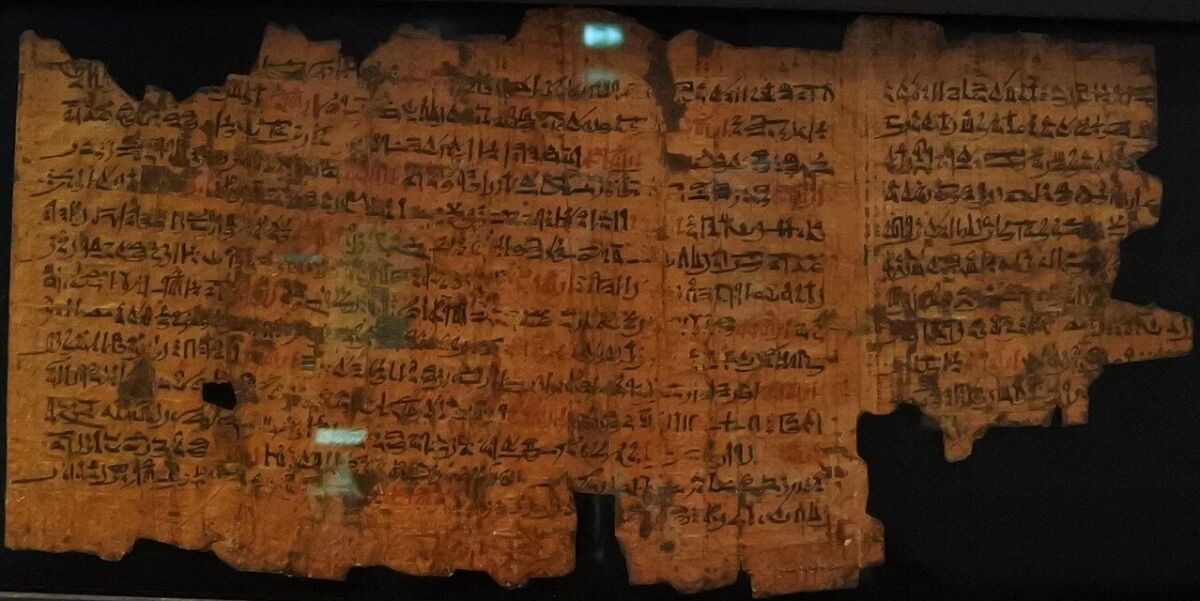
The Ipuwer Papyrus—also referred to as The Admonitions of Ipuwer and officially named Papyrus Leiden i 344 recto—is a lengthy ancient Egyptian document inked in hieratic script (cursive, as opposed to hieroglyphic). The document is nearly 4 meters (13 feet) long. This 17-column, 236-line text first came to light in the early 1800s, when it was acquired by Giovanni Anastasi, consul general of the United Kingdoms of Sweden and Norway in Egypt. Anastasi sold the document to the Dutch government in 1828, and it has since become housed in the Rijksmuseum van Oudheden in Leiden.
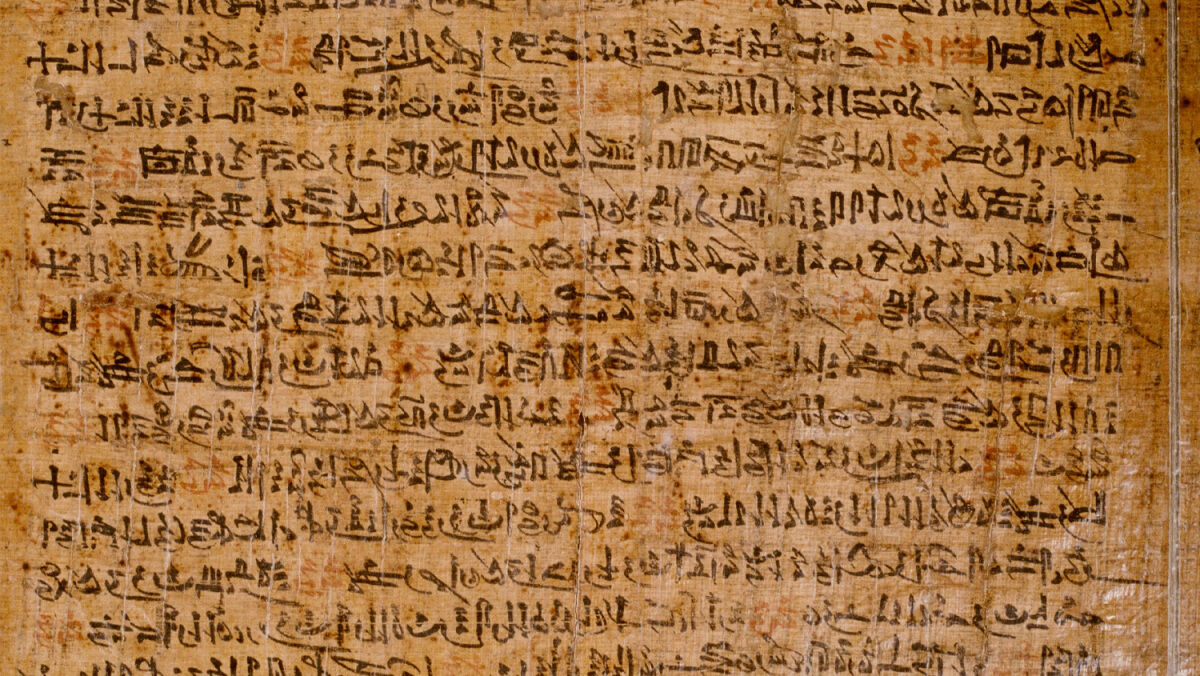
Despite its unknown provenance, there is no debate as to the artifact’s authenticity—not least because it emerged before a full understanding of the hieratic script was known. Neither is there significant debate about the date it was written. Most scholars date it to Egypt’s 19th Dynasty, sometime within the 13th century b.c.e. This is due to the Ramesside-style orthography, as well as evidence that the text most likely came from a 19th Dynasty Saqqara tomb known to have housed a significant number of papyri.
What has been highly debated is the original composition of the text. It is evident that the Ipuwer Papyrus represents a scribal copy of a document written centuries prior. When was the original written? This is a hotly debated question.
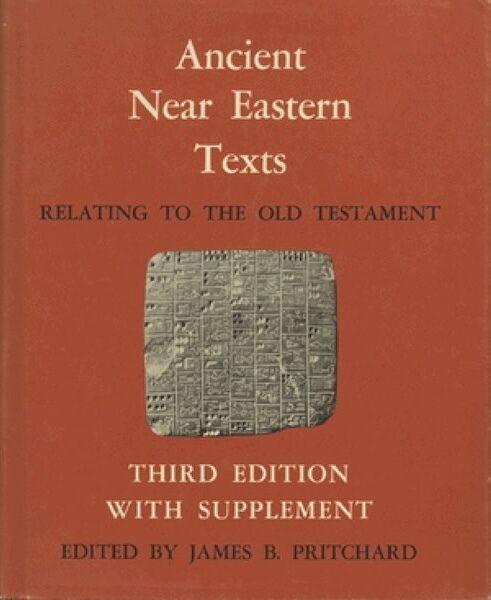
The text’s author is “Ipuwer,” a sage who addresses the pharaoh (or perhaps the sun-god Ra/Amun-Re) about the woeful state of the land of Egypt. A series of unfortunate events had befallen Egypt, turning the kingdom upside down. In James B. Pritchard’s classic work Ancient Near Eastern Texts, Egyptologist John A. Wilson wrote the following about this artifact: “It seems clear … that Egypt had suffered a breakdown of government, accompanied by social and economic chaos. … A certain Ipuwer, about whom nothing is known apart from the surviving text, appeared at the palace and reported to the pharaoh the anarchy in the land. Although our manuscript was written in the 19th [Dynasty] … the original belonged to an earlier time,” with “language and orthography [that] are ‘Middle Egyptian’”—dating somewhere around the early to middle part of the second millennium b.c.e.
In the latter part of this article, we will tackle some of the questions about the dating of the original composition and whether it is possible to harmonize it with the time frame of the biblical Exodus. But first, just how similar is the Ipuwer text to the biblical account?
The following excerpts from the Ipuwer Papyrus are a compilation of Wilson’s translation (published in Pritchard’s Ancient Near Eastern Texts) as well as that of scholar Andre Dollinger (who includes a number of additional, damaged sections that are omitted in Wilson’s text) and an additional section from that of Egyptologist Sir Alan H. Gardiner. Note too: Ipuwer’s text is poetically divided into stanzas, most of which begin with a declaration of surprise or emphasis (per Wilson, Why, really …; Dollinger, Indeed …; Gardiner, Forsooth …).
Egypt Plagued

The biblical account of the plagues famously begins with the turning of the Nile to blood. Near the start of Ipuwer’s text is one of his most famous stanzas:
- Ipuwer: “Why, really, the River [Nile] is blood. If one drinks of it, one rejects it … and thirsts for water. … [B]lood is everywhere.”
- Bible: “I will smite … the waters which are in the river, and they shall be turned to blood. … [A]nd the Egyptians shall loathe to drink water from the river. … [A]nd there shall be blood throughout all the land of Egypt …” (Exodus 7:17-19). “And turned their rivers into blood, So that they could not drink their streams” (Psalm 78:44).
Several biblical plagues, especially the fifth, affected cattle. The Ipuwer text mentions calamity relating to cattle, with the possible implication of such a shortage in the land that the Egyptians began to appropriate “cattle of the destitute” (slaves?) as well as find substitute sacrifices.
- Ipuwer: “Behold, the king’s men thrash around among the cattle of the destitute. … [G]eese … are presented to the gods instead of oxen.”
- Bible: “Behold, the hand of the Lord is upon thy cattle … there shall be a very grievous murrain. And the Lord shall make a division between the cattle of Israel and the cattle of Egypt; and there shall nothing die of all that belongeth to the children of Israel” (Exodus 9:3-4).
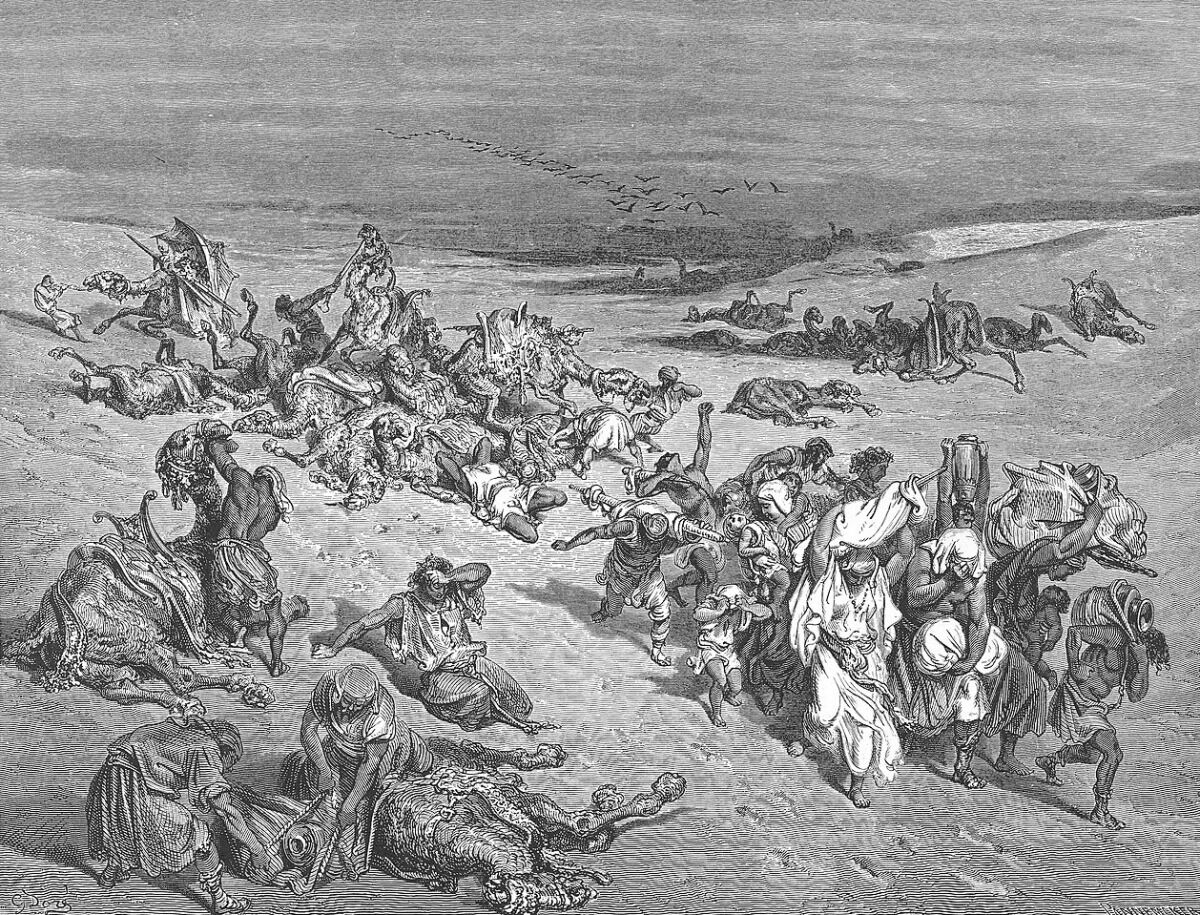
Pestilence (the sixth plague) likewise features in both the biblical account and the papyrus.
- Ipuwer: “[P]estilence is throughout the land …. There are no remedies for it; noblewomen suffer like maidservants …. Remember to immerse … him who is in pain when he is sick in his body.”
- Bible: “[I have] smitten thee and thy people with pestilence …. [B]oils were upon the magicians, and upon all the Egyptians” (Exodus 9:15, 11). “He spared not their soul from death, But gave their life over to the pestilence” (Psalm 78:50).
The seventh biblical plague was a devastating storm of epic proportions. The Ipuwer Papyrus not only refers to a storm, it records it falling on some in Egypt, not others.
- Ipuwer: “Behold, he who had no shade is now the possessor of shade, while the erstwhile possessors of shade are now in the full blast of the storm.”
- Bible: “[A]nd the Lord sent thunder and hail … such as had not been in all the land of Egypt since it became a nation. … Only in the land of Goshen, where the children of Israel were, was there no hail” (Exodus 9:23-24, 26).
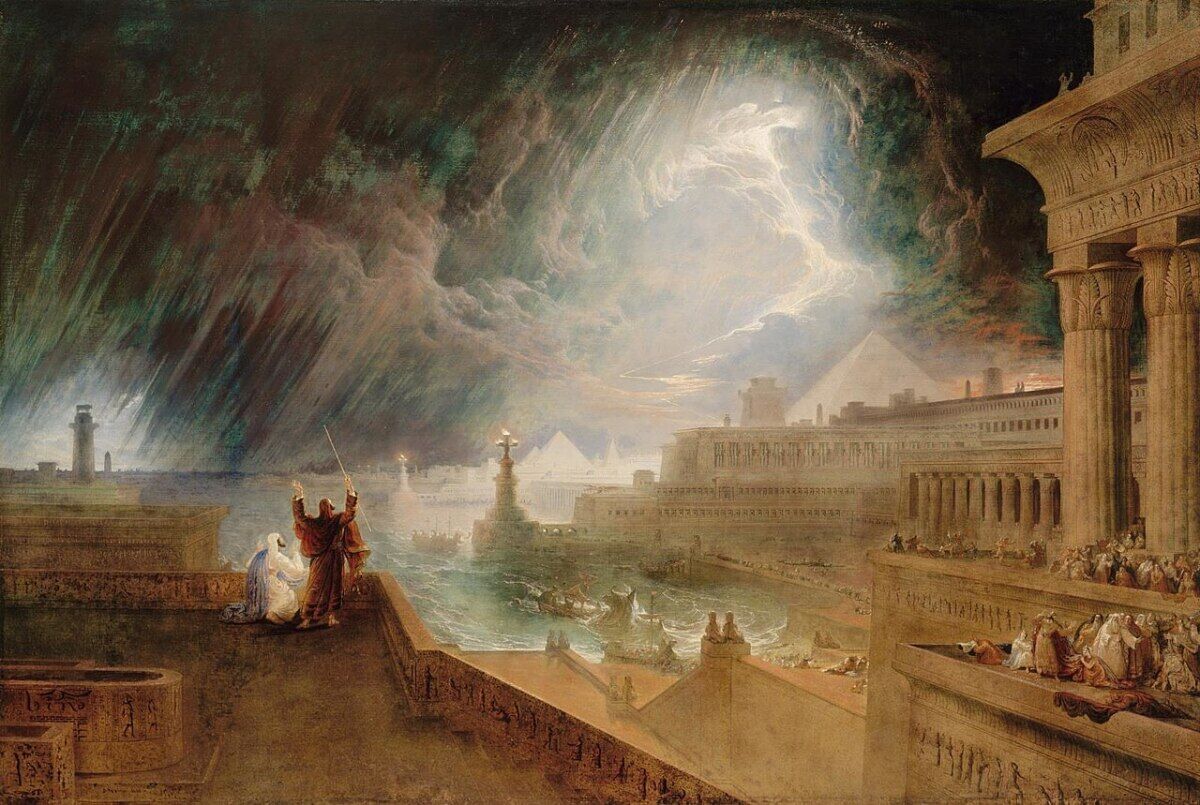
In conjunction with this biblical storm, “fire” from heaven is described.
- Ipuwer: “Why, really, doors, columns and floor planks are burned up …. [T]he fire has mounted up on high.”
- Bible: “[A]nd fire ran down unto the earth …. So there was hail, and fire flashing up amidst the hail, very grievous …” (Exodus 9:23-24). “He gave them … flaming fire in their land” (Psalm 105:32).
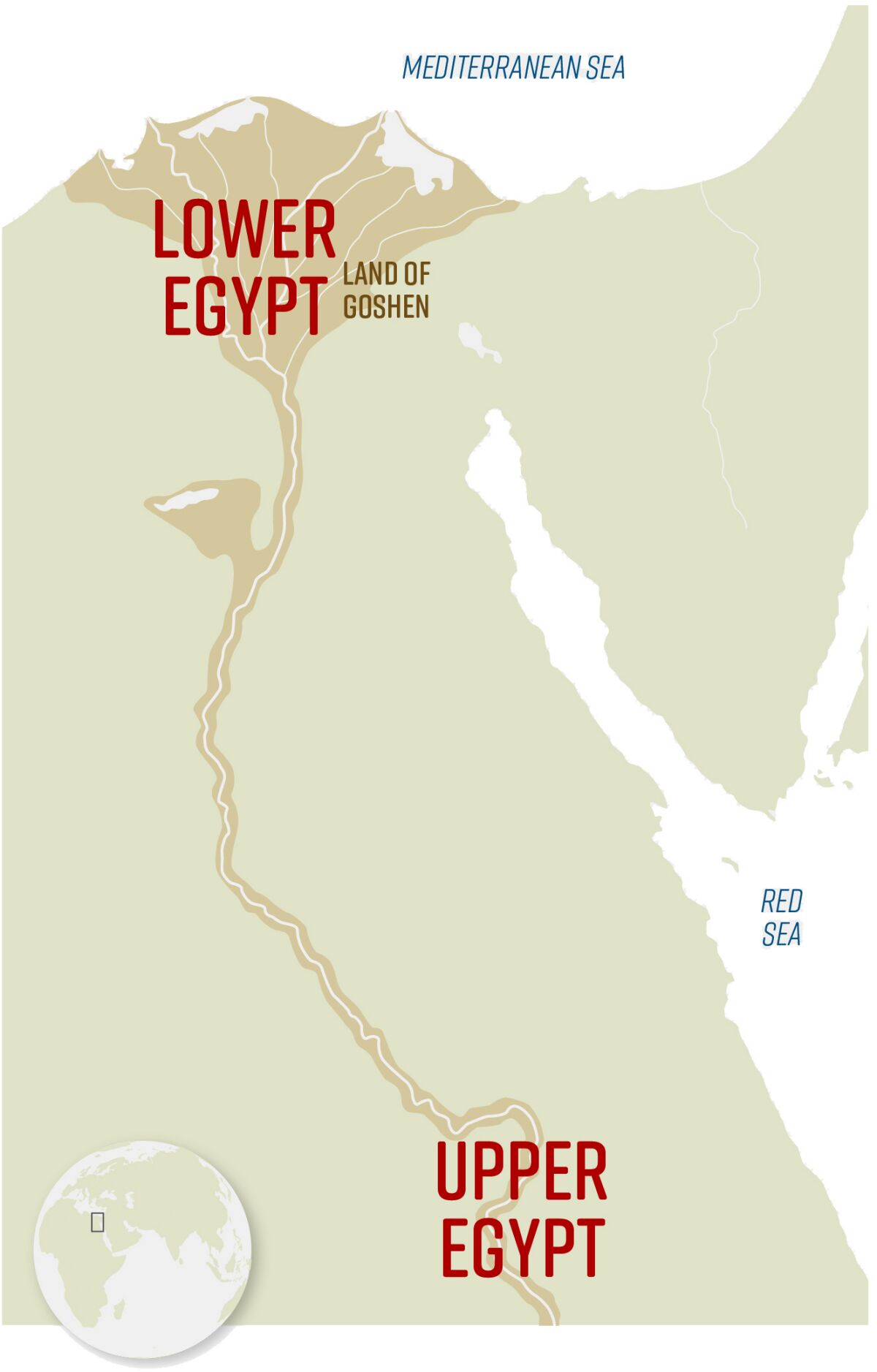
The disparate level of suffering and separation across Egypt may also be alluded to elsewhere in the papyrus. Ipuwer highlights particular destruction and ruin falling specifically upon Upper Egypt, the southern region inhabited by “native” Egyptians (as opposed to Lower Egypt, made up in large part by the Delta region of Goshen). This separation is highlighted in the biblical text.
- Ipuwer: “Indeed, the ship of the southerners has broken up; towns are destroyed and Upper Egypt has become an empty waste.”
- Bible: “And I will set apart in that day the land of Goshen, in which My people dwell …. I will put a division between My people and thy people …” (Exodus 8:18-19; verses 22-23 in other translations).
Significant emphasis is made in the biblical account on the destruction of Egypt’s agriculture, especially by the seventh plague (the storm) and by the eighth (locust swarms). Ipuwer likewise records agricultural devastation.
- Ipuwer: “Why, really, the desert is spread throughout the land. … Lacking are grain [and] irtyw-fruit …. Indeed, that has perished which yesterday was seen, and the land is left over to its weakness like the cutting of flax. … [N]either fruit nor herbage can be found …. Indeed, everywhere barley has perished.”
- Bible: “[T]he hail smote every herb of the field, and broke every tree of the field. … And the flax and the barley were smitten …. [A]nd [locusts] did eat every herb of the land, and all the fruit of the trees which the hail had left; and there remained not any green thing, either tree or herb of the field, through all the land of Egypt” (Exodus 9:25, 31; 10:15).
Ipuwer possibly even alludes to the loss of light (ninth plague) in Egypt.
- Ipuwer: “The land is not light [or, without light].”
- Bible: “[A]nd there was a thick darkness in all the land of Egypt …” (Exodus 10:22).
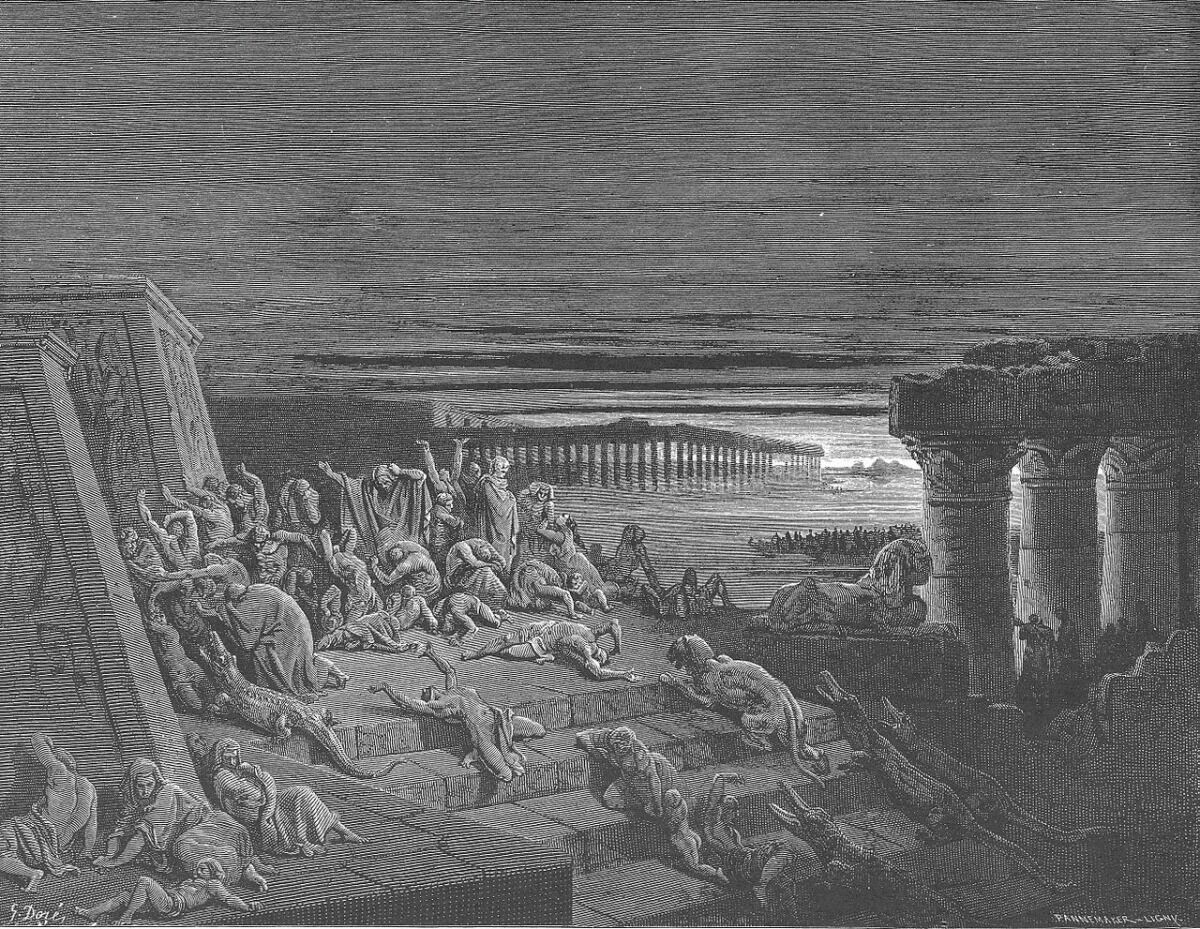
Small wonder the assessment of the land as “destroyed.”
- Ipuwer: “[I]t is the destruction of the land.”
- Bible: “And Pharaoh’s servants said unto him: ‘… let the men go, that they may serve the Lord their God, knowest thou not yet that Egypt is destroyed?’” (Exodus 10:7).
Amid all the devastation, both texts document magic and magicians as making a faltering appearance.
- Ipuwer: “Why, really, magic is exposed. Go-spells and enfold-spells are made ineffectual” (Wilson translation; Dollinger reads, “spells are frustrated”).
- Bible: “And the magicians did so with their secret arts … but they could not …. Then the magicians said unto Pharaoh: ‘This is the finger of God …’” (Exodus 8:14-15; verses 18-19 in other translations).
Widespread Death and Mourning
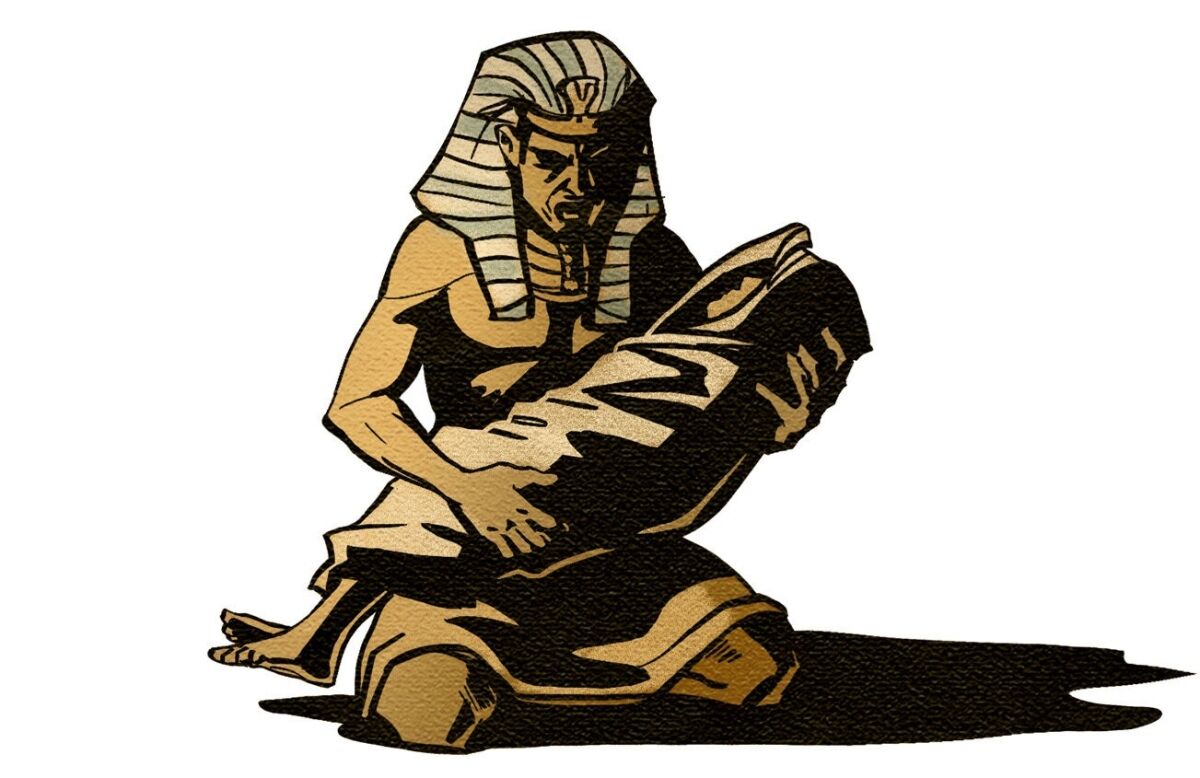
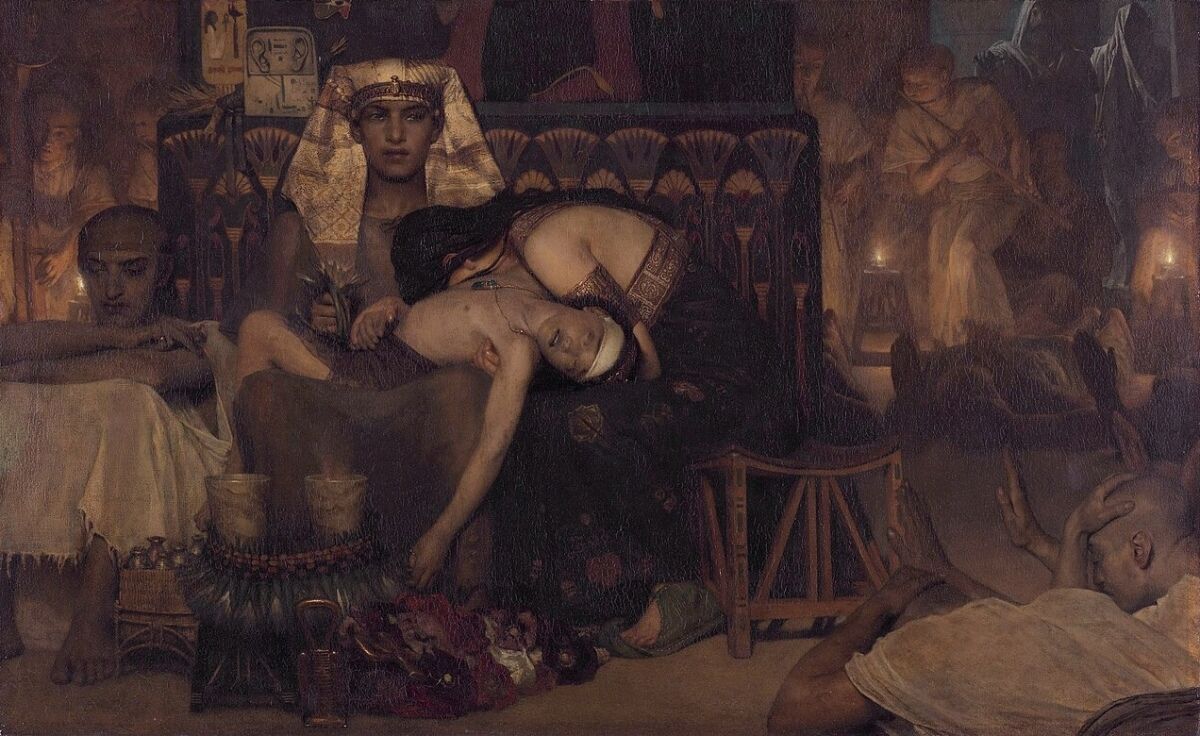
In the biblical text, the first nine plagues crescendo into the 10th, the death of the firstborn. The death angel, it is recorded, visited every household in Egypt. Widespread death is a point of particular emphasis in the Ipuwer Papyrus.
- Ipuwer: “[D]eath is not lacking, and the mummy-cloth speaks even before one comes near it. … Indeed, men are few, and he who places his brother in the ground is everywhere. … There are really no people [Egyptians] anywhere. … What shall we do for cedar for our mummies? … Indeed, every dead person is a well-born man. … Why, really, the children of nobles are dashed against the walls. The once prayed-for children are now laid out on the high ground. … Why, really, the children of nobles are abandoned in the streets. … Why, really, many dead are buried in the river. The stream is a tomb …. Why, really, crocodiles sink down because of what they have carried off—men go to them of their own accord [commit suicide] …. Behold, a man is slain beside his brother.”
- Bible: “[T]he Lord smote all the firstborn in the land of Egypt, from the first-born of Pharaoh that sat on his throne unto the first-born of the captive that was in the dungeon …. [T]here was not a house where there was not one dead” (Exodus 12:29-30).
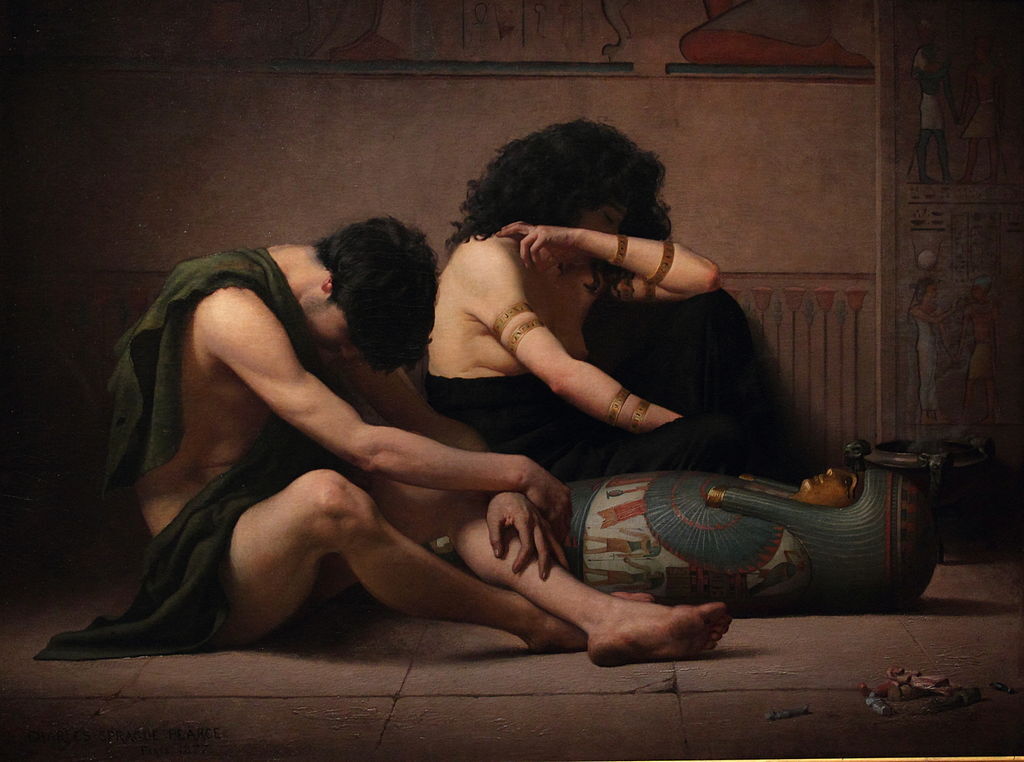
Such widespread death is naturally accompanied by widespread mourning.
- Ipuwer: “A man of character goes in mourning because of what has happened in the land. … Why, really, the face is pale. … There is no man of yesterday. … All is ruin! … Indeed, hair has fallen out for everybody …. Indeed, great and small say: ‘I wish I might die.’ Little children say: ‘He should not have caused me to live.’ Why, really, laughter has disappeared, and is no longer made. It is wailing that pervades the land, mixed with lamentation. … Ah, would that it were the end of men, no conception, no birth! Then the earth would cease from noise, without wrangling!”
- Bible: “And there shall be a great cry throughout all the land of Egypt, such as there hath been none like it, nor shall be like it any more. … And Pharaoh rose up in the night, he, and all his servants, and all the Egyptians; and there was a great cry in Egypt …. [And] they said: ‘We are all dead men’” (Exodus 11:6; 12:30, 33).
Emancipation
Exodus 12 through 14 describe the mass emancipation of Israel after the final plague. Ipuwer records something very similar.
- Ipuwer: “Every town says: ‘Let us banish many from us.’ … Those who used never to see the day have gone out unhindered.”
- Bible: “[W]hen [Pharaoh] shall let you go, he shall surely thrust you out hence altogether. … And the Egyptians were urgent upon the people, to send them out of the land in haste …” (Exodus 11:1; 12:33).
“Foreigners have become people everywhere,” continues Wilson’s translation, with the footnote that “[t]he term ‘men, humans, people,’ was used by the Egyptians to designate themselves, in contrast to their foreign neighbors, who were not conceded to be real people.” This emancipation is received with great joy among the slave class, in sharp distinction to the fear and dread of their oppressors.
- Ipuwer: “Why, really, nobles are in lamentation, while poor men have joy. … Behold, he who knew not the lyre is now the owner of a harp. He who never sang for himself (now) praises the goddess of music.”
- Bible: “[T]he children of Israel went out with a high hand in the sight of all the Egyptians, while the Egyptians were burying them that the Lord had smitten among them …” (Numbers 33:3-4). “Shout unto the God of Jacob. Take up the melody, and sound the timbrel, The sweet harp …. He went forth against the land of Egypt …” (Psalm 81:2-3, 6; verses 1-2, 5 in other translations).
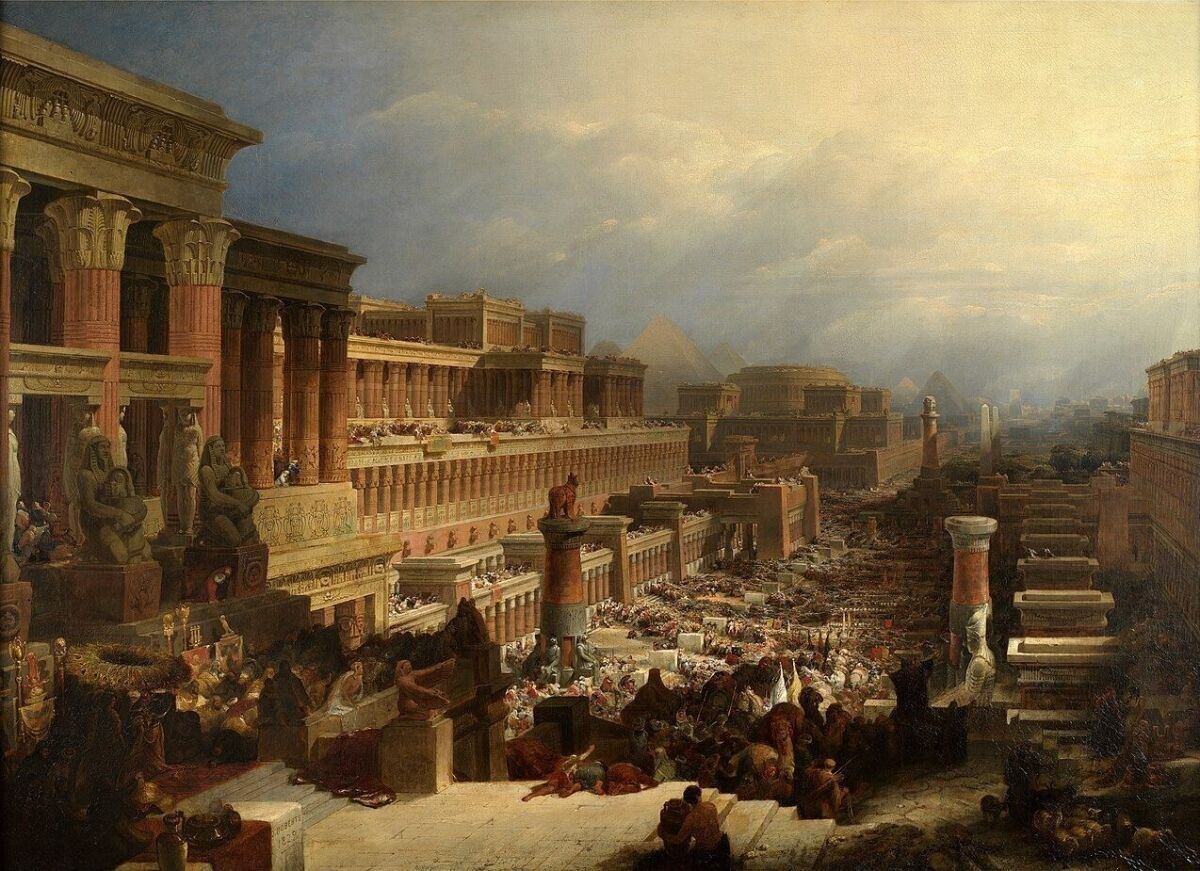
In remarkable parallel to the biblical text, Ipuwer records—with significant emphasis—that the emancipation of the slave class occurred alongside a “despoiling” of the wealthy.
- Ipuwer: “Why, really, poor men have become the possessors of treasures. He who could not make himself a pair of sandals is now the possessor of riches …. Indeed, gold and lapis lazuli, silver and turquoise, carnelian and amethyst, Ibhet-stone and [?] are strung on the necks of maidservants. … Gold is lacking. … Indeed, the poor man has attained to the state of the Ennead [deity] …. [H]e who could not make a coffin for himself is now the possessor of a treasury. … Behold, the owners of robes are now in rags. But he who never wove for himself is now the owner of fine linen. … Behold, the bald-headed man who had no oil has become the owner of jars of sweet myrrh. Behold, she who had not even a box is now the owner of a trunk. She who looked at her face in the water is now the owner of a mirror.”
- Bible: “Speak now in the ears of the people, and let them ask every man of his neighbour, and every woman of her neighbour, jewels of silver, and jewels of gold. … And the children of Israel … asked of the Egyptians jewels of silver, and jewels of gold, and raiment. And the Lord gave the people favour in the sight of the Egyptians, so that they let them have what they asked. And they despoiled the Egyptians” (Exodus 11:2; 12:35-36).
Naturally, the liberation of slaves would have left a massive void in Egypt’s workforce—and Ipuwer relates such a thing.
- Ipuwer: “Why, really, they who built pyramids have become farmers. They who were in the ship of the god are charged with forced labor. … Why, really, the Nile is in flood [overflows], but no one plows …. Behold, nobles’ ladies are now gleaners, and nobles are in the workhouse. … Behold, cattle are left free-wandering, for there is no one to take care of them.”
The point Ipuwer makes about “free-wandering” cattle, with “no one to take care of them,” is especially interesting. The biblical text describes Israel as a veritable nation of cowboys, with a special talent as “keepers of cattle.” When they first arrived in Egypt, the Israelites were charged with raising Pharaoh’s herds, a job normally regarded as an “abomination unto the Egyptians” (Genesis 46:34; 47:6).
Faith Lost, Faith Regained
Studying the events surrounding the Exodus, it quickly becomes evident that God is both reacquainting the Israelites with the God of their forefathers and waging war “against all the gods of Egypt” (Exodus 12:12; see here for more detail). Numbers 33:4 records, “[U]pon their gods also the Lord executed judgments.”
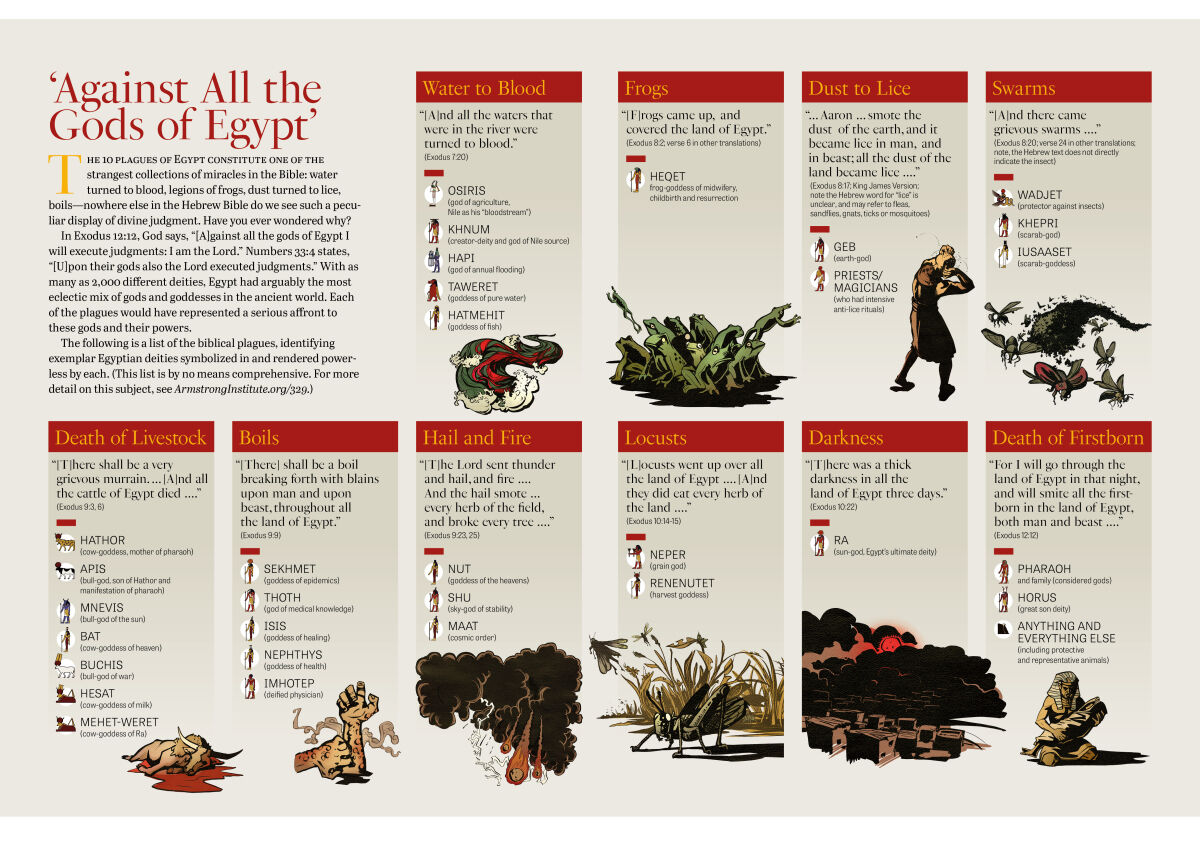
The broader text of Ipuwer’s is a rebuke of both the pharaoh and Egypt’s chief god, Ra/Amun-Re. It also highlights the impotence of other deities.
- Ipuwer: “[The god] Khnum fashions men no more …. Indeed, the hot-tempered man says: ‘If I knew where God is, then I would serve Him.’ … Khnum groans because of his weariness. … Ptah … [w]hy do you give to him? There is no reaching him. … Behold, men have fallen into rebellion against the Uraeus [cobra-goddess] …. Behold, the [deified guardian] Serpent is taken from its hole.”
Further down is the line from Dollinger, “Behold, he who did not know his god now offers to him with incense of another.” This is interesting in light of the Israelites’ lack of knowledge in the God of their forefathers (e.g. Exodus 3:13; 6:3; Joshua 24:14), as well as their request for supplies from the pharaoh in order to sacrifice to Him (e.g. Exodus 10:25).
Demise of the Pharaoh Himself?
One particularly cryptic passage in Ipuwer’s text appears to concern the pharaoh himself. From Wilson’s translation: “Behold now, something has been done which never happened for a long time: The king has been taken away by poor men.” Wilson speculates this as referring to a royal tomb robbery. Dollinger gives a different sense: “The king has been deposed by the rabble.”
These translations are suspiciously close to the sense given in the biblical account—of a pharaoh drawn away after the departing “poor” (Exodus 14:5-8; Psalm 136:15), with both him and his kingdom “overthrown.”
Another cryptic passage appears shortly after. From Dollinger: “Behold, Egypt is fallen to pouring of water, and he who poured water on the ground has carried off the strong man in misery.” This strong man carried off in misery may likewise be a reference to the king, “taken away by poor men.” But who is this mysterious pourer of water, who brought about his—and Egypt’s—demise?
The Exodus account identifies Moses—long prior to any of the plagues—as “he who poured water on the ground.” Exodus 4 reads: “[I]f they will not believe … neither hearken unto thy voice, that thou shalt take of the water of the river, and pour it upon the dry land; and the water which thou takest out of the river shall become blood upon the dry land” (verses 8-9). This act was to be the sign that Moses was chosen by God.
The Source of the Trouble
Whom does Ipuwer ultimately blame for the source of the trouble that befalls Egypt? The latter part of his text addresses this question. Once again, it is in poetic form—and unfortunately, the last two columns are entirely unreconstructible—but a certain picture begins to emerge. From Dollinger’s translation: “He brings coolness upon heat; men say: ‘He is the herdsman of mankind, and there is no evil in his heart.’ Though his herds are few, yet he spends a day to collect them, their hearts being on fire. Would that he had perceived their nature in the first generation; then he would have imposed obstacles, he would have stretched out his arm against them, he would have destroyed their herds and their heritage.” Would that whoever let these people and their herds into Egypt have stopped them from the outset.
Elsewhere, Ipuwer states: “What the ancestors foretold has arrived.”
This rather remarkably parallels the account of the Israelite entrance into Egypt’s Delta, with “their cattle, and their goods, which they had gotten in the land of Canaan” (Genesis 46:6)—the initial symbiotic relationship with the inhabitants of Egypt—their eventual enslavement and the ultimate collapse of Egypt—all elements that were foretold to the ancestors (e.g. Genesis 15:13-16).
But What About the Date?
When comparing the Ipuwer Papyrus with the biblical account, the similarities are, in a word, astonishing. It seems plain that both texts record the same event.
There is, however, significant dispute over this association. The key contention is over the speculated date for the original composition of the Ipuwer Papyrus: It is generally dated to a time earlier than any of the common dates for the biblical Exodus, which generally fall within Egypt’s New Kingdom Period (especially between the 15th to 13th centuries b.c.e.; see here for more detail).
A typical view of the text among scholars, especially early on, was that it describes a period of upheaval between Egypt’s Old Kingdom and Middle Kingdom periods—a time known as the First Intermediate Period (circa 2160–2040 b.c.e.). This very early date was a key reason for Dr. Immanuel Velikovsky’s infamous development of a radical new chronology, down-dating Egyptian history across the third and second millenniums b.c.e. by up to 600 years in aligning the text to the 15th century b.c.e. This novel chronology quickly gained public support. Yet over the decades, a continual unraveling of the theory eventually led to its abandonment by many proponents (see our article “Thoughts on Velikovskian Chronology—From One of Its Staunchest Former Proponents”). An alternative, less-extreme (and similarly popular) revisionist view is promoted by David Rohl, who down-dates the history of Egypt across the second millennium b.c.e. by roughly 300 years. Yet his chronology likewise comes with difficulties and contradictions (see, for example, “Was Ramesses II Shishak?”).
I am not against chronological revision with merit—especially for Egypt’s earliest periods (for example, read “The Curious Conflict Between Radiocarbon Dating and Early Egyptian Chronology”). Yet Egyptian chronology from the early second millennium b.c.e. onward is by now generally well cross-corroborated and harmonized, with comparatively small margins of error (decades, rather than centuries). But does correlating Ipuwer and the Exodus require chronological realignment at all?
18th Dynasty Ipuwer?
This is a question archaeologist Dr. Titus Kennedy tackles in his 2022 Bible and Spade article “Ipuwer vs. the Exodus Plagues.” In his article, Kennedy makes a case for dating the text to within the 18th Dynasty (circa 1550–1292 b.c.e.)—more specifically, within the earlier part of the 18th Dynasty—around the 15th century b.c.e.
“First, it is noted that the poem contains numerous linguistic features of a late form of Middle Egyptian, meaning it does not appear to fit into a composition time of the First Intermediate Period or the Middle Kingdom,” Kennedy wrote. Note that Middle Egyptian language is not restricted to the Middle Kingdom Period (circa 2040–1700 b.c.e.), but rather continues on until circa 1350 b.c.e.—near the end of the New Kingdom Period’s 18th Dynasty. Kennedy continued: “[A]rchaisms in paleography and orthography appear to be consistent with the Second Intermediate Period or the 18th Dynasty. Gardiner, in a translation and study of Ipuwer, also noticed New Kingdom spelling and grammar elements and even remarked that the text could be from the early 18th Dynasty (ca. 16th-15th century b.c.).”
Sir Alan H. Gardiner’s 1909 publication The Admonitions of an Egyptian Sage From a Hieratic Papyrus in Leiden noted: “It is true that we have no means of telling in what style of language literary texts of the early 18th Dynasty were written; and it is of course possible that our text may have been composed while the Hyksos were still in the land.” While preferring an earlier date, he noted that the “view that our Leiden papyrus contains allusions to the Hyksos has the better support from the historical standpoint …. It is doubtless wisest to leave this question open for the present.”
Kennedy continued to list points in favor of a later composition:
Mention of kftjw (Crete), however, is known first from the early 18th Dynasty in Papyrus Ebers, pushing the possible date of Ipuwer into the New Kingdom and the 18th Dynasty. The New Kingdom preposition r-Ht (“under the authority of”), which is not attested in the Middle Kingdom … [may] echo the time when the text was composed, meaning no earlier than the 18th Dynasty. …
Another line that could have links to the composition date mentions that the Medjay are “well disposed toward Egypt” …. The Medjay essentially became a police force at the beginning of the New Kingdom in the 18th Dynasty under Ahmose i ….
In The Admonitions of Ipuwer, Asiatics [Levantines, including Israelites] are also presented as a serious threat, and the extreme negative attitude of the Egyptian mind toward Asiatics suggests the likelihood of either the period when the Hyksos ruled Lower Egypt or the 18th Dynasty.
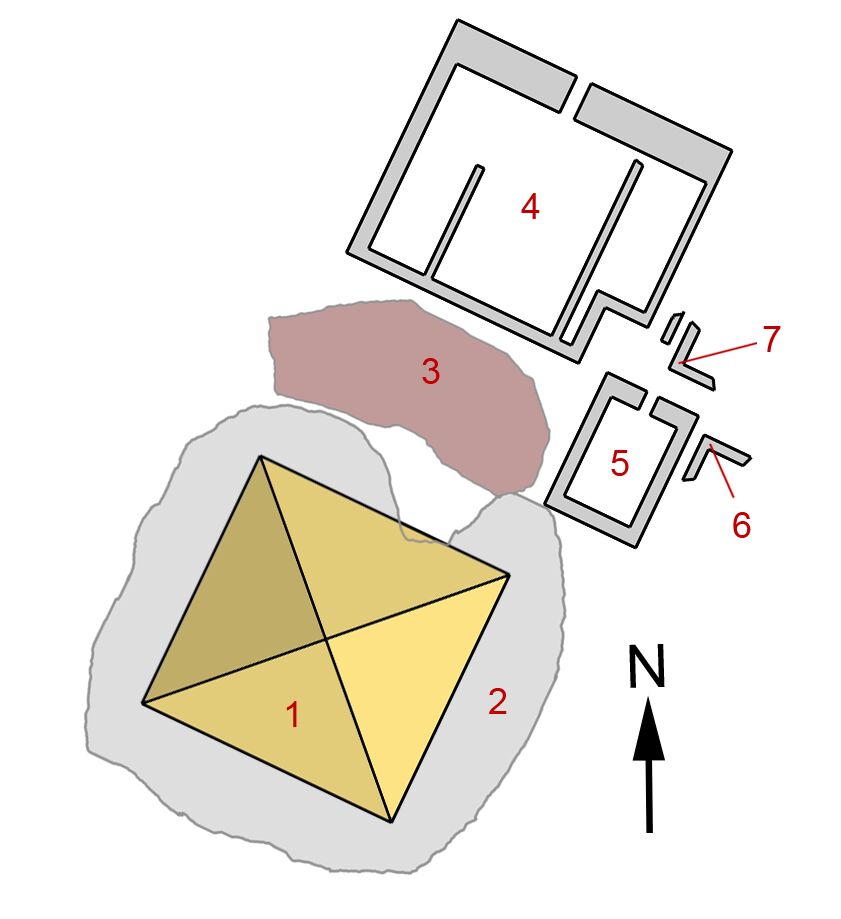
Ipuwer, in his text, longs to return to a time of pyramid-building. “It is indeed good when the hands of men build pyramids,” he states. At face value, this may be seen as fitting well with the period just following the golden age of pyramid-building—the Old Kingdom Period (including the pyramids dominating the Giza Plateau). Yet it is worth remembering that pyramid-building continued on into the mid-second millennium b.c.e.—up until the early 18th Dynasty, with the Pyramid of Ahmose (mid-late 16th century b.c.e.) as the last royal Egyptian pyramid built.
Of particular interest in the question of dating is the very name of our bard, Ipuwer. This is a name in vogue from the 19th century b.c.e. through to the 15th century b.c.e., with one notable example from the early 15th century b.c.e. (during the co-regency of Hatshepsut and Thutmose iii). More interestingly, the name also appears on the now-lost Daressy fragment—a portion of a 19th Dynasty tomb portraying “influential people in Egyptian history”—“kings, high priests, viziers and a group of ‘royal scribes’ that included Ipuwer, who was given the title ‘overseer of singers,’” wrote Kennedy. He noted the positioning of this figure relative to the others, with “Ipuwer appearing in the lower section of the Daressy fragment, apparently indicating that he belonged to a period later than those of the Old Kingdom, First Intermediate Period, and Middle Kingdom,” yet “prior to the 19th Dynasty,” during which time he was portrayed. It seems obvious that this notable Ipuwer must have been none other than the protagonist of this legendary text—“a famous bard or poet from the past whose works were known and sung.” Conversely, Kennedy noted that such an Ipuwer is not mentioned on the “Eulogy of Dead Writers” from the 20th Dynasty, “which covered authors of the Old Kingdom, First Intermediate Period, and Middle Kingdom (Papyrus Chester Beatty iv). Therefore, it seems that Ipuwer was recognized as living in either the Second Intermediate Period or the 18th Dynasty.”
He concluded: “The Admonitions of Ipuwer seems to have been either rewritten with phrases and words that came into use during the 18th Dynasty or originally composed during the 18th Dynasty. … When an examination of specific words and phrases used in The Admonitions of Ipuwer is added to the evaluation, a composition in the 18th Dynasty appears to be the convergence point.”
And as we have argued at length elsewhere, it is precisely during this 18th Dynasty—specifically, within the 15th century b.c.e.—that the biblical data converges for the date of the Exodus (see here and here for more detail).
A Generic Lament?
In modern scholarship, the intriguing and compelling comparisons between the Ipuwer Papyrus and the biblical text are increasingly irrelevant. Broader consensus now sees the Ipuwer Papyrus not as reflective of some catastrophic real-world historical event but rather as generic Middle Kingdom lament literature. This change in perspective is “due to modern trends in historiography and hermeneutics, the lack of historical parallels in Egyptian historical documents, and the vague information on chronological setting,” wrote Kennedy.
Prof. Joshua J. Mark subscribes to this view of the text as part of a didactic “wisdom literature” genre, though grants that Ipuwer’s text stands out above others in its extreme portrayal of the state of Egypt. “This urgent tone of the text, combined with when it was first translated, led a number of scholars in the 20th century to conclude that it was historical reportage, not literature; this theory, however, has been discarded,” he wrote in his article “The Admonitions of Ipuwer: A Tale of Chaos and the Importance of Government.” He continued:
Scholars working on these texts in the 19th and 20th centuries were operating from the old paradigm of the Bible as history, and so, except in cases of texts concerning obvious mythological themes and characters, literary works were taken as historical. …
The Admonitions of Ipuwer stands as a complex and incomplete work of Egyptian literature. The beauty of the piece comes from the recognition of the reader who understands that one’s present misfortunes are nothing new. People throughout time have experienced the same doubts, frustrations and fears that one knows in the present day. This concept may not seem to offer very much comfort, but there is consolation in knowing that what an individual was able to survive over 3,000 years ago is equally survivable in the present. …
To claim that literature, or scripture, must be “true” to be relevant diminishes the worth of such works collectively. … The Admonitions of Ipuwer is a poignant expression of one writer’s experience of life at a given time. Understood in this way, as literature, the work continues to speak through the centuries; misinterpreted and propagandized as history, the piece is meaningless because the “history” it represents never happened as depicted.
Yet is this answer—so typical of “modern historiography and hermeneutics”—satisfactory?
Is Ipuwer’s dramatic text merely a symbol for our daily struggles in life? The Nile turned to blood. Pestilence. Crops destroyed. Well-born children dead. Magicians frustrated. Slaves emancipated. Egyptians despoiled. And what about the parallels with the biblical text? Should we simply ignore the extraordinary similarities between the biblical text and the Ipuwer Papyrus as the product of mere coincidence?
That is a question every reader will have to answer for themselves.
Sidebar 1: Missing Plagues?
It’s a reasonable question: If the Ipuwer Papyrus is referring to the Exodus plagues, why are some left out? The text contains no explicit reference to “frogs” (the second plague), “gnats/lice” (the third plague) or “flies” (the fourth plague), for example.
Keep in mind that significant portions of the text are damaged and missing. More important, however, is the fact that this is a post-catastrophe poetic lament—not a bulletin reporting of to-the-minute events. In many ways, the text is comparable to the biblical Psalms, which also only list certain plagues. Psalm 78, for example, omits plagues three, six and nine; Psalm 105 omits plagues five and six. Furthermore, each lists the plagues nonsequentially: Psalm 78 lists plagues one, four, two, eight, seven, five, ten; Psalm 105, plagues nine, one, two, four, three, seven, eight, ten.
Thorough and sequential narrative prose is hardly to be expected from poetic songs. The same holds true of the Ipuwer Papyrus—the poetic lament of an Egyptian bard, painting a more general picture of the catastrophe to have befallen Egypt.
Sidebar 2: Plague Wars?
The duration of the 10 plagues is a point of debate. While the text is not explicit, clues in the biblical text lead to estimates ranging from months to a year (e.g. Exodus 9:31). During this time, discontent would surely have been fomenting among the populace. Is it too much to imagine that Egypt was without uprising at this time?
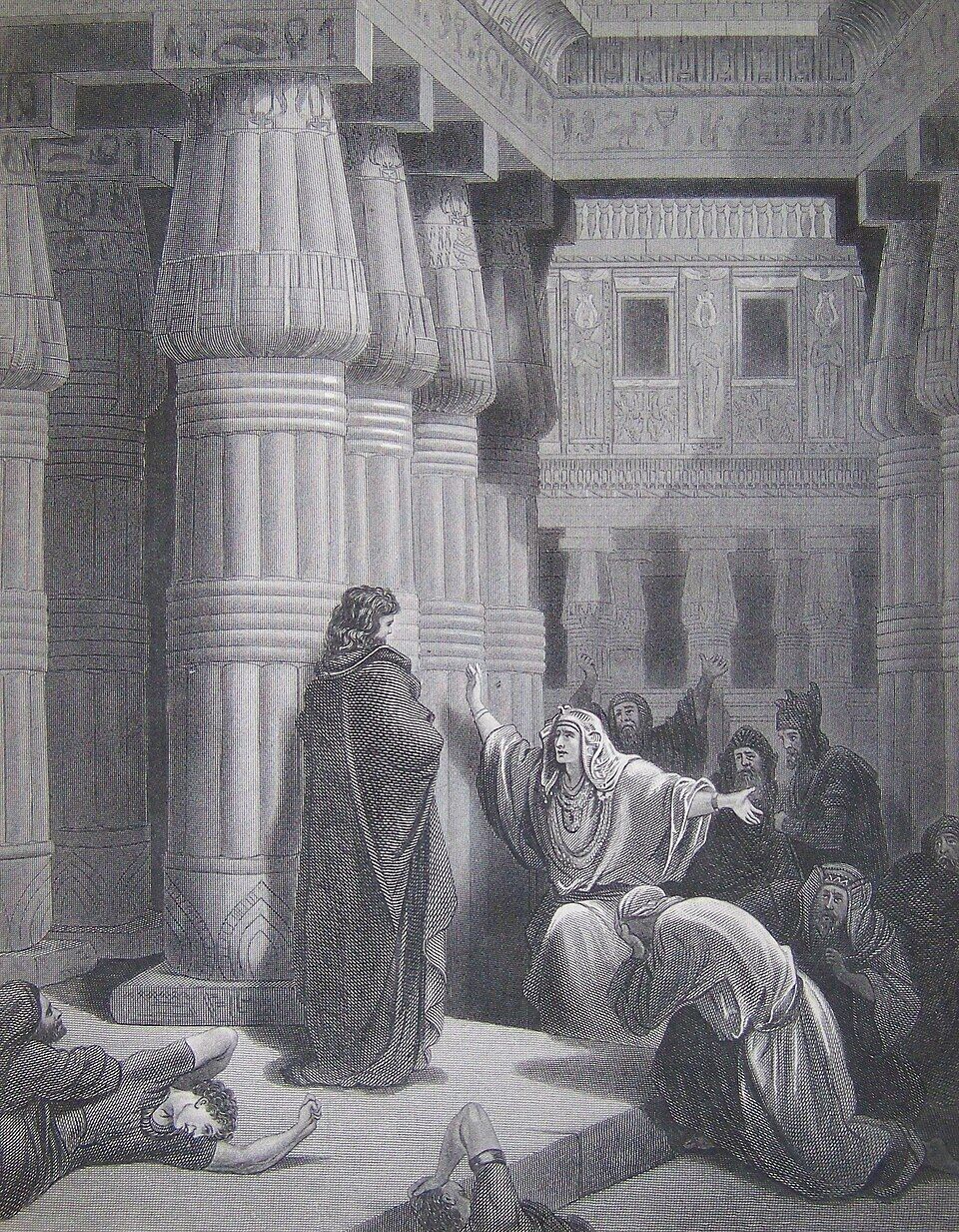
It’s easy to focus on the obstinance of Egypt’s pharaoh and overlook the mindset of the Egyptian population. Interestingly, by the end of the seventh plague, Pharaoh’s advisers were begging him to let the Israelites go. “[K]nowest thou not yet that Egypt is destroyed?” (Exodus 10:7)—an extraordinary statement from the rank and file to the deified ruler of Egypt.
While the Bible is not explicit, Jewish tradition—rooted in a clue found in Psalm 136—holds that such discontent indeed culminated in armed insurrection among the Egyptians against the Pharaoh and his men—something known as the “War of the Egyptian Firstborn.”
Psalm 136:10 states: “To Him that smote Egypt in their first-born ….” This is commonly taken to refer simply to the death of the firstborn—but the turn of phrase here is slightly different from that commonly found in other passages, such as Psalm 78:51 (“smote all the first-born”), Psalm 105:36 (“smote also all the first-born”) and Psalm 135:8 (“smote the first-born”). Psalm 136:10 can also be translated “with their firstborn” (Geneva Bible, Bishop’s Bible, Coverdale Bible, Douay-Rheims). Notably, it is also the sense given in the early Greek Septuagint.
Building off this verse, various midrashim expound that many of Egypt’s firstborn witnessed the Israelites’ mass gathering of lambs for slaughter in advance of Passover (Exodus 12). Finding out the reason for the sacrifice, “[t]he firstborn, having already witnessed the first nine plagues occur exactly as Moses had warned, approached Pharaoh and his generals and demanded that the Jews be freed immediately. When Pharaoh refused, the firstborn took up arms against Pharaoh’s troops, killing many of them,” summarizes the article “War of the Egyptian Firstborn” (Chabad.org). “This event is alluded to by the psalmist, who sings: ‘… who smote the Egyptians with their first born’ (Psalm 136:10).”
Some sense of such an event, or a discontented uprising in general, may be reflected in the Ipuwer Papyrus itself. Wilson’s translation reads: “A man regards his son as his enemy. … None can be found who will stand in their places. … Every man fights for his sister, and he protects his own person. … How is it that every man kills his brother? The military classes which we marshal for ourselves have become barbarians ….” To which Wilson commented, “It would seem that Egypt’s own troops were disloyal.”
There may even be allusion in the biblical text to certain Israelites taking up arms in the lead-up to the Exodus—a fascinating subject for another day, including the Exodus accounts from the classical Egyptian historians Manetho and Chaeremon. Psalm 78, for example, mentions in the context of the Exodus that the “children of Ephraim were as archers handling the bow,” although faltering “in the day of battle” (verse 9). Similarly, the Ipuwer Papyrus states near the beginning of the text: “Men of the Delta marshes [including the territory of Goshen] carry shields …. [T]he bowman is ready.”