‘Thousands’? Not Necessarily: The Scope of the Hebrew Word אלף
“The confused condition of the numbers in the present text of the Old Testament is a well known fact.” So states the Pulpit Commentary in the context of a particular numerical issue in the biblical account of Joshua’s defeat of Ai—a city we have highlighted recently (see here, here and here).
It’s no secret that scholars have wrestled with certain numerical figures given in the biblical account—perhaps none more so than those in the thousands. This is most often found in relation to the question of the size of Israel’s population at the time of the Exodus.
The subject of the Exodus population is a separate and complex topic for another article. In this article, however, we will examine what I believe to be one of the keys that unlocks this “problem” of certain unusually large biblical numbers, in difficult or seemingly contradictory passages.
‘Thousands’? Not Only
The Hebrew word most often rendered as thousand is אלף (plural, אלפים). Dr. Scott Stripling wrote the following of the use of this term, in relation to another biblical passage in question: “There appears to be a translation error of the Hebrew word ‘elep (plural ‘alapim), which certainly meant ‘one thousand’ later in biblical history …. [H]ow do we resolve this apparent contradiction? The resolution lies in the semantic range of ‘elep/’alapim. The Hebrew vocabulary was a fraction of the size of modern vocabulary, so words often held multiple meanings” (section, “Population Density and the Meaning of ‘Elep” in Five Views on the Exodus: Historicity, Chronology, and Theological Implications, 2021).
“Thousand” is indeed the most common interpretation of this word. Yet as Stripling noted, it is not the only one. This three-consonant root can also refer to a “company” or platoon (an explanation Stripling favors in his above entry). It can refer to a “learned” individual. It is even the word used for “oxen” or cattle. (Note that in representing these different words, different vowel markings are used, such as אָלַף and אֶלֶף. These are later Masoretic vocalization aids, however—later interpretative additions to the text—markings not used in the original Hebrew script.)
The interpretation of אלף as referring to a company, platoon or even family group is often favored as an alternative explanation by those seeking to produce smaller Exodus population figures. This “modern suggestion—first suggested by Flinders Petrie (1853–1942), is that אלף, usually translated ‘thousand,’ should be translated like אלוף (troop or contingent),” wrote Prof. Ben-Zion Katz. “Examples of this use of אלוף include Exodus 15:15, ‘clans of Edom (אלופי אדום),’ and Genesis 36:15-30” (“Recounting the Census: A Military Force of 5,500 (not 603,550) Men”). Katz argued for a much smaller Exodus population on the basis of this interpretation. Still, this theory—when used in relation to the Israelite census of Numbers 1-2 and 26—produces a host of internal difficulties and discrepancies of its own, and I would argue that it creates more problems than it purports to solve. In the words of Prof. Joshua Berman: “Admittedly, though, viewing elef in these chapters as ‘troop’ or ‘division’ as opposed to a literal figure of 1,000 men does not solve all of the difficulties raised by the text” (Ani Maamin: Biblical Criticism, Historical Truth, and the Thirteen Principles of Faith, 2020). I believe there is something very different going on with the Exodus census figures—again, Israel’s Exodus population is a topic for another article.
Here, though, in this same vein of the semantic range of the word אלף, I want to highlight a different sense of the word—the use of this term to refer to a captain or chief, a leading figure in the community. When used as such, it is sometimes found with the same spelling referenced in the quote above—אלוף (“Aluf”). This medial ו is what is known as a mater lectionis, essentially a “helper vowel”—though it is not necessary in order to render the same meaning, which can be given, again, as simply אלף. This form can clearly be seen, for example, in Zechariah 9:7 (אלף ביהודה, “a chief in Judah”) and Zechariah 12:5-6 (אלפי יהודה, “chiefs of Judah”).
This sense, I believe, is the key that unlocks one particular long-recognized “problematic” passage.
Bring in the Ark Account
1 Samuel 6 contains the account of the ark of the covenant’s return from the land of the Philistines to Israel. 1 Samuel 6 describes the mishandling of the ark at Beth Shemesh and the destruction that followed. “Then He struck the men of Beth Shemesh, because they had looked into the ark of the Lord. He struck fifty thousand and seventy men of the people, and the people lamented because the Lord had struck the people with a great slaughter” (verse 19; New King James Version).
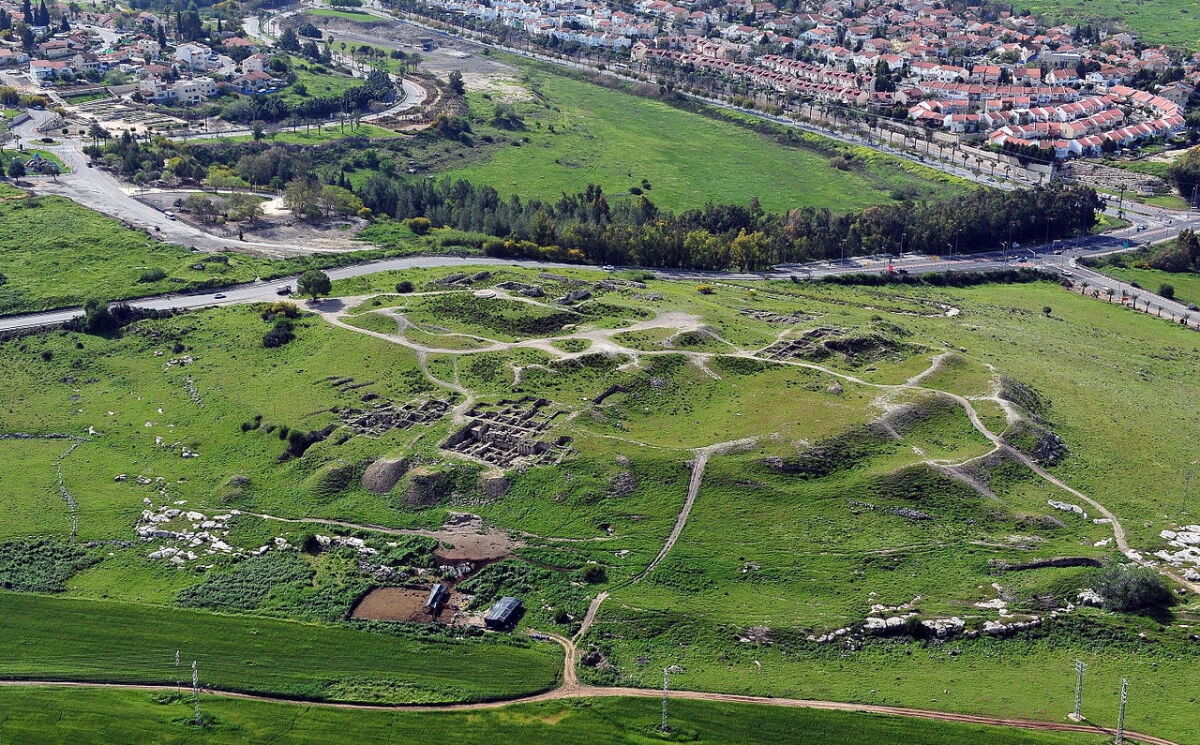
This figure of 50,070 men killed at Beth Shemesh is given by many Bible translations. Yet it is a figure that has long been wrestled with. First is the problem of population size. 50,070 is a colossal population for a single area. The ancient city site of Tel Beth Shemesh is actually a relatively large one, comparatively speaking, at 8 acres. Yet this would only have been able to support a tiny fraction of the population inferred by this interpretation of 1 Samuel 6:19. Certainly, much of Beth Shemesh’s population would have lived in the surrounding area—but even still, this is a massive population for a single locale. Note further that these were only the individuals that were killed—not including those who survived (verse 20). There is also the logical question of how such a large number of individuals desecrated the ark (assuming that each of those killed had done so). Did 50,070 queue up to look inside?
At face value, 50,070 is an incredibly odd number—both large and rounded on the one end, yet also oddly specific on the other. But looking more closely at the Hebrew text, there is something even more curious at play. The lesser figure of 70 is given before and separately from the 50,000 figure. Further, there is a redundancy in the text, if it is interpreted as referring to a single large figure. That’s because the word “men” is repeated twice—once after each figure. The Jewish Publication Society translation captures it well: “seventy men, and fifty thousand men.” Yet another quirk is that there is no “and” in this figure, linking the numbers together. The original Hebrew is as follows:
שבעים איש חמשים אלף איש
Literally, word-for-word (from right to left): “Seventy men fifty אלף men” (“men” highlighted in bold above, and preserving our Hebrew word in question in the translation, often rendered as “thousand”).
Despite the peculiarities in the formulation of this text to produce the number 50,070, this is nevertheless the sense given by many Bible translations, such as the kjv, nkjv, jps, nasb, isv, net, asv, web and erv. Others discard the latter 50- part altogether, giving simply “seventy men”—translations such as the nlt, esv, bsb, csb, cev and gnt. Others add their own curious interpretations, such as the Douay-Rheims Bible: “seventy men, and fifty thousand of the common people”; or the Literal Standard Bible: “seventy men out of fifty thousand men.” Still others shear a zero off the 50,000 figure—thus producing “five thousand and seventy men” (Peshitta, Lamsa).
Others take a different approach, reinterpreting our key word in question—אלף—as something other than “thousand.” Rather humorously, the nkjv—while electing to use the above-cited translation of 50,070 in the main text—does offer the following footnoted alternative, on the basis of אלף as also being the word for “ox”: “seventy men of the people and fifty oxen of a man.” Suffice it to say, the formulation of the sentence this way would be peculiar indeed—let alone the reason for why oxen should have been killed in the incident. The nlt likewise offers a similar footnoted alternative: “Perhaps the text should be understood to read the Lord killed 70 men and 50 oxen.” This again would render the final word “man/men” (after “oxen”) as redundant.
The only real solution that checks all the boxes—that does not add nor subtract anything from the text, that aptly explains the twice-repeated use of the term “men,” that does not produce logical issues of population (or numbers of individuals viewing the ark)—is the sense of the word אלף as meaning “chief,” or similar, a leading man in the community. This is the solution reached by certain other versions (albeit few), such as Young’s Literal Translation: “seventy men—fifty chief men.” In this light, this lower secondary number would only be logical: In stating that while a total of 70 men were killed, a significant number among them—50—were chief men, notable leaders in the regional community. Men, in point of emphasis, who should have known better.
On the basis of this 1 Samuel 6:19 model, we can turn to another passage often seen as problematic—the so-called “confused” passage mentioned in the introduction.
Ai’s Ambush Force
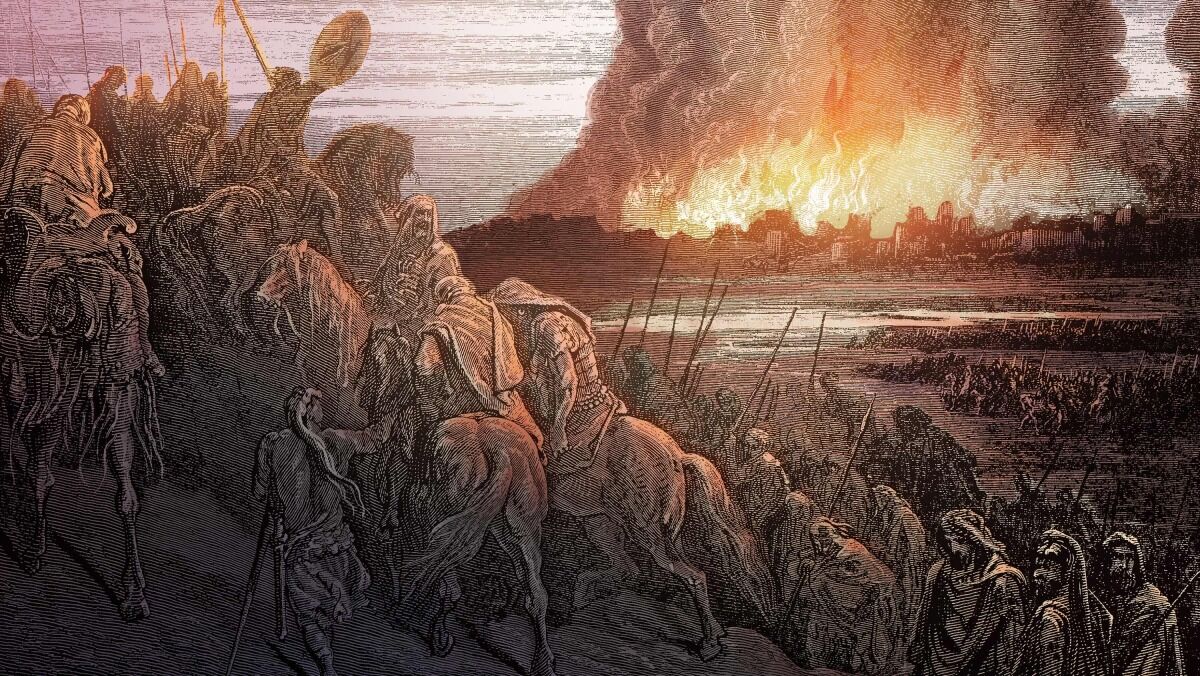
The account of Joshua’s defeat of Ai will be well known to the reader. It was at this second location advanced upon by the Israelites during their conquest that they suffered a surprise defeat, with 36 men killed (Joshua 7:5). Following the execution of Achan—who had brought a curse upon the nation—Joshua led an ambush on Ai, successfully capturing and destroying the city.
A few things to note, from the outset. Ai was apparently a small site (Joshua 10:2), with a comparatively small population (7:3). The initial task force that had been sent consisted of “about three thousand men” (verse 4).
For the second assault, however, we read something very different: “[A]nd Joshua chose out thirty thousand men, the mighty men of valour, and sent them forth by night” (Joshua 8:3). In the ensuing verses, Joshua explains to this specific group where they are to go, and what they are to do—to ambush the city, after Joshua has drawn out the inhabitants with a separate decoy force.
The conundrum comes in verse 12, which enumerates the ambush force as consisting of only “five thousand men.”
On this subject, various Bible commentaries are beside themselves trying to reconcile the account. From Ellicott’s Commentary: “Some difficulty arises from the fact that 30,000 men are mentioned as having been sent away with general instructions to form an ambush in the first instance, while 5,000 were ultimately posted between Bethel and Ai. Were there two distinct bodies in ambush, or only one? It does not seem possible to answer this question with absolute certainty ….” Barnes’ Notes on the Bible suggests that “there is probably a mistake in the numbers of this verse, where an early copyist may have written the sign for 30,000 instead of that for 5,000.”
The Cambridge Bible for Schools and Colleges offers that “while 30,000 were selected for the ambush, 5,000 were actually employed when the decisive moment came”; alternatively, it offers an even odder solution posed by “Wordsworth … [that] the day after the 30,000 had taken up their position, the 5,000 may have been sent from Joshua’s own force to encourage and assure them.” Gill’s Exposition of the Entire Bible offers other solutions—still not appearing to make a great deal of sense—that “[t]his was another ambush, as both Jarchi and Kimchi observe; and the latter adds, perhaps he set them nearer the city than the former.”
The Keil and Delitzsch Biblical Commentary on the Old Testament scoffs at this notion. “[T]hat Joshua 8:12 refers to a second ambuscade, which Joshua sent out in addition to the 30,000, and posted by the side of them, is even more than questionable ….” Instead, it takes the figure of 30,000 to have been in error. “The mistake, however, is not to be found in the 5,000 (Joshua 8:12), but in the 30,000 in Joshua 8:3 … a detachment of 5,000 men would be quite sufficient.” This, as a slightly larger figure than the initial failed force of 3,000—rather than a force 10 times the size. Indeed, a force 30,000 men strong seems hardly an ambush force—more like a massive battlefield army. Further, on the basis of the geography of this particular region, a force of 30,000 would have been virtually impossible to hide.
The Pulpit Commentary agrees, stating: “In verse 12, we read 5,000, and this must be the true reading. Thirty-thousand men could hardly have been posted, without detection, in the ravines around Ai, whereas we are informed by travelers that there would have been no difficulty in concealing 5,000 men there.”
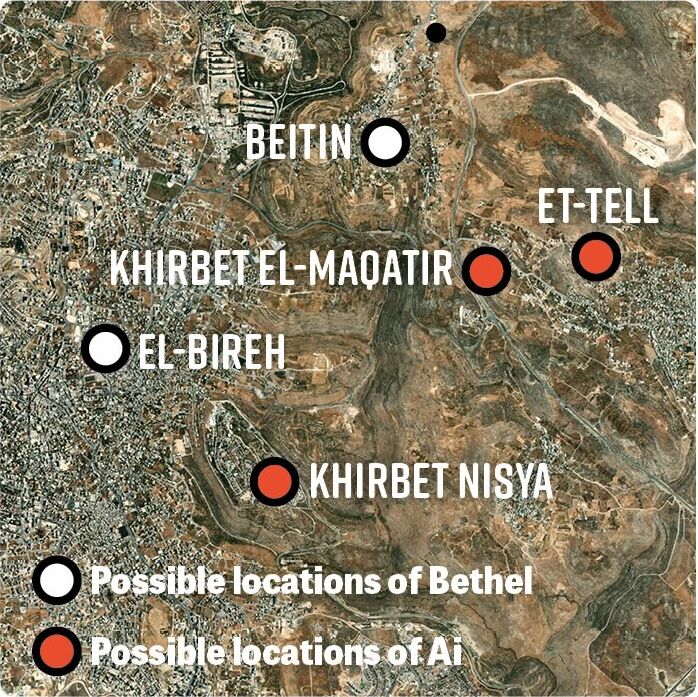
Having walked this region myself, the 5,000 figure of Joshua 8:12 does indeed seem to be the better fit. A force of 30,000 certainly seems an impossibly large number to conceal in any of the valleys corresponding to the proposed locations of Ai. But what about the text of verse 3?
The solution, I believe, is the same as that for 1 Samuel 6:19. That, instead of “thirty thousand men” (שלשים אלף איש), Joshua chose “thirty chief men”—and these men, in turn, formed the sharp edge of the smaller force enumerated in Joshua 8:12—the men leading the charge.
This would make sense of other clues buried in this text. First, nothing special is noted of the “five thousand men” of Joshua 8:12. Yet some length is already taken to address the men of Joshua 8:3 as “mighty men of valor.” Are 30,000 of special note, and 5,000 “normal”? The logic for this seems to be the wrong way around. Further, Joshua 8:3 also notes that Joshua specifically “chose out” these “mighty men of valor” for this ambush force. A force of 30,000 mighty men is one thing—specially choosing them all out the same day is another (as is indicated by the end of the verse). On the flipside, choosing a leadership contingent of “30 chief men,” who would go on to captain the lesser qualified Joshua 8:12 troops, would seem to make more sense. Finally, there is already known Israelite military emphasis on 30 mighty men. This is most famously seen in David’s “thirty chiefs” (2 Samuel 23; 1 Chronicles 11)—men referred to with some of the same Hebrew terminology found here in Joshua.
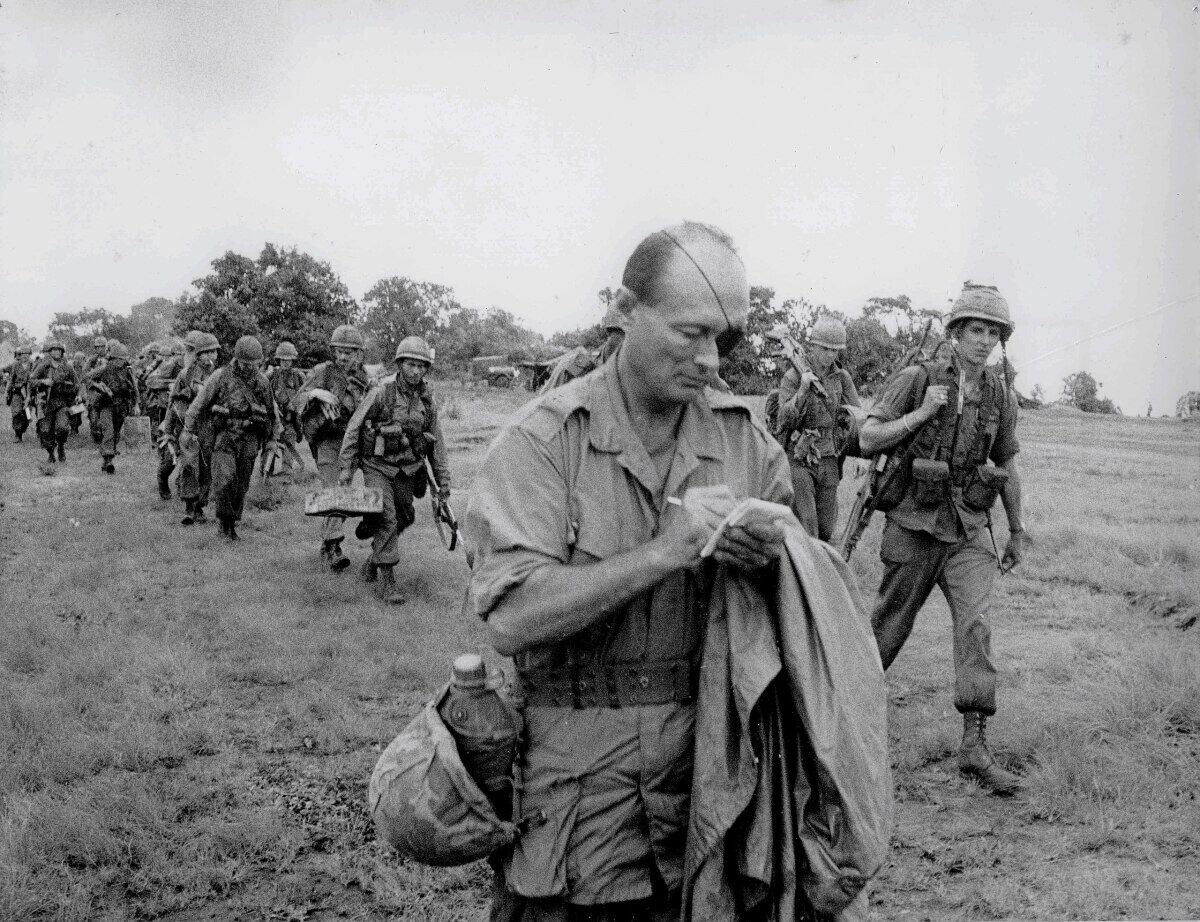
This word we have covered, Aluf (in its slightly elongated form, אלוף), is a rank used in the Israel Defence Forces to this day—in the modern sense, about equivalent to a general or major general. There are additional derivative ranks, such as Rav-Aluf (“Chief Aluf”), Tat-Aluf (“Sub-Aluf”) and Sgan-Aluf (“Vice-Aluf”).
Perhaps I am biased in preferring this interpretation of the word in these contexts—given our Ophel excavation director’s nickname for me as “Chris the Aluf” (probably more of a friendly barb at the leadership style of the area I supervise!). But certainly this seems to me to be the best—perhaps the only—interpretation that fully accounts for all the data, certainly in the case of 1 Samuel 6:19, adding or subtracting nothing from the text. Further, based on this same principle, a similar thing may well be at play in Joshua 8 and elsewhere—other so-called “confused” numerical passages.