Crown Jewel in the Desert
It was a routine day with a remarkable outcome. When Mohammed ed-Dib, a young Bedouin living in the hills of the northwestern edge of the Dead Sea, rose one fateful summer morning in 1947, he could never have imagined he was about to make one of the greatest discoveries in biblical archaeology. Certainly, that wasn’t his goal. How could it be? He wasn’t an archaeologist. He wasn’t searching for the next great find. He wasn’t curious what treasures were hiding in the hills of Qumran.
He was simply searching for a lost goat.
Yet that mundane task led him to the discovery of an ancient library containing the oldest manuscripts of the Bible ever found—the Dead Sea Scrolls.
The history of the scrolls’ discovery is remarkable and intriguing, and it couldn’t have come at a better time. As inspiring as that history is, however, what is most important is the message of the scrolls. As Israel Museum, Jerusalem, celebrates the Great Isaiah Scroll, the longest and most well preserved of the corpus, with a new exhibition, it’s important to remember the words recorded within the book of Isaiah. Although the message was recorded by the namesake prophet nearly 3,000 years ago, it is relevant for us today.
A Stone’s Throw Away
When Mohammed ed-Dib noticed one of the goats from his herd was missing, he began searching the desert hills and limestone cliffs of Qumran. Finding a goat in this region was not a simple task. A key feature of these cliffs is an abundance of caves. His goat could be anywhere.
To save time, he threw stones into the caves, hoping this would startle the goat and cause it to run out. Each and every cave, however, was empty, until he reached what is now called Cave 1.
Throwing a stone into the narrow opening of Cave 1, ed-Dib heard, not the bleating of a goat, but an unusual, and entirely unexpected sound—so unexpected it caused him to flee in fear that he had stumbled upon a jinn, or genie.
Ed-Dib returned the next day with two of his cousins and discovered that the sound he heard was the shattering of a clay vessel. Cave 1 contained several of these vessels, most of which were empty, but a few had parchment and animal skin scrolls within them. All totaled, the Bedouins discovered seven scrolls that day.
Ed-Dib and his cousins took the scrolls to antiquities dealers in Bethlehem. They sold four scrolls to Khalil Iskander Shahin (“Kando”) and three to Faidi Salahi.
In turn, Kando sold his four scrolls to Archbishop Athanasius Samuel, head of the Syrian Orthodox Monastery of St. Mark in Jerusalem. Unsure of what he now had in his possession, Archbishop Samuel invited John C. Trever, then director of Jerusalem’s American Schools of Oriental Research, to study and take pictures of the manuscripts. Trever quickly realized the value of the scrolls, which included a complete manuscript of the book of Isaiah—known today as the Great Isaiah Scroll.
Even before Trever, one man elsewhere in Jerusalem had already identified the significance of the three other scrolls and, in doing so, subjected himself to much personal risk.
Timing Is Everything
In late 1947, an Armenian antiquities dealer alerted Hebrew University professor Eliezer Sukenik about the discovery of the scrolls. Although Jewish-Arab tensions were high, Sukenik traveled to the fenced border between East and West Jerusalem to meet with the Armenian dealer. The dealer passed a fragment of one of the manuscripts through the fence. Sukenik recognized the style of the text but wanted to study it further. He eventually identified the text as Hebrew from the Second Temple Period.
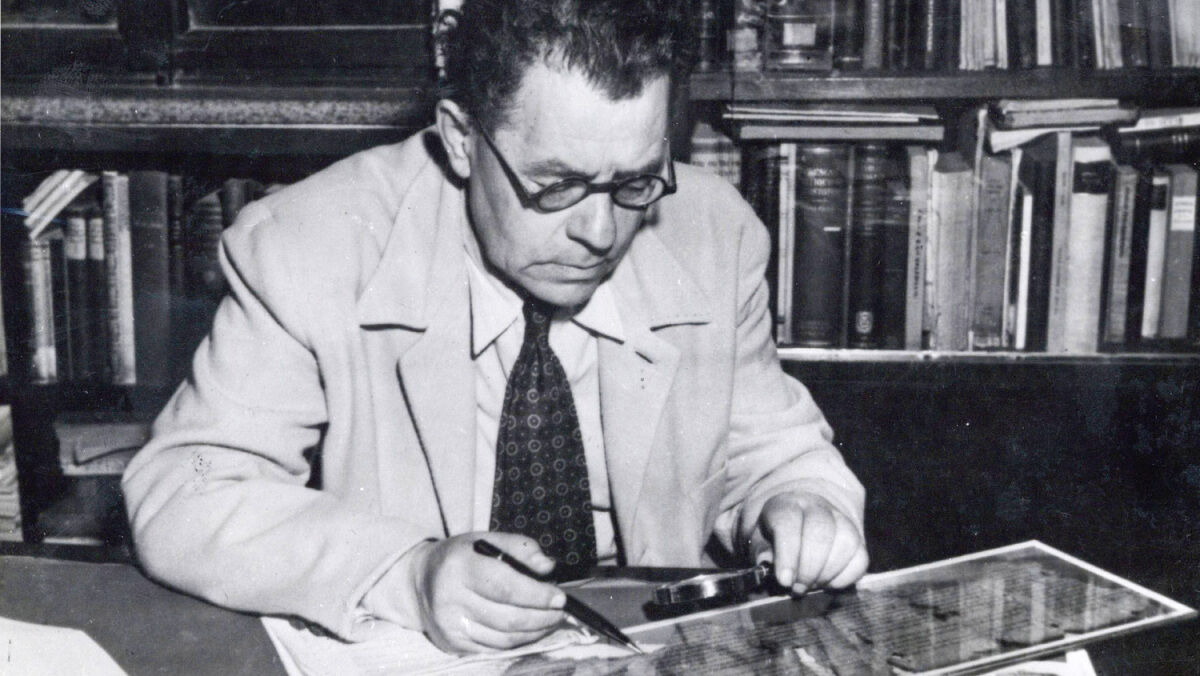
Aroused with excitement, Sukenik wanted to see the scrolls themselves. However, traveling into Arab-occupied Bethlehem at this time, when tensions between Arabs and Jews were high, would put his life at risk. For Sukenik, the potential value of these scrolls was worth it.
“I went over more ‘leathers.’ The very idea overwhelms me, but it might be one of the greatest discoveries ever made in this country—one that is beyond our dreams,” Sukenik wrote in his journal.
He made the journey to Salahi’s shop on Nov. 29, 1947.
“My hands shook as I started to unwrap one of them,” Sukenik recorded. “I read a few sentences. It was written in beautiful biblical Hebrew. The language was like that of the Psalms, but the text was unknown to me. I looked and looked, and I suddenly had the feeling that I was privileged by destiny to gaze upon a Hebrew scroll which had not been read for more than 2,000 years.”
This was an incredible moment for Sukenik. But it wasn’t the only life-changing event of the day. That evening, the United Nations General Assembly voted in favor of establishing a Jewish state.
“While I was examining these precious documents in my study, the late news on the radio announced that the United Nations would be voting on the resolution that night—whether or not Israel would be allowed to become a nation,” Sukenik wrote. “It was past midnight when the voting was announced. And I was engrossed in a particularly absorbing passage in one of the scrolls when my son rushed in with the shout that the vote on the Jewish state had passed. This great event in Jewish history was thus combined in my home in Jerusalem with another event, no less historic—the one political and the other cultural.”
The timing could not have been more perfect. One of the scrolls Sukenik purchased was a fragmentary manuscript of the book of Isaiah. As German scholar Alexander Shick stated in a recent Let the Stones Speak interview, this history brings to mind a scripture in Isaiah 66: “Who hath heard such a thing? Who hath seen such things? Is a land born in one day? Is a nation brought forth at once? …” (verse 8). In many ways, the modern Jewish state of Israel was brought forth in a day—with a vote on Nov. 29, 1947. How remarkable and inspiring that Sukenik was examining one of the oldest manuscripts of the book of Isaiah on the very day the State of Israel
https://www.youtube.com/watch?v=gD8fY3L0tTg was born.
The Race to Purchase
Sukenik purchased his three scrolls for Hebrew University. These included the War Scroll, the Thanksgiving Scroll, which reads similarly to the book of Psalms, and a less complete manuscript of the Isaiah Scroll. But what of the four other scrolls—Community Rule, Genesis Apocryphon, commentary on Habakkuk and the Great Isaiah Scroll? These were still in Archbishop Samuel’s possession.
By 1948, they were no longer in Israel. When Israel’s War of Independence broke out following the UN vote, Samuel took the scrolls to New Jersey to keep them safe.
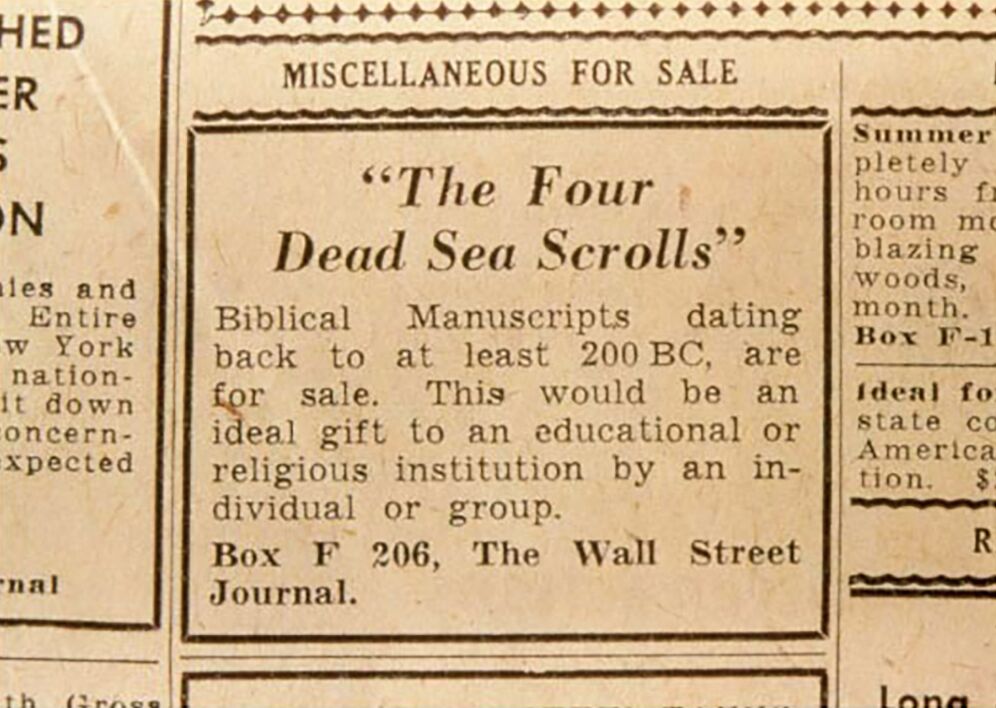
In 1954, Samuel placed an ad in the Wall Street Journal; he was looking for a wealthy buyer for the scrolls. The ad, titled “The Four Dead Sea Scrolls,” stated: “Biblical manuscripts dating back to at least 200 b.c. are for sale. This would be an ideal gift to an educational or religious institution by an individual or group.”
Prof. Yigael Yadin, Sukenik’s son, happened to be in America on a lecture tour at the time of the ad. He sent an urgent letter to Theodor “Teddy” Kollek, Israeli director general to the prime minister, informing him that the scrolls were available for purchase. The asking price was $250,000 (nearly $3 million in today’s value). That was a large sum for the newly formed State of Israel to pay.
The prime minister and minister of finance eventually approved the purchase, which was subsidized by American philanthropist David S. Gottesman. The first seven scrolls, including the Great Isaiah Scroll, were now the property of Israel.
The Complete Corpus
Between 1947 and 1956, nearly 1,000 scrolls were discovered in 11 different caves throughout Qumran. Every book of the Hebrew Bible is accounted for in the Dead Sea Scroll corpus, except for the book of Esther (although there is evidence for even this book among the scrolls; read “Esther in the Dead Sea Scrolls?” for more information).
The scrolls of this corpus of biblical and secular works are traditionally dated to between the second century b.c.e. and second century c.e. However, new research suggests “broadly speaking, it now seems that the oldest scrolls date to the fourth century b.c.e., and there is a larger amount than we thought from the third century b.c.e.” (“Dead Sea Scrolls May Be Older Than We Thought, AI-Based Study Says,” Haaretz). These scrolls predate the next oldest complete, or near-complete, biblical Hebrew texts by 1,000 years. (For more information on the dating of the Dead Sea Scrolls, read Let the Stones Speak contributing editor Christopher Eames’s article “New Research Reveals Dead Sea Scrolls Older Than Previously Thought”.)
The most complete of the Dead Sea Scrolls is the Great Isaiah Scroll. It is over 7 meters (24 feet) long and one of the oldest. This scroll has recently been making headlines because, for the first time since 1968, it is back on display in its entirety at Israel Museum, Jerusalem. This scroll is, as Israel Museum described in its official exhibition brochure, “the crown jewel of the Dead Sea Scrolls.”

A Message of Good Tidings
On the evening of February 23, Israel Museum hosted a special ceremony to open the Isaiah Scroll exhibition, titled “A Voice From the Desert.” My colleague Christopher Eames and I were privileged to attend this invite-only event at which Israeli President Isaac Herzog spoke.
It was fascinating to see the scroll in person. The fact that this ancient manuscript, longer than most two-story buildings are tall, has survived 2,000 years is remarkable. The history of its discovery is intriguing. The most important aspect of the Great Isaiah Scroll, however, isn’t its length or how well preserved it is. On that 2,000-year-old parchment is an incredible message of hope for the Jewish people and all mankind, as recorded by the Prophet Isaiah around 2,700 years ago.
There are many scriptures and prophecies within the book of Isaiah that we could highlight. But when observing the scroll on February 23, the one section I kept coming back to was Isaiah 40. It’s certainly apropos, given that the exhibition title comes from that chapter (e.g. Isaiah 40:3). That chapter also contains a very important message that ties into the discovery of the scroll.
As verse 8 states, “The grass withereth, the flower fadeth: But the word of our God shall stand for ever.” The Great Isaiah Scroll is made of parchment—a material that withers and fades over time. But the message on that parchment is forever. That is what is most important about this discovery, and that is the most important takeaway from the Israel Museum exhibition.
“Comfort ye, comfort ye my people, saith your God. Speak ye comfortably to Jerusalem, and cry unto her, that her warfare is accomplished, that her iniquity is pardoned: for she hath received of the Lord’s hand double for all her sins” (verses 1-2; King James Version). This scroll was discovered just before Israel was embroiled in the War of Independence. It went back on display just days before Israel went to war against Iran in Operation Lion’s Roar—a war that has taken the scroll out of the exhibition and back into a secure location. Much of Israel’s modern history is a history of war—that’s what makes the Jewish people so resilient, a trait I have come to respect and admire since moving to Israel in 2024.
But as Isaiah prophesied, a time is coming when “her warfare is accomplished”! Sirens will no longer wail. Families will no longer have to seek shelter. That is a message of hope, recorded by the Prophet Isaiah, that the Jewish people and the whole world needs. “Despite being occasionally mislabeled as a ‘prophet of doom,’ so much of the Prophet Isaiah’s message is uplifting and positive,” Let the Stones Speak editor in chief Gerald Flurry wrote in the September-October 2023 issue. “And he delivered his message with all the strength and excitement he could muster. At the Armstrong Institute of Biblical Archaeology, we identify with Isaiah and his ‘good tidings.’”
Why? Because as the Dead Sea Scrolls reveal, biblical archaeology itself contains a message of good tidings. We deal with the past, but so much of that points to the future. Archaeology supports the veracity of the Bible, but the Bible isn’t simply a book about the past; it’s a book about what lies ahead.
Behold Your God
In his 2023 article, Mr. Flurry highlighted one of the key scriptures in the book of Isaiah: “O thou that tellest good tidings to Zion, Get thee up into the high mountain; O thou that tellest good tidings to Jerusalem, Lift up thy voice with strength; Lift it up, be not afraid; Say unto the cities of Judah: ‘Behold your God!’” (Isaiah 40:9). Whether it’s the Dead Sea Scrolls, the Tel Dan Stele, Hezekiah’s bulla or countless other finds, Mr. Flurry has said the message of biblical archaeology is “Behold your God!”
“Jerusalem and the State of Israel are filled with history and events that declare, ‘Behold your God!’” Mr. Flurry wrote. “Traveling that land is like walking through the Bible. There are biblically significant archaeological excavations, artifacts and ruins all over the country. In its own way, each of these declares, ‘Behold your God!’” (“One Man and a Vision of Jerusalem,” Let the Stones Speak, January-February 2026).
It’s inspiring to stand in Israel Museum and observe the Great Isaiah Scroll. It’s moving to know the history of the scroll and how intimately the Dead Sea Scrolls are tied to the establishment of the State of Israel. The timing truly was perfect.
Perhaps now, the timing is perfect again, for this “voice from the desert” to go on display as Israel wages a war against Iran and terrorism. As the Prophet Isaiah declared, there is coming a time when “her warfare is accomplished.” It is a time when “they shall beat their swords into plowshares, And their spears into pruninghooks; Nation shall not lift up sword against nation, Neither shall they learn war any more” (Isaiah 2:4). That is a message of incredible hope.
The Great Isaiah Scroll truly does trumpet, “Behold your God!”