
Biblical Cabul: A Gift of Worthless Cities From Solomon?
The 10th-century b.c.e. relationship between Israel and the Phoenicians had all the hallmarks of a robust, friendly alliance. Trade between the two flourished as cedar trees from Lebanon were exchanged for Israel’s surplus of grains. King Hiram of Tyre sent his best tradesman to help with Jerusalem’s building projects, while Jerusalem sent men to sail the seas alongside Phoenician merchants. 1 Kings 10 indicates they even had a joint navy to protect their maritime networks.
When it came to timber and gold imported from Phoenicia for the new royal quarter in Jerusalem, 1 Kings 9:11 records that Solomon received “according to all his desire.” Nothing was lacking. Whatever Solomon needed, he received from Hiram.
In exchange, Solomon gifted Hiram dominion of 20 Israelite cities. “And Hiram came out from Tyre to see the cities which Solomon had given him: and they pleased him not. And he said: ‘What cities are these which thou hast given me, my brother?’ And they were called the land of Cabul [worthless], unto this day” (verses 12-13). The gift of worthless cities wasn’t exactly what Hiram was hoping for. Nevertheless, the book of Kings shows the alliance continued without a hitch.
But what about the 20 cities themselves?
The Bible doesn’t name them outside of the term “Cabul” and noting that the land still went by that name four centuries later, at the time of the writing of the book of Kings.
Can we locate any of these cities, and does the archaeology match well with a 10th-century b.c.e. reality?
Locating Biblical Cabul
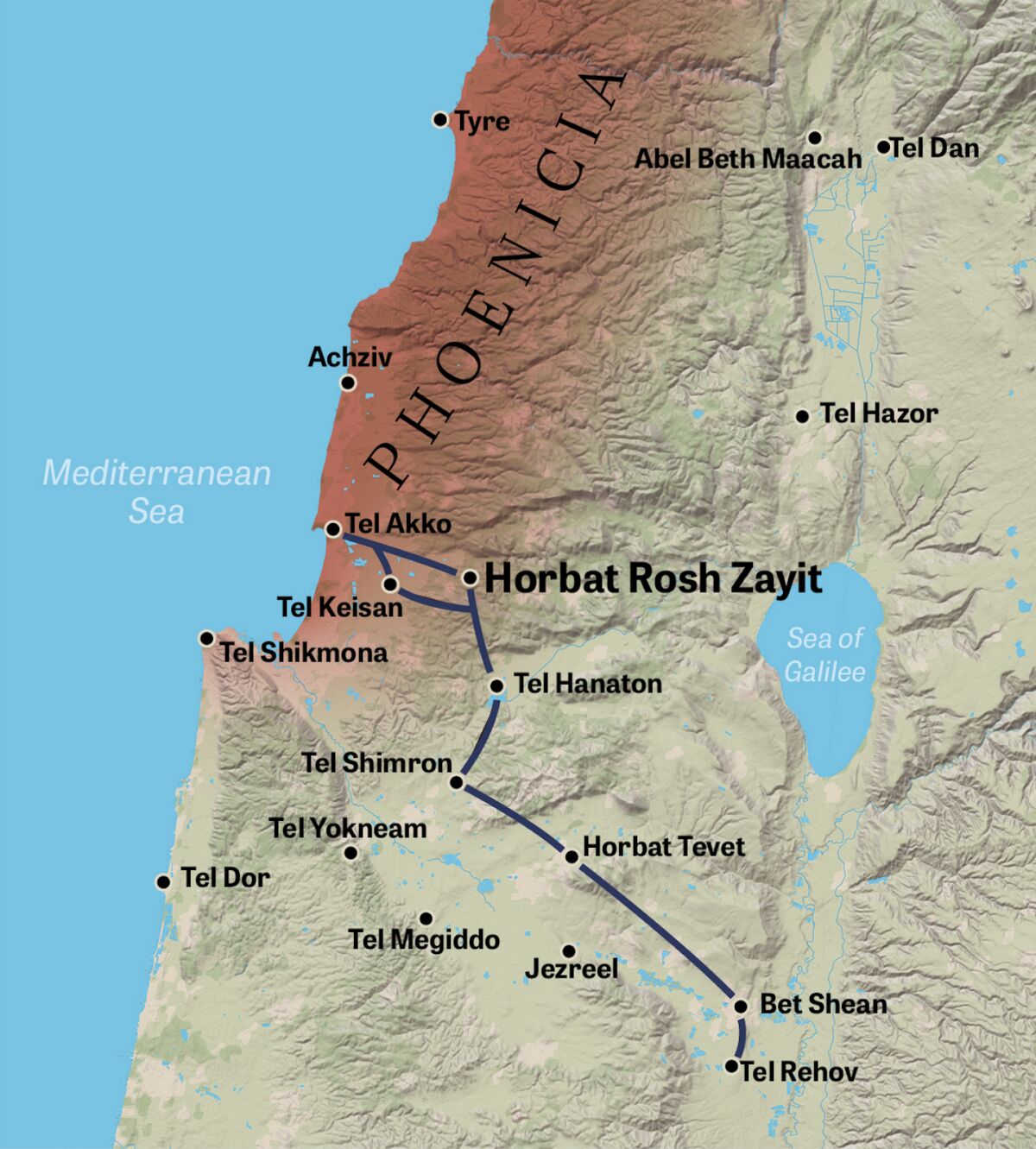
Locating biblical sites can be extremely difficult. But in this case, some clues simplify the task. The only other time Cabul is mentioned in the Bible is in Joshua 19, when the tribes of Israel were allotted territory inside Canaan. Verses 24-27 describe Cabul as part of a series of towns on the border between the tribes of Asher and Zebulun.
We know that Asher was given the most northwestern tribal allotment, a territory that overlapped with land controlled by the Phoenicians. Thus, even from this standpoint, the account in Joshua harmonizes with the Solomon-Hiram exchange in locating the general region of Cabul as the border between Israel and Phoenicia.
Modern history gives an even greater clue. It is common in Israel for the biblical names of sites to be preserved by the contemporary Arabic names of the site. Today an Arab village called Kabul is situated on the ridge above the plain of Asher, in the same area as biblical Cabul. Is this the same city?
An archaeological survey of the village of Kabul first conducted in 1923 did not yield any Iron Age pottery, casting doubt on its identification as biblical Cabul. In the late 1970s, a new survey of the wider area was initiated on behalf of the Archaeology Survey of Israel under the leadership of archaeologist Zvi Gal. On a nearby hill, just 1.5 kilometers (roughly 1 mile) north of the modern Kabul village, Gal’s team investigated the surface level and found an abundance of Iron Age ii pottery (circa 1000–586 b.c.e.) as well as impressive remains still visible on the surface. This hill was known as Horbat Rosh Zayit.
The view from the top of the hill was commanding; the entire Plain of Asher was visible from Mount Carmel in the south to the Ladder of Tyre (modern Rosh Haniqra) in the north.
Was this biblical Cabul?
Gal put the evidence together: “So the location was right, the date of occupation was right, and the biblical name was preserved in a nearby Arab village. This is enough, even to a cautious archaeologist, to suggest that we have located biblical Cabul” (Biblical Archaeology Review, March-April 1993).
According to Gal, the surface finds were intriguing enough to justify excavation, which began in 1983 and continued in 1984. Subsequent excavations took place between 1988 and 1992.
The excavations were conducted by the University of Haifa and supported by Hebrew Union College and the Israel Antiquities Authority (iaa). Although several areas of the hill were excavated, the most interesting excavation was conducted at what was identified as a fort, located at the summit of the hill.
The evidence uncovered was impressive.
The final report of the excavation, titled Horbat Rosh Zayit: An Iron Age Storage Fort and Village, was published in 2000 by Gal and iaa archaeologist Yardenna Alexandre.
Although the Horbat Rosh Zayit excavation is cited regularly in academic papers, this site has garnered very little attention among the general public. It deserves greater attention, especially in light of its connection to the Bible.
The Fortress
The main objective of the fortress excavation was to examine the massive pile of stones at the center of the site. This heap was clearly evidence of the collapse and degradation of a large building. Once it was fully excavated, a massive fortress was revealed, with preserved wall heights in some locations at 3 meters (10 feet) tall.
Examining the wealth of pottery uncovered, archaeologists identified three specific layers of occupation at the fortress area. The earliest, Stratum iii, dated to the first half of the 10th century b.c.e. and was limited to small-scale construction of “flimsy domestic structures.” Horbat Rosh Zayit at this time was still a village.
Sometime between the middle to second half of the 10th century b.c.e., construction began on the fortress, which heralded a new vision and large investment in the site. Excavators were able to divide the use of the fort into two phases: Stratum iib and iia (the names of these layers should not be confused with the archaeological periods Iron Age iia and iib—both phases of construction took place during Iron Age iia).
Stratum iib, the earlier phase, included the initial construction of the fort itself, before a much
larger fortification wall was constructed around the building. The archaeologists dated this early phase to around 960–920 b.c.e., the time of Solomon’s interaction with Hiram of Tyre.
The walls of the fort were almost square, measuring 16 meters by 15.5 meters (52 feet by 50 feet), and were built as the initial core of the structure. The construction style was a mixture of unworked stone and large ashlars laid in header-and-stretcher fashion. The ashlar-constructed corners are magnificent, a telltale sign of the building’s importance.
Adjacent to the base of this wall is a sloped stone-built wall known as a glacis that would have added support to the structure. “In effect, the walls of the glacis functioned as fortification walls. They originally rose above the glacis wall, the latter providing consolidation of the walls and additional strength against attack” (ibid). The archaeologists believe the walls would have originally towered 5 meters (16 feet) high, which would give it a commanding view of the entire Plain of Asher below.
Sometime in the late 10th century, this initial phase of the fort was destroyed, possibly by a localized fire. Almost immediately after the fire, the site was rebuilt (Stratum iia). The walls of the initial phase were reused, and new floors were laid.
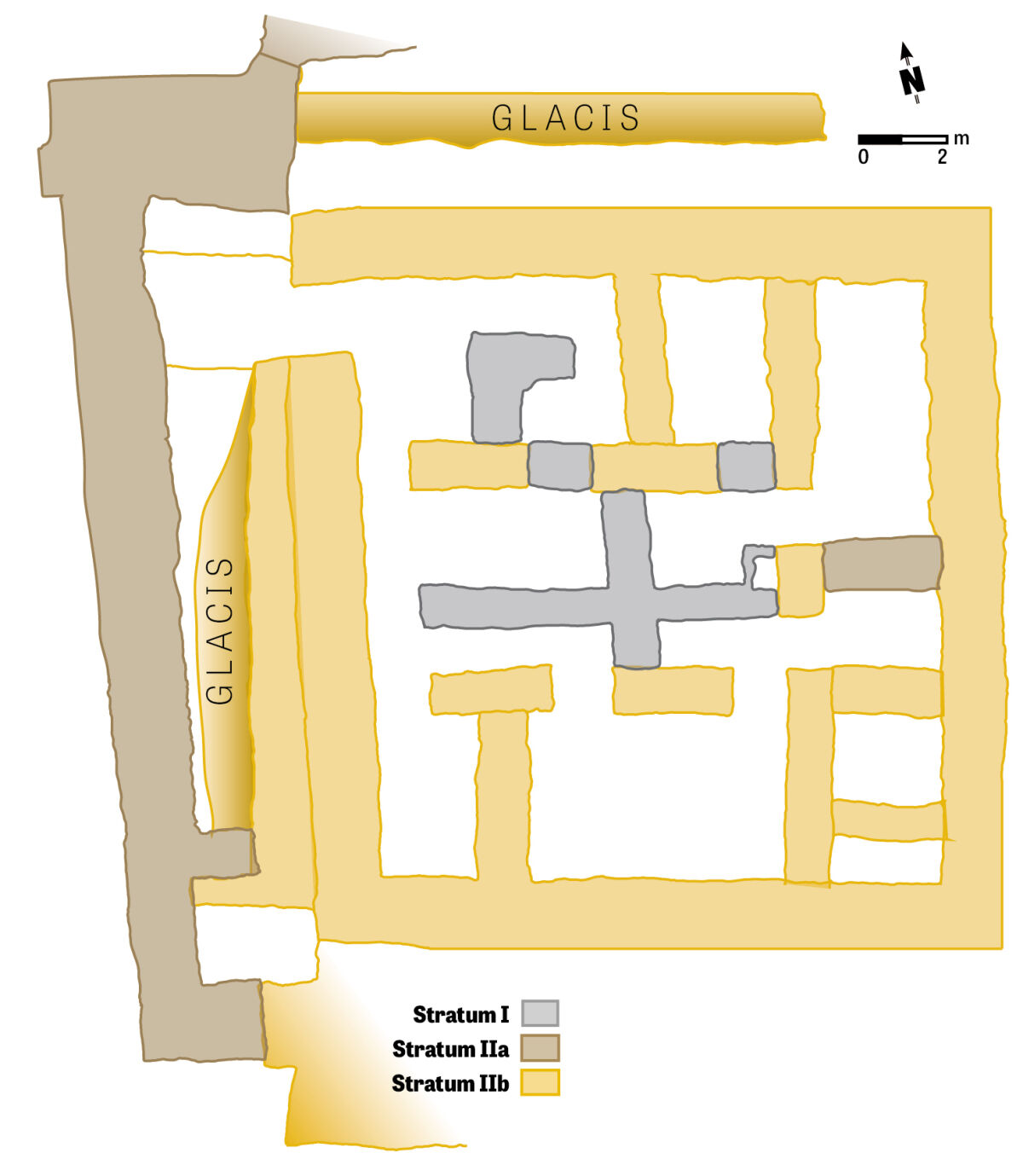
The major architectural change in Stratum iia (dated by the excavators to 920–880 b.c.e.) was that the fort was reinforced with a large external wall, enlarging the entire compound to about 22 meters by 24 meters (72 feet by 78 feet). This large exterior wall was built over the top of the dilapidated remains of Stratum iib.
When a structure is reused like this, material from the earlier phase is removed and replaced by material from the latest phase of use. This phenomenon, referred to as the “old-house effect,” can make dating the earlier phase more challenging. (The “old-house effect” is present at archaeological sites throughout the southern Levant; for example, Building 100 in the Givati Excavation in Jerusalem and Building 101 at Tel ‘Eton.) Still, Gal and Alexandre were able to clearly discern the earlier phase of construction, as well as several features that were not entirely removed during the rebuilding.
The identification of two distinct phases of construction for the fort during the Iron iia period was a critical observation. The majority of the finds come from the second phase (Stratum iia) of use during the decades following King Solomon’s rule. The presence of an earlier phase fits well with the time of Solomon’s interaction with Hiram. This is perhaps why biblical minimalist Israel Finkelstein, in his review of the Horbat Rosh Zayit final report, stated, “I do not see a compelling reason for a division into two phases in the architecture of the building or in its fortification” (“Chronology Rejoinders,” Palestine Exploration Quarterly, 2002). By blending the two phases, Finkelstein uses the pottery from Stratum iia to date the entire fortress to the ninth century b.c.e.
Although a formidable fort defensively, the excavators believe the structure was not built as a military fortress, manned by a garrison. Rather, they consider it a “well-defended storage and administrative center” (op cit). They came to this conclusion based on the scores of metallic agricultural equipment found at the site, as well as the abundance of large storage vessels, some with their ceramic stopper still intact and charred grain within. Some of the clay donut-shaped stoppers are of a similar design to those found in a 10th-century b.c.e. context in Dr. Eilat Mazar’s Ophel excavations in Jerusalem (see The Ophel Excavations to the South of the Temple Mount, 2009–2013: Final Reports, Vol. 1, for more information).
Excavating the interior of the fortress, the team noticed it had two levels, a ground floor and a basement level in each of the four rooms that were excavated down to bedrock. There were no doorways in the lower levels, suggesting the basement was accessed by a ladder or stairs. Dozens of storage vessels—far more than would be expected at a military garrison—were discovered in neat rows inside the cellar. Remarkably, three of these storage vessels were full of carbonized wheat.
Olive oil residues were also found inside the jars. The archaeologists believe the olive oil stored at the site made the fire that destroyed the fort so hot that it had the effect of a limestone kiln inside the rooms. All totaled, over 500 storage jars (complete, restored and rims of different jars) were uncovered at the site, with the majority coming from Stratum iia. “On the basis of the number of jars found in the rooms and cellars, the storage capacity at the Horbat Rosh Zayit was at least 14,000 liters …. Such an immense storage facility must have been part of a central administrative system” (op cit).
Clearly, this was not a typical domestic building.
But it wasn’t just the immense number of storage vessels that indicated the agricultural/storage function of the fort. Other finds justified this conclusion, including a large number of agricultural tools such as grinding stones, numerous stone and ceramic weights and jar stoppers.
Around 90 bronze and iron tools were found in the fort, with most extremely well preserved under the layers of burnt limestone. These included plowshares, sickles, ax-heads and some more unique objects, such as an 80-centimeter-long (over 2.5 foot) two-handed saw. The impressive length would allow for cutting logs with a diameter of up to about 40 centimeters (15 inches).
The only weapons found at the site were several bi-bladed arrowheads, which were discovered close to the entrance door. The authors posit these arrows were shot at the fort when it was destroyed sometime in the early ninth century b.c.e. (This original dating of the destruction, however, was partially based on the archaeologists’ interpretation that the large storage vessels, known as “hippo” jars because of their bulky shape, were not produced later than the early ninth century; more recent studies of the hippo jars show them being created well into the ninth century, which would likely push forward the dating of the destruction to around the mid-ninth century b.c.e.)
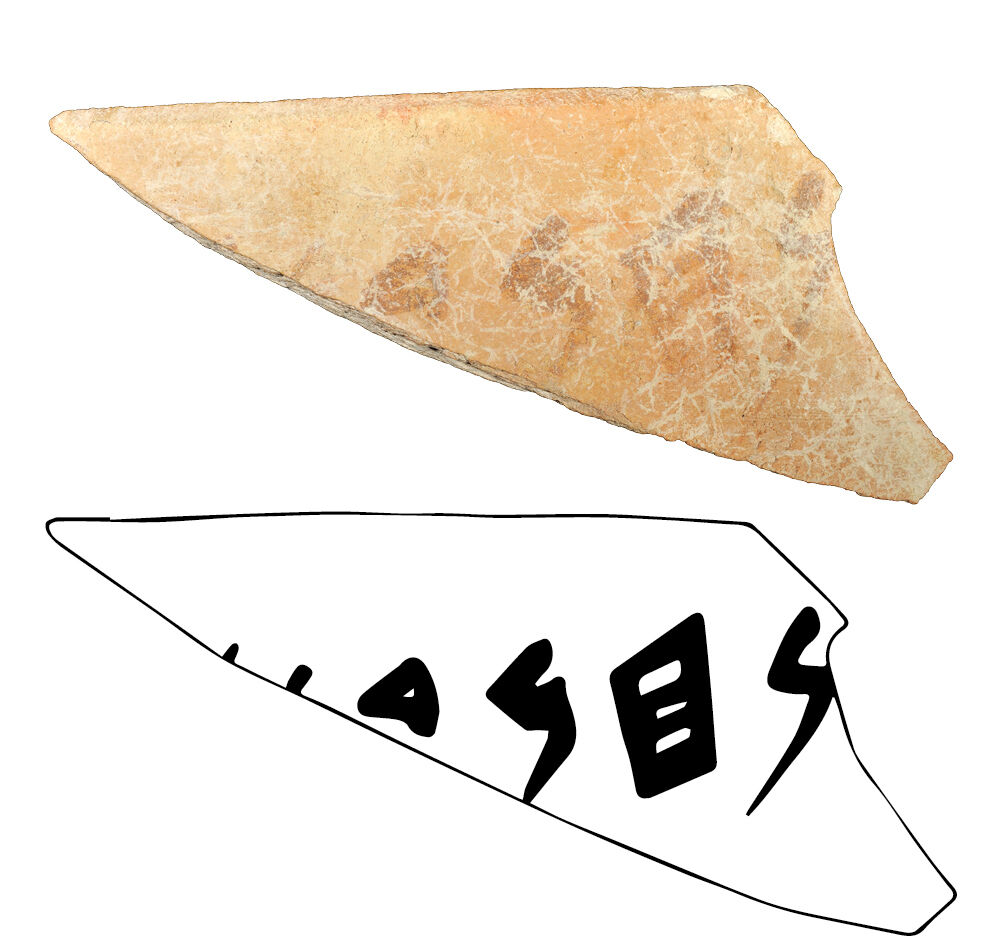
Several of the jar fragments contained inscriptions made with red-brown ink. However, because of the intensity of the fire, only one of the inscriptions could be read with certainty. The inscription reads, nhmr (נחמר). Archaeologists interpreted the inscription as the remnants of two words with the first two letters missing, “[yy]n hmr.” This reading fits well with a biblical reference of a type of wine found in Psalm 75:9, translated as “foaming wine.” According to Gal and Alexandre, “the contents of the jars in the storehouse were probably recorded in ink on the jars. This is another expression of the administration function of the fort” (ibid).
The fort lacked any jewelry or toys, which would have indicated the presence of women and children, underscoring that the building did not serve a domestic purpose.
Taken together, the artifacts led the archaeologists to “conclude that the Stratum iia fort was an efficiently run, well-fortified storage facility and administration center, controlled by a central authority” (ibid).
The question then becomes: Who did the fort belong to?
Israelite or Phoenician?
Perhaps the most interesting discoveries from the fort are the diverse repertoire of vessels related to the Phoenicians. Although most of the pottery is undoubtedly Israelite and compares to that found at Israelite sites such as Megiddo and Hazor, Horbat Rosh Zayit also contains one of the richest assemblages of Phoenician-style pottery and related imported wares from Cyprus discovered in Israel. This pottery is represented by both plain types and also “more elaborate bichrome, Black-on-Red, White Painted and Red Slip wares. The finer pottery may have found its way to the fort through commercial activity or with its Phoenician occupants” (ibid).
The presence of both Phoenician and Israelite pottery and wares is unsurprising, considering Horbat Rosh Zayit sits on the border between the two territories. But it makes it difficult to definitively associate construction and operation of the fort with either the Israelites or the Phoenicians. Gal and Alexandre posit two options: “On the basis of the archaeological evidence, this phenomenon may be interpreted as a fort belonging to the Israelite government, with foreign imports, or as a Phoenician fort with strong affinities to the Israelite material culture.” Either way, the ceramic assemblage attests to the biblical record of Israelite-Phoenician cooperation and collaboration in this location.
Professor Finkelstein’s opinion, conversely, is that the building should be considered “a strong Phoenician farmhouse dating to the ninth century b.c.e.” (based on his own chronological model).
This question about the ethnic makeup of the town highlights the difficulty in using archaeology alone to determine dominance—the so-called “pots do not equal people” paradigm. This becomes more difficult when discussing border towns of allies engaged in a strong trade relationship. Again, we would expect to find both Phoenician and Israelite wares at sites close to the border. This stands in contrast to the border towns in the Judean Lowlands, where the Israelites and Philistines were often at war. Here it is rare to find a mix of Philistine ware at Israelite-controlled sites.
But among allies, things would be different. Such a scenario is expected between the Israelites and the Phoenicians, and not just along the places of exchange at the border towns but also at sites along the main trade routes between the two powers. This is likely why Tel Rehov, a key Iron iia trade center 50 kilometers (30 miles) away, also features a similar Phoenician-Cypriot assemblage. Tel Rehov excavator Amihai Mazar drew attention to the largely parallel assemblage between the sites and posited that a trade route ran from the southern Phoenician coast through Horbat Rosh Zayit and eventually arrived at Tel Rehov via Horbat Tevet and Beth-Shean (“On the Relations Between Phoenicia and the Beth-Shean Valley in the Iron Age,” 2022).
Based on the similarity of the assemblage at both sites, Mazar believes it was more likely that Horbat Rosh Zayit was not Phoenician-controlled but rather an Israelite “border station or trading center (emporium) on the frontier between Israel and Phoenicia” (ibid).
The King’s Gift Discovered?
Based on the archaeology, three different opinions exist about who controlled Horbat Rosh Zayit. But all put it as either the Israelites or Phoenicians within the Iron iia period. This testifies to the limits of using archaeology alone to reconstruct the history of a place or people. Fortunately, there is a historical source for the land of Israel during this time period that can provide extra clues to what actually took place—the Bible.
Here is where we stand on Horbat Rosh Zayit.
The Bible clearly states that at the time of Solomon there was a powerful alliance between Jerusalem and Hiram of Tyre. That alliance resulted in trade of all manner of goods and, at one time, a transfer of territory from Solomon to Hiram. Hiram wasn’t thrilled with the gift, perhaps because of the hilly and rocky terrain of western Galilee, and therefore called the land Cabul.
Almost 3,000 years later, archaeologists excavated a fort next to a modern Arab village, which preserves the name of ancient Cabul. While archaeologists quibble over the exact year of construction of the fort, it was built around the time of King Solomon and continued to be used for about a century. Meanwhile, the site is replete with both Phoenician and Israelite wares, exactly the assemblage of artifacts expected of a storage fort on the border town between allies.
Could Horbat Rosh Zayit be biblical Cabul—Solomon’s gift to his friend Hiram?