
‘Sawn Asunder’: The Fate of the Prophet Isaiah?
There can be few historical methods of execution so brutal as sawing in half. This practice, if comparatively uncommon, was still surprisingly widespread—with examples from around the world—ancient Morocco to Rome to Egypt to Turkey to Persia to India to China. Methods were even developed to keep the victim alive as long as possible through the process—for example, sawing a victim sagitally (length-ways) while suspended upside down, thus keeping blood flow directed down toward the head and comparatively limiting the level of hemorrhaging, which would otherwise rapidly kill the victim.
Longstanding Jewish tradition insists that the famous biblical prophet Isaiah was sawn in two, subjected to this brutal method of execution by King Manasseh. Colorful legends have grown up around the story, yet it contains a core element that has long been recognized by both early Jewish and Christian authors as relating to the prophet’s demise—with perhaps even a hint in the New Testament.
From Good to Bad—to Ugly
“The vision of Isaiah the son of Amoz, which he saw concerning Judah and Jerusalem, in the days of Uzziah, Jotham, Ahaz, and Hezekiah, kings of Judah”—so begins the first verse of the book of Isaiah, mentioning the kings through whose reigns Isaiah served from the early eighth century b.c.e. to the early seventh century b.c.e.
King Hezekiah’s son, Manasseh, is widely regarded as the worst of the kings of Judah. He was responsible for such rank paganism, child sacrifice and massacres of the righteous among his own population that his name became singularly synonymous with the destruction that eventually befell Judah and Jerusalem at the hand of the Babylonians: “for the sins of Manasseh, according to all that he did; and also for the innocent blood that he shed; for he filled Jerusalem with innocent blood” (2 Kings 24:4). “And I will cause them to be removed into all kingdoms of the earth, because of Manasseh the son of Hezekiah king of Judah, for that which he did in Jerusalem” (Jeremiah 15:4; King James Version).
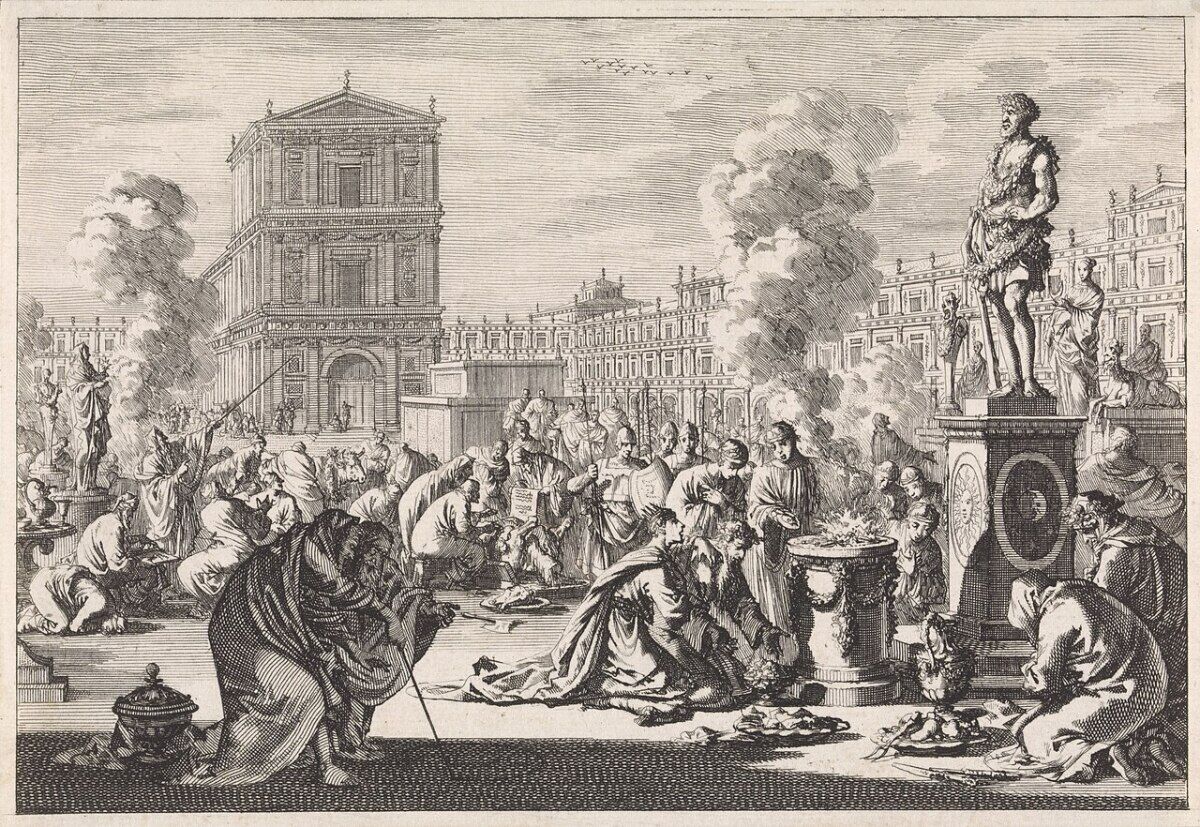
2 Kings 21 and 2 Chronicles 33 describe the evils that Manasseh committed, stating that he:
- “built again the high places”
- “reared up altars for Baal”
- “made an Asherah”
- “worshipped all the host of heaven”
- “built altars in the house of the Lord”
- “made his children to pass through the fire”
- “practiced soothsaying”
- “used enchantments”
- “practiced sorcery”
- “appointed them that divined by a ghost or a familiar spirit”
- “set the graven image of the idol, which he had made, in the house of God”
- “shed innocent blood very much, till he had filled Jerusalem from one end to another.”
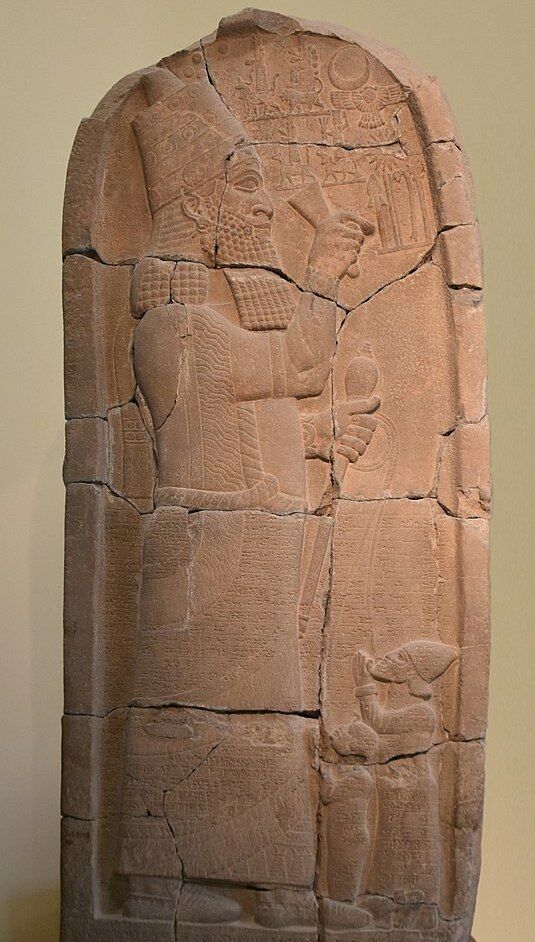
2 Chronicles 33 records Manasseh’s repentance partway through his reign—only after the king of Assyria had extricated Manasseh from the city and led him away to Babylon “among the thorns” (actually referring to hooks pierced through his face—see here for more detail, including a likely ancient depiction of this from the Assyrian king in question). Nevertheless, despite Manasseh’s repentance, including his attempts at ridding Jerusalem of idolatry following his reinstatement in the city, the die was cast: “Notwithstanding the Lord turned not from the fierceness of His great wrath, wherewith His anger was kindled against Judah, because of all the provocations wherewith Manasseh had provoked Him” (2 Kings 23:26).
Enter the Prophets
It’s not as if the king wasn’t warned. During the dark days of the first part of Manasseh’s long 55-year reign, “the Lord spoke by His servants the prophets,” warning the king and the nation with a message of “such evil [to come] upon Jerusalem and Judah, that whosoever heareth of it, both his ears shall tingle” (1 Kings 21:10, 12).
Interestingly, it is immediately following this warning message from the prophets that we read of Manasseh “fill[ing] Jerusalem from one end to another” with “innocent blood very much” (verse 16).
Also interestingly, it is during this very block of time—the early to mid seventh century b.c.e.—that we have little to no prophetic literature. Have you ever wondered why? We have numerous prophets on the scene on either side of this period, living out their lives (even amid persecution): prophets during the ninth century b.c.e., such as Obadiah, Elijah, Elisha and Joel; multiple prophets during the eighth century b.c.e., including Jonah, Amos, Hosea, Micah and Isaiah—the latter of which continued into the first part of the seventh century b.c.e. The bulk of the prophetic literature then picks back up with the likes of Zephaniah, Jeremiah and Habakkuk, on the scene from the late the seventh century b.c.e. onward.

For the better part of half a century, during the early to middle part of the seventh century b.c.e., we have a blank slate—nearly. We do have the Prophet Nahum the Elkoshite on the scene at this time (mid-seventh century b.c.e.)—although even then, he is often regarded as situated within a distant northern location—perhaps even as far away as Alqosh, northern Iraq. Furthermore, his prophecies are chiefly directed toward Assyria.
To the same end, it is telling that of the two historical records of Manasseh’s life—2 Kings 21 and 2 Chronicles 33—the former only contains details relating to the first part of Manasseh’s life. The latter part of Manasseh’s life—including his capture and captivity by the Assyrians, his repentance, his return to Jerusalem, his attempts to purge the city of the idolatry he introduced, and the continued paganism of the populace—these details are found only in the much later Chronicles account.
The omission of these later details in the Kings account is sometimes hand-waved away as the product of the author only wishing to include negative information about the king—part of a bias or grudge against him. Yet could there be more going on here than this overly simplistic explanation implies? The Chronicles account is traditionally ascribed to the much later hand of the scribe Ezra, compiling information in the fifth century b.c.e. Yet the content of the Kings account is traditionally ascribed to the work of prophets. Is it more than coincidence, therefore, that the Kings account of Manasseh’s life stops rather abruptly at verse 16—the passage beginning to describe Manasseh “fill[ing] Jerusalem from one end to another” with “innocent blood very much”?
The main part of the seventh century b.c.e., then—prophetically—represents a comparatively stark blank. But perhaps this should be no surprise, given the massacre described just following the description of God’s warning message. The first-century c.e. Jewish historian Josephus says as much—adding that Manasseh “barbarously slew all the righteous men that were among the Hebrews; nor would he spare the prophets, for he every day slew some of them, till Jerusalem was overflown with blood” (Antiquities of the Jews, 10.3.1).
As for Isaiah?
Josephus does not name specific prophets in this context. The Talmud, however, does—recording the discovery of an ancient document stating specifically that Isaiah was one of these prophets killed by Manasseh. From Yevamot 49b: “Rabbi Shimon ben Azzai said: I found a scroll recording people’s lineages, in Jerusalem …. And it was written in it: Manasseh, king of Israel, killed Isaiah the prophet.”
The timeline for this execution to have happened by the hand of Manasseh would be a good fit with the account contained within the book of Isaiah. Again, the book is introduced with Isaiah as prophesying through the reigns of Uzziah to Hezekiah. Yet we get a rather complete picture of Hezekiah’s life in the book, with details pertaining to his latter years (e.g. Isaiah 39), with the likelihood that Isaiah survived him—although perhaps not for greatly long. Furthermore, Isaiah’s death is not recorded in the books of Kings or Chronicles, as having been mourned. This would certainly have been expected, had he died during the reign of Hezekiah—as with the likes of the Prophet Samuel (1 Samuel 25:1), Elijah (2 Kings 2) and Elisha (2 Kings 13:14)—something that would have been expected especially for Isaiah, given he was a Jerusalem-based prophet.
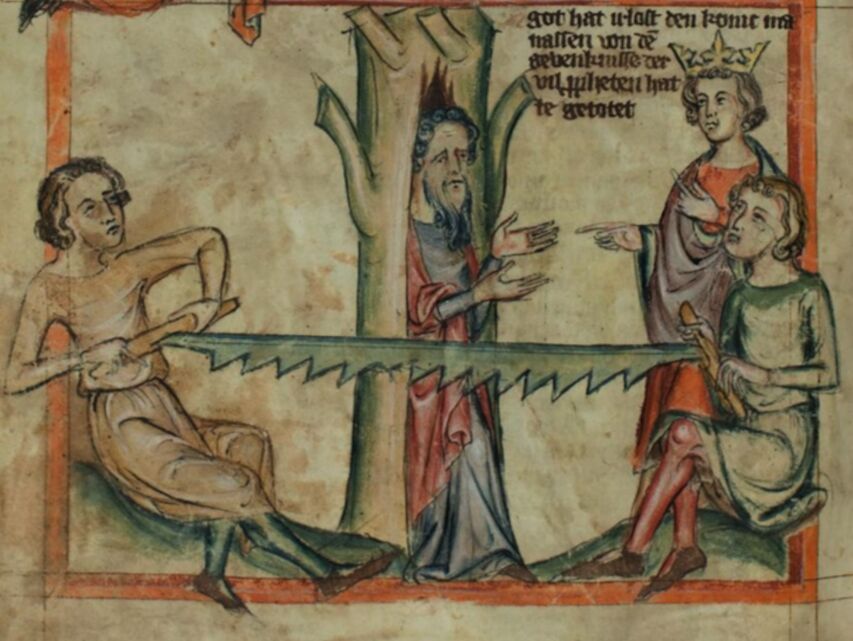
This passage in the Talmud then continues to cite the Gemara, which expands on the particulars of Isaiah’s death—including a back-and-forth dialogue between Manasseh and Isaiah—before Manasseh had Isaiah “sawed through” while he was “within a cedar tree.” Some of the added details are rather fanciful (although curiously enough, binding to a tree was a typical historical method of execution by sawing). But alongside the general record of Isaiah’s death at the hands of Manasseh, could there be an element of truth to death by sawing?
This account is not limited to the early-mid first millennium c.e. text contained within the Talmud—it is also commonly found among the early Christian writers. Gill’s Exposition of the Entire Bible notes that “it is become a generally received opinion of the ancient Christian writers, that Isaiah was sawn asunder; as of Justin Martyr, Origen, Tertullian, Lactantius, Athanasius, Hilary, Cyril of Jerusalem, Gregory Nyssene, Jerome, Isidorus Pelusiota, Gregentius, Procopius Gazaeus, and others.”
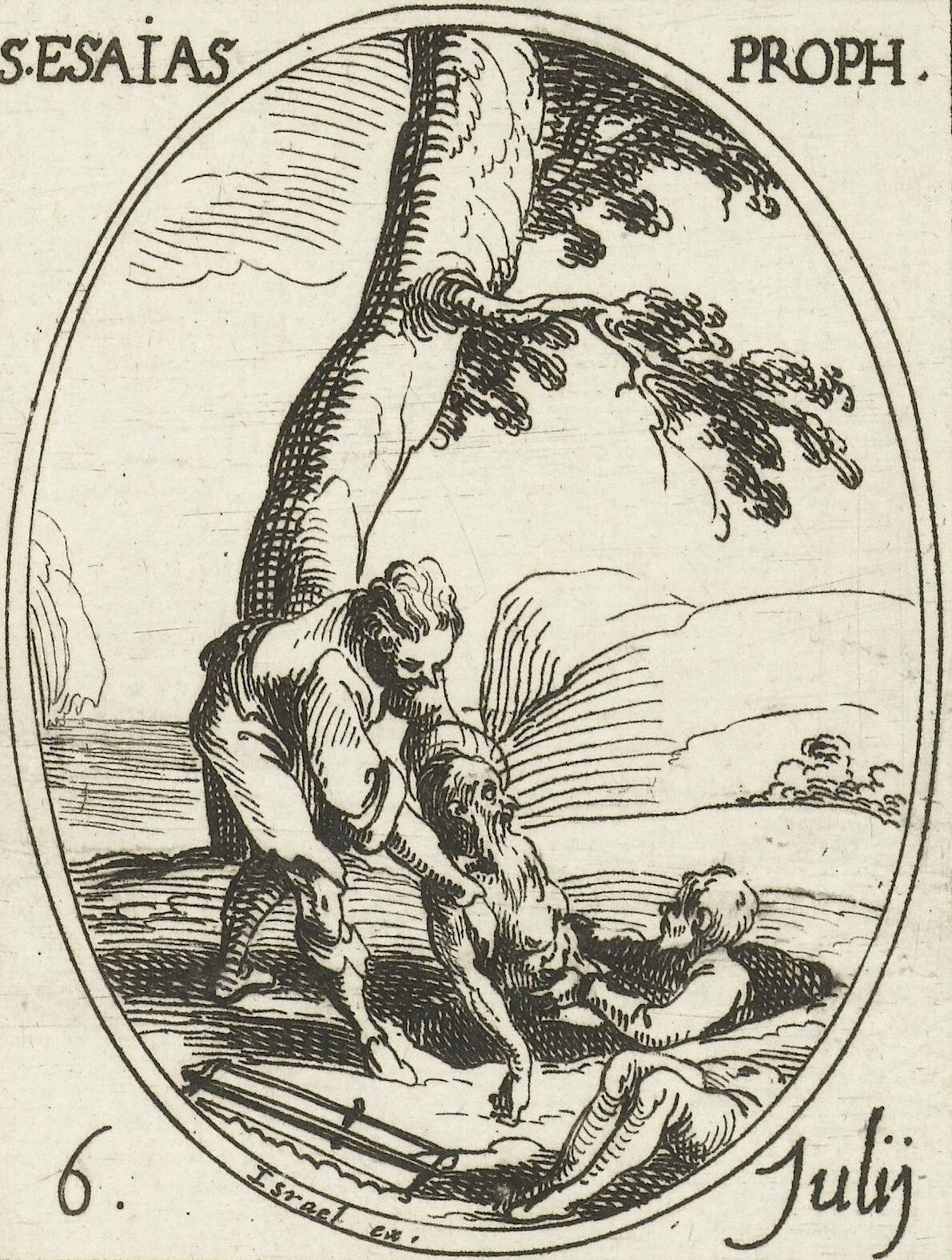
Among the earliest of these, Justin Martyr writes circa 160 c.e. of “the death of Isaiah, whom you sawed asunder” (Dialogue with Trypho, 120). Another early text, the Ascension of Isaiah—dating to the late first-early second century c.e.—contains some detail of “Isaiah … being sawn in sunder.” The fourth century c.e. Jerome called it “an undisputed tradition among us, that he [Isaiah] was sawn asunder by Manasseh” (Commentary on Isaiah).
And while not naming the prophet directly, a likely reference to the same comes from the New Testament itself, from the first century c.e. author of Hebrews.
Hall of Faith
Hebrews 11 is often regarded as the “faith chapter,” listing the giants of faith in the Bible and their deeds. Special attention is given in its first section to various exemplary figures such as Abel, Noah, Abraham and Moses. Verse 32 introduces the final section in summary, highlighting the overcoming and endurance of manifold unnamed figures on the scene during the period of the Hebrew Bible/Old Testament, the Intertestamental period, and the New Testament period. Many of these statements can be directly attributed to names—as follows (verses 32-40):
And what shall I more say? For the time would fail me to tell of Gedeon, and of Barak, and of Samson, and of Jephthae; for David also, and Samuel, and of the prophets; Who through faith
- subdued kingdoms [e.g. Jonah, Daniel],
- wrought righteousness [many],
- obtained promises [many],
- stopped the mouths of lions [e.g. Samson, David, Benaiah, Daniel],
- Quenched the violence of fire [e.g. Shadrach, Meshach, Abed-nego],
- escaped the edge of the sword [many, e.g. David, Elijah],
- out of weakness were made strong [e.g. Job, Samson, David],
- waxed valiant in fight [many],
- turned to flight the armies of the aliens [many, e.g. Shamgar, Samson, Eleazar, Elisha].
- Women received their dead raised to life again [e.g. Woman of Shunem, Woman of Zarephath]:
- and others were tortured, not accepting deliverance; that they might obtain a better resurrection [often associated with the story of Eleazar and the Woman with Seven Sons]:
- And others had trial of cruel mockings [e.g. Elisha, Jeremiah]
- and scourgings [e.g. Paul],
- yea, moreover of bonds and imprisonment [e.g. Joseph, Samson, Michaiah, Jeremiah, Peter, Paul, Silas]:
- They were stoned [e.g. Naboth, Zechariah, Stephen, Paul],
- they were sawn asunder [Isaiah?],
- were tempted [many],
- were slain with the sword [many, e.g. John]:
- they wandered about in sheepskins and goatskins [e.g. Elijah, John];
- being destitute, afflicted, tormented [many]; (Of whom the world was not worthy:)
- they wandered in deserts, and in mountains, and in dens and caves of the earth [many, e.g. David, Elijah, John].
And these all, having obtained a good report through faith, received not the promise: God having provided some better thing for us, that they without us should not be made perfect.
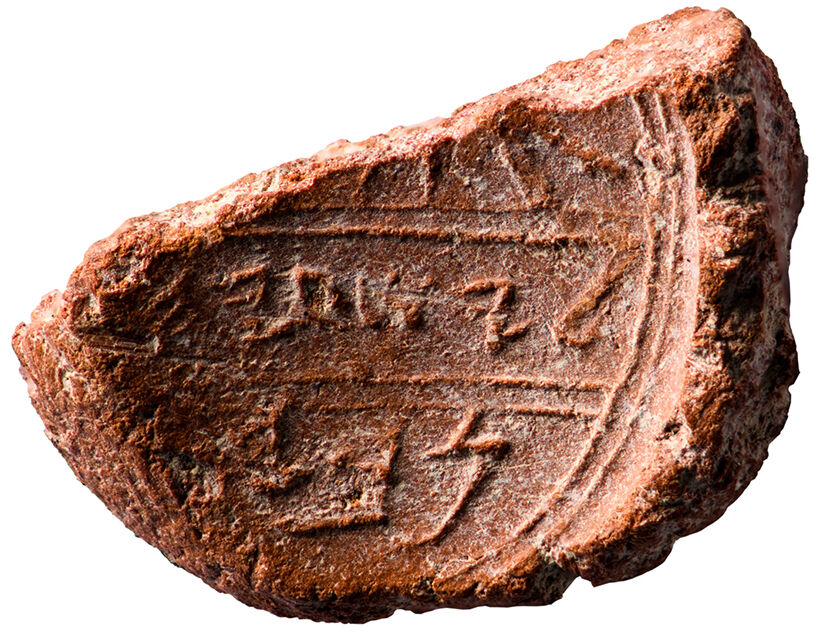
Given the rarity of sawing as an execution method—let alone for a biblical figure—and given the sheer number of early Jewish and Christian writings pointing to Isaiah as having been executed in such a manner, commentaries on Hebrews 11:37 almost ubiquitously indicate this “sawn asunder” phrase as referring to Isaiah. (Some—although much less frequently—include Simon the Zealot with this passage, given traditions that he too was sawn in two, although these traditions are somewhat more tenuous and conflicting. Still, if he is to be included it would give a sense of the plural—“they were sawn asunder.”)
Summarising the Evidence
While the biblical evidence is not explicit, it certainly points in a certain direction. The 19th-century theologian Albert Barnes summarized the evidence in his introduction to Isaiah for his commentary Barnes’ Notes on the Whole Bible. This evidence for Isaiah’s manner of execution by Manasseh is cited by him as follows:
- Isaiah lived to complete the record of the reign of Hezekiah and of course survived him.
- The testimony of the Jewish writers.
- The testimony of the early Christian writers is the same.
- The character of Manasseh was such as to make it probable that, if Isaiah lived at all during his reign, Manasseh would seek his death.
- It affords some confirmation of this statement that Paul (Hebrews 11:37) affirms.
- The character of the second part of the prophecies of Isaiah Isaiah 40-66 accords with this supposition.
Regarding this latter point—could there be a hint from Isaiah himself toward the goings-on during the early part of Manasseh’s reign? This last, separate section of the book of Isaiah hits a different tenor, transitioning to a soaring vision of hope and the World to Come. Yet bound up within it are certain sobering warnings—especially in light of what we have covered above.
From Isaiah Himself?
One such warning is found in Isaiah 57:1—an observation that almost reads verbatim to that described of Manasseh’s reign in the biblical account and in Josephus:
The righteous perisheth,
And no man layeth it to heart,
And godly men are taken away,
None considering
That the righteous is taken away from the evil to come.
What was it that Josephus wrote? “[Manasseh] slew all the righteous men … he every day slew some of them, till Jerusalem was overflown with blood.” Isaiah 57:1 almost reads like an eyewitness account of Manasseh’s—certainly not Hezekiah’s—reign.
And there is yet something more, from the very end of the book—perhaps an indication of something awful to befall the elderly prophet and those around him. The second-to-last verse of the final chapter ends on a high note, wrapping up the message contained within the final third of the book of Isaiah:
And it shall come to pass,
That from one new moon to another,
And from one sabbath to another,
Shall all flesh come to worship before Me,
Saith the Lord (Isaiah 66:23).
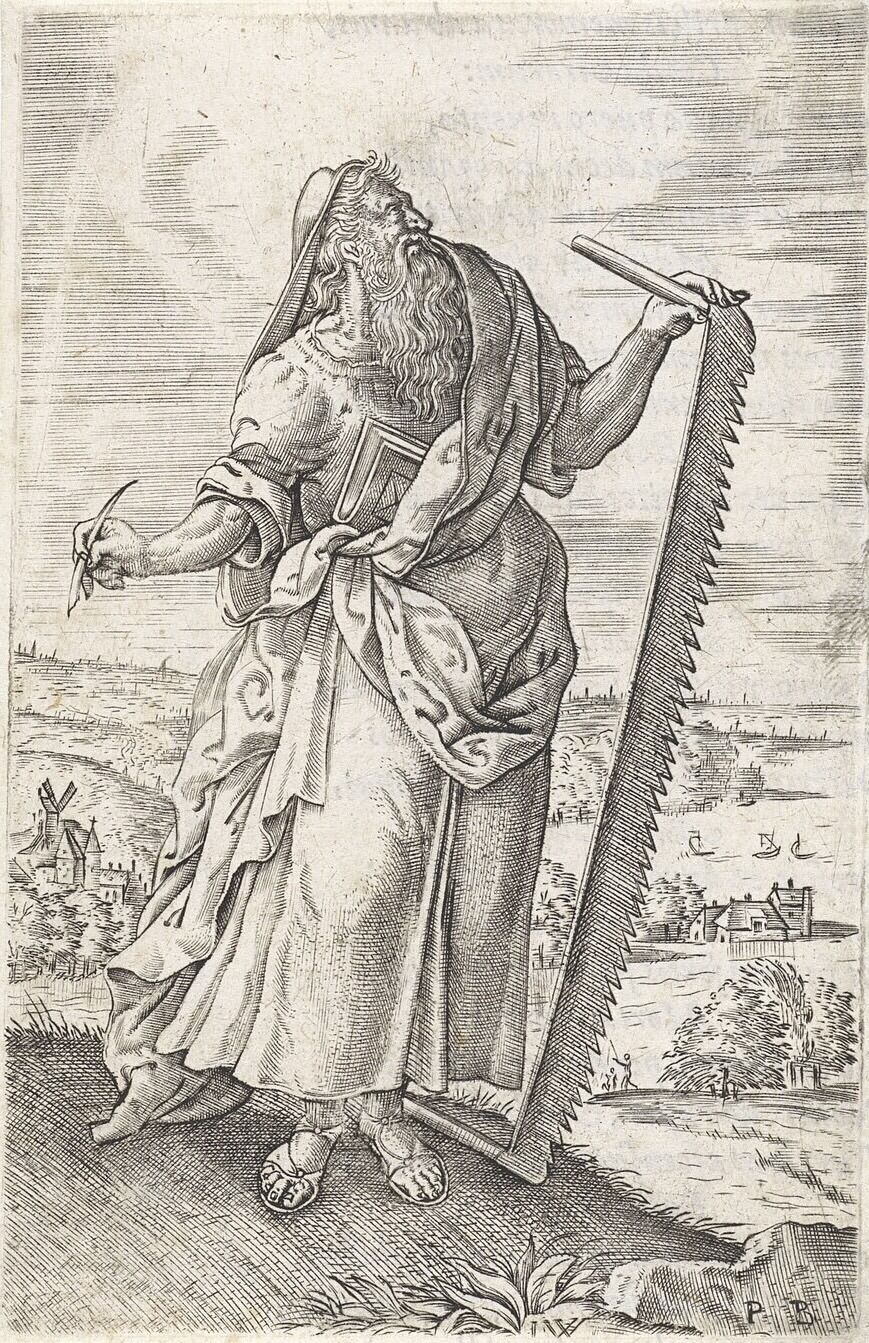
But suddenly the text takes a dark turn, with one final and gruesome verse. So dark, in fact, that some manuscripts re-insert the words of verse 23 after it—a verse re-recited following it in synagogues “on account of the terrible character of the latter, ‘so as to close with words of consolation’” (Keil and Delitzsch Biblical Commentary on the Old Testament).
One wonders what the author saw befalling those around him—and inevitably to himself—when he wrote, in similar manner to Isaiah 57:1, these final words of inversive condemnation against evildoers—what would befall their own carcasses:
And they shall go forth, and look
Upon the carcasses of the men that have rebelled against Me;
For their worm shall not die,
Neither shall their fire be quenched;
And they shall be an abhorring unto all flesh.