
Sennacherib’s 17 Hezekiah Inscriptions
In order to place a biblical story in its wider historical context, connections to foreign powers are essential, especially if those foreign powers kept detailed records.
Perhaps most illustrative of this concept is the push of the Neo-Assyrian Empire into the eastern Mediterranean in the eighth to seventh centuries b.c.e. Six consecutive Assyrian kings are mentioned in the biblical text, beginning with the powerful Tiglath-Pileser iii in the middle of the eighth century. Following him are Shalmaneser v, Sargon ii, Sennacherib, Esarhaddon and Ashurbanipal—all of whom are mentioned to a greater or lesser extent.
In the Bible, these kings are mentioned only as they impact the nations of Israel and Judah. However, when studying the larger Assyrian corpus of inscriptions, we see a far more expansive view of their Assyrian dominion. Thus, what is truly portrayed as a big deal in the Bible for Israel or Judah could be a relatively minor escapade according to Assyrian documents.
In the case of King Sennacherib and King Hezekiah of Judah, however, both the Bible and Assyrian documents give the interaction great emphasis.
Some of these inscriptions are well-known—such as the Taylor Prism, the Oriental Prism and the Jerusalem Prism—all writings by Sennacherib’s scribes that include the king’s third campaign to the Hatti Land, which included the takeover of most of Judah.
But there are more—a lot more! Those prisms are only three of 17 inscriptions that mention King Hezekiah by name.
In 2012 and 2014, Prof. A. Kirk Grayson and Dr. Jamie Novotny produced two massive volumes, titled The Royal Inscriptions of Sennacherib, King of Assyria. These volumes are part of a larger project—The Royal Inscriptions of the Neo-Assyrian Period (rinap)—and detail all of the known Assyrian inscriptions belonging to King Sennacherib. The scholarly work is an extremely thorough synthesis of the context, translation and provenance of the surviving texts of King Sennacherib.
These volumes show that King Hezekiah’s name was written not only on prisms but also on stand-alone tablets and the wall inscriptions in Sennacherib’s palace.
Thus, if we read through all the ancient inscriptions of Sennacherib, we can find King Hezekiah’s name virtually everywhere. In fact, his name is explicitly written over 100 times (101 by my count).
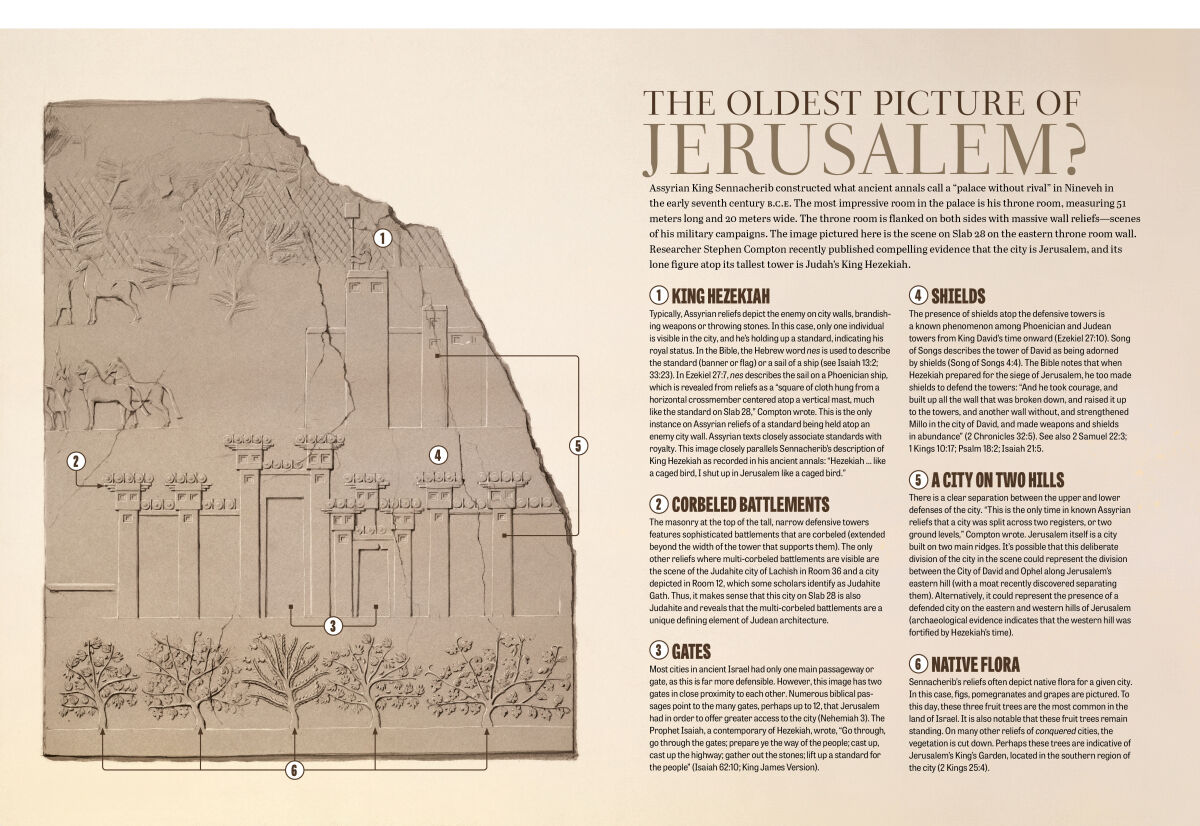
Most notably, King Hezekiah’s name is featured highly in Sennacherib’s inscriptions at the doorways to his massive throne room in Nineveh. On most of the doorways leading into the throne room, Sennacherib boasts about his exploits against Hezekiah. “I made Hezekiah, its king, bow down at my feet so that he now pulls my yoke,” reads one such inscription (rinap 42). “I ruined the wide district of the recalcitrant and strong and of Judah, and I made Hezekiah its king to bow down at my feet,” reads another (rinap 44).
At the main entrance of the throne room, Hezekiah is mentioned three times, largely paralleling the text from Sennacherib’s prisms. One section of the inscription reads, “As for Hezekiah … I confined him inside the city Jerusalem, his royal city.” This inscription is less than 5 meters (16 feet) from Slab 28, which is most likely a scene portraying Hezekiah “trapped” in Jerusalem.
https://www.youtube.com/watch?v=bIGbSIi8-sM