
Redating the Dead Sea Scrolls
Brand-new research, utilizing artificial intelligence (AI)—in conjunction with radiocarbon dating (14C)—is serving to corroborate the earlier composition of biblical texts, upending various theories of much later development.
This research concerns the famous Dead Sea Scrolls—a massive early trove of thousands of fragments of biblical (and other) texts found buried within caves in the Judean Desert—most of which have been dated to between the second century b.c.e. to second century c.e. According to the new research, however, many of these manuscripts should be dated significantly earlier than researchers previously thought.
Former research and dating of the Dead Sea Scrolls relied on more cumbersome paleographic approaches, manually analyzing the development of writing style in order to determine dates, with very few firmly established, securely dated time stamps to go on. The new AI program, named Enoch, is now calling into question the original dating of many of these scrolls.
In a new paper published in June in the scientific journal PLOS One, titled “Dating Ancient Manuscripts Using Radiocarbon and AI-Based Writing Style Analysis,” authors Mladen Popović, Maruf A. Dhali, Lambert Schomaker, Johannes van der Plicht, Kaare Lund Rasmussen, Jacopo La Nasa, Ilaria Degano, Maria Perla Colombini and Eibert Tigchelaar reveal “Enoch, an AI-based date-prediction model, trained on the basis of 24 14C-dated scroll samples.”
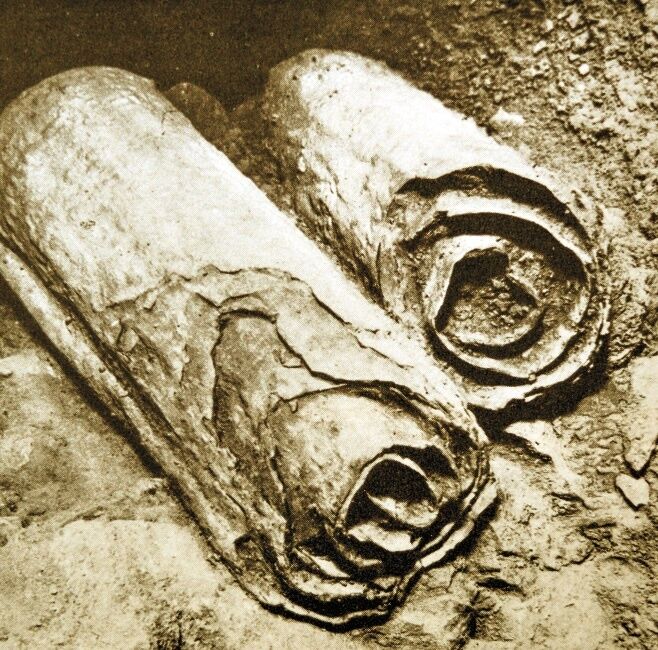
Multiple thousands of Dead Sea Scrolls manuscript fragments exist—obviously, not all of them can be subjected to the expensive and somewhat-destructive process of carbon dating. Further, manual analysis of the fragments can often miss the tiniest of marks and strokes left behind on the often sorely degraded scrolls. The digital program Enoch—trained on the smaller number of 14C-dated scrolls and then tested and proved for accuracy against other scrolls of likewise-known dates—can be turned loose on the broader collection.
The authors explain: “By applying Bayesian ridge regression on angular and allographic writing style feature vectors, Enoch could predict 14C-based dates with varied mean absolute errors (maes) of 27.9 to 30.7 years. In order to explore the viability of the character-shape- based dating approach, the trained Enoch model then computed date predictions for 135 non-dated scrolls, aligning with 79 percent in paleographic post-hoc evaluation. The 14C ranges and Enoch’s style-based predictions are often older than traditionally assumed paleographic estimates, leading to a new chronology of the scrolls and the redating of ancient Jewish key texts that contribute to current debates on Jewish and Christian origins” (emphasis added throughout).
The exciting new research has remarkable potential and significant implications—not least in the redating of some of the key prophetic biblical works found among the Dead Sea Scrolls.
Bringing Back Daniel
The text of Daniel is a key case in point and is “one of the most significant findings of the 14C results,” the authors wrote.
The biblical setting for the Prophet Daniel and his book is during the sixth century b.c.e. Most scholars, however, place the origin of the text centuries later, broadly in attempts to postdate the composition of its many detailed events and prophecies contained within its latter chapters, especially concerning the Seleucid and Ptolemaic empires (312–63 b.c.e. and 305–30 b.c.e., respectively) and in particular, the reign of Antiochus iv Epiphanes (175–164 b.c.e.).
4Q114 is a Dead Sea Scrolls manuscript preserving the text of Daniel 8-11, “which scholars date on literary-historical grounds to the 160s b.c.e.,” the authors wrote. Granted, even this date is long prior to certain early theories for the composition of the book (with relation to the much-debated subject of Daniel’s prophecies concerning even later events and entities, such as the Roman Empire). Yet the new research tantalizingly takes this back a step further again, with an “accepted 2σ calibrated range for 4Q114, [of] 230–160 b.c.e.” for this particular copy of the text.
The 4Q114 Daniel fragment is not the only biblical manuscript from the collection that has been significantly predated. Some of the scrolls already believed to be the oldest in the collection—fragments of Jeremiah and Samuel, originally dated to the third century b.c.e.—have been submitted as dating to as early as the fourth century b.c.e. Ecclesiastes is another text whose fragments have been dated much earlier within the third century b.c.e. by Enoch, pushing the boundaries of the late-composition theories for this text held by many scholars.
It’s worth noting that the accepted 79 percent of dates returned by Enoch following “post-hoc evaluation” are just those dates believed by the researchers to be “realistic”—the “remaining 21 percent judged to be too old, too young or indecisive,” reported Haaretz, following an interview with the lead researcher (“Dead Sea Scrolls May Be Older Than We Thought, AI-Based Study Says,” June 4). “Given that Enoch produces a range of likely dates for an artifact rather than a specific date, it’s hard to specifically say how many scrolls should be backdated, as parts of those ranges often overlap with those provided by radiocarbon or traditional paleographic analysis, Popović says.” Nevertheless, “broadly speaking, it now seems that the oldest scrolls date to the fourth century b.c.e., and there is a larger amount than we thought from the third century b.c.e., in the Hellenistic Period,” as opposed to the later Hasmonean Period (and theories of Hasmonean development of these texts).
On this, there are two particular script-types that have long been highlighted among the Dead Sea Scrolls trove: the earlier “Hasmonean type” script and the later “Herodian type” script. The AI-based findings reveal the “Hasmonean type” script to be significantly older, and the “Herodian type” to be likewise—also, that the “Herodian” existed concurrently with much of the use of the “Hasmonean” (contrary to assumptions of an evolutionary sequence).
“Scholars often assume that the rise and expansion of the Hasmonaean kingdom from the mid-second century b.c.e. onward caused a rise in literacy and gave a push to scribal and intellectual culture,” wrote Popović et al. in their PLOS One paper. “Yet the results of this study attest to the copying of multiple literary manuscripts before this period.”
“The results of this study thus dismantle unsubstantiated historical suppositions and chronological limitations,” they conclude.
Prophetic Pushback
Since its publication, the new research has piqued an immense amount of interest—particularly concerning the dating of the prophetic text of Daniel, in manuscript 4Q114.
Unsurprisingly, the authors themselves do not make a case for the prophetic nature of the text, simply presenting in their article the dates that Enoch returned. Rather, as highlighted especially in follow-up interviews concerning their publication, they attempt to explain 4Q114 as possibly representing a copy of Daniel in circulation at least during the lifetime of its postulated early second-century b.c.e. author—one that would have to be penned almost immediately after the events that occurred during the reign of Antiochus iv Epiphanes had taken place (if taking the latter range of the dating for this scroll—still, most of its dating range predates even this). Yet it would be remarkable for such a text to have not only been penned and entered general circulation, but also a copy to have made it out as far as this esoteric, fringe, cloistered community of ascetics living in the Judean desert.
Regarding this, epigrapher Prof. Christopher Rollston was quick to contest the new dating of 4Q114. A June 20, Biblical Archaeology Society article titled “Can AI Date the Dead Sea Scrolls?” quoted Rollston, saying: “Enoch’s calibrated date range for 4Q114 is: 230–160 b.c.e. This manuscript contains portions of Daniel 8-11. Chapters 7-12 of Daniel reference the desecration of the Jerusalem temple by Antiochus iv Epiphanes (r. 175–164 b.c.e.), something which occurred in 167 b.c.e. Therefore, it has been recognized for centuries that this block of Daniel cannot be dated prior to 167. This has been known all the way back to the Neo-Platonic philosopher Porphyry, who lived in the third century c.e. Thus, in this particular case, which is the one case where we can really fact-check Enoch, it is crystal clear that Enoch’s dates are much too high.”
That, or perhaps the text really is prophetic.
In the more deferential words of Dr. Yonatan Adler—himself a prominent proponent of later compositional theories: “If the reason why scholars critique the results is that it doesn’t necessarily fit in with what they have always thought about dating, then that is not a good critique” (ibid).
The discovery of the Dead Sea Scrolls trove in the late 1940s set off an earthquake in the archaeological and biblical studies communities. With Enoch’s findings, it seems like we may well be experiencing the foreshocks of another. Put succinctly in a social media post by Ph.D. student in Septuagint studies Camilla Recalcati: “This will have extraordinary consequences on our field.”