
Proto-Aeolic Capitals in Spain
In 2006, a fragment of a proto-Aeolic capital was submitted to the Museum of Malaga in Spain. It was found in Cerro Del Villar, an ancient Phoenician colonial settlement in Southern Spain, during preparations for the excavation of a house at the site. The rare find remained unpublished until 2021.
The capital fragment is made of light brown sandstone and bears evidence of being painted with red and white paint. “Everything points to it being part of a volute [spiral shape] that would form one of the ends of a rectangular proto-Aeolic capital,” the report stated.
Proto-Aeolic capitals are defined by their palm-tree (or “tree of life”) motif. The author of the study believes the capital is evidence of an important ritual/religious building yet to be uncovered, as the palm motif was used in Phoenician religious practices. The capital itself would have been at least half a meter in length. Although it’s hard to precisely date the fragment, researchers estimate that, based off when the site was in use, the fragment “must be dated between the first half of the eighth century and the first quarter of the sixth century b.c.e.”
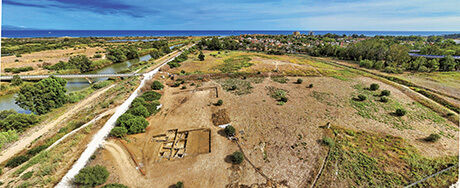
Cerro Del Villar was “a center of pottery production” and had extensive trade with not only the Phoenicians, but also the Greeks and Etruscans. It was eventually abandoned in the sixth century b.c.e. due to multiple catastrophic floods.
An article in the 2025 summer issue of Biblical Archaeology Review, titled “From Tyre to Tarshish: The Phoenicians in Spain,” stated, “Such capitals, well known from royal architecture in ancient Israel and Judah, were widely used in monumental graves and shrines across the Phoenician world.” Biblical Tarshish can be identified with Tartessos, the ancient name for the Guadalquivir River, which lies just off the Spanish coast of Malaga, where the capital fragment was found.
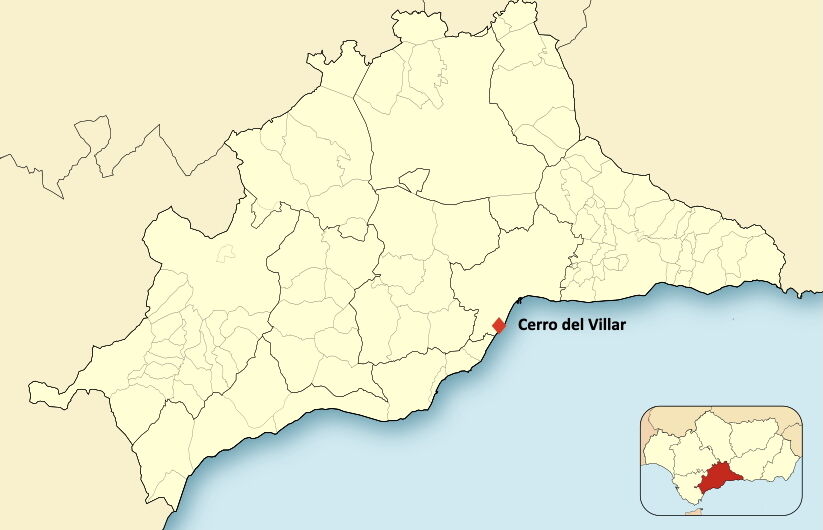
In 2016, another “proto-Aeolic capital with a clear Eastern origin” and showing the same palm-tree motif was found in Alora, near the city of Malaga.
The study on the 2016 capital stated that “the place where they originated may have been Phoenicia itself, although paradoxically, they are not very abundant in that territory at present, which has led some authors to believe that the original focus should be sought in the nearby Jewish sphere during the time of the Omri dynasty.” In the Exhibit issue of Let the Stones Speak, we wrote, “Earlier examples of the volute style capital are found in Israel, rather than in Phoenicia itself. Thus, it is plausible to consider the emergence of proto-Aeolic capitals and the associated ashlar masonry as a new Israelite style of royal architecture created alongside the genius of the Phoenician artists and stonemasons.”
This style of capital as an architectural element was most likely a cultural export through the Phoenicians to their colonies in Southern Spain. The Bible shows that Tyre was strongly connected to Tarshish. The Prophet Ezekiel speaks of Tarshish being Tyre’s “merchant” because of “the multitude of all kinds of riches; with silver, iron, tin, and lead, they traded for thy wares” (Ezekiel 27:12). The Prophet Isaiah, who lived during the eighth century b.c.e. when Cerro Del Villar was being established, makes the same connection in Isaiah 23:5-8.
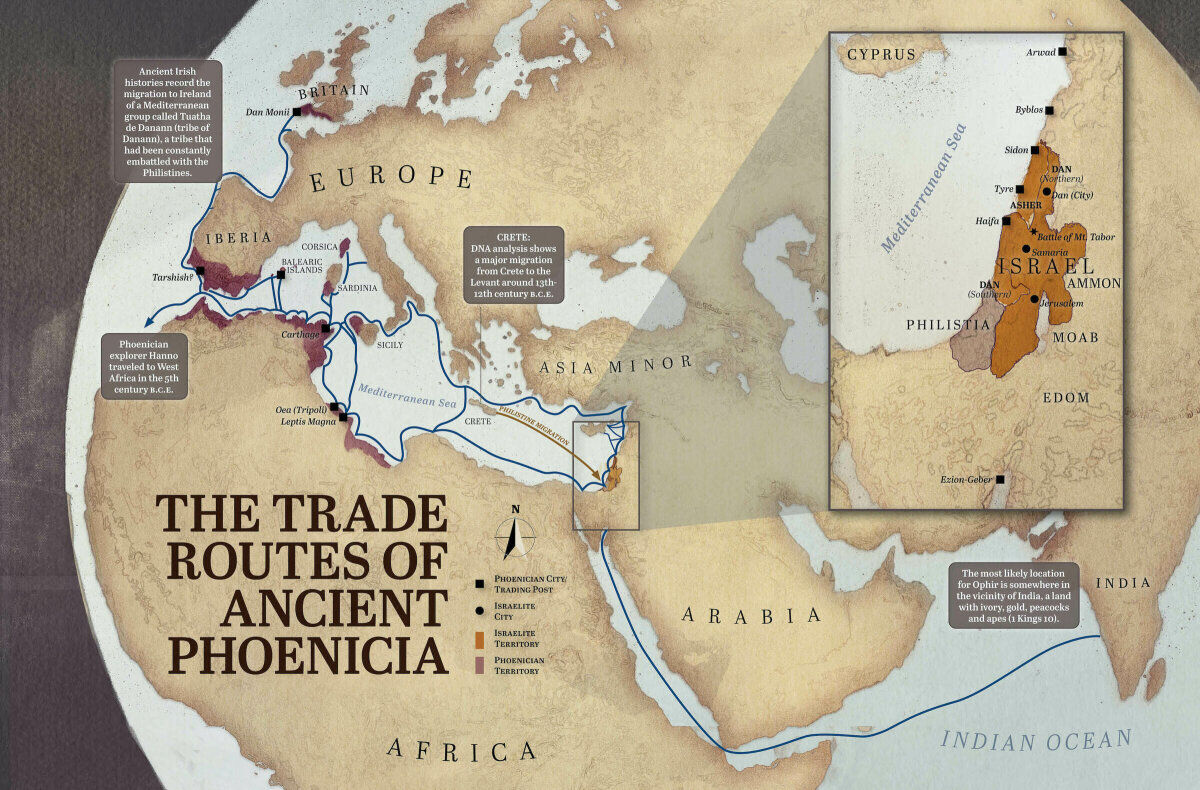
As an extension of Tyrian trade, in the 10th century b.c.e., King Solomon and Hiram, king of Tyre, made a league in which Hiram agreed to assist Solomon in the construction of the temple (1 Kings 5:22). Later, the Bible describes Solomon sending out a “navy of Tarshish,” along with Hiram’s navy, to receive “gold, and silver, ivory, and apes, and peacocks.” (Evidence of Phoenician presence in Jerusalem has been found in the form of a 10th-century b.c.e. Phoenician earring pendant, which parallels discoveries found in Spain.)
Although just a small portion of a capital, the volute fragment adds to our understanding of the architectural connection between Israel, Phoenicia and Spain. As Let the Stones Speak contributing editor Ryan Malone wrote in his article “The Sephardic Connection”: “Harmonizing the biblical record with archaeology, the link between the Holy Land and Spain is certain, strong and quite ancient.”