
Three Ancient Wrecks Analyzed Off Israelite Coast
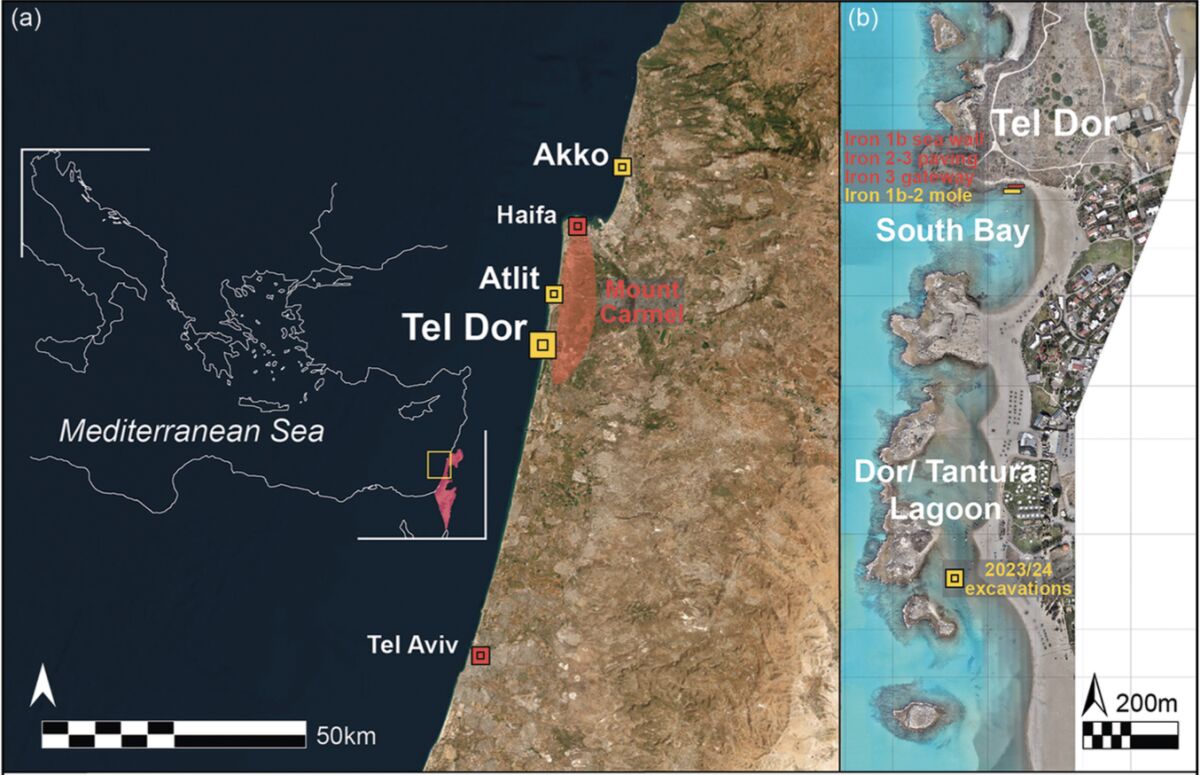
More than 20 ancient shipwrecks and cargoes lie covered in sand off the coast of Tel Dor, an ancient maritime hub situated near Mount Carmel. In 2023 and 2024, Prof. Assaf Yasur-Landau, from the University of Haifa, directed underwater excavations at a Tel Dor lagoon to examine three Iron Age cargoes and what they might reveal about “zones of interaction and the impact of political change on patterns of trade” at the site. The excavation results were recently published in the August issue of Antiquity.
These shipwrecks and cargoes are a treasure trove that can give us a better understanding of maritime trade along the coast of the Levant during the biblical kingdom of Israel and beyond.
Located between Haifa and Tel Aviv, the ancient city of Dor was the perfect place for trade due to its natural harbors. Because of its long occupation, the shipwrecks and lost cargo give insight into change in trade patterns along the coast over multiple centuries.
The earliest of the three cargoes, Cargo M, was dated to the 11th century b.c.e. by several rare Iron i storage jars. At this time, Dor was still under the control of the Sikil (one of the “Sea Peoples”). Judges 1:27 highlights that the tribe of Manasseh failed to drive out “the inhabitants of Dor and her towns.” Cargo M reveals evidence of quite extensive maritime trade by Dor within the Mediterranean, especially Egypt and Cyprus, as well as the Phoenician coast. A stone anchor associated with the cargo was incised with a Cypro-Minoan script, similar to one found elsewhere along the coast of Carmel. Previous underwater excavations along Dor’s coast—revealing monumental architecture of the time period—show that Dor had become a wealthy city (presumably due to its large-scale trade) before it was taken over by the Israelites.
Cargo L1, which had initially been dated to the Persian period, was re-dated to the late ninth to early eighth century. Among the finds in L1 were three complete and 10 partial Phoenician-style storage jars (amphorae). A grape seed in one of the amphorae brought back a radiocarbon date window of 810–775 b.c.e. Researchers also discovered several bowls that are typical of the late ninth to early eighth century b.c.e.
Unlike Cargo M, no Egyptian or Cypriot wares were found.
According to the report on the excavations:
Dor L1, dated to the late ninth–early eighth centuries b.c.e, with its uniform cargo containing coastal-type storage jars and galley wares of thin-walled bowls, may suggest a more restricted interaction zone that did not include Egypt and Cyprus—potentially paralleling the sharp decline of imports found on the tell in this period and according with the assumedly weaker maritime connections of the Israelite kingdom compared to those of the Phoenician polities.
According to the researchers, during Iron Age iib Dor had switched hands to the Israelites. While L1 proves the continuation of maritime trade at Israelite Dor, it does seem to be more confined than during the prosperous age of the town as evidenced by Cargo M and finds from other excavations. This more limited range of trade at Tel Dor points to the biblical description of the kingdom of Israel around the turn of the 9th century b.c.e.
2 Kings 13-14 talk about the political instability within Israel at this time. Verse 4 of chapter 13 describes Israel being oppressed by the king of Syria and 2 Kings 14:26 states, “For the Lord saw the affliction of Israel, that it was very bitter; for there was none shut up nor left at large, neither was there any helper for Israel.” Internal and external political and national instability would cause trade as well as construction at Tel Dor to decline.
As some have pointed out, the range and number of finds used in the study are too small to draw any lasting conclusions. But, so far, the knowledge gleaned from the finds discussed in the report line up with the biblical description of national turmoil in the kingdom of Israel at the time.
In “Rethinking the Iron Age Carmel Coast: A Coastal and Maritime Perspective,” researchers wrote: “Lacking any serious competition from any coastal city between Ashkelon in the south and Tyre in the North, Dor experienced unprecedented prosperity in the Iron Age ib and iia, but it was brought to an abrubt halt by external political pressures of the Israelite kingdom during the late Iron Age iia and iib.”
Cargo L2, initially thought to be from the early Persian Period, was dated by the researchers to the seventh to sixth century b.c.e. Its finds revealed a further expanded interaction zone, based on basket handle amphorae and iron blooms (used to create wrought iron), which were dated to around the turn of the seventh century b.c.e. The researchers believe this shows a revival of connectivity and prosperity occurred after the Assyrian Empire conquered the city, reversing the trend of the Israelite kingdom during Iron iib. They identify this change as “part of a deliberate attempt by the Assyrians [such as Sargon ii and Esarhaddon] to regulate the administration of Dor and its relationship with maritime polities.” At this time, they write, “the port of Dor was operated within the trade concession given by the heads of the empires to client rulers from the Phoenician heartland.” These Phoenician rulers—masters of the sea—caused Dor to flourish once more.
Besides these three cargoes, many more shipwrecks and cargoes off the Dor coast remain to be examined. Hopefully these will reveal more conclusive evidence of the maritime history of the city, especially as it concerns the state of the kingdom of Israel during the reign of some of its last few kings.