
First Temple Period Bulla Discovered—Could It Reference King Josiah’s Servant?
This is a sober time of year in the Jewish world, commemorating the sieges and destructions of both the first and second temples during the month of Av—both on suspiciously similar timeframes, culminating in the fast of Tisha B’Av (the 9th of Av, August 3 this year)—the “saddest day” in the Jewish calendar.
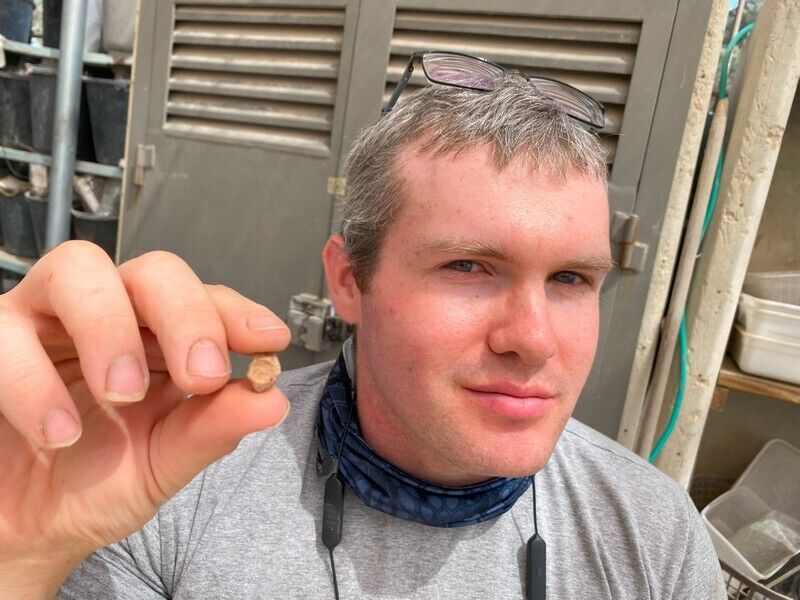
On the eve of a preemptive fast on the 17th of Tammuz (three weeks ago) “commemorating the breaching of Jerusalem’s walls and the start of the mourning period for the destruction of the first and second temples,” archaeologist Mordechai Ehrlich—working at Jerusalem’s Temple Mount Sifting Project (tmsp)—“discovered a rare and exceptionally well-preserved clay sealing, impressed by a stamp seal inscribed with ancient Hebrew letters,” the tmsp announced in a statement issued earlier today. Given the find’s significance and relevance to the time of year, it underwent a “fast-track study … so the find could be announced before the 9th of Av,” with the official publication set to be submitted for peer-review next week.
The clay seal impression, otherwise known as a bulla, was analyzed by expert epigrapher Dr. Anat Mendel-Geberovich and tmsp co-director Zachi Dvira. It bears the following inscription:
ליד[ע]יה (בן) עשיהו
Belonging to Yed[a‛]yah (son of) Asayahu
The clay item was used to seal a bag or storage container (based on its reverse impression). Paleographically, the text fits best with the end of the Iron Age period, within late seventh to early sixth centuries b.c.e. Paleographic dating is one of the limited means of dating such an item found out of stratified context (with the earth handled by the Temple Mount Sifting Project having been illegally excavated from the Temple Mount and dumped outside by the Islamic Waqf—the tmsp has been working for two decades to salvage as many precious finds as possible).
Chronologically, during this very time period the Bible mentions a figure bearing the very same name as Yedayah’s father—anglicized as “Asaiah the king’s servant.” Asaiah (with the shorter theophoric ending -iah or -yah, rather than -yahu—note that both are interchangeable) was a servant of King Josiah (r. circa 640–609 b.c.e.). He is featured in the parallel accounts found in 2 Kings 22 and 2 Chronicles 24, which describe the rediscovery of the “book of the Law” during temple renovations. When King Josiah “heard the words of the Law … he rent his clothes” (2 Chronicles 34:19), fearing the curses that the nation would suffer for failing to obey. Josiah dispatched a group of men—including the servant Asaiah—to “Huldah the prophetess, the wife of Shallum the son of Tokhath, the son of Hasrah, keeper of the wardrobe” (verse 22). She prophesied that destruction would indeed come upon Judah and Jerusalem—although thankfully the righteous King Josiah would not live to see it during his lifetime.
Unfortunately, that lifetime would not last long. Following the young Josiah’s shock defeat and death during an ill-advised battle against the Egyptians at Megiddo, the nation of Judah quickly spiraled into a series of disasters and repeat Babylonian invasions, culminating in the ultimate destruction of Jerusalem and the temple from the 7th to 10th of Av (2 Kings 25:8; Jeremiah 52:12), circa 586 b.c.e.
The discovery of the bulla, then, is simultaneously exciting and sobering. While the researchers do not regard the identification of Asayahu/Asaiah with the biblical figure as entirely certain (this usually requires an additional level of proof, such as a two-generation match paralleling that found in the Bible or a parallel title), they nevertheless point out that the particular name, general dating, Jerusalem location, and the fact that such seals would have been used only by royal affiliates are all points in favor of it, calling the identification “highly plausible.” As such, our “Yeda’yah” would represent an otherwise-unmentioned son of this royal servant Asaiah and this find would join the growing number of such seals and bullae already discovered on excavations referring to biblical figures, including Hezekiah, Ahaz, Jeroboam, Isaiah, Nathan-Melech, Jehucal, Shelemiah, Gedaliah, Pashur, Gemariah, Shaphan, Azariah, Hilkiah, Eliakim, and another Hilkiah.
https://twitter.com/TMSifting/status/1950531632043008176
The discovery of this bulla is additionally significant from a numeric angle. As highlighted in a recent Jerusalem Journal of Archaeology corpus of inscriptions I co-authored with Prof. Yosef Garfinkel, hundreds of First Temple Period bullae and dozens of seal stamps have been discovered in Jerusalem. Jerusalem in this regard stands head and shoulders above all other cities in this region of the Levant—both Judaean, Israelite and neighboring—in its quantity of such inscriptions from the First Temple Period, speaking to the administrative importance of this capital city. The exciting discovery of this new bulla only adds to the impressive trove of such Iron Age ii/First Temple Period epigraphic finds from the city and will have to be added to a future update of our corpus—a corpus that, despite having been published less than a year ago, is already out of date thanks to the rich discoveries continually being made in Jerusalem.
Congratulations to the team for another remarkable find!