
The City of David: A Place of American Heritage?
Many visitors to the City of David are probably surprised to see a large plaque bearing the United States’ seal at the park’s entrance. This plaque is the result of what turned out to be the last official act of U.S. President Donald Trump’s highly industrious first term—when he formally recognized the City of David as a place of American heritage.
“The United States Embassy in Jerusalem, together with the United States Commission for the Preservation of America’s Heritage Abroad, have recognized the City of David as a testament to America’s Judeo-Christian heritage and founding principles,” stated the Jan. 18, 2021, press release. “The archaeological discoveries at the City of David bring biblical Jerusalem back to life and reaffirm the prophetic messages of freedom, justice and peace that inspired America’s founders.”
That is a powerful declaration. But is it true? America is 5,500 miles from Jerusalem and only 250 years old. How connected could it be to the 3,000-year-old history of the City of David?
Origins of Judeo-Christian Values
Named after Israel’s greatest king, the City of David is a roughly 20-acre patch of land situated along a ridge adjacent south of the Temple Mount. Many visitors don’t know it, but this area is the oldest part of Jerusalem. The City of David centers on the Gihon Spring, Jerusalem’s perennial water source. Archaeological evidence reveals human activity in the area of the Gihon as early as 2000 b.c.e.
When it comes to understanding ancient and biblical Jerusalem—and the theology and history of Judaism and Christianity—the City of David is where it all began. Abraham, David, Solomon, the Jewish prophets, the first and second temples—each of these towering biblical figures and stories is central to Judeo-Christian history and theology. And all these epic accounts unfolded in and around the City of David.
The City of David is one of the most excavated archaeological sites in the world. Discoveries in and around this area include King David’s palace and seal impressions of biblical figures, including King Hezekiah, Isaiah and Judean princes mentioned in the book of Jeremiah.
Over the past 10 years, archaeologists have excavated a major Roman Period road that was a key thoroughfare from the massive pool at the southern end of the city to the temple in the north. Designated the “Pilgrimage Road” by the City of David Foundation, the organization responsible for managing the site, Jewish pilgrims at the time of Jesus would ascend this road to worship at the temple.
David Friedman, a former U.S. ambassador to Israel, visited the City of David regularly. During his time in office, he was known for routinely bringing delegations of American officials to the City of David, becoming an informal ambassador for the City of David to his American counterparts.
In June 2019, Friedman was a keynote speaker at an event commemorating the Pilgrimage Road. During his message, Mr. Friedman commented on the significance of the City of David, not just to Jews—but to America. “In modern America,” he said, “we are inspired by many monuments that remind us of the history of our republic. I’ve often wondered, what monuments inspired our Founding Fathers. When the drafters of the Declaration of Independence proclaimed that our Creator had endowed each and every American with certain unalienable rights, what monuments inspired them? I suggest that those monuments are located right here, in the ancient city of Jerusalem” (emphasis added throughout).
Friedman presented a plaque to the City of David Foundation, stating: “We have given this plaque to the City of David Foundation with the hope that it will prompt all who read it to think of the Judeo-Christian values upon which our country was founded and how those values were inspired by ancient Jerusalem and its inhabitants.”
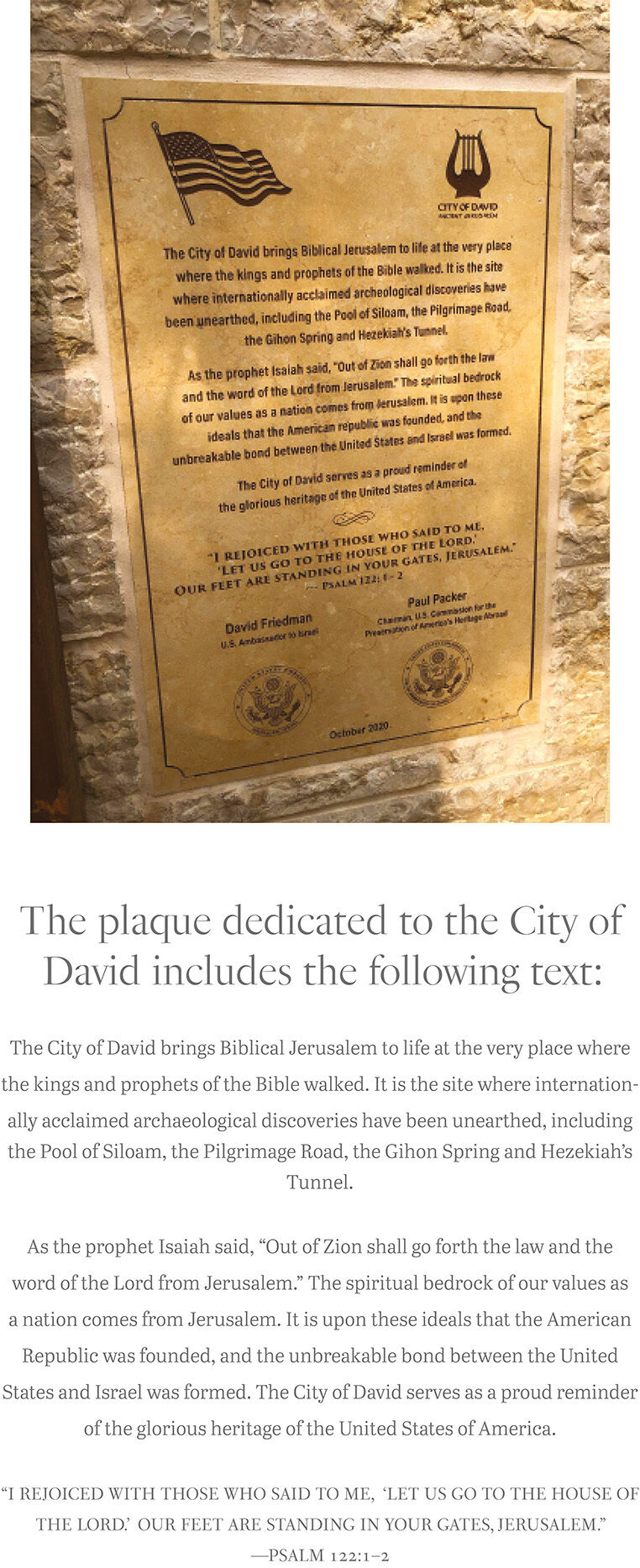
Paul Packer, chairman of the Commission for the Preservation of America’s Heritage Abroad, also attended the ceremony. In his address, he told attendees: “With the unveiling of this plaque and the recognition of the City of David for its contribution to America’s heritage, we are fulfilling another, larger purpose: to unify Americans around our foundational principles and values. The City of David serves as a living testament to those enduring values, and it is our duty to ensure it remains for generations to come.”
This decision to recognize the City of David as a place of American heritage is easily understood by those rooted in U.S. history. America’s founders and forefathers looked to the Bible’s guiding principles in establishing the Constitution (see America’s Hebrew Roots). Those principles and laws, as well as the prophets and kings who espoused them, were located in ancient Jerusalem.
It was in Jerusalem that the Prophet Jeremiah warned that the heart of man is deceitful and desperately wicked (and by implication, needs to be kept in check). It was in Jerusalem that the Prophet Isaiah spoke of a time to come when swords will be beaten into plowshares and spears into pruning hooks. And Jerusalem was home to King David, author of many of the psalms that moved so many early Americans.
These passages of Scripture were as inspiring and potent to many of America’s forefathers in the 18th to 19th centuries as they were to the founders of the Jewish state in the mid-20th century.
Founders Inspired by King David
So many of the speeches and letters of America’s founders reveal how familiar they were with the biblical history centered around Jerusalem, and with the missives of Israel’s kings and prophets. These words not only moved them emotionally but shaped their actions and decisions.
In the midst of the Revolutionary War, Congress leaned on the example of the teenage David to inspire citizens and the Continental Army to keep fighting the British Goliath. Congress released a statement on May 26, 1779, that read, “America, without arms, ammunition, discipline, revenue, government or ally, almost totally stripped of commerce and in the weakness of youth, as it were with a ‘staff and sling’ only dared in the name of the Lord of hosts to engage a gigantic adversary, prepared at all points, boasting of his strength, and of whom even mighty warriors ‘were greatly afraid.’”
Four years after the Revolutionary War ended, Benjamin Franklin employed the use of one of the psalms of ascent to plead for the necessity of prayer before every day of deliberation at the Constitutional Convention of 1787. The psalms of ascent are believed to have been sung as pilgrims came to Jerusalem to observe the holy days three times per year.
Though Franklin might not have been aware of the function of the ancient songs of ascent, he was aware of their sacred value to America. Addressing the president of the assembly, he warned, “I have lived, sir, a long time and the longer I live, the more convincing proofs I see of this truth—that God governs in the affairs of men. And if a sparrow cannot fall to the ground without His notice, is it probable that an empire can rise without His aid? We have been assured, sir, in the sacred writings that ‘except the Lord build the house they labor in vain that build it’ (Psalm 127:1). I firmly believe this; and I also believe that without His concurring aid we shall succeed in this political building no better than the builders of Babel: We shall be divided by our little partial local interests; our projects will be confounded, and we ourselves shall be become a reproach and a byword down to future age. And what is worse, mankind may hereafter from this unfortunate instance, despair of establishing governments by human wisdom, and leave it to chance, war and conquest. I therefore beg leave to move—that henceforth prayers imploring the assistance of heaven, and its blessings on our deliberations, be held in this assembly every morning before we proceed to business, and that one or more of the clergy of this city be requested to officiate in that service.”
In 1813, John Adams penned a letter to Thomas Jefferson in which he declared his own enduring affection for the writings of the sweet psalmist of Israel. He wrote on November 15, “The psalms of David, in sublimity, beauty, pathos and originality, or, in one word, in poetry, are superior to all the odes, hymns and songs of our language.”
His son John Quincy, America’s sixth president, took his appreciation for the psalms to the next level, composing his own metrical version of the psalms. Seventeen of these were included in a widespread hymnbook created by William P. Lunt known as The Christian Psalter. On June 29, 1845, John Quincy recorded, “It was my version of the 65th Psalm; and no words can express the sensations which I heard it sung. Were it possible to compress into one pulsation of the heart the pleasure which, in the whole period of my life, I have enjoyed in praise from the lips of mortal man, it would not weigh a straw to balance the ecstasy of delight which streamed from my eyes as the organ pealed and the choir of voices sung the praise of Almighty God from the soul of David, adapted to my native tongue by me.”
Perhaps no American president was more moved by and familiar with the Hebrew Bible than Abraham Lincoln, the Civil War’s indispensable man. Lincoln regarded the Bible as “the best gift God has given to man.” Without it, he said, “we could not know right from wrong.” His speeches and interactions were full of biblical references.
In one instance, Lincoln resorted to the wisdom of David when deciding upon what mercy to provide the South after the conclusion of the war. John Gillespie, a friend of Lincoln, reported him as saying, “[S]ome think their heads ought to come off; but there are too many of them for that, and for one, I would not know where to draw the line between those whose heads (it might be said) ought to come off or stay on. My policy would be different. I would prefer to follow the example of King David. I have been recently reading the history of the rebellion of Absalom and would be inclined to adopt the views of David. When David was fleeing from Jerusalem, Shimei cursed him. After the rebellion was put down Shimei craved a pardon. Abishai, David’s nephew, the son of Zeruiah, David’s sister, said, ‘This man ought not to be pardoned because he cursed the Lord’s anointed.’ David said, ‘What have I to do with you, ye sons of Zeruiah, that you should this day be adversaries unto me? Know ye that not a man shall be put to death in Israel.’” Lincoln not only knew the text, he looked to the actions and words of David as a source of wisdom for his own leadership of the United States.
For Lincoln, biblical events were not fantasy or fiction. Although archaeology had yet to confirm the historicity of the events described in the Bible, he voiced his agreement that the Bible ought to be given the benefit of the doubt. In one account recorded by Treasury Department official Lucius E. Chittenden, Lincoln said, “Now, let us treat the Bible fairly. If we had a witness on the stand whose general story we knew was true, we would believe him when he asserted facts of which we had no other evidence. We ought to treat the Bible with equal fairness. I decided a long time ago that it was less difficult to believe that the Bible was what it claimed to be than to disbelieve it.” With such a sentiment, it could be opined that Lincoln would actually make a pretty successful biblical archaeologist.
About the Bible, Lincoln once stated: “It’s a good book for us to obey—it contains the Ten Commandments, the golden rule and many other rules which ought to be followed. No man was ever the worse for living according to the Bible” (Lucius E. Chittenden, Recollections of President Lincoln and His Administration).
It has been said that during the night of Lincoln’s assassination, his mind was on Jerusalem. According to a manuscript by Noyes W. Miner, a family friend of the Lincolns, Mary Lincoln told Miner that some of her husband’s final thoughts before he was assassinated were about Jerusalem. Lincoln’s last reported words were, “After the war, we shall go to Jerusalem.” Lincoln never fulfilled that wish, but his mind and heart at the end was on the Bible and on the land of the Bible.
A Bible-Infused Education
Clearly many of America’s most foundational leaders were impacted by history made in the City of David and the larger history written in the biblical canon. But the Bible-informed Constitution, of itself, would not have been enough to safeguard the United States’ republic. As George Washington famously stated in his First Inaugural address, “The foundations of our national policy will be laid in the pure and immutable principles of private morality.” The strength of the nation was dependent on the private morality of the citizens themselves.
A look back at the Bible-based morality of America’s citizenry shows that everyday Americans saw Jerusalem’s laws as their own. The people were familiar with the Bible’s laws and history and were instructed on it weekly in churches and synagogues. This Bible-based education inculcated in the individual both the know-how and the motivation to voluntarily police themselves. It made the American public uniquely governable to a constitution that was designed to limit government intrusion.
Over 100 years before the Revolutionary War, the colonies sought to enshrine in law regular Bible education in the earliest levels of education. In 1647, the “Old Deluder Satan” act required that townships with 50 households establish grammar schools in order to ensure that literacy prevailed—for the express purpose that the public could read the Bible and thus not be deceived on truth. Correspondingly, the first grammar school textbook in America, the New England Primer, was full of biblical themes and stories and instruction on biblical morals. The 90-page work, first published between 1687 and 1690, also included select quotes from the King James Bible, including the Ten Commandments. Over the next century, an estimated 3 million copies of the primer were in circulation.
In 1839, a series of new grammar school texts—the Eclectic Readers or McGuffey Readers, as they’re more commonly known—were published. Along with the Bible, these texts became the backbone of formative education. As with the New England Primer, the McGuffey texts included many Bible themes and quotations. For example, the third book in the series has a lesson on “Things to Remember.” A few of the points read as follows: “When you rise in the morning, remember who kept you from danger during the night. Remember who watched over you while you slept, and whose sun shines around you, and gives you the sweet light of day”; “Let God have the thanks for your heart, for His kindness and His care; and pray for His protection during the wakeful hours of day”; “Never do anything that you would be afraid or ashamed that your parents should know. Remember, if no one else sees you, God does, from whom you cannot hide even your most secret thought”; “Trust in the Lord and He will guide you in the way of good men.” Though not quoting the Bible itself, the values expressed are directly taken from the Jewish text.
“At this time, the nation was at a critical point of forming a distinct identity,” professor of education at Liberty University Samuel Smith wrote about the McGuffey Readers in 2008. “These phenomena created a demand for textbooks that would not only meet the practical need for curriculum in developing schools but would also extend prevailing American values to both children new to the frontier and those new to the nation.” Thus, a childhood education was inseparable from instilling both Bible knowledge and biblical virtue.
It’s estimated that between 1839 and 1920, over 122 million copies of the McGuffey Readers were sold, making it the most popular textbook in American history. The only other two books to be as popular through that century were Webster’s Dictionary and the Bible itself. It’s safe to say that any literate education in America from its founding until the 20th century was completely infused with biblical teaching and values.
A Rightful Connection to Jerusalem
For the century leading up to America’s independence and the century and a half following, the Bible and biblical stories were woven into the United States’ social fabric. This biblical connection links Jerusalem to America. That is what the Trump administration wanted to highlight by making this declaration in the City of David. And rightfully so.
Through that particular official act, the United States officially connected itself to the bedrock of ancient Jerusalem.
With this in mind, notice how the City of David plaque concludes: “As the Prophet Isaiah said, ‘Out of Zion shall go forth the law and the word of the Lord from Jerusalem.’ The spiritual bedrock of our values as a nation comes from Jerusalem. It is upon these ideals that the American Republic was founded, and the unbreakable bond between the United States and Israel was formed. The City of David serves as a proud reminder of the glorious heritage of the United States of America.”
If only Americans really understood the weight of that statement. The glorious history of the United States doesn’t just go back to 1776, rather it goes back 3,000 years or more to when the God of Israel established the law that would inspire many of America’s most influential leaders.
It’s vitally important that we remember this history. This is what it means when America is described as having a Judeo-Christian heritage. It is this biblical foundation, memorialized on a plaque in the heart of Jerusalem, that we should be deeply thankful for and celebrating.