
America’s Hebrew Roots
America’s 250th anniversary is about far more than fireworks and celebrations. It is a moment to reflect on the distinctive cultural and religious values that have set the United States apart from other nations. No other country has so consistently upheld limited government, separation of powers, the rule of law, religious liberty, free speech and free enterprise—principles enshrined in the U.S. Constitution.
But where did these ideas originate?
America’s founders were overwhelmingly Christian—yet a particular kind unwelcome in Europe. They read the Bible literally and held deep reverence for the law of Moses. To them, Europe was Egypt; King George, Pharaoh; the Atlantic, the Red Sea; and America, the Promised Land. Their journey was a new Exodus.
My own 12-times-great-grandfather, William White, sailed on the Mayflower and stepped ashore at Plymouth Rock in 1620. He died that first brutal winter, yet remained convinced his children would build a “New Jerusalem” in the American wilderness. Stories like his explain why the U.S. government recently recognized the City of David archaeological site in Jerusalem as a testament to America’s Judeo-Christian heritage. The U.S.-Israel relationship is far more than diplomacy; it is a civilizational bond rooted in biblical law and history.
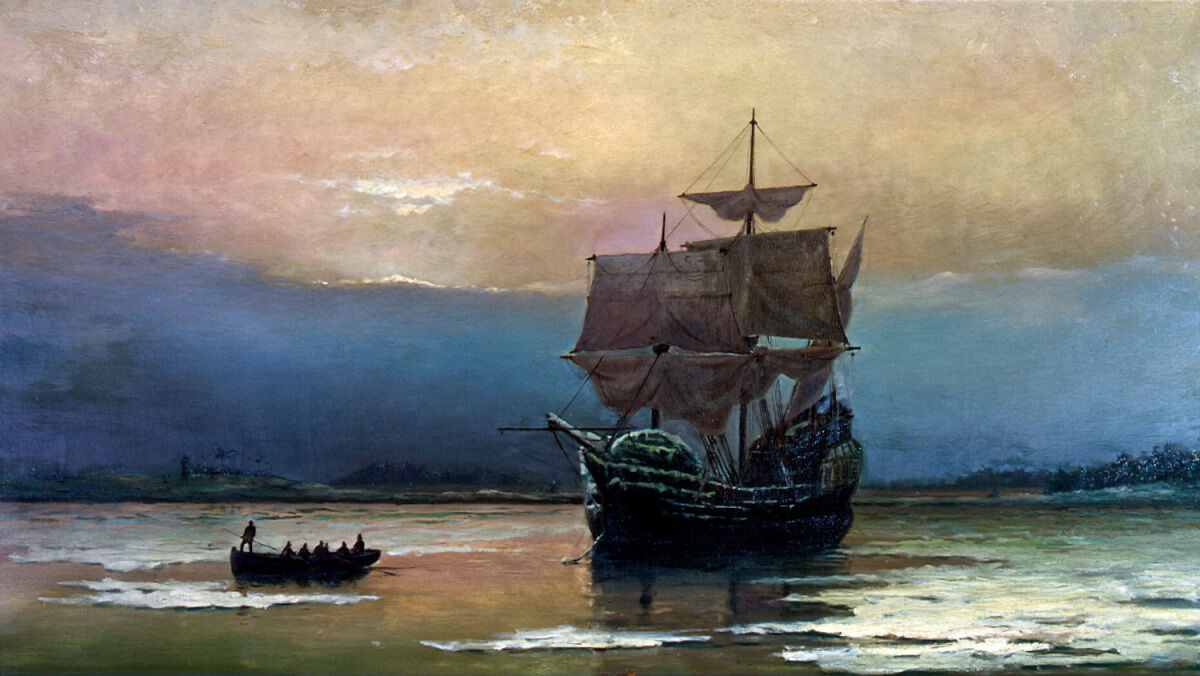
The deeper one digs into early American history, the clearer the parallels with biblical Israel become. No other Christian community has identified so closely with the People of the Book. The early settlers saw their own lives as a living reenactment of the Hebrew nation’s own biblical drama.
“What made this country different from all others was a prevalent belief that God played a direct and active hand in founding a people,” author William Bennett writes in Our Sacred Honor. “Like the Jerusalem of old, America’s ‘New Jerusalem’ was to become God’s promised land to the oppressed—an example to all humankind.”
Puritan Exodus
Medieval Catholic traditions vilified both Jews and “Judaizing” Christians as outsiders, yet English society began to change after the Protestant Reformation. Johannes Gutenberg invented his printing press in 1450. Britain broke with the Catholic Church in 1534. The first English translation of the complete Bible available en masse appeared in 1535. The King James Bible was completed less than a century later in 1611.
For the first time, ordinary Englishmen could read the Scriptures for themselves. The effect was transformational. In The Ecclesiastical History of New England, Puritan minister Cotton Mather compared English parishioners in Austerfield to the Jews of King Josiah’s day. The rediscovered Book of the Law had moved Josiah to weep and reform; similarly, the English Bible transformed a 12-year-old Austerfield orphan named William Bradford, prompting him to join a Separatist congregation in nearby Scrooby.
In Scrooby, Bradford found a small but fervent group of like-minded believers that included my 12-times-great-grandmother Susanna Jackson. Convinced that Anglican traditions such as the observance of Christmas, Easter and other holidays were unbiblical remnants of Roman Catholicism and pre-Christian paganism, the congregation met in secret. When the archbishop of York sent men to arrest them, the congregation realized that it was no longer safe and began planning their exodus to the Netherlands.
It was in Amsterdam, and later Leiden, that Bradford, Susanna and the rest of the community came into contact with Jews for the first time. Jews had been expelled from England for more than 300 years, but Sephardic Jews fleeing persecution in Spain and Portugal had established a thriving merchant community in Holland. These encounters further deepened the Pilgrims’ appreciation for the Hebrew roots of their faith and reinforced their commitment to a simpler, more scriptural form of worship.
Unlike the Catholics and Anglicans, the Pilgrims did not believe that the Christian Church had completely replaced Israel as God’s chosen people. Rather, they anticipated that Jews and Christians would converge in some meaningful way before a great end-time conflict involving “the Turks and the Catholic Church” would culminate in the coming of the Messiah, who would rule the world from Jerusalem.
Covenant Theology
It was in Leiden that my 12-times-great-grandparents, William White and Susanna Jackson, married and had their first child, Resolved, my 11-times-great-grandfather. He was named Resolved because his parents and many other English Separatists in Leiden had resolved that they could not establish a New Jerusalem in the Netherlands. They would have to leave everything and set out for the New World.
This resolution split the Separatist community, with some staying in Holland to join Mennonite groups, others returning to England to become Baptists, and the final core boarding the infamous Mayflower.
The Pilgrims’ famous 66-day journey across the Atlantic is memorialized in America every year on Thanksgiving Day. Yet few Americans today know much about what the Pilgrims actually believed.
During their time in the Netherlands, studying the Bible and conversing with Jews, the Pilgrims concluded that legitimate communities are formed through voluntary consent to agreed-upon, codified terms rather than through submission to a tyrant’s will. God had more power than any tyrant, yet He established His relationship with the Israelites as a voluntary covenant. This was a highly unusual, even revolutionary, development in ancient Israel compared to the surrounding nations.
This understanding prompted Bradford, White and 39 other passengers to sign the Mayflower Compact after arriving at Cape Cod on Nov. 11, 1620. They solemnly agreed, “in the presence of God,” to form a “civil body politic” and to enact “just and equal laws” for the general good of the colony. This was one of America’s first written covenants, and it was directly inspired by the biblical pattern established at Sinai.
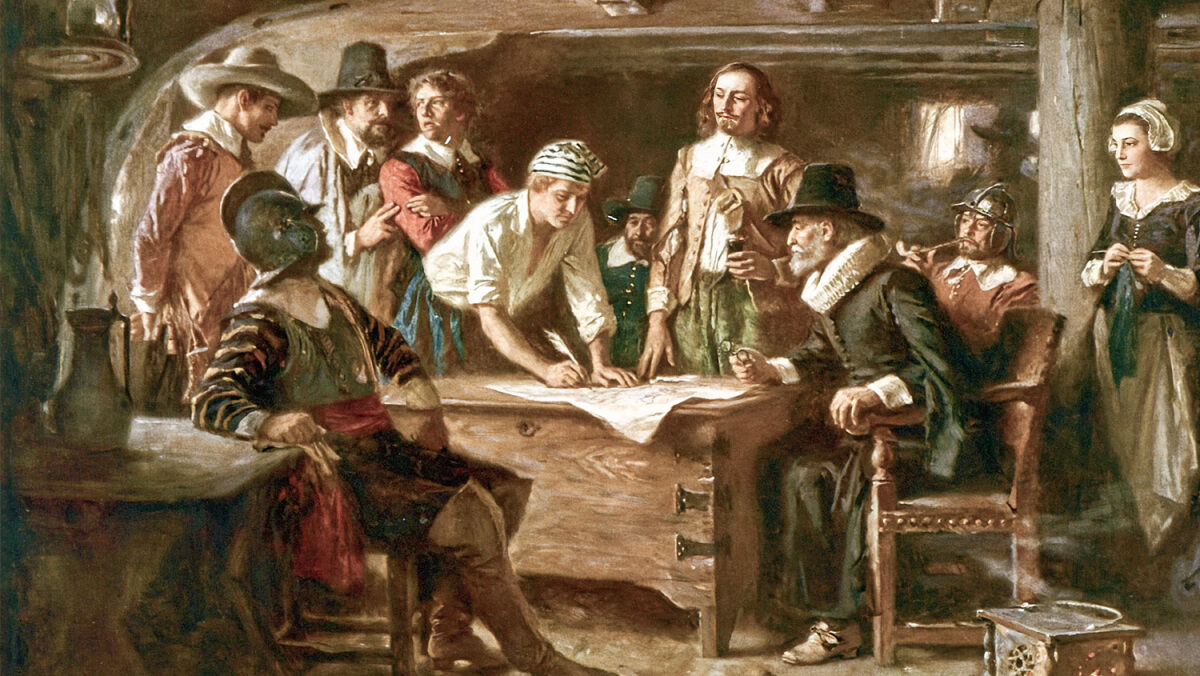
The Mayflower Compact stated that the Pilgrims had undertaken their voyage “for the glory of God, and advancement of the Christian faith,” yet it revolutionized governance in ways few could have imagined.
Though only one page long, the Mayflower Compact inspired practically every colonial charter that followed it, including the Fundamental Orders of Connecticut, which served as a template for the U.S. Constitution.
Today, about 97 percent of the world’s nations have a written constitution. One can easily assume this is simply the normal way governments operate, but the majority of these documents are relatively recent attempts to imitate the success of the U.S. Constitution. Amazingly, even the people who directly benefit from the principles of this Constitution and those like it don’t realize that its core ideas, the rule of law and legitimate authority coming from the consent of the people, trace back to the Bible.
This astonishing truth is why David Hillel Gelernter, a contributing editor at the Weekly Standard, wrote: “Puritanism didn’t merely influence Americanism. It turned into Americanism. In a sense, the molten bronze of Puritanism became the solid metal of the American religion.” Many modern Americans have forgotten the religious doctrines underpinning their founding values, but that doesn’t change the fact that America was established as a Hebraic republic patterned after the example of Old Testament Israel.
Promised Land
My 12-times-great-grandfather died only 102 days after signing the Mayflower Compact. His widow later married Edward Winslow, one of the colony’s leading figures and its unofficial historian. He recorded the details of what happened at the First Thanksgiving, a festival patterned after the biblical Feast of Sukkot.
Together with William Bradford, Edward Winslow coauthored Mourt’s Relation. The book drew heavily on biblical imagery, especially from Joshua, to portray the Pilgrims’ settlement of Massachusetts as a latter-day version of the Israelites’ settlement of Canaan. Later Puritan writers embraced this parallel even more explicitly. They cast John Carver as an American Moses who died after leading his people across the Atlantic Ocean, and Bradford as an American Joshua who guided them into the Promised Land.
You can tell how strongly the early Americans identified with Israel by the litany of cities, towns, mountains, deserts, forests, rivers and other locations they named after places in ancient Israel: Bethlehem, Bethel, Goshen, Hebron, Jericho, Jerusalem, Mamre, Moriah, Pisgah, Rehoboth, Salem, Sharon, Shiloh, Zion and many more. These were not just Bible names; they were locations in the land of Israel.
William Bradford believed that God spoke Hebrew, and the colony he established came within one vote of adopting Hebrew as its official language at a time when no nation spoke it. After Bradford died in 1657, his tombstone bore three Hebrew words: Adonai ezer hayai (“My Lord, the help of my life”).
The Pilgrims’ identification with ancient Israel was even reflected in their children’s names. In early Plymouth Colony, roughly 90 percent of children received biblical names, most of them drawn from the Old Testament, such as Abigail, Benjamin, Hannah, Joseph, Josiah, Ruth and Samuel.
My 11-times-great-grandfather, Resolved, was an exception, named after the decision to come to America rather than after a biblical figure. Yet he named one of his five sons Samuel and another Josiah, emphasizing their position as citizens of the New Israel he was building in America.
America’s founders looked back to ancient Israel’s example as no society had before. The first 10 colleges established in America offered courses in Hebrew. The seal of Yale University includes the words Urim V’Tumim (“Light and Perfection”), which were written on the breastplate of the Israelite high priest. The seals of Dartmouth and Columbia University also featured the name of God written in Hebrew characters.
Such symbology was not a homage to the past; it was a promise for the future. America was meant to be a new Jerusalem, a shining city upon a hill where the principles of biblical liberty and justice could flourish.
Religious Liberty
The first Jews arrived in America just 34 years after the Mayflower, when 23 Sephardic refugees fleeing Portuguese Brazil landed in Dutch New Amsterdam. From there, they spread to Newport, Philadelphia, Charleston and Savannah. By the time of the American Revolution, between 1,500 and 2,500 Jews lived in the colonies. Overwhelmingly patriots, they played key roles in the fight for American independence.
Men like Haym Salomon helped fund George Washington’s Continental Army, and Washington never forgot the Jewish support. After he was elected president, he wrote to the Hebrew congregation in Newport, Rhode Island, in 1790 declaring that the nation would give “to bigotry no sanction, to persecution no assistance.”
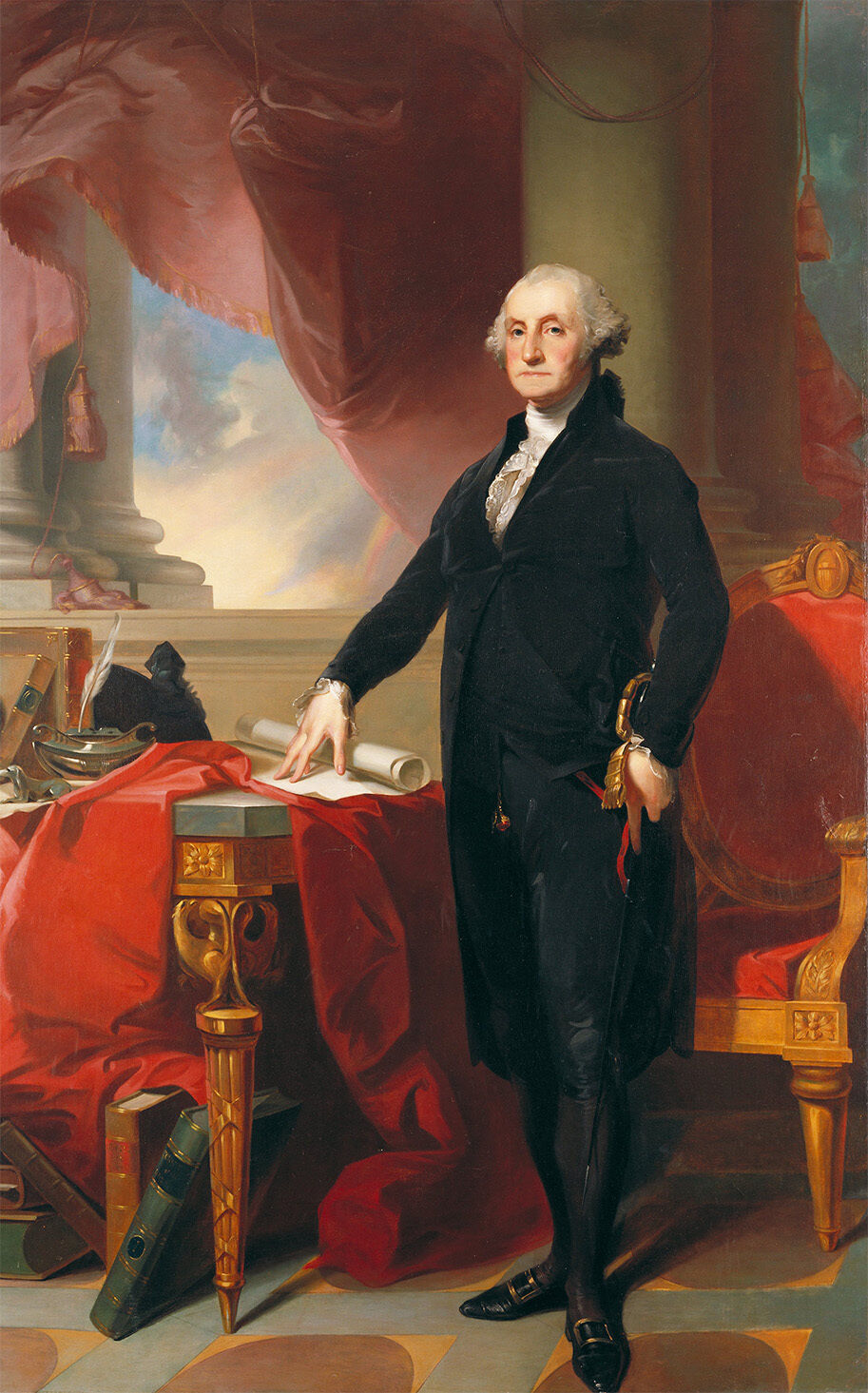
“It would be inconsistent with the frankness of my character not to avow that I am pleased with your favorable opinion of my administration and fervent wishes for my felicity,” he wrote. “May the children of the stock of Abraham who dwell in this land continue to merit and enjoy the good will of the other inhabitants—while everyone shall sit in safety under his own vine and fig tree and there shall be none to make him afraid. May the Father of all mercies scatter light, and not darkness, upon our paths, and make us all in our several vocations useful here, and in His own due time and way everlastingly happy.”
Alongside figures like James Madison and Thomas Jefferson, Baptists and Jewish Americans were instrumental in building the foundation for the First Amendment’s guarantees of religious freedom. The Jews had been persecuted in Europe for centuries, as had the Baptists, whom many Christians accused of “Judaizing” for practicing traditions such as adult baptism, rejecting certain church hierarchies, and emphasizing a direct return to Scripture. Both groups had a vested interest in helping establish America as a land where everyone could live according to the dictates of their conscience without fear of persecution.
In fact, so many Jews and Seventh-Day Baptists settled in Rhode Island that the state altered some of its “Blue Laws” to make it easier for businesses to close on Saturday and open on Sunday. This created a kind of economic synergy in many communities as Sabbath-keeping Christians traded with Jewish merchants instead of persecuting them. Such activity greatly enriched America.
“Nowhere else in Christendom,” wrote Angelo Codevilla, “was the Old Testament read so much and the notion of God as Lawgiver so widespread” (The Character of Nations). Here, both Jews and Protestants drew from the same Hebrew Scriptures while living side by side under a government that refused to pick winners among consciences.
Mosaic Republic
Over a century after Bradford’s death, Samuel Langdon, who graduated from Harvard alongside Samuel Adams, continued campaigning for biblical Hebrew to be made an official American language.
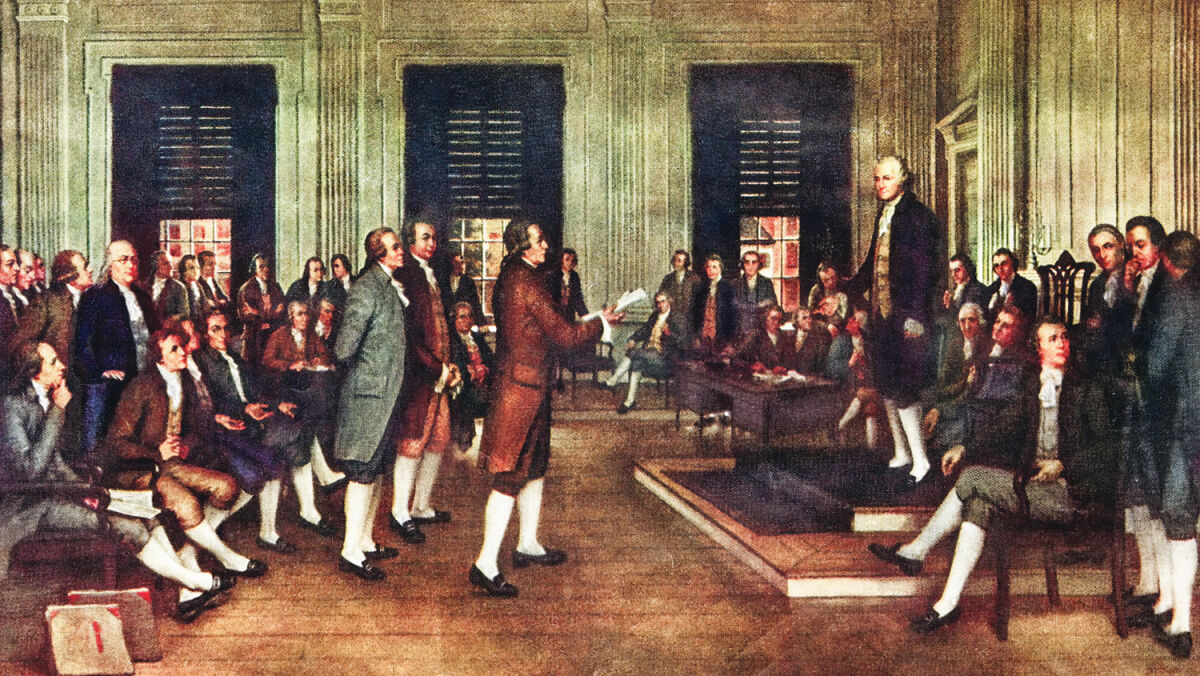
Like Governor Bradford, Langdon wanted to establish the law of God as the law of America. As the 11th president of Harvard University, he pointed people back to the law of Moses. “The Jewish government, according to the original constitution which was divinely established, … was a perfect republic,” he said in a famous sermon he gave in 1788. “… Let us, therefore, look over their constitution and laws. … They had both a civil and military establishment under divine direction, and a complete body of judicial laws drawn up and delivered to them by Moses in God’s name. … Instead of the 12 tribes of Israel, we may substitute the 13 states of the American union; and instead of the high priest and his successors, we may substitute a president and his successors in office; and instead of the great council of the nation, we may substitute a Senate and House of Representatives; and the great similarity will at once appear.”
In a world dominated by kings, emperors and rigid class systems, America’s founders were impressed by the Bible’s emphasis on equal justice and limited government. Old Testament Israel offered a different system where every person had rights to life, liberty and property, and even the king had to obey the law.
These were principles that no nation on Earth espoused until God used Moses to lead the Israelites out of Egypt. Even in Christian Europe, the political system resembled the hierarchy of the Roman Empire more than that of ancient Israel, so America’s founders knew they would have to study the Old Testament.
Israeli Prime Minister Benjamin Netanyahu understands these truths well. “Moses was the greatest revolutionary of all time,” he said in a 2022 interview for the documentary Patterns of Evidence. “Remember that in antiquity, there were grand empires that were based on one principle, and that is slavery. Moses challenged that twice. He challenged it by taking his people, who were slaves in bondage in Egypt, and freed them and took them to their Promised Land. But he also challenged it by providing a code, a moral code for mankind, that said that it is not the king or the emperor that decides the law, there is a higher law. And that higher law means respect for your fellow man, and it also means that you have to be free. One of the reasons that Judaism didn’t make its way so rapidly, and didn’t spread in the ancient world, was that it premises its conception that you had to be a free man to espouse Judaism.”
America’s founders didn’t want to live in a feudal society. They wanted to live in a republic of free men, a republic based on the Bible. Therefore, they looked to Moses and the ancient Israelites as their example.
Biblical Alliance
The fact that the Pilgrims, Puritans and founders saw themselves as modern Israelites goes a long way toward explaining the special relationship between America and the State of Israel. Even though the former is predominantly Christian and the latter is Jewish, the republican political values of America and Israel are more similar to each other than either is to technocracies like the European Union.
Even before the British Balfour Declaration allied the Jewish diaspora to return to their Holy Land, Supreme Court Justice Louis Brandeis became the leader of the American Zionist movement. He argued that Zionism and American patriotism were compatible because Jewish nationalism was deeply aligned with American ideals. In a sense, the mass Jewish return to Israel echoed what the American Pilgrims had done centuries earlier. My 12-times-great-grandparents wanted to build New Jerusalem in the American wilderness, while the Jewish diaspora wanted to restore the glory of Old Jerusalem in the Holy Land.
The U.S. became the first country to officially recognize the State of Israel in 1948, granting de facto recognition just 11 minutes after its declaration of independence. It did not do this because it favored the Jews over Arabs, but because it recognized the Jews’ right to live in the land of their forefathers and saw the Jewish people as a civilizing force in the region. Just as the Pilgrims introduced the rule of law to the United States, the Jews reintroduced the rule of law to the Middle East after centuries of absence.
“Judaism is the West’s civilizational soul,” Melanie Phillips writes in The Builder’s Stone. “Christianity itself, the institutional foundation of that civilization, rests upon Jewish precepts that Christianity channeled into Western culture. The Islamists, whose hatred of the Jews is embedded in religious ideology, grasp this very well. They understand that without Jewish values, there would have been no Western modernity. … The West doesn’t realize this because it doesn’t realize how deeply Jewish precepts are embedded in the cultural values it has taken for granted. It doesn’t realize that by turning on Israel, the Jewish people, and biblical religion, it’s turning on itself. It’s only by restoring biblical values that the West will be able to save itself. And it can’t even begin to do so unless it first acknowledges the Jewish people.”
America became great because its founders looked back to precepts in the Hebrew Bible that most of Europe had discarded during the Middle Ages. America’s greatness depends on remembering its Hebrew roots. To forget them is to risk becoming just another nation adrift. To reclaim them is to renew the shining city upon a hill that the founders envisioned—a beacon of ordered liberty for all mankind.