
Genesis 6 Manifest? New Study Shows Neanderthal Men ‘Preferred Homo Sapiens Women’
“Neanderthal Men Preferred Human Woman, Study Finds”—so reads the dramatic title of Haaretz correspondent Ruth Schuster’s report on new genetic research published in the journal Science. Schuster is Haaretz’s primary archaeology correspondent. Prehistory is her “thing.” Much of her writing centers around prehistoric animals and evolutionary theories—articles that rarely grab my attention. But when I saw this recent piece, my jaw dropped.
The Science paper itself—titled “Interbreeding Between Neanderthals and Modern Humans Was Strongly Sex Biased,” by Alexander Platt, Daniel Harris and Sarah Tishkoff of the University of Pennsylvania—is no less dramatic.
At its core, the new research “strongly suggests that Neanderthal men preferred human [Homo Sapiens] women … explain[ing] the uneven distribution of Neanderthal genes in humans today,” reported Schuster. Of course, Neanderthals are no less “human” than Homo Sapiens—indeed, by definition the term “human” signifies “belonging to the genus Homo,” which includes our Neanderthal brethren (Homo neanderthalensis)—and the popular reference in such articles to each as a “different species” is somewhat grating, since the general definition of the term “species” refers to organisms that can produce offspring (which is clearly the case here).
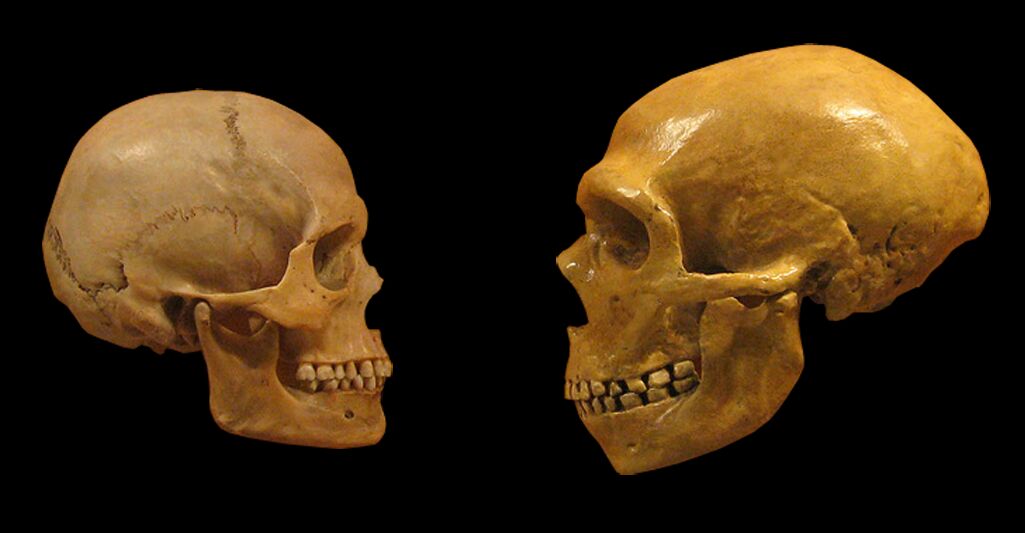
We today carry the faintest traces of Neanderthal dna—to differing degrees among differing communities. It has actually been identified as the reason for a number of health problems—such as allergies, greater pain sensitivity, depression and autoimmune diseases (as accounted, for example, in an article from LiveScience). Yet there is an unusual pattern in the presence of such Neanderthal dna: “Several of our chromosomes exhibit Neanderthal deserts [parts of the genome without Neanderthal dna] but their absence is especially prominent on the X chromosome—the female chromosome. The question is why,” summarized Schuster (emphasis added throughout). “[G]iven that Neanderthal absence is especially glaring in our X chromosome, for obvious reason, and that the Neanderthals retained a strong human signal in their X chromosome (62 percent ‘relative excess’), another theory came to mind.”
The Science article authors wrote: “By observing a 62 percent relative excess of amh [anatomically modern human] ancestry in Neanderthal X chromosomes, we characterized the interbreeding between the two groups as predominantly male Neanderthals with female amhs. Analytic and numerical modeling presents mate preference as a more parsimonious cause of the sex bias ….”
Reading between the lines, the remarkable new research smacks of Genesis 6—but perhaps not in the way you might have thought.
Preferring ‘Daughters of Men’
The pre-Flood, Genesis 6 account needs no introduction—though it has long been shrouded in mystery, with no end of speculation as to its meaning. “And it came to pass, when men began to multiply on the face of the earth, and daughters were born unto them, that the sons of God saw the daughters of men that they were fair; and they took them wives, whomsoever they chose. And the Lord said: ‘My spirit shall not abide in man for ever, for that he also is flesh; therefore shall his days be a hundred and twenty years’” (verses 1-3).
The general picture of freewheeling “marriage” is summarized in the New Testament by Jesus himself: “For as in the days that were before the flood they were eating and drinking, marrying and giving in marriage, until the day that Noe entered into the ark” (Matthew 24:38).
The Genesis passage continues: “The Nephilim [often translated ‘giants’] were in the earth in those days, and also after that, when the sons of God came in unto the daughters of men, and they bore children to them; the same were the mighty men that were of old, the men of renown. And the Lord saw that the wickedness of man was great in the earth …” (verses 4-5). From this passage, it is typically inferred that these Nephilim were the product of these unions between the “sons of God” and the “daughters of men.”
There are two main schools of thought regarding the identity of these biblical “sons of God.” One sees them as angelic beings, breeding with human women and engendering demigods (this view became especially popular on the back of developing Second Temple Period legends and apocryphal works). The other sees these “sons of God” as the very much human descendants of Seth, whose lineage is the “righteous” one (compared to that of the banished Cain).
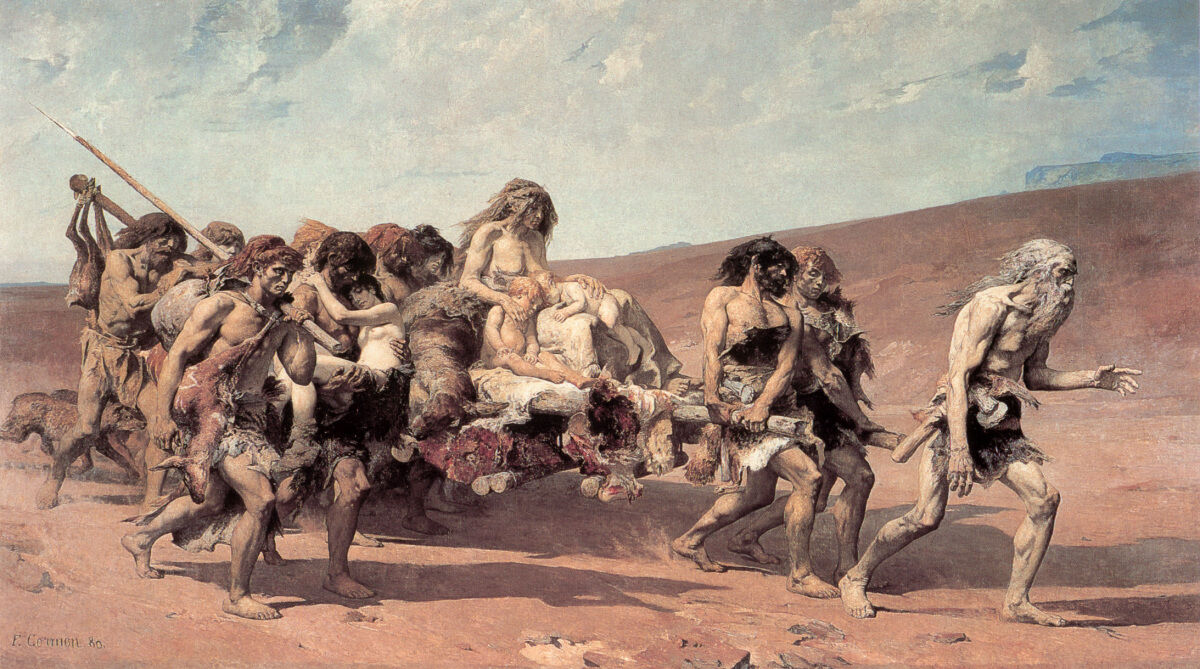
In our 2020 article “Did Angels Marry Women and Breed Giants?” we present another conclusion entirely—that the “sons of God” were instead descendants of a falsely-deified line of Cain—and that these “daughters of men” were the descendants of Seth, the ultimate progenitor of the human race. (This identification may seem counterintuitive at first—but there is more than meets the eye here, especially in the build-up to Genesis 6.)
In aiba contributor Robert Morley’s article “Caveman Are People Too!”, building off Roy Shultz’s 1967 Exploring Ancient History, he speculated that the “Nephilim” of Genesis 6 may have some link to the Neanderthals, as “giants in strength but not in tallness of stature.” Once again, these Nephilim are typically understood to be the product of these unions between the “sons of God” and “daughters of men.” More generally, the question could be asked—might Neanderthals have even represented this biblical line of Cain?
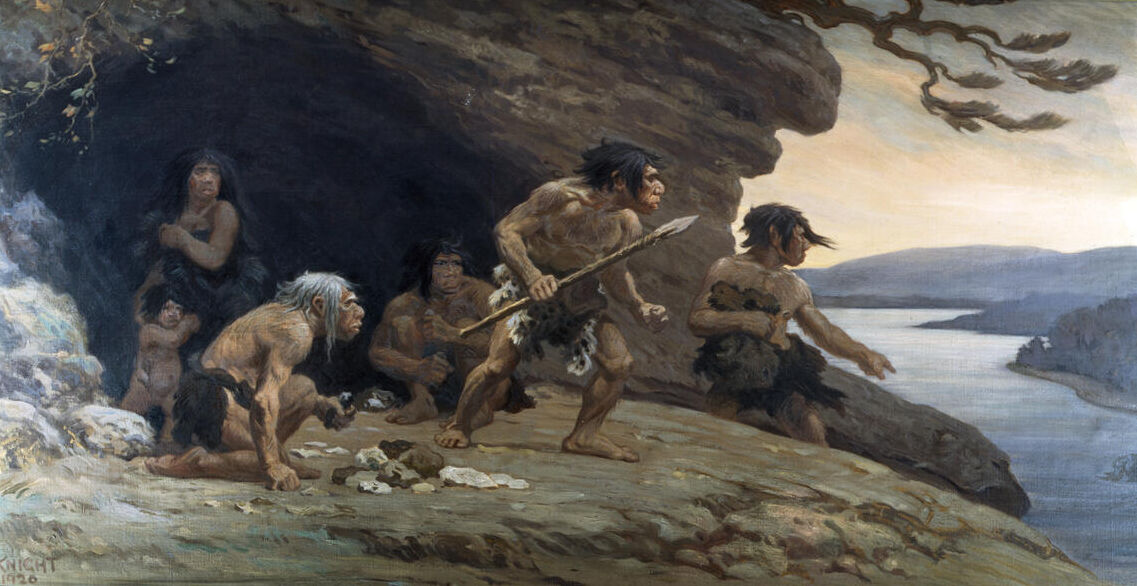
Whatever the case, from the biblical account, we learn of sexual unions between two clearly different antediluvian groups—“sons of God” on the one hand and “daughters of men” on the other. This, making the recent headlines all the more dramatic—with new evidence of commonplace unions between “Neanderthal men” on the one hand and “daughters of Homo Sapiens” on the other—research “suggest[ing] that Neanderthal men liked our ladies, or our ladies liked them, or both—there’s no accounting for tastes; or it might not have been a matter of choice, for the females. About that, the statistics do not speak,” wrote Schuster. “The end result is today we have all sorts of Neanderthal genes all over the place but not in our X.”
The Science article authors Platt, Harris and Tishkoff conclude: “Fundamentally, the patterns that we observed in amh-Neanderthal divergence and hybridization … [indicate] a persistent preference for pairings between males of predominantly Neanderthal ancestry and females of predominantly amh ancestry over the reverse. The bias that we inferred seems to have remained consistent across admixture events”—preference maintained for a significant duration of time, not limited to a one-off event—“preferences in mate choice … persist[ing] across time and space” (ibid).
The terms might be scientific—but in many ways, the language feels biblical—a prehistoric time of “marrying and giving in marriage,” with a distinct predilection for “daughters of men.”