
Judah’s ‘Storehouses’: Post-Invasion Prosperity Revealed
Sennacherib’s invasion of Judah near the end of the eighth century b.c.e. was one of the most violent intervals in the history of the southern kingdom of Judah. The Assyrian army marched through the nation and ravaged 46 of its fortified cities and took more than 200,000 people captive, per Sennacherib’s own annals. By the time the invasion was over, Judah was laid waste.
There is abundant evidence supporting Sennacherib’s campaign. Archaeologically, it is arguably the most well-attested biblical event. Excavations have uncovered the destruction of specific cities; burn layers, arrowheads, Assyrian annals and inscriptions—the evidence is all there. We’ve also been able to learn a lot from what has not been found, such as the lack of a destruction layer in Jerusalem at this time. This provides verifiable evidence that Sennacherib did not conquer Jerusalem, just as the Bible describes.
But what about Judah after the Assyrian invasion?
The Bible describes that Hezekiah, free from the threat of Assyria, experienced peace and prosperity for the remainder of his reign: “And Hezekiah had exceeding much riches and honour; and he provided him treasuries for silver, and for gold, and for precious stones, and for spices, and for shields, and for all manner of goodly vessels; store-houses also for the increase of corn, and wine, and oil; and stalls for all manner of beasts, and flocks in folds. Moreover he provided him cities, and possessions of flocks and herds in abundance; for God had given him very much substance” (2 Chronicles 32:27-29).
Notice that this description of prosperity within Judah specifically highlights the “treasuries” and “storehouses” that flourished under Hezekiah. While archaeological excavation doesn’t unearth an abundance of perishable items—such as grain, wine or oil—it does often reveal storage vessels and the buildings that contained them.
Two large administrative centers in particular have been unearthed south of Jerusalem—one at Ramat Rahel and one in the Arnona neighborhood—giving us evidence of this post-invasion prosperity.
Ramat Rahel
Let’s start with the one that was discovered first. Ramat Rahel was an ancient settlement on the mountain ridge between Jerusalem and Bethlehem—a strategic position above the two main roads that led to the capital city from the south and west. The settlement’s position lent itself to commanding the Rephaim Valley, a rich agricultural area.
The archaeological park at the site consists of a palatial structure, a courtyard encircled by a casemate wall, a watchtower and a later period royal garden. It has been excavated on and off since 1930. The first archaeologist to excavate Ramat Rahel was Prof. Benjamin Mazar, a man with whom we had a long and special history (The Man Who Built an Iron Bridge).
Its biblical identification isn’t certain. Various scholars have produced several options. The most agreed upon identification was given by Prof. Yohanan Aharoni, who excavated the site in the 1950s and ’60s: He proposed it as the biblical site of Beth-cherem (Jeremiah 6:1), which means “house of vineyards.” This is a fitting name since Ramat Rahel lies in the middle of a rich agricultural area.
The first phase of the palace was constructed during the reign of Hezekiah in the late eighth to early seventh century b.c.e. Some of the most important discoveries of this earliest stage were a large number of stamps, proto-Aeolic capitals, balustrades, crenellations, casemate walls and an impressive ashlar stone assembly. All these features are typical of Judean construction.
Ramat Rahel’s role as an administrative center is demonstrated by the more than 600 stamp impressions discovered at the site. The most common type of stamps from phase one are the well-known lmlk seals, meaning “to the king.” These stamps are associated with the reign of Hezekiah and demonstrate the administrative power of his kingdom. Their presence at the site further proves its function as an administrative center during his reign.
According to Ramat Rahel excavation director Prof. Oded Lipschits, the stamps served two purposes: “This system, which appears to have been primarily administered from the Judahite center of Ramat Rahel south of Jerusalem, was used to collect, store and transport the agricultural products—mainly wine and olive oil—supplied across an expansive network of royal estates, to support Judah’s economy …” (“Enduring Impressions,” Biblical Archaeology Review, 2022; emphasis added throughout).
Notice that it was used to administer the storage of agricultural products, just like Hezekiah’s “storehouses” described in 2 Chronicles 32. The majority of the lmlk stamps found at Ramat Rahel (and Jerusalem) were of the late type—the production of which started after Sennacherib’s conquest. This means this Ramat Rahel “storehouse” became most prominent in the second half of Hezekiah’s reign, providing evidence of the post-invasion prosperity described in the Bible.
Assyrian or Judean?
It is hard to precisely date the building’s construction, and archaeologists debate whether the palace was initially constructed by the Assyrians or the Judeans under King Hezekiah.
The most recent excavators believe construction was initiated by the Assyrians to serve as the seat of their local governor and to collect tribute for the empire. This is in line with a commonly assumed paradigm in scholarship, that Sennacherib maintained a strong presence in Judah—in spite of the biblical account of his defeat in Jerusalem—with the spared city going on to become tributary to the empire, with local governors installed in its regional centers whose fealty was to Assyria.
This is summarized in Bible History Daily’s article “Sennacherib’s Administration in Jerusalem”: “Although Sennacherib’s invasion of Judah—mentioned in numerous biblical books and contemporary Assyrian sources—did not succeed in conquering Jerusalem itself, the Assyrians did conquer much of Judah’s territory. This led directly to King Hezekiah pledging fealty to the Assyrians and paying them tribute as a vassal kingdom.”
This, of course, is not the way the Bible describes it. Nevertheless, Ramat Rahel’s more recent excavators, in following this logic, believe the fact that its palace was built out of sight of Jerusalem carries “much weight in any discussion of who originally built the site and why.” By intentionally building the palace out of sight of Judah’s capital, Assyria’s power was “clearly demonstrated and expressed, but wisely does not overshadow the capital, the religious center, and thus the honor of the local regime” (“Ramat Rahel IV—The Renewed Excavations by the Tel Aviv–Heidelberg Expedition [2005–2010],” Lipschits, et al. 2020). Others also point to Assyrian wares discovered at the site as evidence of its Assyrian origin.
But if the palace was constructed by the Assyrians, then why does it bear so many royal Judean features like the volute capitals and balustrades—and why is it replete with so many Judean administrative stamps?
Archaeologist Dr. Raz Kletter from the University of Helsinki, using the volute capitals as evidence, believes the Assyrians were not involved at all in the construction. Contrary to Lipschits, who argued that the Assyrians “encouraged, approved or sponsored” the use of such capitals, Kletter says that there is no evidence for this. Pointing to known Assyrian constructions, he wrote: “If the Assyrians adored volute capitals and ‘encouraged, approved or sponsored’ their use at Ammon, Moab and Judah, how can it be that at the same time and in the same area, the use of stone volute capitals was avoided in all those Assyrian/Assyrianized buildings?” (“Yavneh II: The ‘Temple Hill’ Repository Pit,” Kletter, et al., 2015).
To Kletter, the “only possible conclusion is that volute capitals have nothing to do with Assyria.”
Another in Arnona
In 2020, a palace from the same era was uncovered in even closer proximity to Jerusalem. On Aug. 3, 2020, Biblical Archaeology Society published an article about the discovery of “a major 2,700-year-old governmental administrative center in the Arnona neighborhood of Jerusalem” (“Arnona: Administrative Center Found From Time of Jerusalem Kings”). Excavations led by the Israel Antiquities Authority revealed more than 120 seal-impressed jar handles, many of which were also inscribed with lmlk—mainly of the “late” type.
The first phase contained a large building akin to the Ramat Rahel palace, which most likely served the same administrative function. It was eventually and purposefully dismantled and covered by a large heap of stones for unknown reasons (perhaps as part of the Assyrian destruction of buildings surrounding Jerusalem).
According to the archaeologists, sometime after the Assyrian conquest, a thick wall was constructed on the north side, which, together with the stone heap, functioned as a platform for a building belonging to the next phase. The new construction was made of large ashlar stones, which, “together with the high concentration of late types of lmlk stamp impressions found in the construction fills surrounding the platform walls, suggest that a new monumental administrative structure was built in Phase 6b, most probably in the early part of the seventh century b.c.e.” (“A New Assemblage of ‘Private’ Stamped Jar Handles from the Mordot Arnona Excavations, Jerusalem,” Neria Sapir, et al., 2023). The dating of this new structure corresponds nicely to the post-invasion period and the latter part of Hezekiah’s reign.
“Ramat Rachel and the administrative center recently uncovered by the Israel Antiquities Authority on the slopes of Arnona, attests to a new revival in the city and a somewhat ‘exit from the walls’ of the First Temple Period, after the Assyrian siege,” wrote iaa archaeologist Ya’akov Billig. “We reveal villas, mansions and government buildings in the area outside the walls of the city. This testifies to the relief felt by the city’s residents and the recovery of Jerusalem’s development after the Assyrian threat was over.”
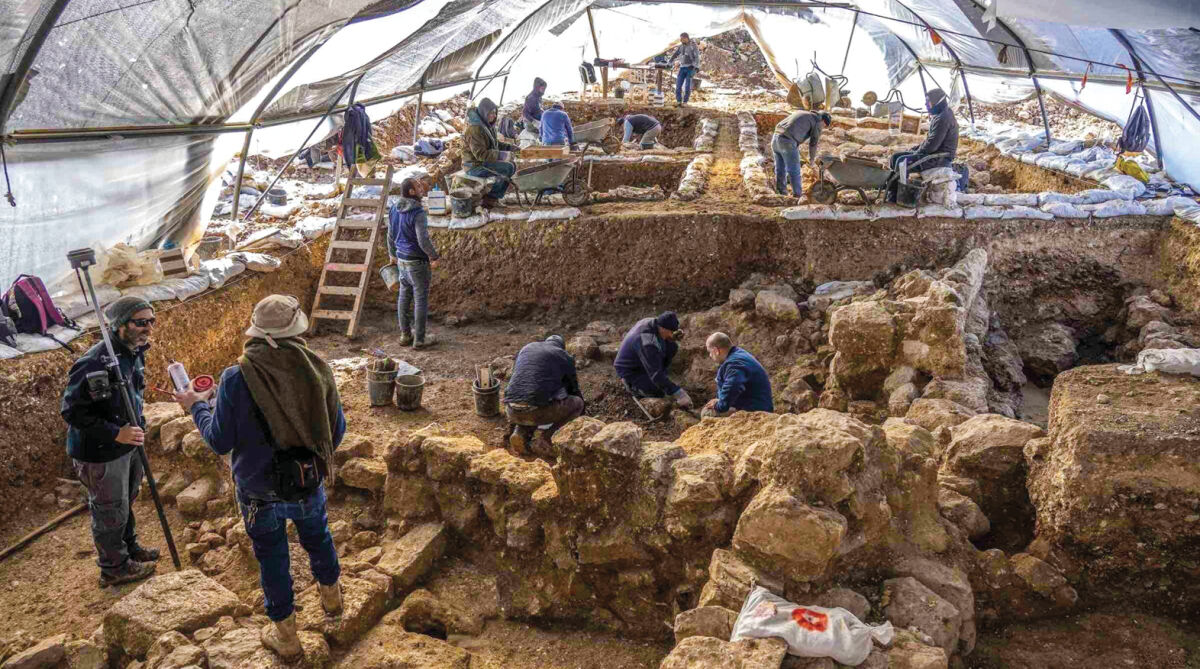
Not only do these discoveries testify to relief, but also to prosperity. The preponderance of late-type lmlk stamps indicate that Ramat Rahel began to truly flourish as an administrative center after Sennacherib’s invasion; the case is similar for the later Arnona structure.
What is perhaps most remarkable about these two sites is just how close they are to Jerusalem, the administrative heart of the nation: Ramat Rahel is located 3.5 kilometers (2 miles) from the city; the Arnona neighborhood structure is around 2.5 kilometers (1.2 miles) away.
The significance of these administrative centers being established so close to the capital was noted in a 2024 Jerusalem Journal of Archaeology article by Christopher Eames and Yosef Garfinkel, highlighting the nearly 700 Iron Age ii inscriptions from Jerusalem proper, as well as the nearly 400 inscriptions from Ramat Rahel and Arnona: “First Temple Period Jerusalem, the administrative capital of the kingdom of Judah, was not an isolated center, as outside its walls were subsidiary administrative support structures, which should be considered jointly when assessing the capital’s significance and strength” (“A Corpus of Iron Age II Inscriptions From Jerusalem”).
Both Ramat Rahel and the Arnona complex confirm a great agricultural renaissance around Jerusalem right after the Assyrian conquest—a blessing foretold by the Prophet Isaiah: “And this shall be the sign unto thee: ye shall eat this year that which growth of itself, and in the second year that which springeth of the same; and in the third year sow ye, and reap, and plant vineyards, and eat the fruit thereof. And the remnant that is escaped of the house of Judah shall again take root downward, and bear fruit upward” (Isaiah 37:30-31).
Consolidating Power
Having examined the archaeological evidence of these storehouses, let’s complete the picture of Hezekiah’s post-invasion kingdom.
We do know that Judah lost some territory to the Assyrian Empire. Sennacherib records in his annals: “I detached from his [Hezekiah’s] land the cities of his that I had plundered and I gave them to the kings of the [Philistine] cities Ashdod, Ashkelon, Ekron and Gaza, and thereby made his land smaller.”
Cities like Lachish, Azekah, Timnah and Socoh were destroyed; the Philistine cities Hezekiah had captured were taken from him. “Hezekiah’s kingdom was reduced and many of the sites that were destroyed were either not resettled, or were only partially resettled, or were resettled for a very brief period,” archaeologist Oded Borowski wrote in “Sennacherib in Judah—the Devastating Consequences of an Assyrian Campaign.”
The exact extent of the nation at this time is hard to determine. We know sites like Gibeon and Mizpah in the north were not destroyed, and Sennacherib’s war path indicates that most of the lost territory was in the west. Excavations at the eastern side of Beth Shemesh show evidence of some new construction right after the city was devastated, suggesting it was close to the new western limit of Hezekiah’s kingdom.
The decrease in Judahite-controlled land close to the Philistine Coastal Plain could explain why these storehouses were either built or flourishing close to the capital Jerusalem after the Assyrian devastation. “During this period the Shephelah [Judean lowland] was already cut off from Judah, increasing the importance of the agricultural areas around Jerusalem. As such, it is likely that the royal estates around Jerusalem became more important and continued to develop in this period,” wrote Ramat Rahel’s excavators (Sapir, et al., 2022).
Even though the nation became smaller, it was still able to thrive. Evidence, such as from Ramat Rahel and Arnona, shows that Hezekiah likely consolidated the administrative power of the nation closer to Jerusalem. Once again, the picture we get corresponds to these “storehouses” flourishing in the latter half of Hezekiah’s rule and onward.
At this time, the smaller but independent southern kingdom of Judah stored the “great abundance” of its post-invasion kingdom at Ramat Rahel and Arnona—examples of the great storehouses of Judah, and a further illustration that even with the remnant that remained, Judah was able to “take root downward and bear fruit upward.”