
Israel’s Ancient Olive Oil Industry
One of the most prevalent trees in the land of Israel today is the olive tree. The Jewish National Fund estimates that 52,500 acres of Israel is occupied by olive plantations. Other sources estimate the number to be closer to 84,000 acres. Countless more olive trees grow wild throughout the country. This land certainly is, as God described it to the Israelites, “a land of olive-trees” (Deuteronomy 8:8).
What does Israel do with such an abundance of olive trees? One way they take advantage of this prevalent natural resource is by producing olive oil. Israel today produces around 15,000 tons of olive oil annually. But what about at the time of the ancient Israelites—those who inherited the “land of olive-trees”? Can we know how they used this resource?
In fact, we can. And it’s been uncovered through archaeology.
Archaeological excavations have revealed that Israel and Judah took advantage of this prevalent natural resource by industrializing the production of, and exporting, olive oil.
In the biblical period, olive oil production developed from early elementary processes during the Bronze Age (3700–1200 b.c.e.) to a more sophisticated and industrialized process in the Iron Age (1200–586 b.c.e.). This development proved to have a large impact on the economy of Israel, Judah, Philistia and beyond.
Let’s examine what the Bible and archaeology have revealed about the industrialization of this staple of the Promised Land.
An Important Part of Israelite Life
In addition to grapes and grain, olives were one of the three main pillar resources of the Promised Land (Deuteronomy 11:14). They formed an important part of the Israelite diet. These vital resources are sometimes referred to as the “Mediterranean Triad,” as they were essential to the Mediterranean civilizations. (Interestingly, many of the olive presses we’ll discuss have been found alongside evidence of wine production and wheat grinding.)
Olive oil was an important part of Israel’s religious practices. For example, it was one of the three key ingredients in the meal offering (Leviticus 2:1). A constant supply of it was also necessary as a fuel source to keep the service of the tabernacle going: “And thou shalt command the children of Israel, that they bring unto thee pure olive oil beaten for the light, to cause a lamp to burn continually” (Exodus 27:20). (As a side note: Several oil lamps have been uncovered throughout Israel and even as far as Spain, likely ancient Tarshish. Ezekiel 27:17 shows that Tarshish traded oil with Judah and Israel.) Olive oil was also used when anointing priests and kings (e.g. Exodus 29:7; 1 Samuel 16:13; 1 Kings 9:6).
Early Development and Industrialization
During the Iron Age, the most common method of extracting olive oil was through the lever-and-weight press. The earliest example of this type of press, from the 13th century b.c.e., has been discovered at Lachish.
This is a system that continued to be developed into the Iron Age. Examples from the 11th century b.c.e. have been found at Megiddo and Tel Dan.
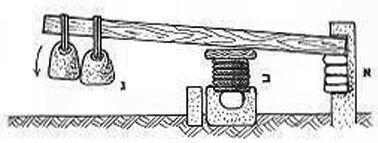
The lever-and-weight process went as follows: First, the olives were crushed in a central basin using a stone roller. The crushed olives were then collected into woven baskets, several of which were subsequently stacked on top of each other and pressed using a large beam set in the niche of a wall, weighed down by several weights. The liquid oil would flow into the pressing vats and left there to sit until the oil would eventually separate from the wastewater. Finally, the oil would be skimmed off the top and be put into storage jars for transportation.
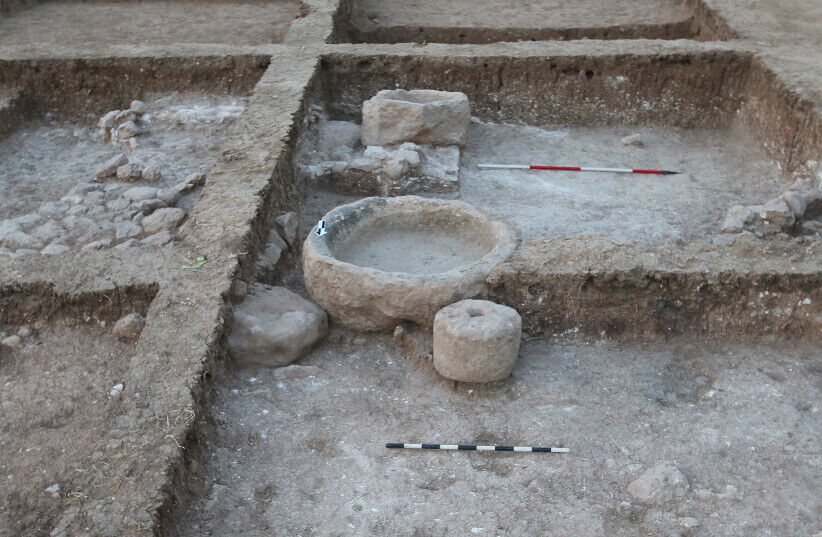
Recent excavations at its lower city have shown that the Philistine city of Gath was possibly one of the earliest major oil production centers of the region in Iron Age i and early Iron Age ii. Its five presses from the Iron Age iia are a little different than those known from the later Iron Age, which might “represent a typological phase in the development of olive presses in the region, an intermediary stage between the round, stone-built presses of the Iron iia and the well-known [lever-and-weight] presses of the Iron iib,” Gath excavator Aren Maeir from Bar-Ilan University suggested in his paper, titled “A Note on Olive Oil Production in Iron Age Philistia: Pressing the Consensus.”
Maeir believes that there may be many more Iron Age iia olive oil installations present in this area of ancient Gath, pointing to the concentrated devotion to olive oil production in this zone of the city.
These presses therefore show that olive oil was of great importance in Philistia and Gath before Iron iib. “Olive oil production might have been one of the economic mainstays of Iron iia Philistine Gath, and its central political and economic role in the region prior to its destruction by Hazael,” wrote Maeir. Following that ninth-century b.c.e. destruction by Syrian King Hazael described in 2 Kings 12:17, Gath ceased to be an olive oil producer and was eventually replaced by another Philistine city in this role, as we will see later.
Centralized Control and Planning
As the Bible describes, under King David’s administration (10th century b.c.e.), olive oil was collected and regulated under a central authority in the Judean lowlands: “[A]nd over the olive-trees and the sycomore-trees that were in the Lowland was Baal-hanan the Gederite; and over the cellars of oil was Joash” (1 Chronicles 27:28). When Solomon was king, he gave Hiram, king of Tyre, “twenty measures of beaten oil” (1 Kings 5:11). One “measure” equates to 263 liters (58 gallons). References to such quantities may point to the beginning of the industrialization of oil in the Iron iia.
In the ninth and eighth centuries b.c.e. (Iron iib), however, Israel and Judah truly began their industrialization of olive oil production. Archaeology has revealed that it was produced in a variety settlements—large to small, industrial to rural—and that production and transport were quite organized during this period. This industrialization impacted the way settlements were planned and constructed. “In the provincial towns in the hill country and mountain region of Judea, industrial areas become part of urban planning,” wrote Prof. David Eitam, an independent researcher affiliated with the Hebrew University of Jerusalem (“Olive Culture in Ancient Israel”).
Eitam pointed to four key industrial settlements in the southwestern Samarian Highlands in between Samaria and Jerusalem in particular—Khirbet Khudash, Qla’, Kurnet Bir et-Tell and Khirbet Deir Daqla—that show evidence of a central “royal authority” controlling olive oil production. The urban planning of these sites has shown that this central authority constructed these cities to revolve around the oil industry.
At Khirbet Khudash, archaeologists discovered dozens of rock-cut presses, which would have produced “between 6,993 and 11,340 liters” of olive oil per year, according to Eitam. The site, however, would have only been occupied by about 120 people, who, according to Eitam’s calculation, would have only consumed around 400 liters per year. That means there was a surplus of about 6,500 to 10,500 liters available for export.
Excavations at Qla’ revealed 22 oil presses, which would have produced an estimated surplus of about 5,000 to 8,400 liters. Furthermore, the majority of these presses were outside the city’s fortified walls, which according to Eitam, “indicates prior planning directed toward marketing and efficient labor under one centralized authority.” The large number of pottery remains, primarily consisting of large storage jars, show that its production output was meant to be transported far away.
These sites prove that olive oil was a major impetus for the strength of the Israelite economy in the ninth to eighth century b.c.e. “Khirbat Khudash and other similar sites served as royal production centers that were part of a significant project by the kingdom of Israel of erecting settlements in the southern Samaria Highlands,” wrote Eitam. “This enterprise was a means of revising the state economy in the ninth century b.c.e. by exporting olive oil to other countries, such as Egypt, in collaboration with the Phoenicians.” The extent of this export would have been quite a bit more than what Solomon sent to Hiram annually (1 Kings 5:11). The surplus at just these sites “may have reached about 26,000 liters of olive oil per year, up to 130 kur [measures], considered a substantial amount of oil,” Eitam estimated in his article on Khirbet Khudash. That is 6.5 times as much as Solomon’s supply for Hiram.
According to Eitam these sites were constructed under the command of a central royal authority. He wrote that the “process was initiated and led by the central government in Samaria and probably provided economic prosperity and political strength in the days of Jeroboam ii (786–746 b.c.e.).” The Hebrew Bible describes the reign of King Jeroboam ii as a time of great prosperity despite the sins of the nation (see 2 Kings 14; Amos 6:1-9). Previous excavations have confirmed his reign to be most prosperous for the northern kingdom of Israel.
These smaller fortified sites reveal that a major underpinning for that economic prosperity may have been olive oil export.
Judah and Philistia
The eighth-century b.c.e. industrialization in the northern kingdom is paralleled in the southern kingdom of Judah. Key Judean sites include Tel en-Nasbe, Tel Beit Mirsim, Tel Beit Shemesh, Tel Gezer and Tel Batash. Similar to the settlements in Israel, these sites reveal central planning by a royal authority according to Professor Eitam.
One thing that set the Judean industry apart during this period is how it developed its pressing technology. By moving the press vats further from the niches in the wall more pressure could be applied and the yields and production levels increased.
After the Assyrian Empire invaded Israel, Judah and Philistia in the late eighth century b.c.e., the dynamics of olive oil production in the Holy Land changed. In Philistia, Gath’s neighboring city, Ekron, suddenly became a regional center for oil production.
Once the Assyrians took control of Ekron, the city experienced somewhat of a renaissance that was marked by an increase in trade. Much of that trade centered around olive oil. Prof. Seymour Gitin of the Albright Institute of Archaeological Research said that Ekron became “the largest olive-oil production center that we know of from antiquity.”
Over 100 oil presses have been found buried at Tel Miqne—modern-day Ekron. These presses would have produced an annual output of at least 230 tons of oil. This large surplus was traded around the Mediterranean by way of Phoenician maritime prowess, under the auspices of the Assyrians.
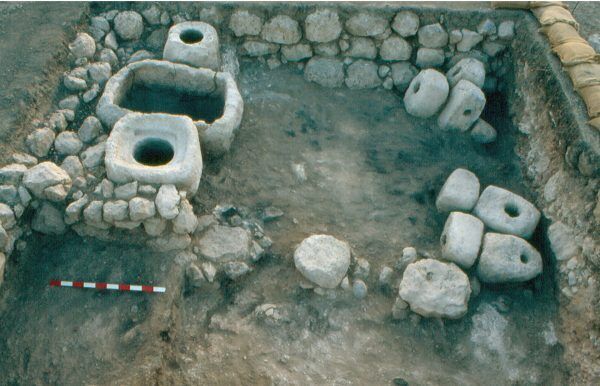
Initially it was assumed that the Assyrians charged the Philistines to carry out the oil production at Ekron. This is perhaps the reason the Assyrians structured Ekron around the industry. There is still debate, however, about whether it was the Assyrians or the locals who initiated the industrialization at Ekron.
In Judah, Beth Shemesh had a thriving olive oil industry under King Hezekiah, as indicated by the lmlk (“to the king”) seal impressions discovered at the site. While there is some discussion on whether the site continued to independently produce olive oil after Assyria’s invasion, the most recent excavations of Beth Shemesh, conducted by Hebrew Union College and Tel Aviv University, paired with previous data suggests that the city remained settled and active during the seventh century b.c.e. An “impressive olive-oil press” was found in an Iron iic context, showing the continued oil production at the site. Prof. Yehuda Govrin from Hebrew Union College proposes in his preliminary report that its olive industry did not succumb to the Assyrian hegemony, but rather “survived and flourished uninterruptedly until the end of the Iron iic period [circa 700–586 b.c.e.].”
2 Chronicles 32:27-29 state that God blessed Hezekiah with “substance very much” after Sennacherib’s invasion, including oil, which was stored in large amounts in “storehouses.” Therefore, this passage shows that Judah continued to produce large quantities of oil under royal authority, just as the data from Beth Shemesh suggests.
Not only is the land of Israel covered with millions of olive trees, but it is also scattered with numerous ancient olive oil presses that have been revealed through archaeological excavations. Throughout the Iron Age, production at these various presses became industrialized by the royal authorities in Israel and Judah and was eventually exploited at Philistine Ekron under the Assyrians. This industrialization led to an increase in trade and prosperity, demonstrating how olive oil became a vital industry of these biblical civilizations.