
Excavating the Time of David and Beyond at Abel Beth Maacah
Situated just inside Israel’s border with Lebanon, Abel Beth Maacah is the northernmost archaeological site in Israel. The Bible also situates the site on the northern frontier of the ancient nation of Israel during the time of King David (c. 1000 b.c.e.). 2 Samuel 20 records that Sheba, the son of Bichri, took refuge in Abel Beth Maacah after raising an insurrection against David. When Joab, David’s general, began to destroy the city in pursuit of Sheba, a wise woman asks him why is he attacking a city that is a “mother in Israel.”

Biblical minimalists claim Israel’s territory was much smaller than what is recorded in the biblical text. They believe Abel Beth Maacah did not belong to Israel in the 10th century b.c.e. and did not become part of the kingdom until 200 years later.
In July, Let the Stones Speak contributing editor Brent Nagtegaal visited the archaeological site to discuss Abel Beth Maacah with Prof. Naama Yahalom-Mack, codirector of the site. Here is a transcript of their discussion, edited for clarity.
Brent Nagtegaal (BN): Thank you for taking the time for this interview.
Naama Yahalom-Mack (NYM): Thank you for visiting us up north.
BN: Let’s begin with you telling us a little about this site.
NYM: The excavation was first initiated in 2012 by Nava Panitz-Cohen of Hebrew University of Jerusalem and Robert Mullins of Azusa Pacific. [Since 2017, Yahalom-Mack has been the codirector of the site.]
BN: Where is the tel situated in the larger geographic area?
NYM: We’re at the very northern point of the Hula Valley. As you know, the borders of Israel kind of penetrate into Lebanon at this point. It’s the finger of the Galilee. Only the town of Metula is north of us. And we are in the same valley as Hazor, which is in the southwestern corner of the Hula Valley. Tel Dan is 6 kilometers (4 miles) east and Hazor is 30 kilometers (19 miles) south. The Phoenician coast is 30 kilometers west and Damascus as the crow flies is about 70 kilometers (43 miles) to the northeast.
BN: Anciently this site was at the crossroads of Aram, Phoenicia and northern Israel. And this is what makes this site so fascinating.
NYM: Yes. This is a meeting point, a border. It’s a junction during the Iron Age. It’s between the expanding, strong Aramean kingdom of Aram-Damascus, that basically swallowed every other small Aramean entity in the region in the ninth century b.c.e.
In the 10th century b.c.e., we are still in a calmer world. With the Phoenicians, we’ve got the Tyre expansion in the ninth century b.c.e., but Tyre and Sidon are already strong cities in the 11th century b.c.e. as well. And we’ve got the Israelite kingdom, which is expanding from its core in the Jezreel Valley. And of course, the rate of this expansion is debated today in archaeological research.
BN: What happens at the site as we enter the Iron Age?
NYM: We know that the entire site is settled during the early Iron Age (11th century b.c.e.), and it begins with a pit settlement. This is a village settlement that is characterized by multiple quarrying pits. It’s a known phenomenon for the beginning of the Iron i; we see it at Tel Dan and elsewhere. And then not much later, we see a rebuilding of the site and the construction of public buildings. Here in Area A, in the very center of the mound, we have one of the most complete sequences of Iron Age between 12th and ninth centuries b.c.e. of any site. It’s a really good stratigraphical sequence.
BN: When we get to the Iron i period what would be some of the dates or related biblical personalities?
NYM: Good question. Although we don’t know how much after the destruction of Hazor this happens, we do identify newcomers that are excavating these pits sometime in the Iron i. It is difficult to say exactly who they are.

BN: So we don’t have an ethnic identity attached to this people, but we know they arrived here and quarried somewhere in the judges period?
NYM: The only thing that we could say is that during the second millennium b.c.e., Abel Beth Maacah is mentioned as Abel or Abilu in texts and sources, mainly Egyptian sources. And then when we come to the Bible, suddenly it’s Abel Beth Maacah. So there is a suffix that suggests newcomers are in play here. But we do see some continuity of the Late Bronze Age material culture. It’s not a strict change. We’re not talking about ethnicities. We’re talking about complex identities here.
BN: So the earliest mention of this town in the Bible would date from around what period?
NYM: From the time of David. But let’s separate two things. There’s the kingdom of Maacah with its sister kingdom, Geshur, and that’s a story that we’re not sure how to relate to what’s going on here. Maacah is a name that we find in the Bible since the days of Genesis. But the kingdom of Maacah or Geshur are thought to have existed a little more to the east. Maacah should be located in Bashan or the Golan.
Some scholars see our site as the capital of the kingdom of Maacah. In any event, the earliest Abel Beth Maacah is mentioned in the Bible is from the time of David, with the story of the wise woman. We have the rebel, Sheba ben Bichri. He escapes from Jerusalem.
BN: Just after Absalom’s revolt.
NYM: Exactly. And he travels as far as he can, almost to the very north. He escapes here, and then Joab pursues him. And there’s a very interesting discussion with a woman that is defined as the wise woman of Abel Beth Maacah.
BN: And as far as the narrative goes, Sheba’s head is lopped off.
NYM: He’s beheaded, and the head is thrown over the wall.
BN: And Joab goes back to Jerusalem.
NYM: Exactly.
BN: Do you have habitation from around that time?
NYM: First of all, not even considering the historicity of this passage, the conversation that the wise woman has with Joab is very interesting to us because she tells him, “We are the faithful and the righteous. We believe in the God of Israel. And why are you trying to kill a city and a mother in Israel?”
So what we learn from this text is that these people are situated at a very far away, distant location, and they need to prove that they belong. And this is very interesting for the question of the identity of the people living here. What is their material culture? How is it affected by the Arameans to the north, by the Phoenicians? How Israelite are they, if they are, or when they are? Maybe an easier question is to ask, who are the paying their taxes to? This is a very interesting question to us.
BN: So as far as the structures in this area, there are two main periods that we can see here: Iron i and then Iron ii.
NYM: Yes.
https://www.youtube.com/watch?v=KnZ8aaqY0rg
BN: What does this area look like during the Iron i period?
NYM: In the Iron i we have a gradual development after the pit settlement. There are some very interesting public buildings. And these are a combination between cult and production. We’ve got multiple matzevot, standing stones and other cultic features that are together with a lot of production remains, such as grinding stones and ash installations and all kinds of things. So it’s something different than what we have in the Bronze Age. There is development in cultic and religious practices. And then this is destroyed too, sometime in the middle of the 11th century b.c.e., based on radiocarbon dates.
Interestingly, we have a very similar destruction at Tel Dan. At Tel Dan at the time, there is a village and a lot of bronzeworking, but no public buildings. We are thinking that in the seesaw relationship between the sites, Abel is the major site and that Dan was secondary and Hazor practically nonexistent during the Iron i. The 11th century b.c.e. is the time for Abel Beth Maacah to shine. So after the destruction of those buildings, we have an elaborate, lavish building.
BN: Is it a palace?
NYM: I want to call it a palace. I don’t want to excuse myself. I think it’s a palace. It’s built beautifully.
BN: Right, we saw some of the construction of the walls, the doorways. It’s impressive.
NYM: The walls you can see are really nicely angled. And the door frames have nice flat stones. They’re all in the corner of the rooms. They have nice frames with flat stones, and we have these alternating basalt floors. One room with stone floor and then one without and then one with and one without and one with.

When we started to appreciate this building, we understood we need to know the full plan of this building. And as much as we’ve expanded and removed a lot of the Iron iia remains to get down to this building, we still do not know its full plan. It’s going on and on and on. And there’s a major destruction at the end of this period, which is a very similar destruction to what we know at Megiddo: the Megiddo viia destruction and the Yokneam destruction. This is the time when many sites are destroyed.
BN: Do we know who caused the destruction of those other sites?
NYM: Well, that’s a major question in the archaeology of Israel. And also when were the following cities built? Were they built immediately on top of the destruction? Was there a gap? The minimalists like to expand this gap between the destruction of the Iron i and the building of the Iron ii buildings and kind of push it down as far as the ninth century b.c.e. to the Omride dynasty.
BN: But you don’t really see that in the material here.
NYM: We see the opposite. We see them building immediately on top of the destruction. We see them utilizing the earlier Iron i walls. The walls are built in the same orientation. It is a different construction; it’s a different character, but we do see some continuity between the phases of the Iron i and Iron iia. And this is, again, one of the questions that we’re pursuing here.
BN: When is this transition from the destruction of the Iron i city to the construction of the new Iron iia city? It wasn’t in the 12th century b.c.e., and it wasn’t in the eighth century b.c.e. So you’ve got a window that you’re working in, correct?
NYM: My window is the 10th century b.c.e. This is when it happens. And the reason I know this is because we have excavated a huge citadel in the upper mound of this site, which we date again to the Iron iia. Below the citadel, in the foundations of the citadel, we have dates from the late 10th century b.c.e.
So, it’s a good question whether our dates are really the earliest dates of the citadel. And then when you look at the radiocarbon dates, there are two possible peaks: one in the first half of the 10th century, one in the second half of the 10th century. But we are saying that there’s not a big gap between both dates. We need to, of course, prove this. But still, we think somewhere in the beginning of the second half of the 10th century would be a good date for the destruction and the rebuilding.
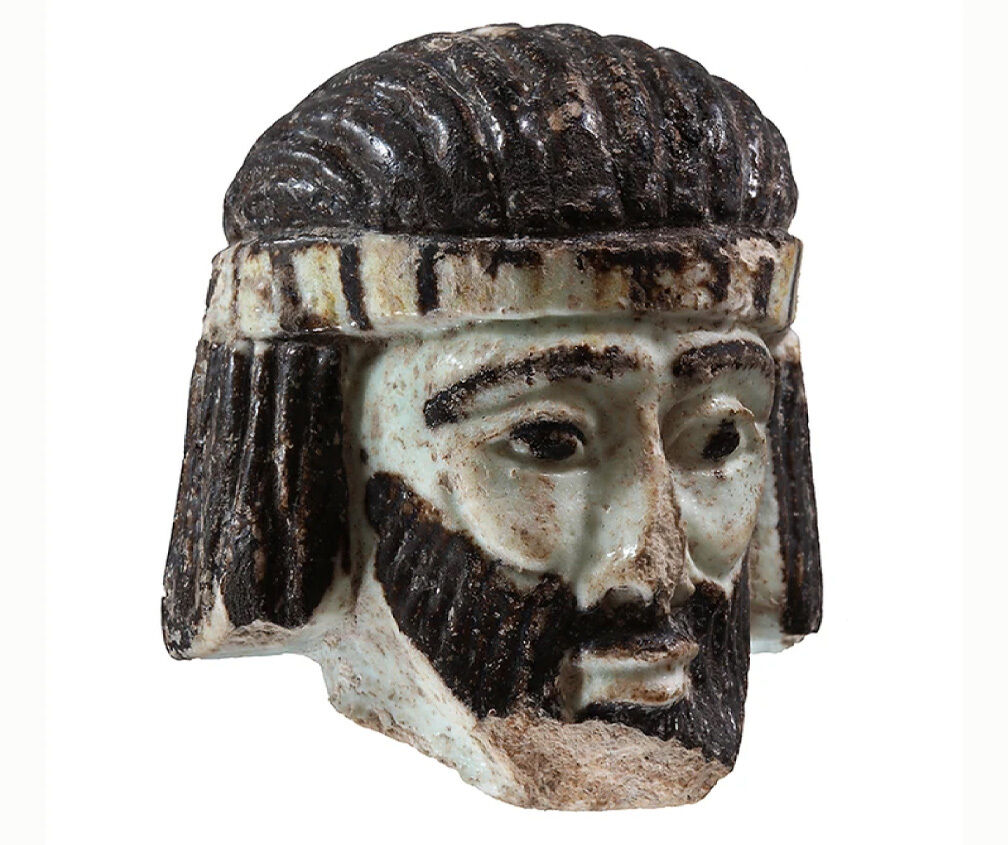
BN: Let’s talk now about some major discoveries that you’ve made here over the past few years. Tell us about the beautiful faience head.
NYM: We found it in the latest phase of the citadel up in Area B, in a possible cultic room. We have a very massive entrance to this chamber. It’s one of the casemates. There’s a massive entrance and in front of the entrance is a circle of stones and ash beside it. And this guy was found on that floor in this room. He was lying facing up, as if he wanted people to find him!
When we brought him back to the lab, Mimi Lavi, our conservator, cleaned him up, and he was absolutely exquisite. It’s workmanship that we don’t see everywhere. He is a bearded male. He has a lot of hair and very black, which means something: He has black hair, black eyebrows, black pupils, black beard. Debbie Ben Ami, who worked with us on the interpretation of his iconography, says it’s a very manly thing to do. If you want to be a man in the ancient Near East, you want to have a lot of black hair.
And he’s wearing this bandanna on his head. This is a typical Semite type of headdress for a male. In the stripes we see yellow, and the yellow is probably indicating gold, so we’re thinking that this guy is an elite.
BN: Can we date this find?
NYM: He can be dated to the abandonment of the citadel, which is the second half of the ninth century. The entire site was abandoned at the second half of the ninth century. He possibly represents someone—someone who placed him on his behalf in this cultic place to stand before the god permanently, even when he’s busy. He represents some sort of elite person or governor. He doesn’t necessarily depict one of the kings, as was hypothesized by many journalists.
BN: Even without knowing who exactly he depicts, the artifact itself is so unique and beautiful.
NYM: It is beautiful. And it is made of faience, which is like an early form of glass. It was made in a mold. We’ve done some research about it. We did a head scan at the Weizmann Institute, and we could see the technique, the way that he was pressed into a mold and the way that things broke when they removed him from the mold. And the materials that were used, for example, the manganese that was used for the black features and the green that was used for the faience itself, which are probably copper minerals. It’s still one of our most prized finds today. It’s in the Israel Museum.
BN: And there was another major discovery, one that relates to who the people here were paying their taxes to? This was an inscription that was found on a storage vessel?
NYM: OK, we’ll start from the beginning. We opened another area of excavation to the south of this area, in an area that is slightly depressed. We thought that this is a good place for an entrance to the city, maybe a gate. In excavating, we came to a really nicely built storage building, which seems to have one phase. It’s defined by a long wall on the east and then walls going perpendicular, creating elongated halls. The halls were full of jars. So this was a storage building for sure.
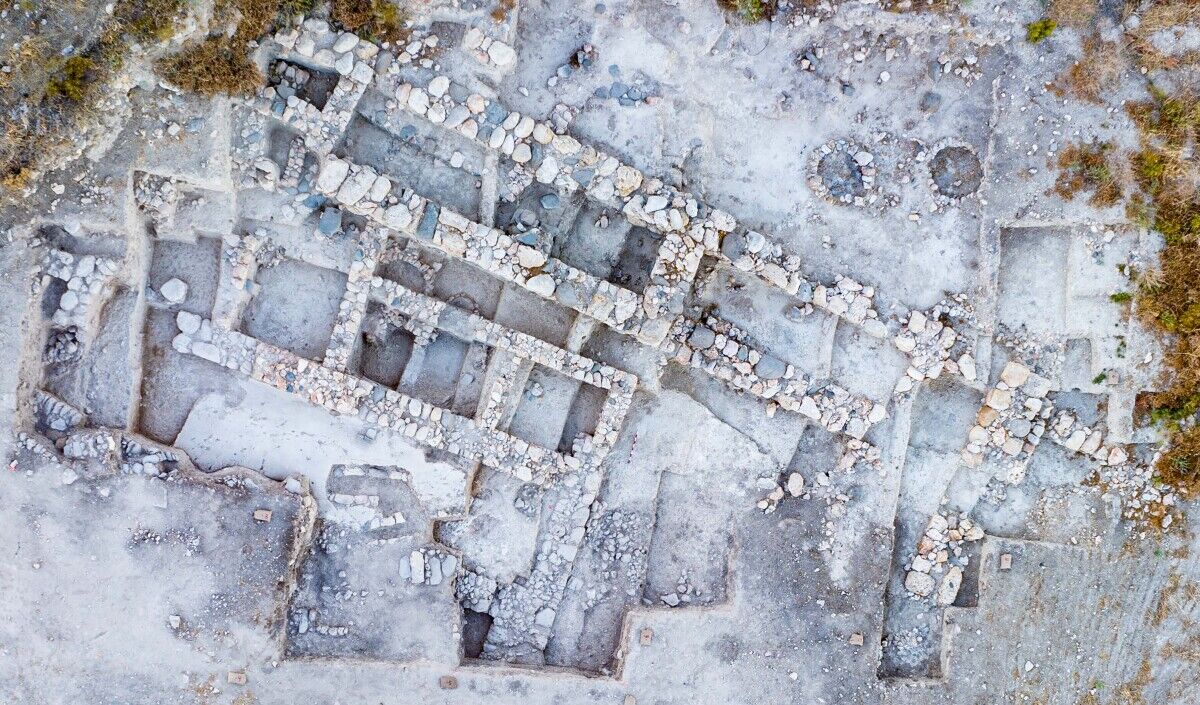
We know these vessels were burnt, so they were part of some sort of a destruction. We have no dates from this building. We don’t know when it was built. One radiocarbon date from below the building tells us that it was built during the ninth century. So it’s not a 10th-century b.c.e. building. We’ve already excavated more than 70 vessels. We’ve restored more than 60. One of them had an ink inscription below the handle, which read, l’Benayau, meaning belonging to a guy named Benayau. And Benayau is the shorter form of the name. If he was in Judah, he would have been Benayahu.
BN: In English, his name is Benaiah.
NYM: The name Bana, meaning “built”—Benayau, meaning “God has built”—is common. You find it everywhere, even in the Aramean sphere. But the ending “yau” or “yahu,” of course, refers to the God of Israel. So if we’re reading it correctly, it’s a Hebrew name with a theophoric ending in an Israelite form. And our epigrapher Christopher Rollston identified the script as Hebrew.
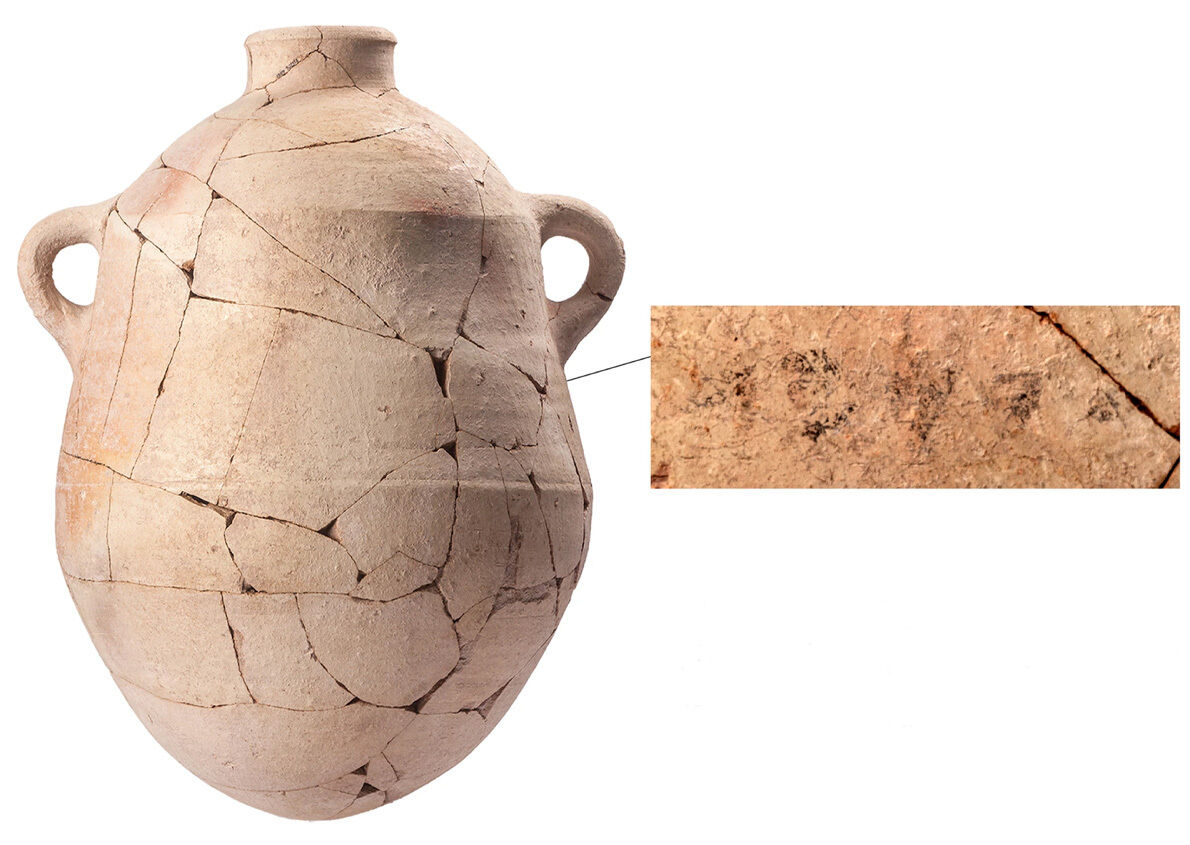
Now it is important as well to date this building. One name on one vessel doesn’t make this an Israelite building. But the building is something that is very planned and administrative. It’s part of some kind of central administration. It’s not one building. It’s probably three buildings as we see it today. A second one, definitely. Maybe a third to the south. About a third of the jars are marked on their handles. The vessels were examined by Anat Cohen-Weinberger. She showed that they’re local production. So they were producing jars probably to contain wine.
And maybe they were keeping this jar with the inscription for someone from the Israelite sphere. Or maybe it was built by a central administration that was Israel at the time.
I would say that maybe this is where the Omrides come in. So we’ve got building activity from the 10th century b.c.e. But then later, the Omrides would be responsible for some makeover during the middle of the ninth century b.c.e. I don’t think this storehouse lived long. It was built and abandoned or destroyed not long after.
BN: I’m a big believer that the scientists who excavate a site should be the first to interpret the site, rather than other people interpreting for them. But this period is very debated in archaeological circles. How far did the kingdom of Israel come toward the north? People have different theories on when the northward expansion happened. Many of the minimalists would put that as far as the eighth century b.c.e. when Israelite domination came under Jeroboam ii.
NYM: Right.
BN: But from what you’re finding here, the eighth century b.c.e. is way too late?
NYM: If we want to be careful, we would say that our excavations first and foremost put Abel Beth Maacah on the map during the 10th century b.c.e. and the ninth century b.c.e. If you look at The Forgotten Kingdom, Prof. Israel Finkelstein’s 2013 book, you’ll see Abel Beth Maacah is not even on his map during the time of the 10th century b.c.e., nor in the time of the ninth century b.c.e.
BN: But that’s when you have the biggest period of construction at Abel Beth Maacah?
NYM: Exactly. But in his book, Abel Beth Maacah along with Dan is placed on a map only at the time of Jeroboam ii in the eighth century b.c.e. But we see a very different picture from our excavations.
We know that Abel Beth Maacah was thriving during the ninth century b.c.e., and even in the late 10th century b.c.e. Whether it was Israelite to begin with or whether it was annexed during the time of the Omrides still remains a question. Rather, it is the eighth century b.c.e. that is missing here. We do not have the Tiglath-Pileser destruction here. We have it at Dan. We have it at Hazor. But we do not have it here. It seems like we have lost ground and other sites regained. So it’s a bit of a seesaw effect, maybe between us and Dan. I know that Dan is highly debated today. According to the Bible, it’s a religious center from the time of Jeroboam i. And what we see here, if we can do the comparisons and relate our finds to Tel Dan, which we’re trying to do that as we speak, there’s no reason to suspect that Dan is not existing at this time. It could be a modest settlement. It doesn’t mean that it’s not a cultic center. The biblical narrative generally falls in place with our excavations here in Abel Beth Maacah in the region I would say.
BN: We talked briefly about the faience head, and we talked about the inscription. You also found a large vessel full of bones?
NYM: That’s true. But you know, we’re kind of focusing on the anomalies and not saying anything about the larger assemblage here. And I have to say that we have pottery here that includes the red burnished pottery that we know from the Israelite territory. Of course, it’s also found in the north. So it could reach here that way. And we’ve got a hippo jar here.
BN: Why is the hippo jar significant?
NYM: You have multiple hippo jars in the Jezreel Valley. This is like the economic system of the Jezreel Valley. And this is one reason why some researchers would like to leave the Hula Valley out of the Israelite kingdom, assuming that the hippo jars kind of define the boundaries of Israel. Of course, it’s not necessarily so. It’s an economic system. And there are other economic systems to the north. We’ve got our K jars that form a different economic system. I don’t think it means anything about geopolitics. Yet we still do find the hippo jars here.
We have material culture that is very diverse here. It could be recognized in sites to the south and in the north.
BN: By north you mean Phoenicia?
NYM: I mean Phoenicia. And the few sites in Lebanon where we know a little bit about their material culture. We have some elements that are koine. It doesn’t mean you define them as Phoenician or Aramean or whatever. Then we do have things that correlate with the material culture of the kingdom of Israel. So we have both.
BN: How much do you have that would correlate with Aram-Damascus?
NYM: We don’t know the material culture of Aram-Damascus. That’s a big problem. And generally with the Arameans, it’s not always easy to define what it is exactly. It’s not the case of pots and people. The Arameans are dispersed. They come into existing settlements, and they kind of sink in there. And we really tried in the beginning of the excavation. It was a major theme that this excavation would shed light on the Aramean material culture. But it didn’t, as far as we know.
So again, we’ve got elements that work well with the Israelite kingdom to the south. We also have elements that are a sort of koine, shared material culture.
Then we have a jar full of astragali bones found in a monumental Iron ii building where there is a lot of industry. We’ve got a pottery kiln and many tabuns and a lot of giant walls that were very difficult to remove. Part of one of these giant buildings was a stone pavement. On top of the stone pavement was a jar. It was full of astragali bones. That’s the knuckle bones of the hind leg of an animal. We had 406 smashed in one jar. These were analyzed by Dr. Matthew Susnow. He could show that it wasn’t 200 animals slaughtered for this event. It was collected over time. And they were used. Some of them were perforated. And it seemed like someone collected them together at this time, which is the end of the occupation here, the very final phase.
BN: This is mid-ninth century b.c.e.?
NYM: That would be second half of the ninth century b.c.e. I can’t really say exactly when. Whatever happened there, we don’t know. We just know that in many cultures, these bones are used for divination. The other possibility is a game, but this is not a game. They left it there standing, full of astragali. So there could have been some kind of ceremony and the result was the abandonment of the site. That’s a dramatic find, I think.
BN: So just finally, in terms of modern day geopolitics; when we were walking up the tel, we can see the demilitarized zone with Lebanon. But you said you actually felt a little bit safer right now, than before the war with Hezbollah.
NYM: Previously when we excavated here, there were Hezbollah outposts on top of the village to the west and on top of this demilitarized hill to the east. And they were watching us. Basically the last 10 years we were at gunpoint, and we knew that they were there, and we were excavating here and not knowing what the future entails and what they were thinking about. Once this threat was removed, I think we’re safer here than we ever were to dig. The army is watching over us. We inform them every day that we’re going up the tel. We let them know that we’re leaving the tel, and they’re watching over us. We know they’re looking over our shoulders.
BN: Thank you very much for touring us around the site and bringing our viewers along with you. Thanks for your efforts over the past decade—10-year anniversary for you at least being up here on the site. How many more seasons do you think it’ll tick on? Until you find the rest of this building here behind us?
NYM: Exactly.
BN: Thank you very much for your time.
NYM: Sure.